
Author
Types of LLM Integration refer to different ways of connecting applications with AI models to build intelligent and scalable systems
These include approaches like Direct API, Multi-Provider, Local LLM, Framework-Based, RAG, Hybrid, and Agent-Based integration
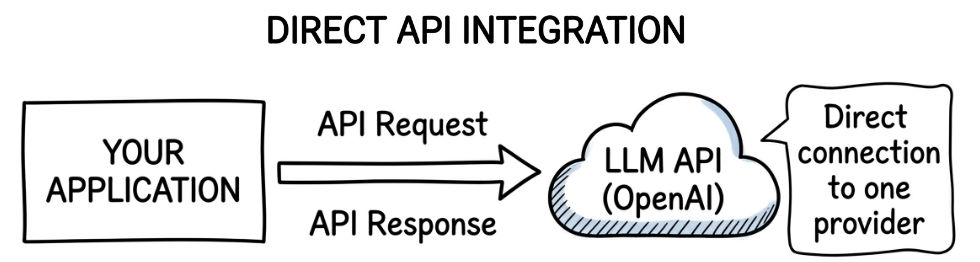
Example (Spring Boot using RestTemplate)
import org.springframework.http.*;
import org.springframework.web.client.RestTemplate;

public class OpenAIService {

    private static final String API_URL = "https://api.openai.com/v1/chat/completions";
    private static final String API_KEY = "YOUR_API_KEY";

    public String getResponse(String userInput) {

        RestTemplate restTemplate = new RestTemplate();

        String requestBody = """
        {
          "model": "gpt-4o-mini",
          "messages": [
            {
              "role": "user",
              "content": "%s"
            }
          ]
        }
        """.formatted(userInput);

        HttpHeaders headers = new HttpHeaders();
        headers.setContentType(MediaType.APPLICATION_JSON);
        headers.setBearerAuth(API_KEY);

        HttpEntity<String> entity = new HttpEntity<>(requestBody, headers);

        ResponseEntity<String> response = restTemplate.exchange(
                API_URL,
                HttpMethod.POST,
                entity,
                String.class
        );

        return response.getBody();
    }
}
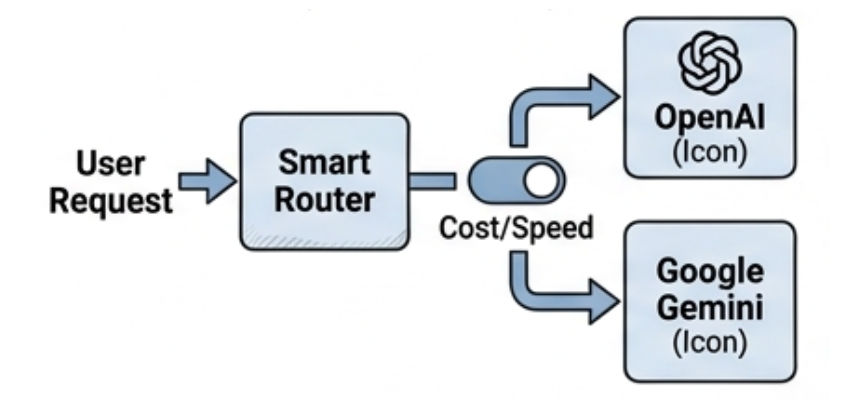
Example
public class LLMRouterService {

    public String getResponse(String provider, String input) {

        if (provider.equals("openai")) {
            return callOpenAI(input);

        } else if (provider.equals("gemini")) {
            return callGemini(input);

        } else {
            return "Unsupported provider";
        }
    }

    private String callOpenAI(String input) {
        return "Response from OpenAI for: " + input;
    }

    private String callGemini(String input) {
        return "Response from Gemini for: " + input;
    }
}
Example (Ollama API)
import org.springframework.web.client.RestTemplate;

public class LocalLLMService {

    public String askLocalModel(String prompt) {

        RestTemplate restTemplate = new RestTemplate();

        String url = "<http://localhost:11434/api/generate>";

        String request = """
        {
          "model": "llama3",
          "prompt": "%s",
          "stream": false
        }
        """.formatted(prompt);

        return restTemplate.postForObject(url, request, String.class);
    }
}
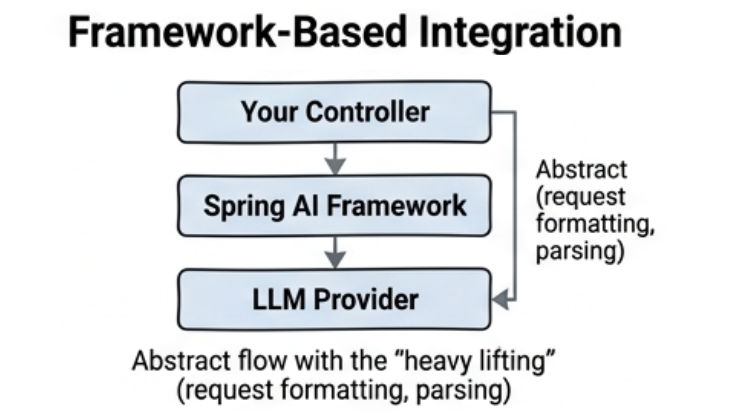
Example
import org.springframework.ai.chat.client.ChatClient;
import org.springframework.stereotype.Service;

@Service
public class AIService {

    private final ChatClient chatClient;

    public AIService(ChatClient chatClient) {
        this.chatClient = chatClient;
    }

    public String getAnswer(String prompt) {

        return chatClient.prompt()
                .user(prompt)
                .call()
                .content();
    }
}
Example Controller
import org.springframework.web.bind.annotation.*;

@RestController
@RequestMapping("/ai")
public class AIController {

    private final AIService aiService;

    public AIController(AIService aiService) {
        this.aiService = aiService;
    }

    @GetMapping("/ask")
    public String ask(@RequestParam String q) {
        return aiService.getAnswer(q);
    }
}
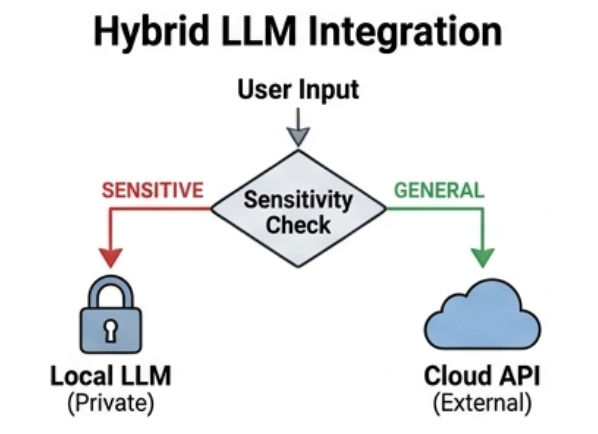
Example (Routing Logic)
public class HybridLLMService {

    private final LocalLLMService localLLMService;
    private final OpenAIService openAIService;

    public HybridLLMService(LocalLLMService localLLMService, OpenAIService openAIService) {
        this.localLLMService = localLLMService;
        this.openAIService = openAIService;
    }

    public String getResponse(String input, boolean sensitiveData) {

        if (sensitiveData) {
            return localLLMService.askLocalModel(input);
        } else {
            return openAIService.getResponse(input);
        }
    }
}
Example (Simple Retrieval + LLM Flow)
public class RAGService {

    private final DocumentService documentService;
    private final OpenAIService openAIService;

    public RAGService(DocumentService documentService, OpenAIService openAIService) {
        this.documentService = documentService;
        this.openAIService = openAIService;
    }

    public String askQuestion(String question) {

        String context = documentService.searchRelevantData(question);

        String finalPrompt = "Answer based on this context: " + context +
                             " Question: " + question;

        return openAIService.getResponse(finalPrompt);
    }
}
Example Use Case Flow
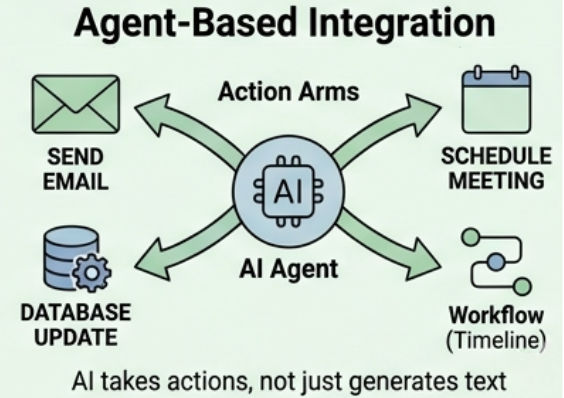
Example (Tool Calling Agent Style)
public class AIAgentService {

    private final EmailService emailService;
    private final MeetingService meetingService;

    public String processTask(String task) {

        if (task.contains("email")) {
            emailService.sendEmail("[email protected]", "Hello from AI");
            return "Email sent successfully";
        }

        if (task.contains("meeting")) {
            meetingService.scheduleMeeting("Team Sync");
            return "Meeting scheduled successfully";
        }

        return "No valid action found";
    }
}
| Feature | Direct API Integration | Framework-Based Integration |
|---|---|---|
| Approach | Directly calls LLM APIs | Uses frameworks like Spring AI or LangChain |
| Complexity | Low to Medium | Low (but structured) |
| Code Handling | Manual request/response handling | Abstracted and simplified |
| Development Speed | Slower | Faster |
| Scalability | Limited | High |
| Best For | Small or simple projects | Production-grade applications |
| Feature | Normal LLM Integration | RAG (Retrieval Augmented Generation) |
|---|---|---|
| Data Source | Only trained model data | External data + LLM |
| Knowledge Base | Static knowledge | Dynamic + custom knowledge |
| Accuracy for business data | Low | High |
| Use of Documents/DB | Not used | Uses PDFs, DB, files, APIs |
| Complexity | Simple | Medium to High |
| Best For | General chatbot | Enterprise AI systems |
LLM integration is a modern approach to build intelligent applications by connecting your system with powerful AI providers.
With proper architecture like Direct API, Multi-Provider, Local LLM, or Framework-Based integration, developers can build scalable, secure, and production-ready AI systems.
