
Author
In modern microservices architectures, systems are distributed, dynamic, and complex. Failures are inevitable, and traditional monitoring is not enough to fully understand what’s happening inside your system.
Observability allows you to see inside your system, analyze its behavior, and find root causes quickly.
Observability is the ability to understand the internal state of a system by analyzing the data it produces.
This data usually comes from:
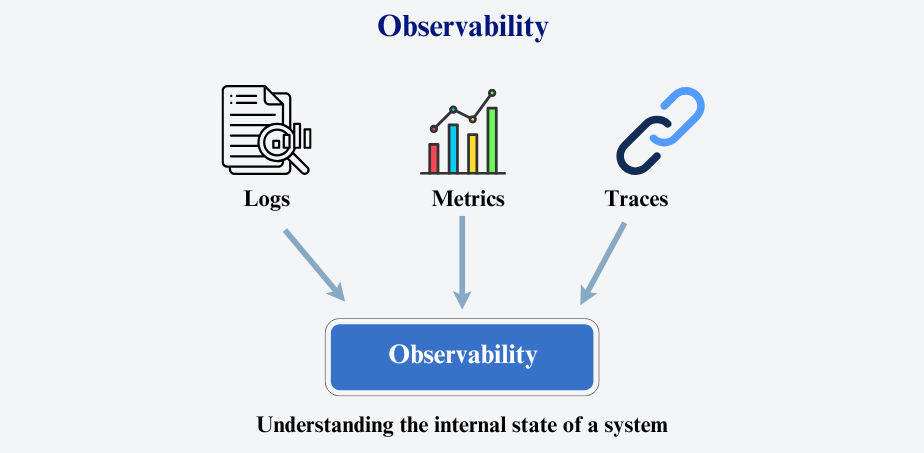
In short: Monitoring tells you something is wrong. Observability tells you why it’s wrong. Monitoring is a subset of observability.
Modern microservices architectures provide scalability and flexibility but also introduce new challenges:
These factors make troubleshooting and debugging far more difficult than in monolithic systems.
In a system without observability, failures can be hard to detect and diagnose:
User → API Gateway → Service A → Service B → Service C
Problems encountered:
Observability provides actionable insights into your system’s internal state through metrics, logs, and traces:
User Request
   ↓
Trace ID propagated across services
   ↓
Metrics highlight latency spikes
   ↓
Logs show timeout in Service B
   ↓
Root cause identified in minutes
Benefits achieved:
| Aspect / Feature | Monitoring | Observability |
|---|---|---|
| Purpose | Detect known issues | Understand unknown issues |
| Goal | Identify that something is wrong | Analyze why it is wrong and debug |
| Approach | Threshold-based, reactive | Context-driven, proactive |
| Scope / Data Sources | Metrics only (CPU, memory, error rate) | Metrics, logs, traces (all system outputs) |
| Alerts | Triggered when thresholds are crossed | Helps investigate unknown or intermittent issues |
| User Experience | Limited insights; tells a problem exists | Detailed insights; helps pinpoint root cause |
| Example | “CPU usage is high” | “CPU usage is high because Service X is retrying calls to Service Y” |
| Use Case | Spotting spikes, errors, outages | Root cause analysis, debugging complex microservice failures |
| Dashboard / Analysis | Predefined dashboards & alerts | Exploratory dashboards, logs correlation, trace analysis |
Observability is built on three core signals that together provide a complete picture of system behavior.
Logs are time-stamped records of events generated by applications and infrastructure.
They capture rich contextual information such as:
Logs answer the question:
“What exactly happened inside the system?”
They are especially useful when diagnosing unexpected failures, understanding execution paths, and performing root-cause analysis.
Metrics are numerical measurements collected over time that represent system health and performance.
Common metric examples include:
Metrics answer the question:
“How is the system behaving over time?”
They are ideal for:
Traces track a single request as it flows through multiple services in a distributed system.
They provide visibility into:
Traces answer the question:
“Where is the request slowing down or failing?”
They are essential for understanding latency, bottlenecks, and failures in microservices-based systems.
The Golden Signals are a practical set of metrics used to quickly assess system health and reliability.
Monitoring these signals together helps teams prevent outages, detect performance issues early, and maintain system reliability.
To achieve effective observability in complex systems, teams should follow these best practices:
Strong observability enables teams to debug faster, reduce downtime, and deliver reliable systems at scale.
User tries to checkout:
User → API Gateway → Order Service → Payment Service (Slow)
Result: Root cause identified quickly → system recovers faster → better user experience
Observability is essential for modern, distributed systems, especially in microservices and cloud-native environments. It goes beyond basic monitoring by combining metrics, logs, and traces to provide deep visibility into system behavior. With observability, teams can quickly identify root causes instead of just symptoms, troubleshoot issues faster, and ensure more reliable, high-performance deployments in production.
