Event-Driven Architecture & Patterns
Modern microservices architectures demand scalability, resilience, and loose coupling. As systems grow, synchronous REST-based communication often creates bottlenecks, cascading failures, and tight service dependencies.
Event-Driven Architecture (EDA) addresses these challenges by enabling services to communicate asynchronously via events, promoting independent scaling, fault tolerance, and flexibility.
What Is Event-Driven Architecture (EDA)?
Event-Driven Architecture (EDA) is a software design paradigm where components communicate by producing and consuming events rather than directly invoking each other. In this approach, services emit events when something meaningful occurs, and other services react asynchronously.
EDA is especially useful for microservices and distributed systems, as it enables:
- Loose coupling: Services do not need to know the internal workings of others.
- Scalability: Multiple consumers can process events independently.
- Resilience: Failures in one service do not cascade to others.
- Real-time responsiveness: Systems react immediately to events and changes in state.
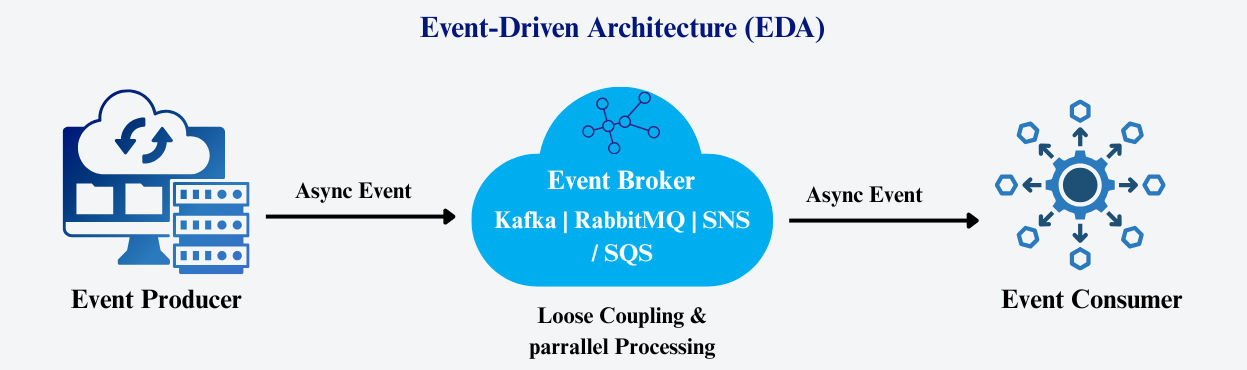
By moving away from synchronous REST calls, EDA allows systems to operate asynchronously, scale horizontally, and process events in real-time, improving both performance and fault tolerance.
Core Concepts of EDA
1. Event
- An event is a record of a significant action or change of state in a system.
- Events are immutable facts; they describe something that has already happened.
- Examples:
OrderPlaced – A customer created a new order.PaymentProcessed – A payment was successfully completed.InventoryUpdated – Stock levels changed for a product.
2. Event Producer
- A service or component responsible for creating and publishing events.
- Producers do not know which services will consume the event, ensuring loose coupling.
- Example: The
Order Service emits an OrderPlaced event after creating a new order.
3. Event Consumer / Subscriber
- A service or component that listens to specific events and performs actions based on them.
- Consumers operate independently of the producers, enabling parallel and asynchronous processing.
- Example: The
Inventory Service updates stock whenever it receives an OrderPlaced event.
4. Event Broker
- Middleware that acts as a central hub for events, ensuring they are delivered reliably from producers to consumers.
- It handles message persistence, delivery guarantees, and load balancing.
- Examples: Apache Kafka, RabbitMQ, AWS SNS/SQS.
5. Asynchronous Communication
- Services communicate without waiting for immediate responses, allowing non-blocking processing.
- This reduces tight dependencies between services and prevents cascading failures in distributed systems.
6. Event Payload / Schema
- The event contains all necessary data for consumers to process it.
- Maintaining a clear, versioned schema ensures backward compatibility and avoids breaking consumers.
- Example:
OrderPlaced event payload may include orderId, customerId, items, and totalAmount.
7. Event Channels / Topics
- Events are often organized into channels or topics that consumers can subscribe to.
- This allows multiple services to consume the same event independently, supporting scalability and decoupling.
8. Event Processing Patterns
- Publish/Subscribe (Pub/Sub): Many consumers subscribe to events from a producer.
- Point-to-Point: Only one consumer processes the event from a queue.
- Event Sourcing: The system stores a sequence of events instead of the current state.
- CQRS (Command Query Responsibility Segregation): Events update read models for optimized queries.
- Saga / Outbox Pattern: Ensures data consistency and reliability in distributed transactions.
Why Move Away from REST-Only Communication?
While REST APIs are widely used, relying solely on them introduces challenges in large distributed systems:
| REST |
Event-Driven Architecture |
| Synchronous |
Asynchronous |
| Strong coupling |
Loose coupling |
| Request-response |
Publish-subscribe |
| Fragile under failure |
Fault-tolerant |
EDA allows services to operate independently, avoid cascading failures, and scale horizontally.
Key Event-Driven Patterns in Spring Boot
Spring Boot supports multiple EDA patterns, often in combination with messaging platforms like Kafka or RabbitMQ:
Publish/Subscribe (Pub/Sub)
- Producers publish events to a topic or queue.
- Multiple consumers can subscribe to the same event.
- Forms the foundation of most EDAs.
Point-to-Point
- An event flows from one producer to a specific consumer through a queue.
- Ensures single-consumer processing.
Event Carried State Transfer (ECST)
- Event payload includes all relevant state data.
- Consumers can update their local state without querying the producer.
Event Sourcing
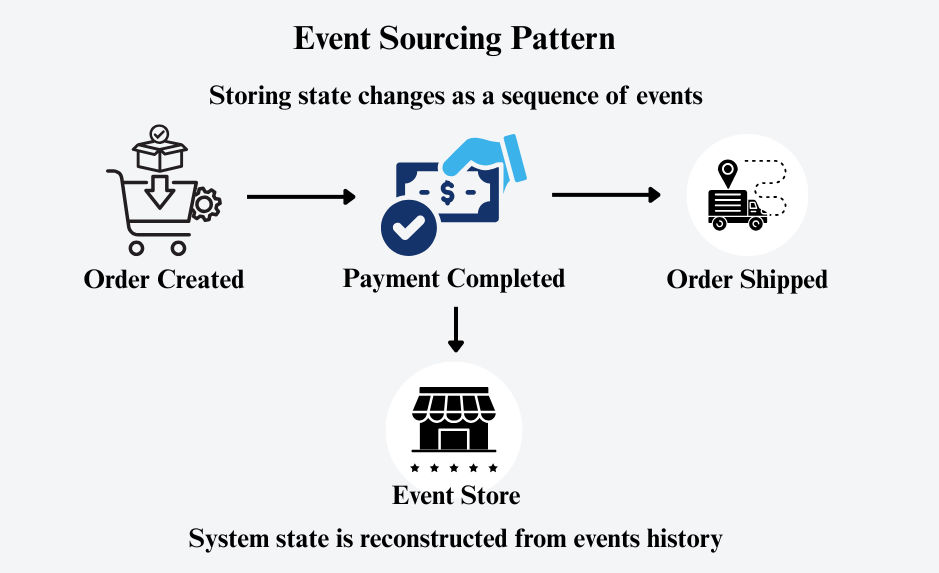
Stores all state changes as a sequence of events instead of overwriting current state.
Traditional Approach:
OrderTable → Current State Only
Event Sourcing Approach:
OrderCreated → PaymentCompleted → OrderShipped
Benefits:
- Complete audit history
- Easy rollback & debugging
- Integrates naturally with CQRS
Challenges:
- Event versioning
- Storage growth
- Requires careful design
Outbox Pattern
Ensures atomicity between database updates and event publication.
Workflow:
- Save business data in the database.
- Write an event to the outbox table.
- Background process publishes the event to the broker.
- Consumers process the event reliably.
CQRS (Command Query Responsibility Segregation)
- Separates commands (writes) from queries (reads).
- Commands trigger events, which update read-optimized models.
Benefits:
- Optimized reads and writes
- Independent scaling
- Simplified business logic
Saga Pattern: Managing Distributed Transactions
In microservices, traditional two-phase commit (2PC) is often impractical due to scalability and fault-tolerance issues. The Saga Pattern provides a way to manage long-running distributed transactions by breaking them into a sequence of local transactions, coordinated either decentrally or centrally.
Choreography-Based Saga:
- No central coordinator; each service reacts to events and emits new events to continue the workflow.
- Highly decoupled, very scalable, minimal single points of failure.
- Harder to monitor, debug, and trace in complex workflows.
Orchestration-Based Saga:
- A central orchestrator directs services by sending commands and tracking transaction states.
- Easier to monitor and manage, clearer visibility of workflow.
- Introduces a central dependency, which can become a bottleneck.
Difference Between Choreography-Based Saga vs Orchestration-Based Saga
| Aspect |
Choreography |
Orchestration |
| Control |
Each service independently decides what to do next based on events (decentralized) |
A central orchestrator dictates the workflow and next steps for all services (centralized) |
| Complexity |
Complexity is spread across multiple services, requiring careful event design and coordination |
Complexity is concentrated in the orchestrator, which manages the workflow logic |
| Debugging |
Harder to trace because events flow asynchronously and no single component has full visibility |
Easier to debug because the orchestrator has complete visibility of the workflow |
| Scalability |
Highly scalable as services operate independently without central bottlenecks |
Scalable, but the orchestrator can become a limiting factor under high load |
Dead Letter Queue (DLQ)
- Failed events after multiple retries are sent to a DLQ for inspection.
- Prevents data loss and ensures reliability.
Implementation Tools in Spring Boot
Spring Boot provides native support for building event-driven systems:
- Spring for Apache Kafka: High-throughput event streaming.
- Spring Cloud Stream: Unified programming model for messaging with Kafka or RabbitMQ.
- Spring Integration: Enterprise integration patterns and messaging protocols.
- Application Events: Intra-application events using
@EventListener.
Best Practices for Event-Driven Systems
- Model events as immutable facts
- Use clear, meaningful event names
- Avoid overly chatty events
- Implement retries and DLQs
- Monitor event lag and failures
- Ensure idempotency in consumers
- Manage schema versions (Avro, JSON Schema)
Why Event-Driven Architecture Matters
EDA enables microservices to be:
- Highly scalable
- Fault-tolerant
- Reactive & real-time
- Easily deployable independently
- Future-ready for complex distributed systems
Conclusion
Event-Driven Architecture empowers microservices to operate scalably, reliably, and efficiently. By combining:
- Event Sourcing
- Outbox Pattern
- CQRS
- Saga Pattern
teams can build systems that avoid tight coupling, process events asynchronously, and deliver consistent, resilient, and scalable business workflows.

