
Author
Spring Data JPA is a part of the Spring Data ecosystem that simplifies working with JPA (Java Persistence API) and ORM frameworks like Hibernate. It provides a repository abstraction on top of JPA, reducing boilerplate code and making database operations cleaner and easier to maintain.
Hibernate is the most popular JPA implementation, responsible for object-relational mapping (ORM)—converting Java objects into database tables and vice versa.
Spring Data JPA is a Spring module that simplifies data access using JPA (Java Persistence API).
It provides repository abstractions that reduce boilerplate code for database operations.
In simple words:
Spring Data JPA = JPA + Repository Abstraction
Hibernate is a popular JPA implementation.
It provides the ORM (Object-Relational Mapping) layer, translating Java objects to database tables.
In simple words:
Hibernate = JPA Implementation (ORM Engine)
Using Spring Data JPA with Hibernate brings several advantages:
JpaRepository.@Transactional.Ideal for enterprise applications and complex domain models requiring ORM features.
| Feature | Description |
|---|---|
| ORM Support | Maps Java objects (entities) to database tables automatically. |
| Repository Abstraction | Auto-generated CRUD methods via JpaRepository, CrudRepository. |
| JPQL & Native Queries | Write object-oriented queries (JPQL) or native SQL as needed. |
| Entity Relationships | Supports @OneToOne, @OneToMany, @ManyToMany. |
| Lazy & Eager Loading | Control when related entities are fetched for performance. |
| Transactions | Integrated with Spring @Transactional for consistent database operations. |
| Caching | First-level caching with Hibernate; optional second-level caching. |
Spring Data JPA with Hibernate follows a layered architecture:
+-----------------+
|   Controller    |   Handles HTTP requests
+--------+--------+
         |
         v
+--------+--------+
|     Service     |   Business logic
+--------+--------+
         |
         v
+--------+--------+
|   Repository    |   Spring Data JPA CRUD & queries
+--------+--------+
         |
         v
+--------+--------+
| Hibernate / JPA |   ORM, SQL generation, caching
+--------+--------+
         |
         v
+--------+--------+
|    Database     |   Stores entities as tables
+-----------------+
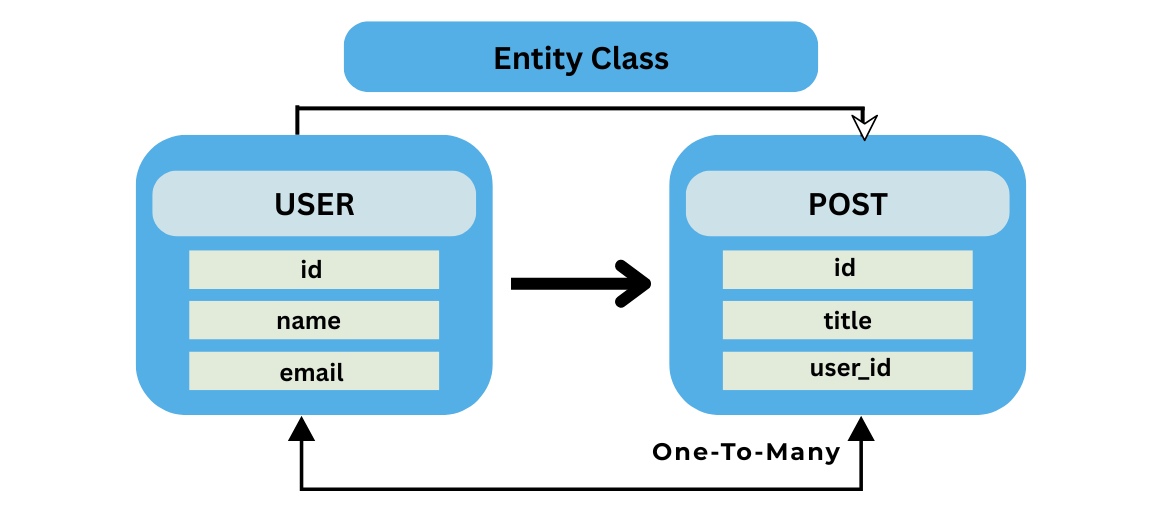
1. Entity Class
Defines a database table mapping using JPA annotations. Fields are mapped to table columns, with @Id and @GeneratedValue for primary key handling.
import jakarta.persistence.*;

@Entity
@Table(name = "users")
publicclassUser {

@Id
@GeneratedValue(strategy = GenerationType.IDENTITY)
private Long id;

@Column(nullable = false)
private String name;

private String email;

// Getters and setters
}
2. Repository Interface
Extends JpaRepository to provide CRUD operations and allows custom queries by following method naming conventions.
import org.springframework.data.jpa.repository.JpaRepository;
import java.util.List;

publicinterfaceUserRepositoryextendsJpaRepository<User, Long> {
    List<User>findByName(String name);
}
JpaRepository provides built-in methods: save(), findById(), findAll(), delete().3. Service Layer
Encapsulates business logic and interacts with the repository to perform database operations like saving or fetching users.
import org.springframework.stereotype.Service;
import org.springframework.beans.factory.annotation.Autowired;
import java.util.List;

@Service
publicclassUserService {

@Autowired
private UserRepository userRepository;

public UsercreateUser(User user) {
return userRepository.save(user);
    }

public List<User>getUsersByName(String name) {
return userRepository.findByName(name);
    }
}
4. Controller Layer
Exposes REST endpoints to create and retrieve users, delegating calls to the service layer.
import org.springframework.web.bind.annotation.*;
import java.util.List;

@RestController
@RequestMapping("/users")
publicclassUserController {

privatefinal UserService userService;

publicUserController(UserService userService) {
this.userService = userService;
    }

@PostMapping
public UsercreateUser(@RequestBody User user) {
return userService.createUser(user);
    }

@GetMapping("/{name}")
public List<User>getUsersByName(@PathVariable String name) {
return userService.getUsersByName(name);
    }
}
@Transactional ensures database operations are executed safely and rolled back on errors.| Feature | JDBC / NamedParameterJdbcTemplate | Spring Data JPA + Hibernate |
|---|---|---|
| Mapping | Manually map result sets using RowMapper | Automatic mapping using entity classes |
| SQL | Full control over SQL queries, more verbose | Less SQL, can use JPQL or derived queries |
| Relationships | Joins handled manually | Automatic via JPA annotations |
| Lazy Loading | Not supported | Supported for associated entities |
| Transactions | Managed manually or with JdbcTemplate | Integrated with Spring’s @Transactional |
| Learning Curve | Easy to start | Moderate, requires understanding of JPA/Hibernate |
Use Spring Data JPA + Hibernate when:
Avoid when:
Spring Data JPA with Hibernate is a powerful combination for building enterprise-grade, database-driven applications in Java.
