
Author
The Database per Service Pattern is one of the most critical and non-negotiable principles of microservices architecture.
It ensures loose coupling, scalability, autonomy, fault isolation, and clear data ownership by allowing each microservice to manage its own database.
In a true microservices system:
? If microservices share a database, they are not real microservices — they become a distributed monolith.
In microservices architecture, each microservice owns its database, and only that service can read or write to it.
One Microservice = One Database (or schema) it fully controls
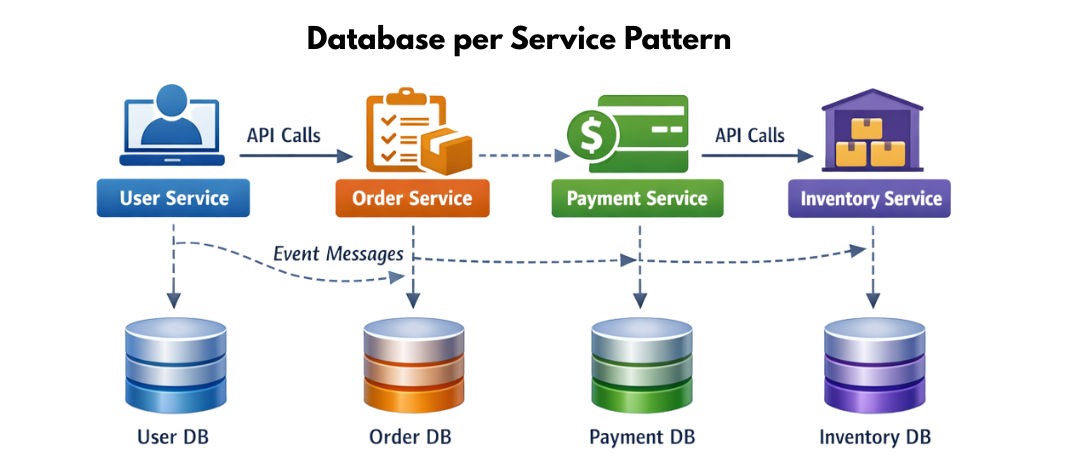
This rule:
Each microservice represents a business capability, not just a technical module.
To stay independent, it must own its data completely.
Independent Development
Independent Deployment
Independent Scaling
Clear Data Ownership
Without database ownership, microservices lose their purpose.
Sharing a database between microservices is one of the most dangerous anti-patterns.
Shared Database Between Services
User Service  ─┐
               ├── SharedDatabase
Order Service ─┘
Problems with Shared Databases:
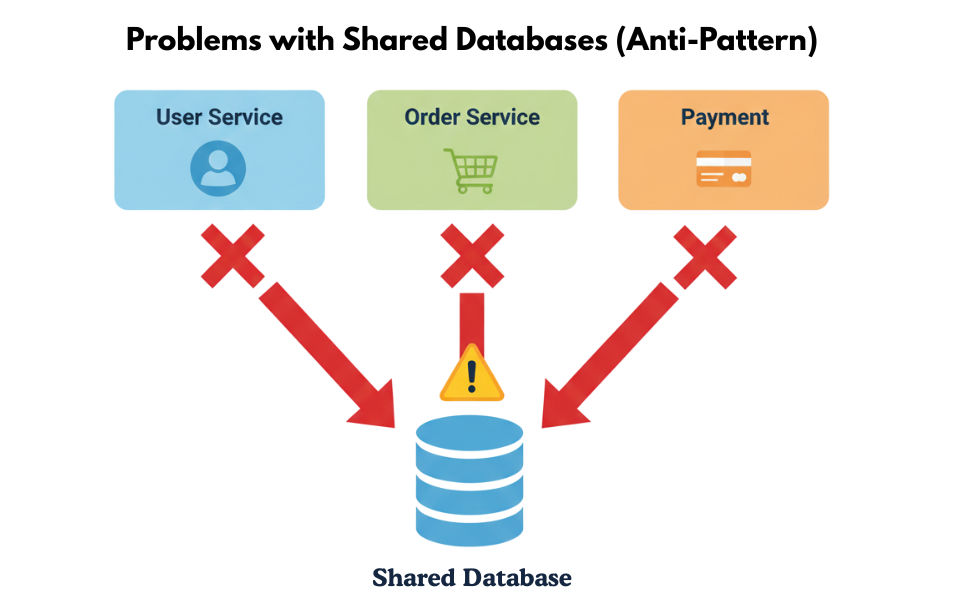
? Shared Database = Distributed Monolith
Even if services are deployed separately, a shared database makes them tightly coupled.
Loose Coupling
Independent Scaling
Technology Flexibility
Fault Isolation
Clear Boundaries
E-Commerce Microservices System
| Microservice | Responsibility | Database |
|---|---|---|
| User Service | Users & profiles | MySQL |
| Order Service | Orders & items | PostgreSQL |
| Payment Service | Payments | MongoDB |
| Inventory Service | Stock | Redis |
Each service:
Microservices never query each other’s databases.
1. REST / gRPC (Synchronous)
GET <http://user-service/users/{id}>
2. Event-Driven Communication (Recommended)
User Service publishes:
UserCreatedEventUserUpdatedEventOrder Service:
✔ Loose coupling
✔ High scalability
✔ Better resilience
✔ Eventual consistency
? Data is shared by communication, not by database access.
Entity
@Entity
@Table(name = "users")
public class User {

    @Id
    @GeneratedValue(strategy = GenerationType.IDENTITY)
    private Long id;

    private String name;
    private String email;
}
Repository
public interface UserRepository extends JpaRepository<User, Long> {
}
Controller
@RestController
@RequestMapping("/users")
public class UserController {

    private final UserRepository userRepository;

    public UserController(UserRepository userRepository) {
        this.userRepository = userRepository;
    }

    @PostMapping
    public User createUser(@RequestBody User user) {
        return userRepository.save(user);
    }

    @GetMapping("/{id}")
    public User getUser(@PathVariable Long id) {
        return userRepository.findById(id).orElseThrow();
    }
}
? User Service accesses only User DB.
Entity
@Entity
@Table(name = "orders")
public class Order {

    @Id
    @GeneratedValue(strategy = GenerationType.IDENTITY)
    private Long id;

    private Long userId;
    private Double amount;
}
Repository
public interface OrderRepository extends JpaRepository<Order, Long> {
}
Controller
@RestController
@RequestMapping("/orders")
public class OrderController {

    private final OrderRepository orderRepository;

    public OrderController(OrderRepository orderRepository) {
        this.orderRepository = orderRepository;
    }

    @PostMapping
    public Order createOrder(@RequestBody Order order) {
        return orderRepository.save(order);
    }
}
? Order Service never accesses User DB.
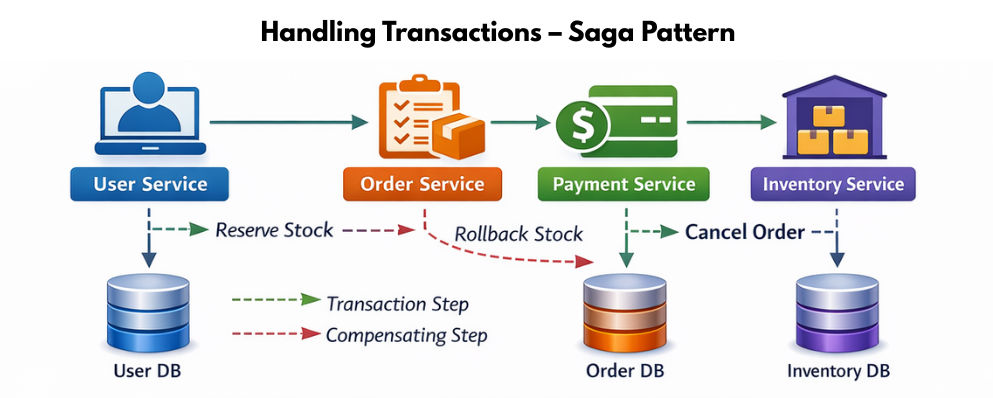
Since each service has its own database, traditional distributed transactions are avoided.
Common Challenges:
? Microservices rely on eventual consistency, not immediate consistency.
The Saga Pattern manages transactions across multiple microservices.
How Saga Works:
Example:
? In these cases, a monolith with a single database is better.
Companies using Database per Service Pattern:
The Database per Service Pattern is a foundational principle of microservices.
No microservice should ever directly access another microservice’s database.
