
Author
Vector Databases and RAG (Retrieval Augmented Generation) form the core intelligence layer of modern AI applications.
They allow AI systems to understand, search, and generate responses using real and relevant data instead of relying only on pre-trained knowledge.
? Without this layer, AI gives generic answers.
? With this layer, AI becomes context-aware, accurate, and reliable.
A vector database stores data in the form of numerical representations called vectors, which are created using embeddings.
In simple words: it stores the meaning of data, not just the raw text.
This enables fast and intelligent similarity-based search instead of traditional keyword matching.
Popular vector databases:
? These databases are designed to handle large-scale semantic search efficiently.
Embeddings convert text into numerical vectors that capture meaning and context.
In simple words: they transform human language into numbers so machines can understand relationships between words and sentences.
Example:
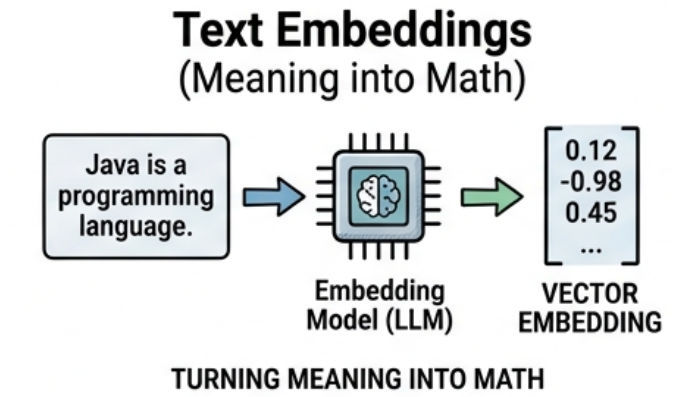
? Both sentences will have similar embeddings because their meaning is related.
Embeddings are the foundation of semantic search and RAG systems.
Semantic search finds results based on meaning rather than exact keyword matching.
Instead of matching exact words, it understands the intent behind the query.
Example:
? Even if the words are different, the system understands the context and returns relevant results.
Example (Embedding + Search)
// Convert text to embedding (pseudo example)
List<Double> queryVector = embeddingService.embed("How to store data in DB?");

// Search similar vectors
List<String> results = vectorStore.similaritySearch(queryVector);

// Print results
results.forEach(System.out::println);
RAG is a technique that combines vector databases with Large Language Models (LLMs) to generate accurate and context-aware responses.
It enhances AI by allowing it to use external data instead of relying only on pre-trained knowledge.
In simple words: RAG = Search + AI Answer.
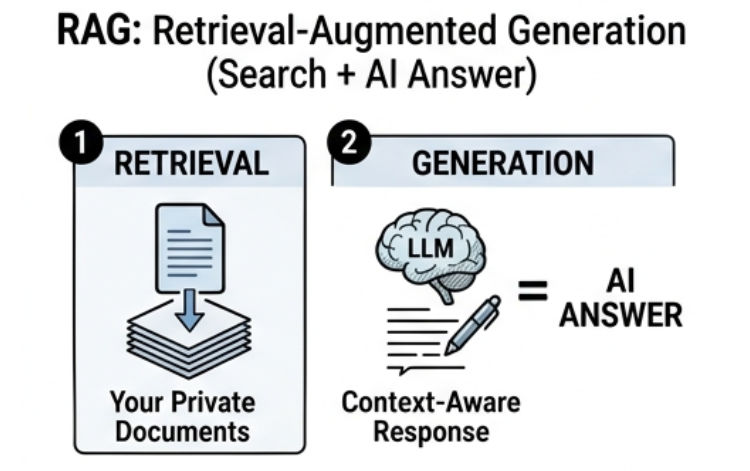
? Instead of guessing, the system first retrieves relevant data and then generates a response based on that context.
? This approach makes responses more accurate, reliable, and up-to-date.
A complete RAG system works in structured stages to ensure accurate and context-aware responses.
? Result → Accurate and context-aware response.
public class RAGExample {

    private final DocumentService documentService;
    private final OllamaService ollamaService;

    public RAGExample(DocumentService documentService, OllamaService ollamaService) {
        this.documentService = documentService;
        this.ollamaService = ollamaService;
    }

    public String askQuestion(String question) {

        String context = documentService.searchRelevantData(question);

        String prompt = "Answer based on this context: " + context +
                        " Question: " + question;

        return ollamaService.generateResponse(prompt);
    }
}
Spring AI simplifies the integration of vector databases and LLMs, making it easier to build RAG-based applications.
It handles embedding, retrieval, and response generation in a more structured and developer-friendly way.
Basic flow:
vectorStore.similaritySearch("Explain Docker");
chatClient.prompt()
    .user(query)
    .call()
    .content();
? This flow creates a complete RAG-based AI system that can answer queries using custom data.
Vector databases use mathematical techniques to find the closest and most relevant matches.
These techniques compare vectors based on their meaning and similarity.
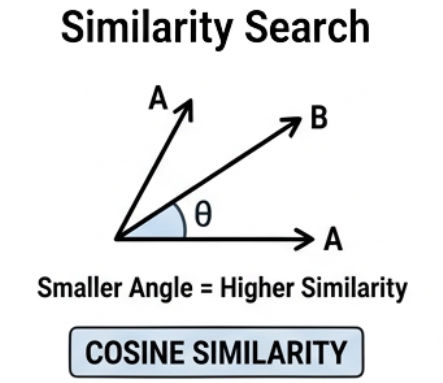
? These methods help identify the most relevant data quickly and efficiently.
Vector Databases and RAG are widely used in real-world AI applications.
Example:
User asks → “What is our leave policy?”
? System retrieves relevant data from stored documents.
? AI generates an accurate and context-based answer.
Vector Databases and RAG are the backbone of intelligent AI systems that provide real, context-aware responses instead of generic outputs. They allow AI to search real data before generating answers, making results more useful, accurate, and reliable.
Start with small datasets, test the RAG pipeline, and gradually scale to build production-ready AI applications.
