
Author
Microservices are independent and dynamic—instances can scale up/down, restart, or move across hosts. To enable communication without hardcoding URLs, service discovery and load balancing are essential for scalable, resilient, cloud-native architectures.
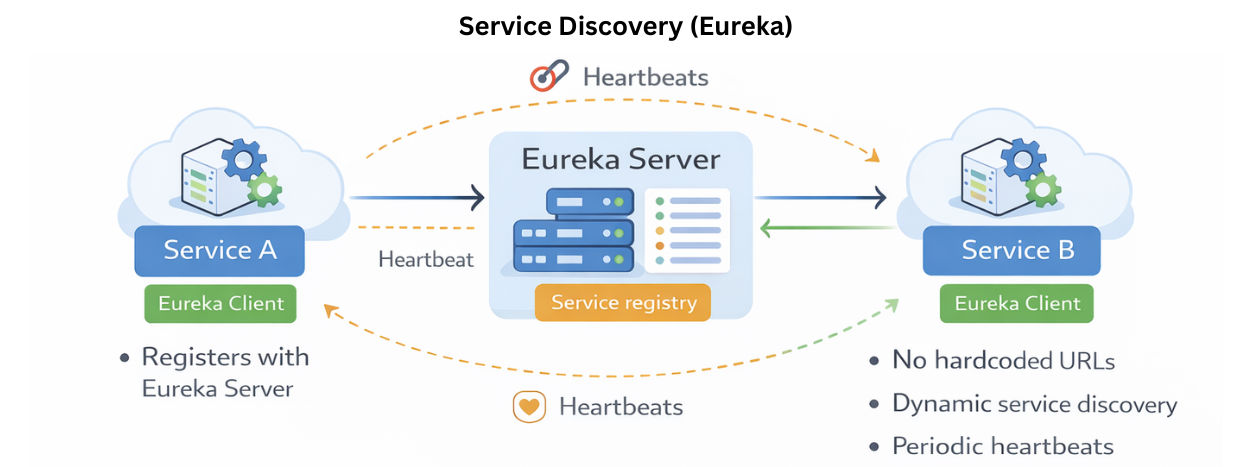
Service discovery allows microservices to register themselves and discover other services dynamically at runtime, without relying on hardcoded URLs.
Key Components:
| Component | Role |
|---|---|
| Eureka Server | Central registry for all microservices. Maintains a list of available service instances. |
| Eureka Client | Each microservice registers with Eureka Server and queries it to find other services. |
Workflow:
Spring Boot Setup Example:
Eureka Server:
@SpringBootApplication
@EnableEurekaServer
publicclassEurekaServerApplication {
publicstaticvoidmain(String[] args) {
        SpringApplication.run(EurekaServerApplication.class, args);
    }
}
application.yml (Server):
server:
  port: 8761

eureka:
  client:
    register-with-eureka: false
    fetch-registry: false
Eureka Client (Service A / Payment Service):
@SpringBootApplication
@EnableEurekaClient
public class PaymentServiceApplication {
    public static void main(String[] args) {
        SpringApplication.run(PaymentServiceApplication.class, args);
    }
}
application.yml (Client):
spring:
  application:
    name: payment-service

eureka:
  client:
    service-url:
      defaultZone: <http://localhost:8761/eureka/>
Benefits of Eureka:
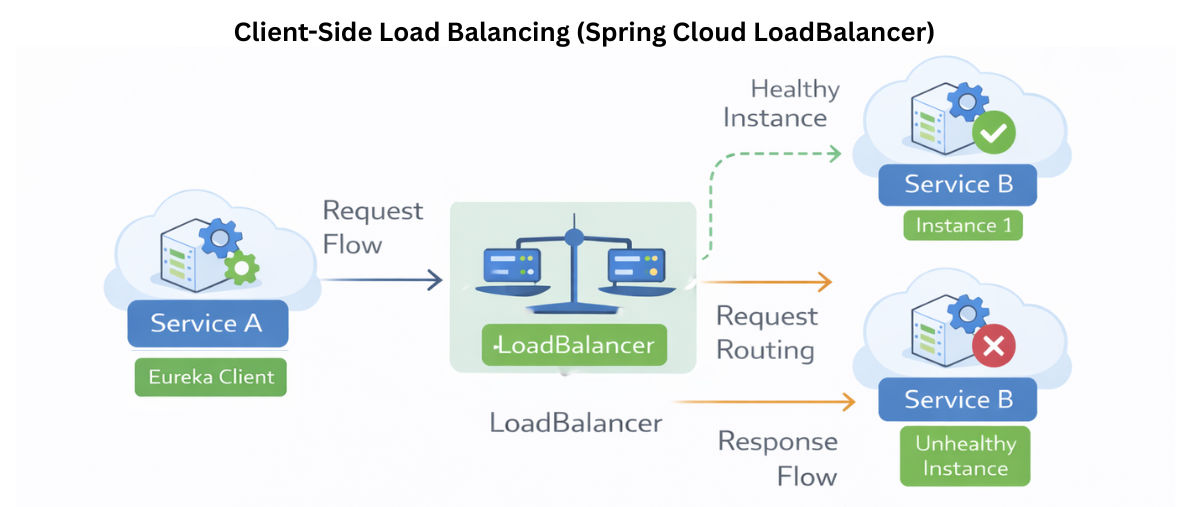
Even with service discovery, multiple instances of a service may exist. Load balancing ensures requests are distributed among available instances for high availability and fault tolerance.
Distributes client requests across multiple service instances dynamically.
Key Features:
Workflow:
Spring Boot Example (WebClient + LoadBalancer):
@Bean
@WebClientLoadBalanced
public WebClient webClient(WebClient.Builder builder) {
    return builder.build();
}

// Using WebClient
@Autowired
private WebClient.Builder webClientBuilder;

public Mono<PaymentResponse> callPaymentService(PaymentRequest request) {
    return webClientBuilder.build()
            .post()
            .uri("<http://payment-service/payments>") // logical service name
            .bodyValue(request)
            .retrieve()
            .bodyToMono(PaymentResponse.class);
}
Feign Client + LoadBalancer Example:
@FeignClient(name = "payment-service")
public interface PaymentClient {

    @PostMapping("/payments")
    PaymentResponse pay(@RequestBody PaymentRequest request);
}
Benefits:
             +----------------+
             | EurekaServer  |
             +----------------+
               ^           ^
               |           |
     +---------+           +---------+
     |                           |
+---------+                 +---------+
| Service A |  <--LoadBalancer-->  | Service B |
+---------+                 +---------+
Flow:
Workflow:
Client → LoadBalancer → Eureka → Service Instance → Response
@LoadBalanced with WebClient, RestTemplate, or Feign when calling other services.| Feature | Eureka | Spring Cloud LoadBalancer |
|---|---|---|
| Purpose | Service registry | Distribute requests across instances |
| Works With | Any Spring Boot microservice | Works with service discovery (Eureka) |
| Type | Server-Client | Client-side load balancer |
| Key Benefit | Dynamic discovery | Scalability & fault tolerance |
