
Durgesh Tiwari
Author
Artificial Intelligence is no longer limited to answering questions or creating content from a prompt.
Modern AI systems can understand a goal, plan the steps needed to complete it, use tools, remember useful information, and perform actions. This type of AI is commonly known as Agentic AI.
If you are new to AI agents, you may come across terms such as AI Agents, Agent Architecture, Function Calling, Agent Memory, Planning and Reasoning, Prompt Chaining, AI Workflows, Multi-Agent Systems, MCP, and Agents vs Workflows.
Agentic AI is an AI system that can work toward a goal by deciding and completing multiple steps instead of only giving a direct answer.
A basic AI application may work like this:
User asks a question → AI gives an answer.
An agentic AI system can work like this:
User gives a goal → AI understands the goal → Plans the steps → Uses tools → Takes actions → Checks the result → Completes the task.
For example, suppose you ask an AI:
"Find a good laptop under ₹70,000 and compare the best options."
A basic AI may give you general suggestions. An AI agent could search for current products, check prices and specifications, compare the options, and prepare a final comparison.
The main idea is simple:
Agentic AI allows AI systems to take multiple steps to achieve a goal.
An AI agent is a software system that uses AI to understand a task, decide what to do next, and take actions using available tools.
An AI agent may use:
A language model
Instructions
Tools
Memory
Information about the current task
A system for deciding the next step
Think of an AI agent like a person completing a task.
Suppose you tell an employee:
"Check our sales data and tell me which product sold the most last month."
The employee may:
Open the sales system.
Find last month's data.
Check the numbers.
Compare the products.
Find the best-selling product.
Give you the result.
An AI agent can follow a similar process using software and connected tools.
Imagine a customer asks:
"My order has not arrived. Can you check it?"
An AI agent can:
Understand the request.
Find the order details.
Use an order tracking tool.
Check the delivery status.
Explain the result to the customer.
This is different from an AI that only gives general information about delivery times.
The key difference is that an AI agent can use information and tools to take steps toward completing a task.
LLM Application | AI Agent |
|---|---|
Uses an LLM to perform a specific task. | Uses an LLM to work toward a goal through multiple steps. |
Usually follows a predefined process. | Can decide what to do next based on the current situation. |
The developer controls most of the workflow. | The AI can decide some of the actions or steps. |
Usually takes input and returns an output. | Can use tools, access information, and take actions. |
The same type of task often follows a similar flow. | The steps can change depending on the task and results. |
Example: Summarize a document. | Example: Research a company and prepare a report. |
Best suited for simple and predictable tasks. | Useful for complex and multi-step tasks. |
Main focus: Generate an output. | Main focus: Achieve a goal by taking multiple actions. |
Agent architecture is the structure of an AI agent and the way its different components work together to complete a task.
A simple AI agent may follow a flow like this:
User Goal → AI Model → Plan → Use Tools → Check Result → Take Next Action → Final Response
The exact architecture can be different depending on what the agent needs to do.
The user gives the agent a goal or task.
For example:
"Find the best flight for my trip."
The AI model understands the request and identifies the important details, such as:
Destination
Travel dates
Budget
Number of passengers
Travel preferences
The agent decides which steps are needed to complete the task.
For example:
"First, search for available flights. Then compare prices and travel times."
The agent can use tools to get information or perform actions.
These may include:
Search
Databases
Calculators
Calendars
APIs
Web browsers
Some agents can remember useful information from the current task or previous interactions.
For example:
"The user prefers morning flights."
Memory is optional and depends on how the agent is designed.
After completing the required steps, the agent gives the result to the user.
In simple words, agent architecture connects the AI model, planning, tools, memory, and other components so the agent can work toward a goal.
Tools are an important part of many AI agents.
A language model can understand and generate text, but it cannot directly access every external system or perform every action.
For example, an AI model cannot automatically check your bank account balance. If the agent has access to an authorized banking tool, it can use that tool to get the required information.
AI agents can use different tools depending on the task, such as:
Web search
APIs
Databases
Calculators
File systems
Calendar applications
CRM software
Internal company systems
Suppose you ask an AI agent:
"What is 25% of ₹80,000?"
The agent can use a calculator tool to get the exact answer.
Similarly, if you ask:
"What is the weather today?"
The agent can use a weather service or API to get current information.
The key idea is simple: Tools allow AI agents to access information and interact with external systems beyond the language model itself.
Function calling is a way for an AI model to request a specific function or tool when it needs to perform a task.
The AI model usually does not run the function itself. Instead, it tells the application which function it wants to use and provides the required information.
For example, if a user asks:
"What's the weather in Lucknow?"
The AI model may request:
get_weather(city="Lucknow")The application then runs the function and sends the result back to the AI:
Temperature: 31°C
Condition: Clear
The AI can use this information to give the user a final answer.
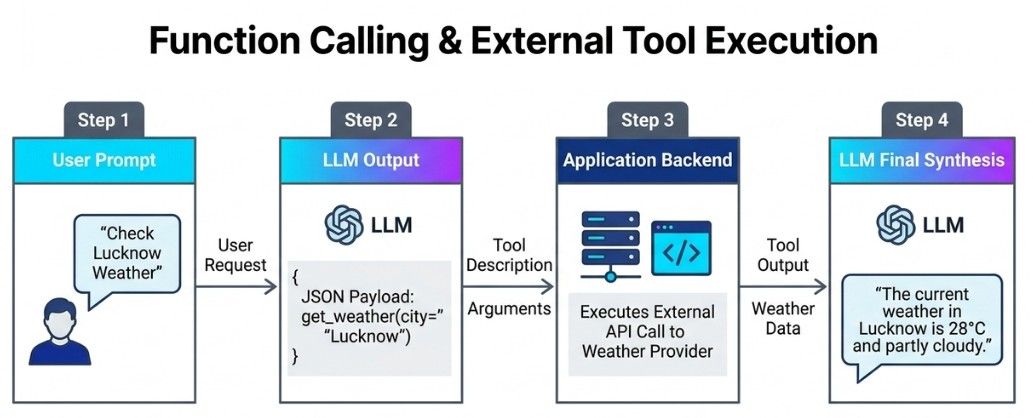
Function calling allows an AI application to connect the language model with external tools and systems.
It can be used for tasks such as:
Searching for information
Checking databases
Calling APIs
Sending messages
Creating calendar events
Performing calculations
Updating records
In simple words, function calling allows an AI model to request actions from external tools in a structured and controlled way. It is an important part of many AI agents and tool-using AI applications.
An AI agent often needs to decide what to do next to complete a task. This is where planning and reasoning are useful.
Suppose you ask an agent:
"Plan a three-day trip to Delhi under ₹20,000."
The agent may need to consider:
Where to stay
How to travel
Which places to visit
How much each activity may cost
Whether the total cost fits the budget
Planning means breaking a larger goal into smaller steps and deciding what needs to be done.
For example, if the goal is:
"Prepare a market research report."
The agent may create a plan like:
Research the market.
Find major competitors.
Collect important data.
Compare the companies.
Identify key trends.
Prepare the report.
Reasoning helps the agent decide which action or step makes sense based on the information available.
The agent may not always create the complete plan at the beginning.
For example:
"First, find information about the company. Then, based on what I find, decide what information is still needed."
This approach is useful when the next step depends on the result of the previous step.
In simple words, planning decides the steps, while reasoning helps the agent choose what to do next based on the situation.
Agent memory allows an AI agent to store and use useful information when it is needed later.
Memory can help an agent remember things such as:
User preferences
Previous conversations
Important facts
Task history
Past actions
Useful documents
For example, you tell a travel agent:
"I usually prefer budget hotels near railway stations."
Later, you ask:
"Find a hotel for my next trip."
If the agent has access to relevant memory, it can use your previous preference when searching for a hotel.
AI agents can use different types of memory depending on the application.
Short-term memory keeps information needed during the current conversation or task.
For example:
"The user wants a hotel under ₹5,000."
Long-term memory stores useful information that may be used in future interactions.
For example:
"The user usually prefers hotels near railway stations."
The exact way memory is stored and used depends on how the AI agent is designed.
In simple words, agent memory helps an AI system use relevant information from previous interactions when it is useful for the current task.
Prompt chaining means breaking a larger AI task into smaller steps, where the output of one step is used as the input for the next step.
Instead of asking AI to complete everything in one prompt, the task is divided into a sequence of prompts.
For example:
Prompt 1 → Find the main points
     ↓
Prompt 2 → Create an outline
     ↓
Prompt 3 → Write the first draft
     ↓
Prompt 4 → Review the draft
     ↓
Prompt 5 → Improve the final versionSuppose you want to create a product description.
Instead of asking AI to research the product, understand the customer, write the content, check grammar, and optimize it all at once, you can divide the work into smaller steps:
Research the product.
Identify the target customer.
Find the main product benefits.
Create an outline.
Write the description.
Review and improve the content.
Each step uses the result from the previous step.
Prompt chaining makes complex AI tasks easier to manage because each prompt has a specific job and the overall process follows a clear sequence.
An AI workflow is a series of connected steps used to complete a task. The steps are usually designed by the developer or business in advance.
For example, an AI customer support workflow may look like this:
Customer Message → Classify Request → Find Customer Record → Search Knowledge Base → Create Answer → Send Response
Each step has a specific purpose, and the workflow follows a defined process.
Imagine an online store receives a customer return request.
The workflow may be:
Receive the customer's message.
Identify it as a return request.
Find the customer's order.
Check the return eligibility.
Create a response.
Send the response to the customer.
AI can be used in one or more steps of the workflow.
In simple words, an AI workflow is a predefined sequence of steps that helps an application complete a task in a consistent way.
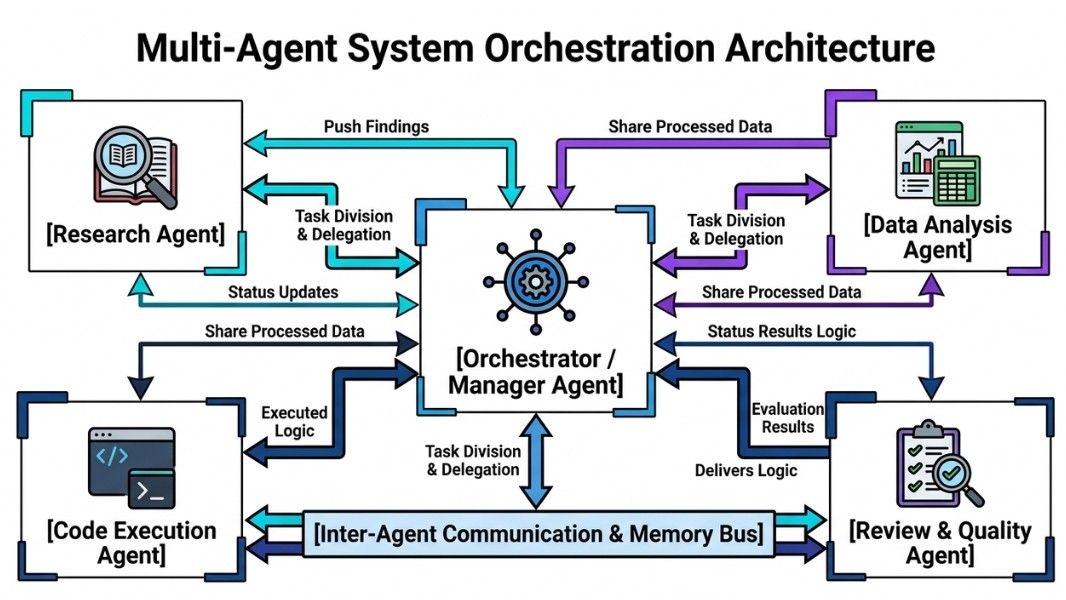
A multi-agent system uses multiple AI agents to work on the same task or goal. Each agent can have a specific role instead of making one agent handle everything.
For example, a business report system could use:
Research Agent: Collects relevant information.
Data Agent: Analyzes data and numbers.
Writing Agent: Creates the report.
Review Agent: Checks the final report.
The agents can share information and work together to complete the overall task.
Suppose a company wants to analyze customer feedback.
One agent can read customer comments, another can identify common complaints, and another can group those complaints into categories. A final agent can use the results to prepare a report.
In simple words, a multi-agent system divides a larger task among multiple AI agents, with each agent handling a specific part of the work.
This approach can be useful for complex tasks, but managing multiple agents can also make the system more difficult to build and maintain.
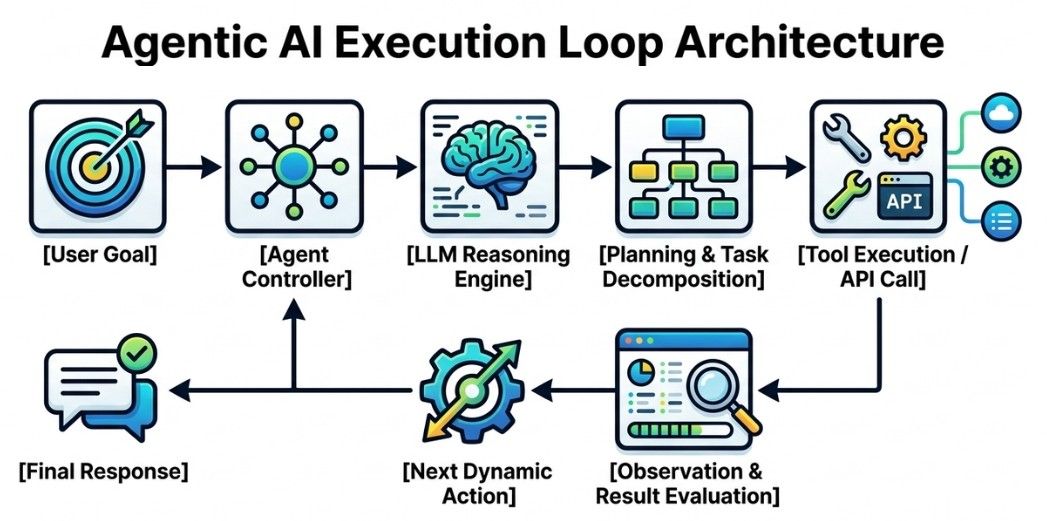
Agentic AI architecture describes how the main components of an AI agent work together to complete a task.
A simple agentic AI system can follow this flow:
User Goal → Agent → LLM → Plan → Tool → Observe Result → Next Action → Final Answer
Let's understand each part.
User Goal: The user gives the agent a task or goal.
For example:
"Find the best laptop under ₹70,000."
Agent: The agent manages the task and decides what needs to happen next.
LLM: The language model understands the user's request, processes information, and helps the agent decide the next step.
Planning: The agent identifies the steps needed to complete the task.
Tools: The agent uses tools to search for information, access data, or perform actions.
Observation: The agent checks the result after using a tool.
For example:
"The search returned five laptops under ₹70,000."
The agent can use this result to decide what to do next.
Next Action: Based on the result, the agent chooses the next step. It may search again, compare the options, or use another tool.
This plan → act → observe → act cycle can continue until the agent has enough information to complete the task.
Final Answer: Once the task is complete, the agent provides the result to the user.
In simple words, agentic AI architecture connects the model, tools, planning, and results into a loop that allows an AI agent to work toward a goal.
MCP, or Model Context Protocol, is an open standard that helps AI applications connect with external tools and sources of information in a consistent way.
Think of MCP as a common communication method between an AI application and the systems it needs to work with.
For example, an AI assistant may need access to:
Files
Databases
APIs
Business systems
Development tools
Without a common standard, developers may need to build different integrations for different systems. MCP provides a standardized way to connect AI applications with supported tools and resources.
Imagine an AI coding assistant that needs to work with files in a software project.
With an MCP-based setup, the AI application can connect to a supported MCP server and use the tools or resources it provides.
The simple idea is:
MCP provides a standard way for AI applications to access tools and external information.
This can make it easier to connect AI applications with different systems as their tool and data needs grow.
AI Agents | AI Workflows |
|---|---|
Can decide the next step based on the task and results | Usually follow predefined steps |
Can adapt when the situation changes | Work best when the process is predictable |
Can choose from available tools or actions | Tools and actions are usually defined in advance |
Can handle tasks where the next step may change | Follow a planned sequence from start to finish |
Useful for complex or open-ended tasks | Useful for repeatable and structured tasks |
In simple words: Workflows follow a plan, while agents can adapt the plan as they work toward a goal.
These concepts are closely related, but they work in different ways.
LLM Application: Uses an LLM to perform a specific task.
AI Workflow: Connects predefined steps to complete a process.
AI Agent: Uses an LLM, tools, and other components to decide how to work toward a goal.
A simple way to remember them is:
LLM Application: "Generate an answer."
Workflow: "Follow these steps."
AI Agent: "Achieve this goal by deciding what to do next."
In real applications, these approaches can also work together. For example, an AI agent can be one part of a larger workflow.
Suppose a company uses an AI system to handle employee leave requests.
An employee says:
"I want to take five days off next month."
The agent may follow these steps:
Step 1: Understand the Request
The agent identifies that the employee wants to apply for leave.
Step 2: Check Employee Information
It uses the company's system to check the employee's available leave balance.
Step 3: Check the Dates
It checks the requested dates and the employee's calendar.
Step 4: Check Company Rules
It checks whether the request follows the company's leave policy.
Step 5: Take Action
If the request is allowed and the agent has the required permission, it can submit the leave request.
Step 6: Respond
The employee receives a confirmation about the request.
This example shows how an AI agent can combine LLMs, tools, function calling, planning, and other components to complete a real-world task.
AI agents are useful for tasks where the system needs to understand a goal, make decisions, and choose different actions based on the situation.
Common use cases include:
Research tasks
Customer support
Data analysis
Business operations
Software development
Personal assistants
Document processing
Travel planning
Sales support
IT support
However, not every AI application needs an agent.
For simple tasks such as summarizing text, classifying an email, or generating a short response, a basic LLM application may be enough. Using an AI agent for these tasks can add unnecessary complexity.
An AI agent can be useful when a task:
Requires multiple steps.
Has different possible paths.
Requires decisions based on available information.
Needs to use tools or external systems.
Cannot be handled well with fixed rules alone.
For example, a customer-support agent might need to:
Understand Customer Problem
          ↓
Check Customer Information
          ↓
Find Relevant Policy
          ↓
Choose an Action
          ↓
Provide a Response
The exact steps may change depending on the customer's situation.
Traditional Automation | Agentic AI |
|---|---|
Follows predefined rules | Can make decisions based on the situation |
Usually follows a fixed workflow | Can choose between different actions |
Best for predictable tasks | Useful for less predictable tasks |
Limited decision-making | More flexible decision-making |
Example: Send an email when an order exceeds ₹5,000 | Example: Investigate a customer issue and suggest a solution |
Agentic AI is easier to understand when you stop thinking of it as just a smarter chatbot.
An AI agent is a system that can work toward a goal by understanding the task, deciding what to do, using tools, looking at results, and continuing until the work is finished.
The main concepts are closely connected:
AI Agents are systems that can work toward goals.
Agents vs LLM Applications explains the difference between simple AI applications and systems that can take actions.
Agent Architecture describes the parts that make an agent work.
Tools give agents access to outside systems and information.
Function Calling allows an AI model to request specific tools or functions.
Planning and Reasoning help an agent decide what to do.
Agent Memory helps an agent use useful information from earlier interactions.
Prompt Chaining breaks a large AI task into smaller steps.
AI Workflows connect predefined steps to complete a process.
Multi-Agent Systems use several agents with different responsibilities.
Agentic AI Architecture brings these parts together into one larger system.
MCP provides a common way for AI applications to connect with tools and external context.
Agents vs Workflows helps you choose between flexible AI decision-making and predefined processes.
