
Durgesh Tiwari
Author
Modern applications are commonly built using a Microservices Architecture, where an application is divided into multiple independent services. These services communicate with each other to complete different business operations.
As the number of microservices increases, managing communication between them becomes more challenging. Every service needs features such as service discovery, load balancing, security, retries, monitoring, logging, and traffic management. Implementing these features in every microservice leads to duplicated code and increases development and maintenance effort.
A Service Mesh solves this problem by managing service-to-service communication automatically. It handles networking tasks separately, allowing developers to focus on building business logic instead of communication logic.
A Service Mesh is an infrastructure layer that manages communication between microservices in a distributed system.
Instead of communicating directly, microservices send requests through lightweight sidecar proxies. These proxies handle tasks such as request routing, load balancing, encryption, retries, monitoring, and authentication automatically.
In simple words, a Service Mesh manages and secures communication between microservices.
Unlike an API Gateway, which manages traffic between clients and an application, a Service Mesh manages communication between internal services.
As the number of microservices grows, managing communication inside the application becomes more difficult. Along with business logic, developers also have to implement networking features such as retries, security, monitoring, and traffic routing in every service.
This increases code duplication, makes services harder to maintain, and creates inconsistency across the application.
A Service Mesh moves these networking responsibilities out of the application code and manages them in a centralized way.
It helps to:
Simplify service-to-service communication.
Improve security between services.
Automatically balance traffic.
Enable monitoring and distributed tracing.
Reduce duplicate networking code.
Improve reliability and fault tolerance.
A Service Mesh works by deploying a lightweight sidecar proxy alongside every microservice.
When one service sends a request to another, the request first goes to its local sidecar proxy instead of directly reaching the destination service. The proxy applies security policies, load balancing, retries, and traffic rules before forwarding the request to the destination service through its sidecar proxy.
Because every request passes through these proxies, the Service Mesh can monitor, secure, and control communication without requiring changes to the application code.
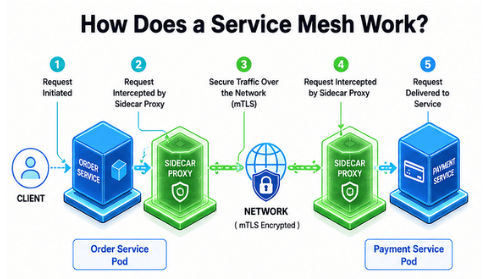
A Sidecar Proxy is a lightweight proxy that runs alongside every microservice in a Service Mesh. Instead of handling networking tasks inside the application, these tasks are managed by the sidecar proxy.
Each sidecar proxy is responsible for:
Load balancing
Traffic routing
Service discovery
Request retries
Security using mTLS
Logging
Monitoring
Metrics collection
Because these responsibilities are handled by the sidecar proxy, developers can focus on writing business logic instead of networking code.
Suppose an online shopping application has the following services:
Order Service
Payment Service
Notification Service
Each service runs with its own Sidecar Proxy. Whenever a service communicates with another service, the sidecar proxies automatically handle networking tasks such as traffic routing, security, retries, and monitoring without requiring any changes to the application code.
A Service Mesh has two main components:
Control Plane
Data Plane
Both work together to manage communication between microservices.
The Data Plane handles the actual communication between services, while the Control Plane decides how that communication should happen by managing policies and configurations.
The Data Plane consists of sidecar proxies that run alongside each microservice.
Whenever one service communicates with another, the request passes through these sidecar proxies. They follow the rules configured by the Control Plane and handle all service-to-service communication.
In simple words, the Data Plane handles the actual communication between microservices.
Routes requests between services.
Performs load balancing.
Encrypts communication using mTLS.
Retries failed requests.
Collects logs and metrics.
Enforces security policies.
Monitors service traffic.
Example
Suppose the Order Service sends a request to the Payment Service.
The request first reaches the Order Service's sidecar proxy, which applies routing and security policies before forwarding it to the Payment Service's sidecar proxy. The proxy then delivers the request to the Payment Service.
The Control Plane is the central management component of a Service Mesh.
It does not handle application requests directly. Instead, it manages and configures all the sidecar proxies running in the Data Plane.
Whenever routing rules, security policies, or traffic configurations change, the Control Plane automatically updates every sidecar proxy.
In simple words, the Control Plane manages and configures the entire Service Mesh.
Manages proxy configurations.
Controls traffic routing policies.
Distributes security certificates.
Applies authentication and authorization rules.
Manages service discovery.
Monitors the Service Mesh.
Example
Suppose an administrator wants to send only 20% of traffic to a new version of a service.
Instead of updating every microservice, the administrator changes the configuration in the Control Plane. The Control Plane automatically updates all sidecar proxies, and they begin routing traffic according to the new rule.
Control Plane | Data Plane |
|---|---|
Manages the Service Mesh. | Handles service-to-service communication. |
Configures sidecar proxies. | Runs inside sidecar proxies. |
Does not process user requests. | Processes all service-to-service requests. |
Applies routing and security policies. | Executes the configured policies. |
Centralized management component. | Distributed across all services. |
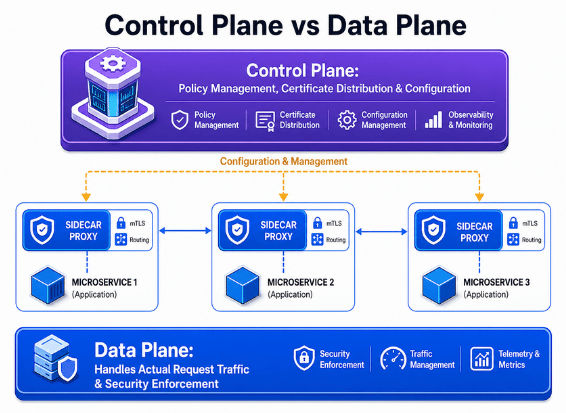
A Service Mesh consists of two main components:
Control Plane
Data Plane (Sidecar Proxies)
The Control Plane manages the Service Mesh by configuring policies, routing rules, and security settings. The Data Plane, which consists of sidecar proxies, handles communication between microservices.
                    Control Plane
          (Configuration & Management)
                     │
     ┌───────────────┼───────────────┐
     │               │               │
     ▼               ▼               ▼

 Service A       Service B       Service C
┌──────────┐    ┌──────────┐    ┌──────────┐
│ Sidecar  │◄──►│ Sidecar  │◄──►│ Sidecar  │
│  Proxy   │    │  Proxy   │    │  Proxy   │
└──────────┘    └──────────┘    └──────────┘
     │               │               │
     ▼               ▼               ▼
 Application     Application     Application
Every microservice runs with its own Sidecar Proxy.
Sidecar proxies handle all service-to-service communication.
The Control Plane manages and updates all sidecar proxies.
Networking features such as routing, security, retries, and monitoring are handled outside the application code.
This architecture separates business logic from network management, making applications easier to build, manage, and scale.
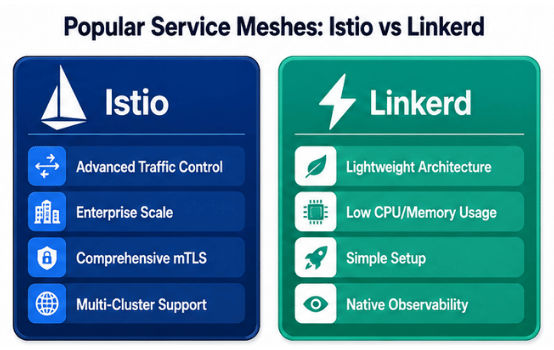
Several Service Mesh solutions are available for Kubernetes and cloud-native applications. The two most commonly used Service Meshes are Istio and Linkerd.
Istio is one of the most popular Service Mesh platforms for Kubernetes. It provides features such as traffic management, security, monitoring, and policy enforcement without requiring changes to application code.
Traffic routing.
Automatic load balancing.
Mutual TLS (mTLS).
Authentication and authorization.
Distributed tracing.
Metrics and monitoring.
Traffic splitting for canary deployments.
Large microservices applications.
Kubernetes deployments.
Multi-cluster environments.
Enterprise applications.
Linkerd is a lightweight Service Mesh designed for Kubernetes. It is easier to install and uses fewer system resources than Istio, making it suitable for small and medium-sized applications.
Lightweight architecture.
Automatic mTLS.
Load balancing.
Service discovery.
Low resource usage.
Built-in observability.
Small and medium Kubernetes clusters.
Applications with simple service communication.
Teams looking for an easy-to-manage Service Mesh.
A Service Mesh offers several benefits for microservices-based applications.
Simplifies Communication: Manages service-to-service communication automatically.
Improves Security: Secures communication using Mutual TLS (mTLS).
Better Traffic Management: Supports routing, retries, and traffic splitting.
Automatic Load Balancing: Distributes requests across service instances.
Improved Observability: Collects logs, metrics, and traces for monitoring.
Increases Reliability: Handles retries, timeouts, and failovers automatically.
Centralized Policy Management: Applies security and traffic policies from one place.
Although a Service Mesh offers many benefits, it also comes with some challenges.
Increased Complexity: Adds extra infrastructure such as the Control Plane and sidecar proxies.
Higher Resource Usage: Sidecar proxies consume additional CPU and memory.
Performance Overhead: Every request passes through proxies, adding slight latency.
Learning Curve: Requires understanding concepts like sidecar proxies, mTLS, and traffic policies.
Operational Management: The Service Mesh must be monitored, configured, and maintained.
Netflix runs thousands of microservices that continuously communicate with each other. A Service Mesh helps manage this communication by handling traffic routing, load balancing, security, monitoring, and request retries automatically.
This allows Netflix to deliver a fast, secure, and reliable streaming experience even during high traffic.
A Service Mesh manages communication between microservices.
It uses Sidecar Proxies to handle service-to-service communication.
The Control Plane manages configuration, while the Data Plane handles requests.
A Service Mesh provides features such as load balancing, traffic routing, security, monitoring, and retries.
Popular Service Mesh solutions include Istio and Linkerd.
Service Mesh helps build secure, reliable, and scalable microservices applications.
