
Durgesh Tiwari
Author
Every time you log in with Google, check the weather, make an online payment, or book a ride, different applications exchange information behind the scenes. This communication is possible because of APIs (Application Programming Interfaces).
An API is a set of rules that allows different applications, systems, or services to communicate and share data with each other.
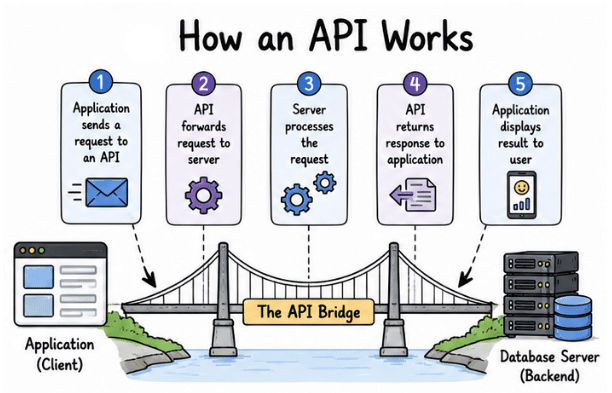
In simple words: An API acts as a bridge that allows two applications to exchange information without needing to know how each one is built internally.
Instead of building every feature from scratch, developers use APIs to connect with external services and reuse existing functionality. This saves development time and makes applications easier to integrate.
APIs are widely used in web applications, mobile applications, cloud services, payment gateways, social media platforms, and third-party integrations.
A typical API communication follows these steps:
An application sends a request to an API.
The API forwards the request to the appropriate server or service.
The server processes the request.
The API returns the response to the application.
The application displays the result to the user.
Imagine you open a weather application on your phone.
The app doesn't collect weather information on its own. Instead, it sends a request to a weather service through an API. The weather service processes the request, returns the latest weather data, and the app displays it on your screen.
This entire process happens within a few seconds.
APIs are used in many everyday applications, including:
Online payment gateways
Social media login
Weather applications
Maps and navigation services
E-commerce platforms
Cloud services
Mobile applications
REST (Representational State Transfer) is a popular architectural style used to build web APIs. It allows different applications to communicate over the internet using standard HTTP methods.
A REST API is stateless, meaning every request is processed independently. Each request contains all the information the server needs, so the server does not remember previous requests.
Most REST APIs use JSON (JavaScript Object Notation) to exchange data because it is lightweight, easy to read, and supported by almost every programming language. While REST also supports formats like XML, JSON is the most commonly used format today.
A typical REST API request follows these steps:
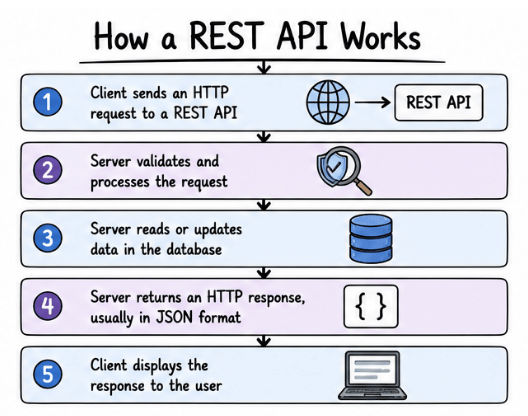
The client sends an HTTP request to a REST API.
The server validates and processes the request.
If needed, the server reads or updates data in the database.
The server returns an HTTP response, usually in JSON format.
The client displays the response to the user.
REST APIs use different HTTP methods to perform different operations on server resources. Each method has a specific purpose.
HTTP Method | Purpose | Example |
|---|---|---|
GET | Retrieve data from the server | Get a user's profile |
POST | Create new data | Create a new account |
PUT | Update existing data | Update profile information |
DELETE | Delete existing data | Delete a user account |
Suppose you are using an online shopping application.
The application sends different REST API requests based on the action you perform:
GET → Retrieve product details.
POST → Place a new order.
PUT → Update the delivery address.
DELETE → Remove an item from the shopping cart.
Each HTTP method performs a specific operation, and the server returns the appropriate response based on the request.
REST APIs are popular because they:
Use standard HTTP methods, making them easy to understand.
Are stateless, which improves scalability.
Support multiple data formats, with JSON being the most common.
Work well with web, mobile, and cloud applications.
Are easy to integrate with different programming languages and platforms.
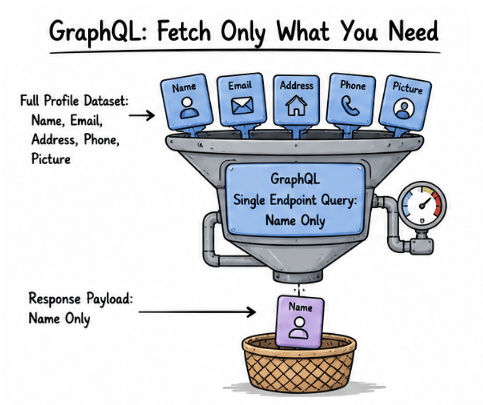
GraphQL is a query language for APIs that allows clients to request only the data they need. Instead of returning a fixed response, the server sends exactly the information requested by the client.
Unlike REST APIs, which often use multiple endpoints for different resources, GraphQL typically uses a single endpoint to handle different types of requests. This gives developers more flexibility and reduces unnecessary data transfer.
Suppose a user's profile contains the following information:
Name
Address
Phone Number
Profile Picture
If your application only needs the Name:
A REST API may return the complete profile, including all the fields.
A GraphQL API returns only the Name because that's the only data requested.
This makes GraphQL more efficient, especially for applications where different screens require different sets of data.
The communication process is simple:
The client sends a query specifying the required data.
The GraphQL server validates and processes the query.
The server fetches the requested data.
The server returns only the requested fields in the response.
A Query is used to retrieve data from the server.
Example: Fetching a user's profile details.
A Mutation is used to create, update, or delete data.
Example: Updating a user's profile information.
A Subscription is used to receive real-time updates from the server.
Example: Live chat messages or instant notifications.
Returns only the required data.
Reduces unnecessary data transfer.
Uses a single API endpoint.
Reduces the number of API requests in many cases.
Works well for applications with complex or related data.
Especially useful for mobile applications and modern front-end frameworks.
gRPC (Google Remote Procedure Call) is an open-source, high-performance framework developed by Google that allows different applications and services to communicate with each other.
Unlike REST APIs, which typically use HTTP/1.1 and JSON, gRPC uses HTTP/2 for communication and Protocol Buffers (Protobuf) to serialize data. This makes gRPC faster, more efficient, and suitable for high-performance applications.
It is widely used for communication between microservices, distributed systems, and cloud-native applications.
A typical gRPC request follows these steps:
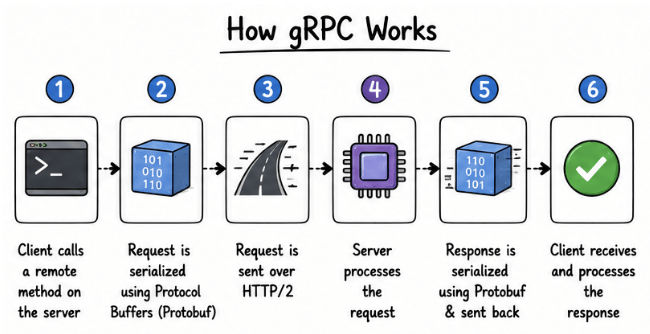
The client calls a remote method on the server.
The request is serialized using Protocol Buffers (Protobuf).
The request is sent over HTTP/2.
The server processes the request.
The response is serialized using Protobuf and sent back to the client.
The client receives and processes the response.
gRPC is commonly used in:
Communication between microservices
Cloud-native applications
Distributed systems
Internal service-to-service communication
Real-time applications such as chat and live streaming
IoT and edge computing applications
Faster than REST because it uses HTTP/2 and Protocol Buffers.
Transfers data in a compact binary format, reducing network usage.
Supports bi-directional streaming for real-time communication.
Generates client and server code automatically for multiple programming languages.
Well suited for large-scale, high-performance systems.
Not as easy to test directly in a web browser as REST APIs.
Binary data is not human-readable like JSON.
Requires Protobuf definitions before communication.
Limited native browser support, often requiring gRPC-Web for frontend applications.
Feature | REST | GraphQL | gRPC |
|---|---|---|---|
Communication Style | Resource-based architecture | Query language for APIs | Remote Procedure Calls (RPC) |
API Endpoints | Multiple endpoints | Usually a single endpoint | Service-based methods |
Data Fetching | Fixed response from the server | Client requests exactly the required data | Client calls remote methods |
Data Format | Usually JSON | Usually JSON | Protocol Buffers (Binary) |
Transport Protocol | HTTP/1.1 or HTTP/2 | HTTP | HTTP/2 |
Performance | Good | Better than REST for complex data | Excellent (Very High Performance) |
Real-Time Support | Requires WebSockets or SSE | Supports Subscriptions | Built-in Streaming Support |
Best For | Public APIs, Web & Mobile Applications | Applications with complex or flexible data requirements | Internal microservices and distributed systems |
Learning Curve | Easy | Moderate | Moderate to Advanced |
APIs enable different applications and services to communicate and exchange data efficiently.
REST API is the most widely used API architecture and uses standard HTTP methods for communication.
GraphQL allows clients to request only the data they need, reducing unnecessary data transfer.
gRPC provides high-performance communication and is commonly used in microservices and distributed systems.
The choice between REST, GraphQL, and gRPC depends on the application's requirements, scalability, performance, and communication needs.
Understanding these API technologies helps developers choose the right approach for building secure, scalable, and efficient applications.
