
Durgesh Tiwari
Author
Designing an Uber-like ride-hailing system is a classic system design interview problem because it combines real-time location tracking, geospatial search, driver-rider matching, trip state management, pricing, payments, and high write throughput.
The main challenges are finding nearby available drivers quickly, assigning exactly one driver to a ride, processing massive location-update traffic, and maintaining reliable trip state despite retries and failures.
Note: This article designs a conceptual Uber-like architecture for system design interviews. It does not claim to describe Uber's private production architecture.
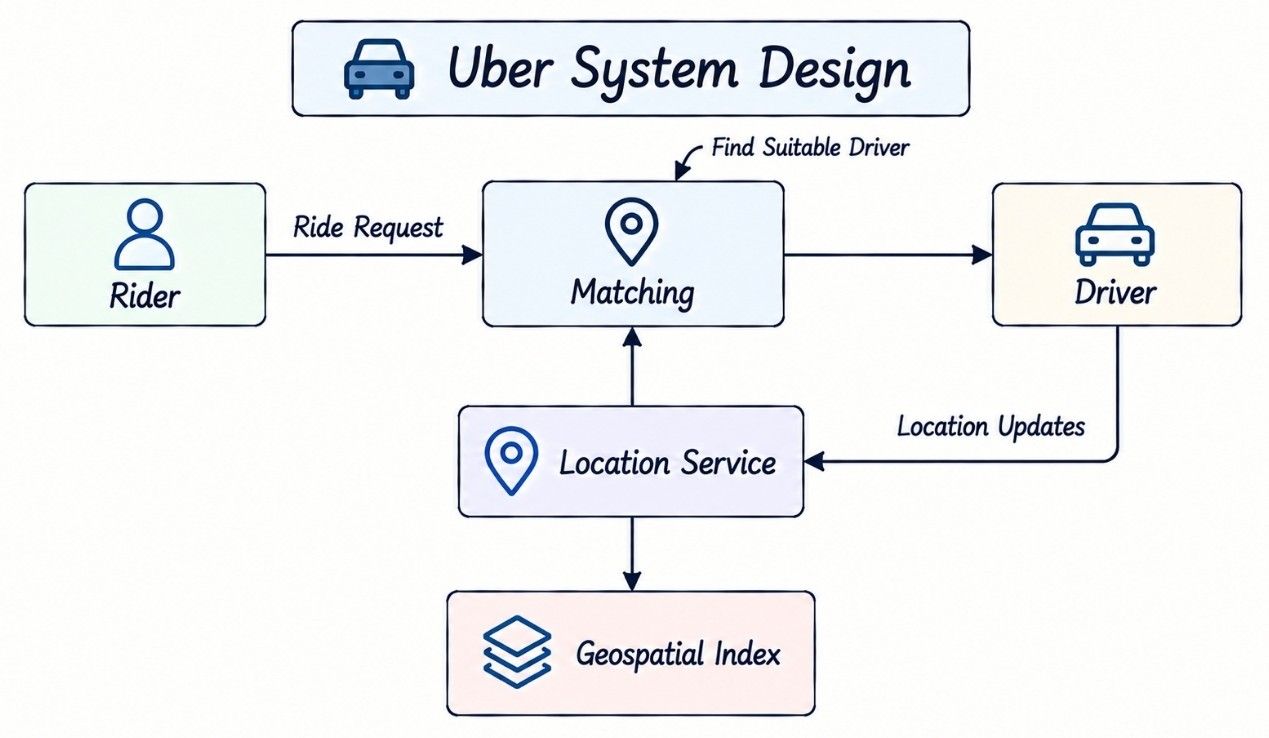
An Uber-like system connects riders with nearby available drivers and manages the complete ride lifecycle.
At a high level:
Rider Opens App
      ↓
Find Nearby Drivers
      ↓
Request Ride
      ↓
Match Driver
      ↓
Driver Accepts
      ↓
Driver Approaches
      ↓
Trip Starts
      ↓
Live Location Tracking
      ↓
Trip Ends
      ↓
Payment
The architecture has two important workloads:
Path | Responsibility |
|---|---|
Real-Time Path | Driver location, nearby-driver discovery, matching, live tracking |
Transactional Path | Ride state, driver assignment, payment, trip history |
The real-time path prioritizes low latency and high throughput, while the transactional path prioritizes correctness and durability.
Requirements define the core scope before choosing databases, queues, caches, or communication protocols.
The system should support:
Requesting rides using pickup and destination locations
Drivers going online and offline
Driver location updates
Nearby-driver discovery and matching
Driver acceptance or rejection
Live driver tracking
Fare and ETA estimation
Ride lifecycle management
Payment after trip completion
Features such as scheduled rides, ride sharing, ratings, promotions, and food delivery can remain outside the initial scope.
The most important system qualities are:
Low matching and tracking latency
High availability and fault tolerance
Massive location-update throughput
Horizontal and regional scalability
Correct and durable ride assignment
Secure payment processing
Consistency requirements vary by workflow. A driver's displayed position can be slightly stale, but final ride assignment must prevent the same driver from being assigned to conflicting active rides.
Scale estimation shows why driver location tracking needs a different architecture from ordinary ride transactions.
Assume:
Metric | Estimate |
|---|---|
Active drivers | 10 million |
Drivers online at peak | 2 million |
Location update frequency | Every 4 seconds |
Rides per day | 20 million |
Peak location-update traffic:
2,000,000 / 4
= 500,000 location updates/second
Average ride creation traffic:
20,000,000 / 86,400
≈ 231 ride requests/second
Peak ride traffic can be several times higher, but the important insight remains:
Location updates can generate far more traffic than ride creation.
These are hypothetical interview estimates, not Uber production numbers.
This difference in workload is why high-frequency GPS updates should not be treated like ordinary transactional database writes.
A clean architecture separates ride management, real-time location processing, driver matching, and asynchronous downstream workflows.
RIDER PATH

Rider App
    ↓
API Gateway
    ↓
Ride Service
    ↓
Matching Service
   /        \
  ↓          ↓
Location    ETA / Routing
Service       Service

DRIVER LOCATION PATH

Driver App
    ↓
Location Gateway
    ↓
Location Service
    ↓
Geospatial Store
Supporting services such as Pricing Service and User/Driver Service can be called when required without making every service a sequential request hop.
Ride lifecycle events can be processed asynchronously:
Ride Service
     ↓
Transactional DB
     +
   Outbox
     ↓
Outbox Publisher
     ↓
 Event Bus
  /   |    |    \
 ↓    ↓    ↓     ↓
Payment  Notifications  Analytics  Fraud
The real-time location path is optimized for high-throughput updates and fast geospatial queries, while the ride path protects durable business state and assignment correctness.
The transactional data model stores durable rider, driver, vehicle, ride, and payment state.
Rider
-----
rider_id
name
rating

Driver
------
driver_id
status
vehicle_id
rating

Vehicle
-------
vehicle_id
driver_id
type
registration

Ride
----
ride_id
rider_id
driver_id
pickup
destination
status
estimated_fare
final_fare
created_at

Payment
-------
payment_id
ride_id
amount
status
High-frequency driver location should be handled separately from this transactional model.
Avoid continuously updating:
Driver.current_latitude
Driver.current_longitude
in the main transactional database for every GPS update.
Instead, use a dedicated real-time location system with geospatial indexing for current driver positions, while the transactional database remains responsible for durable ride and assignment state.
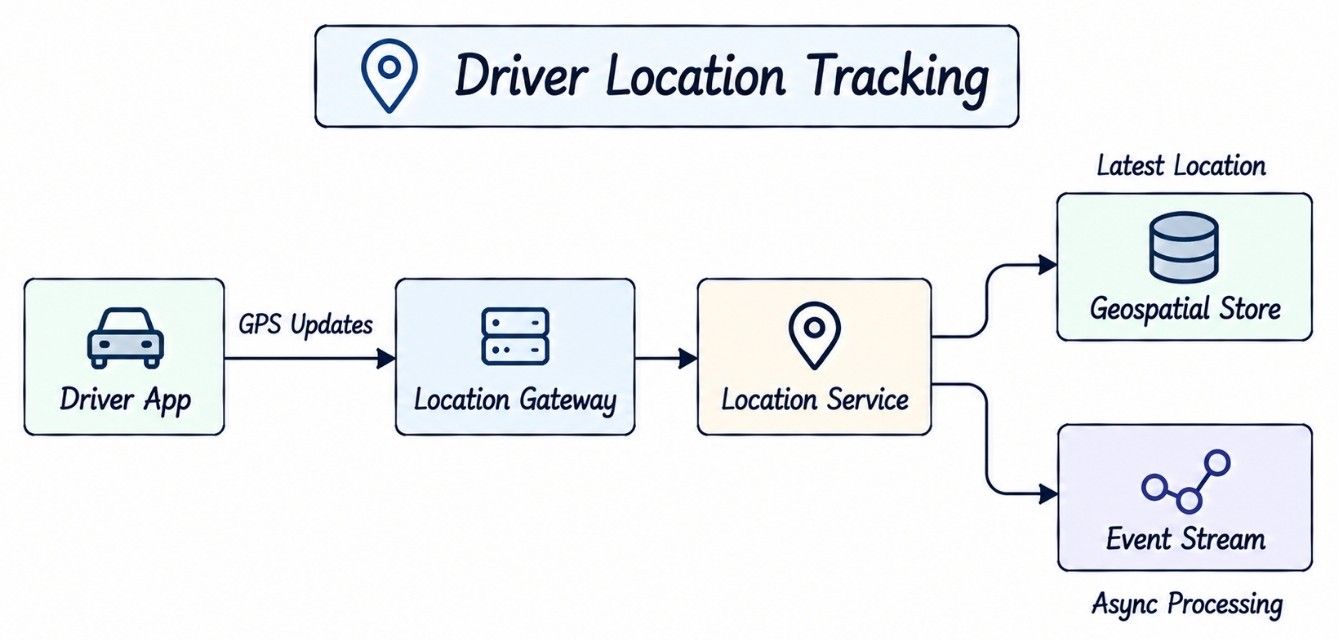
Online drivers continuously send location updates through a dedicated high-throughput ingestion path.
Driver App
    ↓
GPS Update
    ↓
Location Gateway
    ↓
Location Service
   /        \
  ↓          ↓
Geospatial   Event Stream
Store        (optional downstream processing)
A location update might contain:
{
  "driver_id": "D123",
  "latitude": 26.8467,
  "longitude": 80.9462,
  "timestamp": 1789620000
}
For matching, the system primarily needs the driver's latest usable location, not every historical GPS point.
Where is driver D123 right now?
Historical location events can be processed separately when required for analytics, safety, support, or compliance.
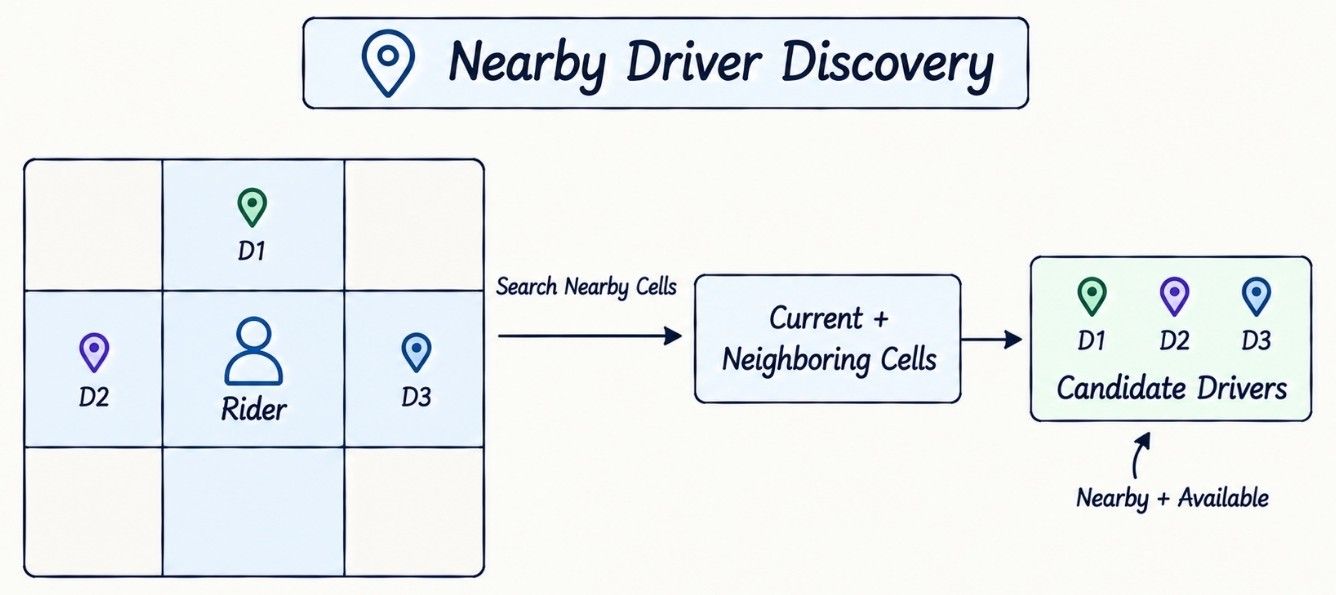
A geospatial index allows the system to find nearby drivers without scanning every active driver.
A naive approach such as:
SELECT *
FROM drivers
WHERE latitude BETWEEN ...
  AND longitude BETWEEN ...;
may work at small scale, but repeatedly searching a large, rapidly changing driver table becomes inefficient.
Instead, divide geography into searchable cells:
+-----+-----+-----+
| A1  | A2  | A3  |
+-----+-----+-----+
| B1  | B2  | B3  |
+-----+-----+-----+
| C1  | C2  | C3  |
+-----+-----+-----+
Active drivers are associated with cells based on their latest location.
Cell B2
  ↓
D12
D18
D41
D87
A rider near B2 can search the current and neighboring cells instead of searching every driver in the city.
Common approaches include:
Geohashing
Hierarchical spatial cells
Quadtrees
Other spatial indexes
The exact strategy depends on geographic density, query patterns, scale, and operational complexity.
The geospatial index generates a small candidate set that can then be filtered and ranked more accurately.
Pickup Location
      ↓
Find Spatial Cell
      ↓
Current + Neighboring Cells
      ↓
Candidate Drivers
      ↓
Filter Offline / Busy / Stale
      ↓
Distance / ETA
Neighboring cells must also be searched because a nearby driver can be physically close to the rider while belonging to a different spatial cell.
The spatial index provides approximate candidate discovery. Actual distance or road-network ETA can then be calculated for the remaining candidates.
Disconnected or inactive drivers should not remain eligible for matching indefinitely.
Store freshness information with the latest location:
driver_id
coordinates
last_updated_at
If:
now - last_updated_at > freshness_threshold
the driver should be excluded from matching.
Heartbeats and driver availability state can provide additional signals.
As drivers move, their latest location and spatial-cell membership must be updated.
Driver Moves
     ↓
Update Location
     ↓
Update Cell Membership
Suitable cell sizes, movement thresholds, batching, or stream processing can reduce unnecessary index updates.
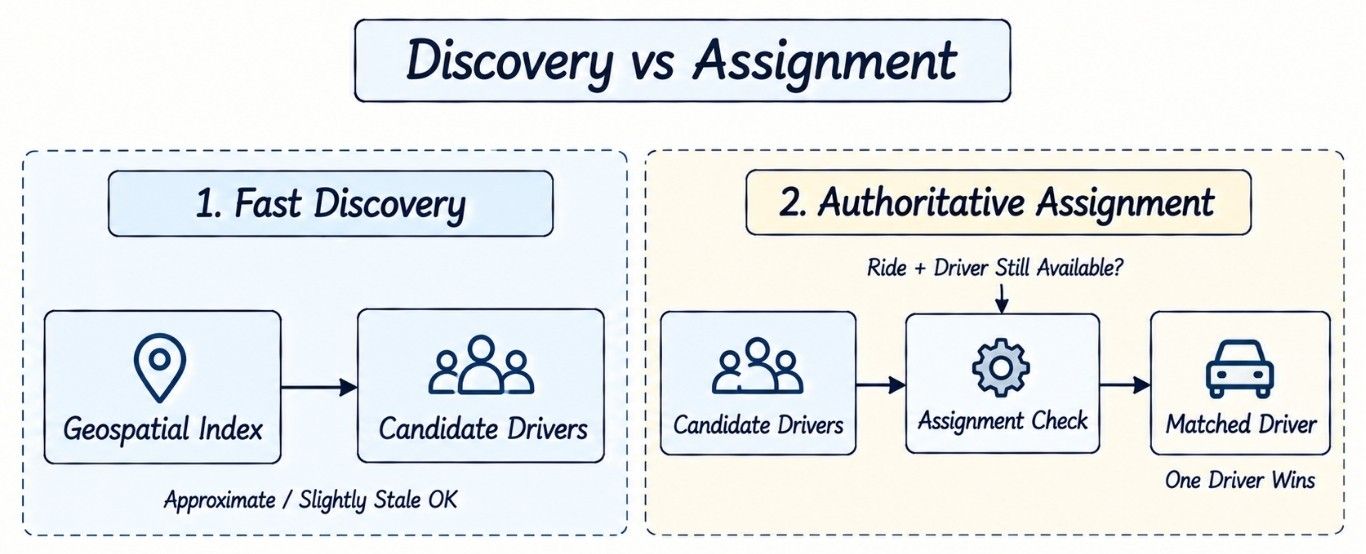
Driver discovery and final ride assignment have different consistency requirements.
Aspect | Discovery | Assignment |
|---|---|---|
Goal | Find nearby candidate drivers | Assign one driver to one ride |
Data source | Geospatial index | Authoritative transactional state |
Consistency | Slightly stale data is acceptable | Stronger correctness required |
Example | “Which drivers are nearby?” | “Can D123 be assigned to R456?” |
Failure impact | Candidate list may be temporarily inaccurate | Double booking or conflicting assignment |
The flow is:
Geospatial Index
      ↓
Candidate Discovery
      ↓
Authoritative Assignment
The geospatial index finds candidates quickly, but final assignment must verify that both the ride and driver are still available before committing the assignment.
Discovery can be approximately fresh; assignment must protect business invariants.
When a rider presses Request Ride, the backend creates a durable ride and starts matching.
Rider
  ↓
Ride Service
  ↓
Create Ride
  ↓
Pricing / Eligibility
  ↓
Matching Service
  ↓
Nearby Driver Search
  ↓
Candidate Drivers
  ↓
Dispatch
The ride may initially move through:
REQUESTED
    ↓
SEARCHING
Matching then attempts to reserve and assign a suitable driver.
Driver-rider matching selects the most suitable driver from the candidates returned by nearby-driver discovery.
Candidate ranking may consider:
Pickup ETA
Distance
Vehicle type
Driver availability
Driver direction
Road and traffic conditions
Regional constraints
Marketplace conditions
Conceptually:
Nearby Drivers
      ↓
Eligibility Filters
      ↓
ETA Calculation
      ↓
Candidate Scoring
      ↓
Dispatch
The geographically closest driver is not always the fastest. For example, a driver 500 meters away may have a longer pickup time than one 900 meters away because of traffic, one-way roads, bridges, restricted turns, or road topology.
Therefore, straight-line distance is useful for fast candidate pruning, while road-network ETA is generally more useful for final ranking.
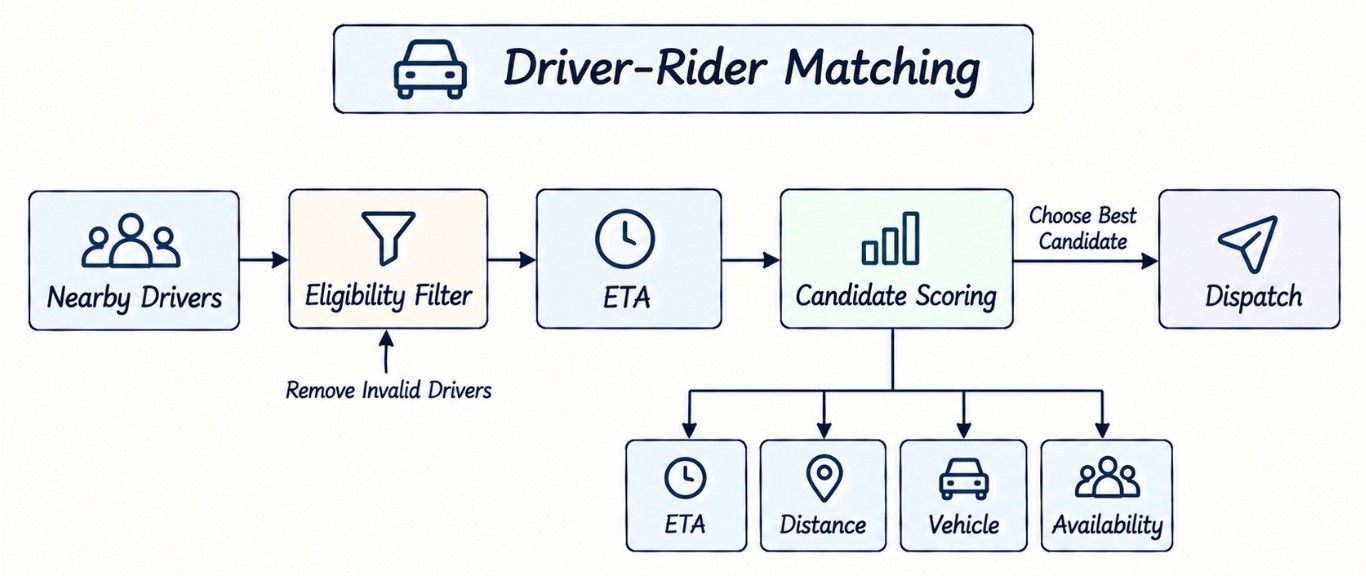
After ranking candidate drivers, the system must decide how ride opportunities are dispatched.
Aspect | Sequential Dispatch | Batch Dispatch |
|---|---|---|
Approach | Offer to drivers one by one | Offer to multiple drivers |
Matching latency | Potentially higher | Usually lower |
Driver competition | Lower | Higher |
Concurrency complexity | Lower | Higher |
Assignment conflicts | Less likely | More likely |
Sequential dispatch:
Ride
 ↓
D1
 ↓ reject / timeout
D2
 ↓
Accept
Batch dispatch:
          Ride
       /   |   \
      ↓    ↓    ↓
     D1   D2   D3
Sequential dispatch is simpler but may increase matching time when drivers reject or ignore requests. Batch dispatch can reduce matching latency, but multiple drivers may accept almost simultaneously.
Therefore, batch dispatch requires strong concurrency control so that only one driver can successfully claim the ride.
Suppose two drivers accept the same ride concurrently:
Ride R1

D1 → ACCEPT
D2 → ACCEPT
Only one assignment can succeed.
A conditional update can enforce this:
UPDATE rides
SET driver_id = :driver_id,
    status = 'MATCHED'
WHERE ride_id = :ride_id
  AND status = 'SEARCHING';
Only one concurrent operation should successfully transition the ride.
Optimistic concurrency with a version number or another transactional compare-and-set mechanism can also work.
But ride protection alone is insufficient.
The system must atomically ensure:
Ride is still unassigned
AND
Driver is still available
Otherwise the same driver could be assigned to two different rides.
The business invariant is:
One active ride has one assigned driver, and one driver cannot own multiple conflicting active rides.
A temporary reservation can protect drivers while an offer is active.
AVAILABLE
    ↓
RESERVED
    ↓
ON_TRIP
A reservation should expire if the driver does not respond.
Reserve D1 for R123
        ↓
Offer Expires
        ↓
Release D1
        ↓
Try Next Candidate
The system must also prevent a late acceptance from claiming an already expired reservation.
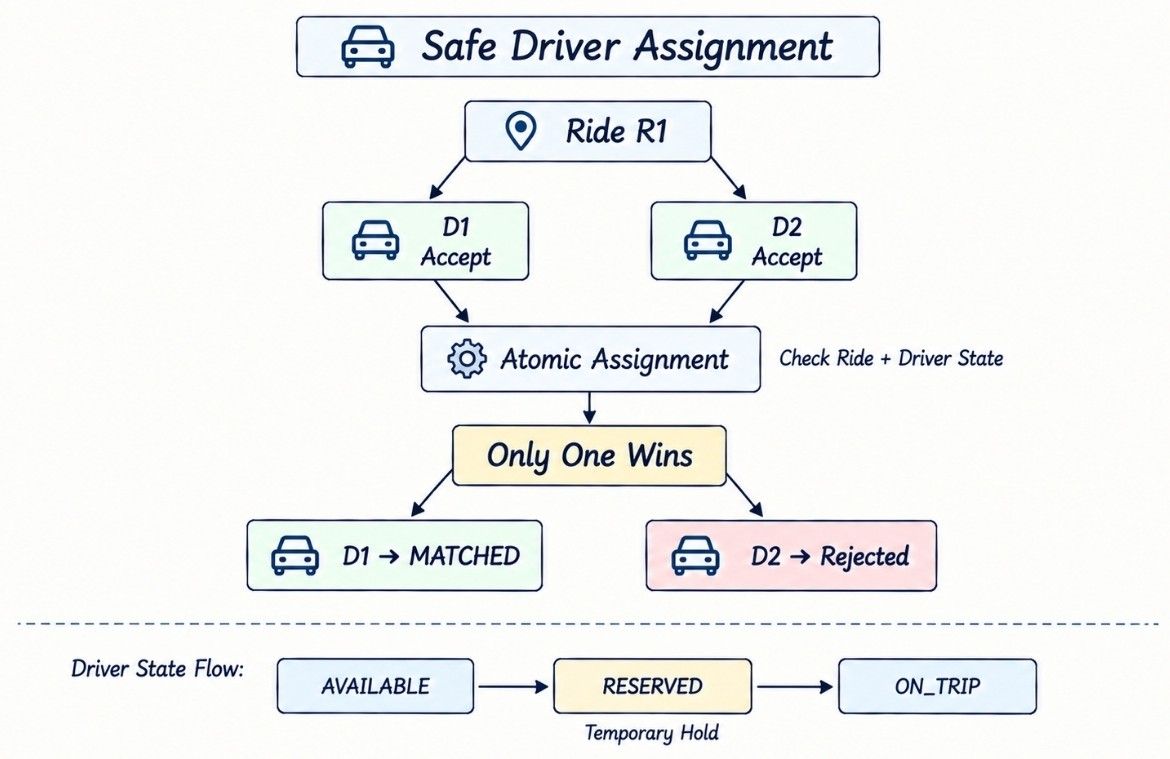
Ride lifecycle should be represented using explicit states rather than unrelated Boolean flags.
REQUESTED
    ↓
SEARCHING
    ↓
MATCHED
    ↓
DRIVER_ARRIVING
    ↓
DRIVER_ARRIVED
    ↓
IN_PROGRESS
    ↓
COMPLETED
Alternative transitions include:
REQUESTED → CANCELLED
SEARCHING → NO_DRIVER_FOUND
MATCHED   → CANCELLED
State transitions should be validated.
For example:
COMPLETED → IN_PROGRESS
should normally be rejected.
An explicit state machine makes retries, failures, cancellations, and concurrency much easier to reason about.
Mobile clients operate over unreliable networks, so important state-changing requests must handle retries safely.
Suppose:
POST /v1/rides
Idempotency-Key: abc123
The backend creates R123, but the response is lost. The client retries.
Without idempotency:
Request 1 → R123
Request 2 → R124
The rider could accidentally request two cars.
Instead persist a unique mapping such as:
(rider_id, idempotency_key)
            ↓
           R123
A retry returns the original ride.
The same principle applies to payments and other critical state-changing operations.
A small API surface is enough to explain the core ride lifecycle in a system design interview.
Create a ride:
POST /v1/rides
Idempotency-Key: abc123
{
  "pickup": {
    "lat": 26.8467,
    "lng": 80.9462
  },
  "destination": {
    "lat": 26.9100,
    "lng": 80.9500
  },
  "vehicle_type": "STANDARD"
}
Find nearby drivers:
GET /v1/drivers/nearby?lat=...&lng=...
Update driver availability:
PUT /v1/drivers/me/status
Accept a ride offer:
POST /v1/rides/{ride_id}/accept
The backend must verify that the ride is still assignable and the driver is still eligible before committing the assignment.
Get current ride state:
GET /v1/rides/{ride_id}
Real-time driver location and ride updates can use a persistent connection such as WebSocket, rather than frequent REST polling.
After a ride is matched, the rider needs frequent driver-location updates.
Driver App
    ↓
Location Service
    ↓
Real-Time Gateway
    ↓
Rider App
WebSockets are a natural option for active trips.
An update may look like:
{
  "ride_id": "R123",
  "driver_lat": 26.8501,
  "driver_lng": 80.9472,
  "timestamp": 1789620010
}
The client can smoothly move the vehicle marker between received coordinates.
Updating every 100 milliseconds wastes battery, bandwidth, and backend capacity. Updating once per minute makes tracking too stale.
Frequency can adapt based on:
Driver movement
Speed
Trip state
Network quality
Battery conditions
App state
The client can also interpolate movement visually between updates.
Real-time connections will fail occasionally.
Connection Lost
      ↓
Backoff + Jitter
      ↓
Reconnect
      ↓
Fetch Current Ride State
      ↓
Resume Live Updates
The client must not assume every WebSocket event was received.
WebSocket state is not durable ride state.
If either rider or driver reconnects, authoritative ride state should be recoverable from backend storage.
Pricing estimates can consider:
Pickup
Destination
Vehicle Type
Marketplace Conditions
        ↓
  Pricing Service
        ↓
   Fare Estimate
Conceptually:
Fare =
Base Fare
+ Distance Component
+ Time Component
+ Fees
+ Marketplace Adjustment
Exact business formulas are outside the system-design scope.
For dynamic pricing, the system can aggregate regional supply and demand:
Ride Requests → Demand Aggregation

Available Drivers → Supply Aggregation

Supply + Demand
      ↓
Regional Pricing Signals
This avoids scanning all active rides and drivers for every pricing request.
ETA is useful for:
Driver-to-pickup time
Pickup-to-destination time
Matching candidate ranking
Conceptually:
Origin
Destination
Traffic
Road Network
Historical Travel Data
        ↓
Routing / ETA Service
Accurate routing can be computationally expensive.
A common approach is therefore:
Cheap Geospatial Filtering
          ↓
Small Candidate Set
          ↓
More Expensive ETA Calculation
This keeps matching fast without running expensive routing calculations for every nearby driver.
Several systems need to react to ride lifecycle events.
For example:
RideCompleted
      ↓
  Event Bus
   / |  |  \
  ↓  ↓  ↓   ↓
Payment
Receipt
Analytics
Driver Earnings
The Ride Service should not synchronously execute every downstream workflow before completing the ride transition.
Asynchronous events reduce coupling and allow consumers to scale independently.
A dangerous failure can occur between database commit and event publication.
1. Ride becomes COMPLETED
2. Database commit succeeds
3. Service crashes
4. RideCompleted event is never published
Payment or other consumers may never learn about the completed ride.
Use a transactional outbox:
Single Database Transaction
        ↓
UPDATE Ride → COMPLETED
INSERT Outbox → RideCompleted
        ↓
      COMMIT
An asynchronous publisher later sends the outbox event to the event broker.
Consumers must remain idempotent because events can still be delivered more than once.
Distributed systems should not casually promise exactly-once processing across every service.
A practical model is:
At-Least-Once Delivery
          +
Idempotent Consumers
          +
Deduplication
For example, Payment Service should recognize that:
RideCompleted(R123)
has already been processed instead of charging the rider twice.
This provides effectively-once business behavior without assuming globally exactly-once execution.
Payment can begin after trip completion.
Ride Completed
      ↓
Payment Service
      ↓
Payment Provider
      ↓
Payment Status
Use a stable payment reference or idempotency key tied to the ride.
A provider timeout does not necessarily mean the payment failed.
For example:
Provider Charged Successfully
           ↓
Response Lost
           ↓
Backend Sees Timeout
Blindly retrying could create a duplicate charge.
The Payment Service should resolve uncertain outcomes through provider status checks, idempotency, and reconciliation.
Cancellation is a state transition, not deletion of the ride.
MATCHED
   ↓
CANCELLED
Useful cancellation data includes:
cancelled_by
cancellation_reason
timestamp
applicable_fee
Retaining this information supports payments, driver compensation, customer support, fraud analysis, and analytics.
Users need updates such as:
Driver accepted
Driver arriving
Driver arrived
Ride cancelled
Payment completed
Delivery channels can include:
In-app real-time updates
Push notifications
SMS where appropriate
Notification delivery should not determine whether the underlying ride transition succeeds.
If push infrastructure is temporarily unavailable, the durable ride should still exist.
Ride-hailing traffic is naturally geographic.
A ride in one city generally does not need to search active drivers on another continent.
Ride Request
     ↓
Geographic Region
     ↓
Regional Matching
     ↓
Spatial Cells
This reduces search space and improves fault isolation.
Traffic density is uneven.
Airports, railway stations, downtown areas, and major events can produce extremely hot spatial cells.
If:
partition_key = cell_id
maps all activity in a dense area to one partition, that partition can become overloaded.
Possible approaches include:
Hierarchical cells
Subdividing dense regions
Virtual shards
Load-aware partitioning
Replicated reads where appropriate
The spatial partitioning strategy should account for changing geographic density.
Caching is useful for data such as:
Driver and profile metadata
Vehicle metadata
Regional configuration
Pricing configuration
Frequently requested routing or map data
Do not treat cache as authoritative for:
Final driver assignment
Payment status
Critical ride state
A useful principle is:
Cache loss should hurt performance, not destroy correctness.
Large events can create sudden regional demand.
Concert Ends
     ↓
Huge Ride Request Spike
Useful controls include:
Rate limiting
Queues
Bounded concurrency
Regional admission control
Autoscaling
Request deduplication
Graceful degradation
During overload, prioritize:
Critical ride state
Driver assignment
Safety-sensitive operations
Secondary analytics and non-critical work can be delayed.
Location and matching workloads are naturally regional.
                 Global Routing
                       ↓
        +--------------+--------------+
        |              |              |
        ↓              ↓              ↓
     Region A       Region B       Region C
        |              |              |
   Location +      Location +      Location +
    Matching        Matching        Matching
Account, payment, and other shared data may require broader synchronization.
An active ride should ideally have a clear home region that owns critical ride-state transitions.
Automatic cross-region failover sounds simple but can create dangerous split-brain behavior.
During a regional failure, questions include:
Which region owns new writes?
What is the latest ride state?
Is the driver still reserved?
Was payment already initiated?
For critical ride state, conflicting ownership can be worse than temporary degradation.
Multi-region architecture therefore needs explicit ownership, replication, and failover rules.
Driver and rider location data is sensitive and should be protected throughout its lifecycle.
Important controls include:
TLS for data in transit
Encryption at rest where appropriate
Strict authentication and authorization
Least-privilege access
Limited retention of unnecessary raw location history
Audit logging for sensitive access
Purpose-based access to location data
A rider should receive only location information necessary for the relevant ride.
The system should not expose arbitrary driver locations simply because they exist in the location store.
A ride-hailing platform must detect suspicious behavior without adding unnecessary latency to every ride request.
Common risks include:
Fake GPS locations
Payment fraud
Account takeover
Repeated or automated ride requests
Promotion abuse
Driver-rider collusion
Fraud signals can be collected from ride, location, account, device, and payment events and processed asynchronously.
Ride / Location / Payment Events
             ↓
       Fraud Detection
             ↓
       Risk Signals
Most analysis can happen outside the critical ride path, while high-confidence safety or security rules can block or challenge risky operations in real time.
Observability should measure both system health and the rider-driver experience.
Important metrics include:
Ride request and match latency
Match success and driver acceptance rate
Location update lag and stale-driver percentage
Geospatial query latency
ETA accuracy
Active rides and real-time connections
Event-broker lag
Payment failure rate
Regional error rate
A particularly useful end-to-end metric is:
Ride Request
     ↓
Successful Driver Match
The elapsed time between these events measures the performance of the complete matching path from the rider's perspective.
Monitor individual services, but also track end-to-end ride metrics that reflect the actual user experience.
The complete flow connects driver location, matching, authoritative assignment, live tracking, and asynchronous processing.
1. Driver goes ONLINE and starts sending location updates.

2. Location Service updates the driver's latest position
   and geospatial index.

3. Rider opens the app and nearby drivers are discovered.

4. Rider enters a destination and receives fare + ETA estimates.

5. Rider requests a ride using an idempotency key.

6. Ride Service creates the ride and starts matching.

7. Matching Service discovers eligible drivers and uses
   ETA/scoring to rank candidates.

8. A candidate driver is temporarily RESERVED.

9. Driver accepts the ride.

10. Atomic assignment verifies the ride and driver are
    still available, then the ride becomes MATCHED.

11. Rider receives live driver-location updates while
    the driver approaches.

12. Driver arrives and the ride eventually becomes IN_PROGRESS.

13. Location updates continue until the trip is completed.

14. Ride Service durably transitions the ride to COMPLETED
    and reliably publishes RideCompleted.

15. Payment is processed idempotently, while notifications,
    earnings, history, fraud, and analytics update asynchronously.
The most important correctness boundary is:
Candidate Discovery
      ↓
Temporary Reservation
      ↓
Atomic Assignment
Fast discovery finds a candidate; authoritative assignment decides who actually owns the ride.
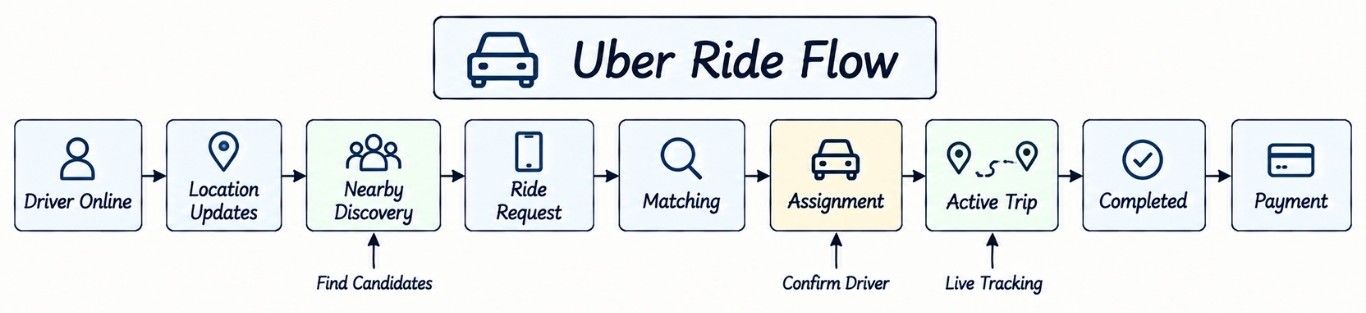
HLD focuses on the distributed architecture, while LLD focuses on internal objects, interfaces, and behavior.
Aspect | High-Level Design (HLD) | Low-Level Design (LLD) |
|---|---|---|
Focus | Distributed architecture | Classes and behavior |
Examples | Ride, Matching, Location services | Ride, Driver, Payment objects |
Key concerns | Scale, storage, communication, failures | States, methods, interfaces |
Goal | Explain how the system works at scale | Explain internal implementation |
For an Uber-like system:
HLD
├── Ride Service
├── Location Service
├── Matching Service
├── Geospatial Index
├── ETA / Pricing
├── Real-Time Gateway
└── Payment + Events
LLD may model objects such as Ride, Driver, Vehicle, Payment, RideStatus, and DriverStatus, with explicit state-transition rules.
For example:
Ride

request()
assignDriver()
driverArrived()
start()
complete()
cancel()
In a system design interview, focus on HLD first. Move into class-level LLD only when the interviewer specifically asks for it.
A good system design evolves as traffic, geographic scale, and operational requirements increase.
Stage | Architecture Change | Why |
|---|---|---|
Small Scale | Backend + relational DB with spatial support | Keep the initial system simple |
Growing Location Traffic | Dedicated Location Service | Isolate high-frequency GPS updates |
Better Discovery | Geospatial index | Find nearby drivers efficiently |
Better Matching | Matching + ETA services | Improve candidate selection |
More Workflows | Event-driven processing | Decouple payments, notifications, and analytics |
Regional Scale | Regional location and matching | Reduce latency and search space |
Global Scale | Multi-region ownership and fault isolation | Support geographic scale and regional failures |
The architecture should become more complex only when scale, reliability requirements, or a concrete bottleneck justifies the additional complexity.
The final architecture separates high-throughput location processing, authoritative ride management, real-time tracking, and asynchronous downstream workflows.
                    RIDER APP
                        ↓
                   API GATEWAY
                        ↓
                  RIDE SERVICE
                  /     |      \
                 ↓      ↓       ↓
             Pricing  Matching  Transactional DB
                        |
                  +-----+-----+
                  |           |
                  ↓           ↓
             Location       ETA Service
              Service
                  ↑
                  |
          Geospatial Index
                  ↑
                  |
          Location Service
                  ↑
          Location Gateway
                  ↑
              DRIVER APP

ACTIVE RIDE TRACKING

Driver Location
      ↓
Location Service
      ↓
Real-Time Gateway
      ↓
Rider App

RELIABLE RIDE EVENTS

Ride Service
      ↓
Transactional DB + Outbox
      ↓
Outbox Publisher
      ↓
Event Bus
  /      |       |      \
 ↓       ↓       ↓       ↓
Payment  Notification  Analytics  Fraud
The architecture has three important responsibilities:
Path | Primary Goal |
|---|---|
Location + Matching | Discover and rank nearby drivers quickly |
Ride Management | Protect assignment and durable trip state |
Async Processing | Handle payments, notifications, analytics, and fraud independently |
The central principle is:
Use a scalable, eventually consistent geospatial system to discover candidate drivers, but use authoritative transactional state to decide who actually owns the ride.
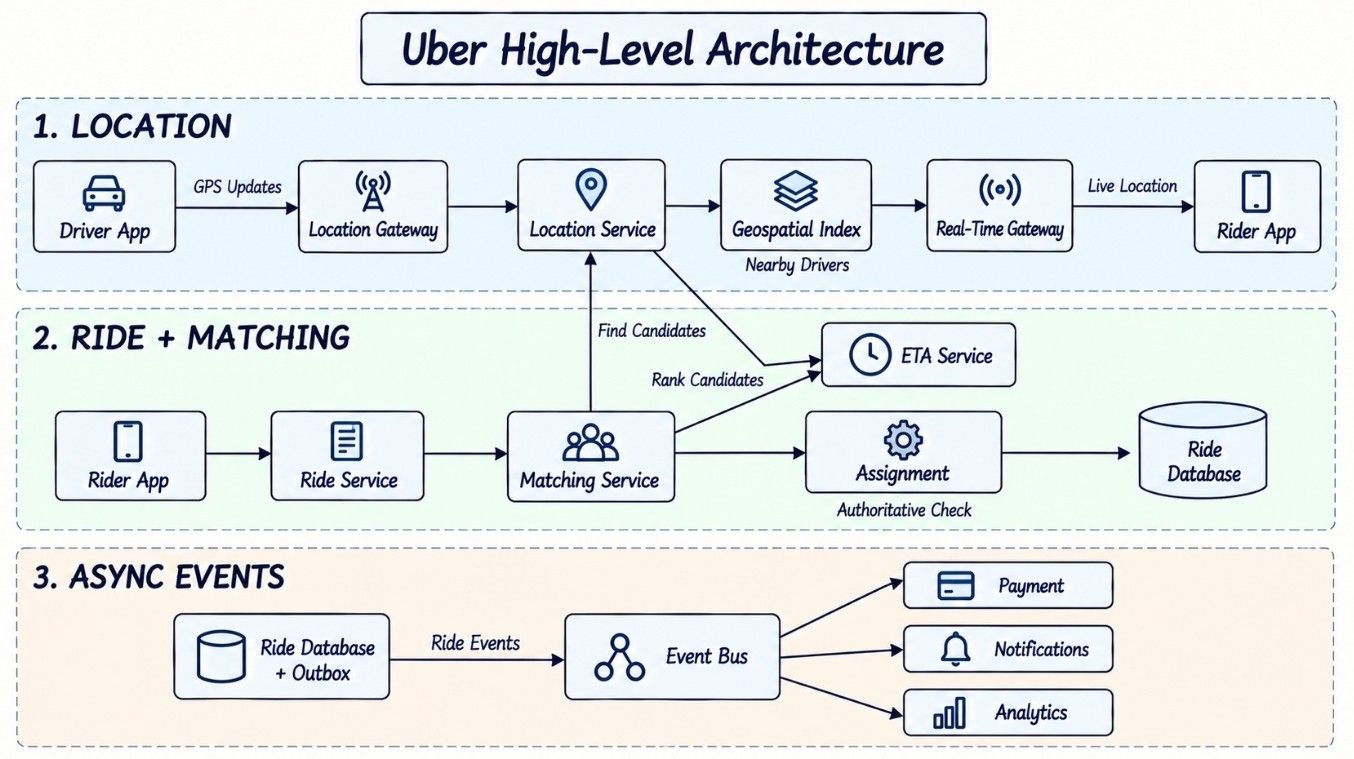
These questions cover the areas interviewers commonly explore after the initial architecture discussion.
Separate high-frequency location tracking from durable ride management. Use a geospatial index for nearby-driver discovery, a Matching Service for candidate selection, transactional state transitions for final assignment, real-time connections for tracking, and asynchronous events for downstream workflows.
Map active drivers into spatial cells. Search the pickup cell and neighboring cells, remove stale or unavailable drivers, and calculate actual distance or ETA for the remaining candidates.
Driver coordinates change far more frequently than normal transactional records. A dedicated location and geospatial system provides a better write and query model for this workload.
Both are reasonable conceptual approaches. Geohashes provide hierarchical cells, while quadtrees can adapt naturally to spatial density. The decision depends on density, boundary handling, query patterns, operational complexity, and scale.
Use an atomic conditional transition or transaction so only one driver can successfully change the ride from an assignable state to MATCHED.
Final assignment must atomically verify both sides: the ride must still be unassigned and the driver must still be available.
Timestamp location updates and use freshness thresholds, TTLs, or heartbeat information. Drivers with stale location data should be excluded from matching.
Straight-line distance ignores traffic, road topology, vehicle eligibility, and other marketplace factors. It is useful for candidate pruning, while ETA is often better for final ranking.
The driver sends location updates to the Location Service, which forwards relevant updates through a real-time gateway to the rider.
Reconnect with backoff and jitter, fetch authoritative current ride state, and then resume live updates. WebSocket delivery should not be the only source of ride truth.
Use a fast location store with geospatial indexing for current positions. Historical location data can use a separate storage pipeline when retention is required.
Geography is a natural first boundary. Route traffic to regional infrastructure and partition location data further using spatial cells or related strategies.
Subdivide dense cells, introduce virtual shards or load-aware partitioning, and avoid assuming every spatial cell should permanently map to one partition.
Aggregate supply and demand signals by geographic and time buckets, then use those aggregates during pricing rather than scanning raw marketplace state for every request.
Require an idempotency key and store its unique association with the created ride. Retries with the same key return the existing ride.
Use stable payment identifiers and provider-supported idempotency. If the outcome is uncertain, check provider status or reconcile it rather than blindly charging again.
Ride events are useful to payments, notifications, analytics, fraud detection, earnings, and other consumers. An event bus allows these workflows to run independently of the critical ride request path.
Use a transactional outbox so the business-state update and pending event are committed atomically.
Usually not across the entire distributed system. At-least-once delivery combined with idempotent consumers and deduplication is a more practical design.
Different workloads have different requirements. Ride assignment and payments benefit from transactional guarantees, while locations, caches, event streams, and analytics may use specialized distributed systems.
Use dedicated location ingestion, geographic partitioning, efficient latest-location storage, geospatial indexing, and asynchronous processing for historical streams.
Release or expire the reservation and continue with another candidate. A late response must not be able to claim an expired offer.
Use clear regional ownership for active rides, preserve durable state, and define explicit failover rules that prevent multiple regions from independently assigning the same ride.
Driver assignment, critical ride transitions, payment state, and other business invariants need stronger correctness. Map markers, analytics, and many aggregate signals can tolerate eventual consistency.
Monitor location freshness, match latency, match success, ETA accuracy, geospatial query latency, ride-state errors, active real-time connections, broker lag, payment errors, and regional availability.
Every major design decision exchanges one system property for another.
Fresh location vs infrastructure cost: More frequent GPS updates improve freshness but consume more battery, bandwidth, and backend capacity.
Nearest vs best driver: Straight-line distance is cheap; accurate ETA and marketplace-aware matching require more computation.
Sequential vs batch dispatch: Sequential dispatch reduces concurrency but can increase match latency. Batch dispatch is faster but needs stronger assignment protection.
Availability vs consistency: Nearby-driver displays can tolerate stale data, while assignment and payment require stronger correctness.
Large vs small spatial cells: Large cells reduce index churn but produce more candidates. Small cells improve precision but increase boundary and partition complexity.
Several mistakes repeatedly weaken Uber system-design answers.
Starting with technologies instead of requirements and bottlenecks
Writing every GPS update into the main transactional database
Searching every driver globally
Querying only the rider's spatial cell and ignoring boundaries
Assuming nearest distance always means lowest ETA
Trusting stale location data during matching
Using WebSocket state as durable ride state
Ignoring concurrency during driver assignment
Forgetting idempotency for rides and payments
Treating caches or geospatial indexes as authoritative assignment state
Uber System Design is fundamentally a combination of high-throughput real-time location processing and correctness-sensitive transactional workflows.
The geospatial system should make nearby-driver discovery fast and scalable. The Matching Service should reduce candidates and choose suitable drivers. But the final assignment must be protected by authoritative state and concurrency controls.
Real-time channels improve the user experience, while durable ride state provides recovery. Event-driven processing keeps payments, notifications, analytics, and fraud systems away from the critical matching path.
The central design principle is simple:
Use fast, approximately fresh data to discover candidates, but use authoritative transactional state to make irreversible business decisions.
