
Durgesh Tiwari
Author
So far, you've learned how computers communicate over a network. But modern applications also need a structured way to process requests, store data, and deliver services. This is where network architectures come in.
A network architecture defines how devices communicate, where data is stored, and how requests are handled.
The two most common architectures are:
Client-Server Architecture
Peer-to-Peer (P2P) Architecture
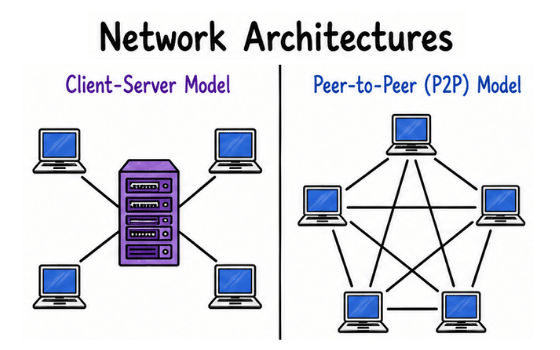
Although both enable communication between devices, they work differently and are designed for different use cases.
Understanding these architectures is important because they are widely used in web applications, cloud computing, distributed systems, and System Design.
The Client-Server Architecture is the most common communication model used in modern applications.
In this model, a client sends a request for data or a service, and a server processes the request before sending back a response.
Instead of storing application data on every user's device, the server manages the data and business logic, while the client is responsible for sending requests and displaying the results.
This separation makes applications easier to manage, secure, update, and scale.
Today, almost every application—such as Google, YouTube, Instagram, Amazon, and online banking apps—uses the Client-Server Architecture.
Modern applications need to serve millions of users while keeping data secure and up to date. Instead of storing data on every user's device, they keep it on centralized servers.
Whenever a user performs an action, the client sends a request to the server, which processes it and returns the required response.
This approach offers several benefits:
Centralized data management
Better security
Easier updates and maintenance
Supports millions of users efficiently
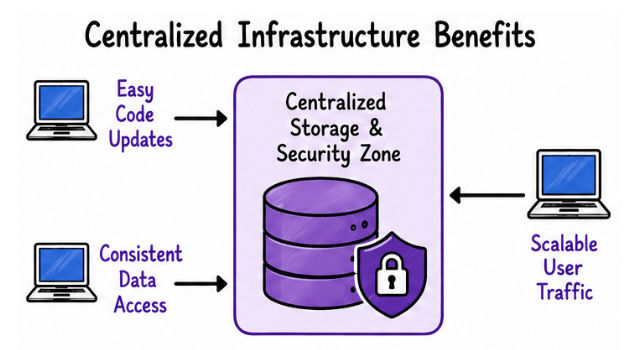
That's why the Client-Server model is used by most modern websites and applications.
A Client-Server Architecture consists of four main components that work together to process user requests and deliver responses.
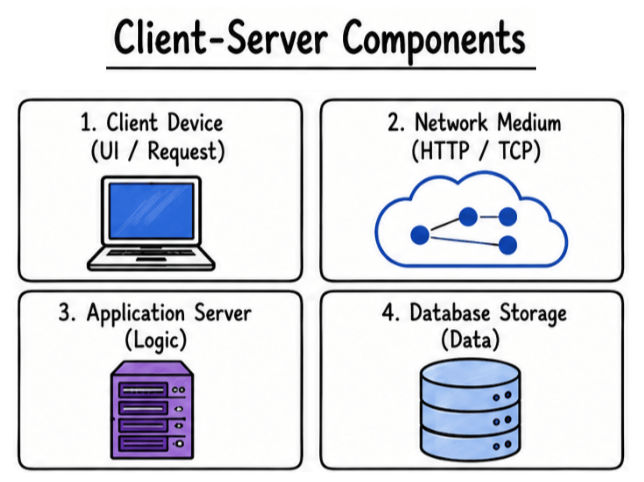
The client is the application or device that users interact with. It sends requests to the server and displays the response.
Common examples include:
Web browsers
Mobile applications
Desktop software
Smart TVs
IoT devices
For example, when you search on Google or open YouTube, your browser or mobile app acts as the client.
The server receives client requests, processes them, and returns the required response.
Depending on the application, a server may:
Run business logic
Authenticate users
Process requests
Access databases
Return API responses
Modern applications often use multiple servers to handle large numbers of users efficiently.
A database stores the application's data, such as user accounts, products, orders, messages, and media files.
When a client requests information, the server reads data from the database or updates it before sending the response.
The network enables communication between the client and the server.
It carries requests and responses using networking protocols such as HTTP, HTTPS, TCP, and IP, allowing applications to communicate over the internet.
Let's see how the Client-Server Architecture works when you log in to an application.
You enter your email and password.
The client sends the login request to the server.
The server validates the credentials.
It retrieves the user information from the database.
If the login is successful, the server generates a session or authentication token.
The server sends the response back to the client.
The application displays your dashboard.
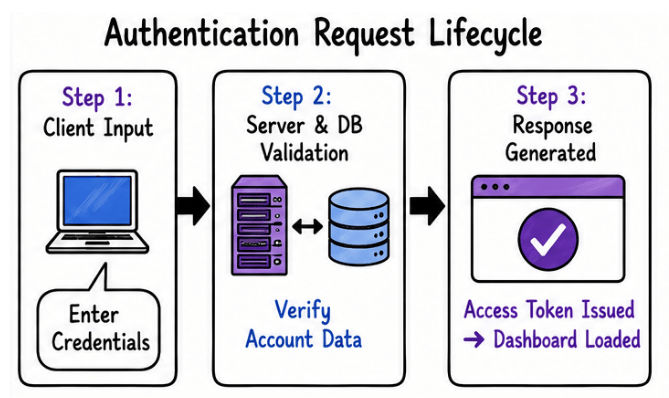
The same request-response flow is used when you search, upload a file, place an order, or send a message.
The Client-Server model is widely used because it offers several benefits:
Centralized data management
Better security and access control
Easier application updates and maintenance
Supports millions of users
Easy to monitor and troubleshoot
Scales by adding more servers when needed
These advantages make it the preferred architecture for web applications, cloud platforms, and enterprise systems.
Although the Client-Server model is widely used, it also has some challenges:
Heavy traffic can overload the server.
If the server fails, the application may become unavailable.
Scaling large systems requires additional infrastructure.
High availability increases development and operational costs.
Modern technologies such as Load Balancers, Caching, CDNs, and Microservices help address these limitations.
The Client-Server Architecture is used in applications where multiple users need to access centralized services and data.
Common examples include:
Websites
Mobile applications
E-commerce platforms
Banking systems
Social media platforms
Email services
Cloud applications
Video streaming platforms
Online gaming services
Interview Tip: A common interview question is, "Why is Client-Server Architecture widely used?"
A concise answer is:
Centralized data management
Better security
Easier maintenance
Supports scalable applications
Unlike the Client-Server model, a Peer-to-Peer (P2P) Architecture allows devices to communicate directly with each other instead of relying on a central server.
In a P2P network, every connected device is called a peer. Each peer can both request resources from other peers and share its own resources, making every device act as both a client and a server.
Because there is no single central server, the workload is distributed across all participating peers. This makes P2P suitable for applications that require decentralized communication and resource sharing.
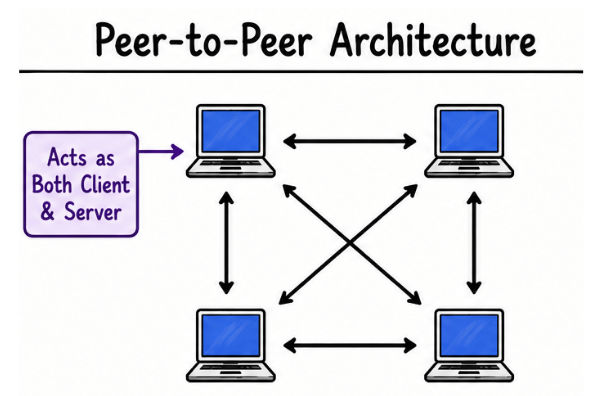
Some applications need to share resources among many users without depending on a single server.
For example, if thousands of users download the same file from one server, it can become overloaded. In a P2P network, users also share the downloaded data with others, reducing the load on any single device and improving resource distribution.
This decentralized approach is commonly used in file-sharing systems and blockchain networks.
A typical P2P communication works as follows:
A device joins the P2P network.
It discovers other available peers.
It requests data from one or more peers.
Multiple peers share different parts of the required data.
The device can also share its own data with other peers.
By exchanging data directly between devices, the network distributes the workload instead of relying on a single central server.
In a Pure P2P network, all peers communicate directly with each other without any central server.
Every peer has equal responsibility and can both request and share resources, making the network fully decentralized.
A Hybrid P2P network combines the Client-Server and Peer-to-Peer models.
A central server helps peers discover each other, while the actual data transfer takes place directly between peers.
This approach provides centralized coordination with the efficiency of peer-to-peer communication, making it common in modern file-sharing applications.

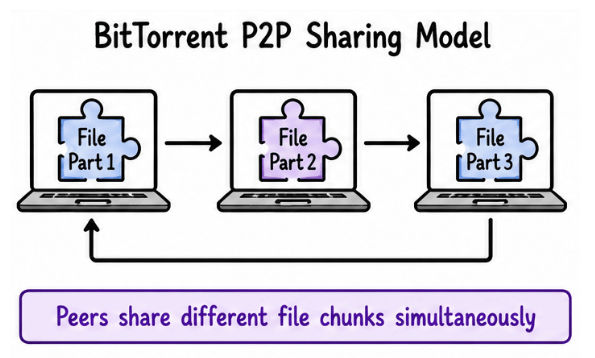
BitTorrent is one of the most popular examples of a P2P network.
Instead of downloading a file from a single server, users download different parts of the file from multiple peers simultaneously. As they download, they also share those parts with other peers.
This improves download speed and distributes the workload across the network.
Blockchain networks such as Bitcoin and Ethereum also use a Peer-to-Peer architecture.
Each node stores a copy of the blockchain and communicates directly with other nodes to verify and share transactions, creating a decentralized and fault-tolerant network.
The P2P model offers several benefits:
No single point of failure
Better resource sharing
Lower infrastructure cost
Distributed workload
Easy to expand as more peers join
Suitable for decentralized applications
Despite its benefits, P2P also has some limitations:
More difficult to manage
Harder to secure
Performance depends on active peers
Maintaining data consistency is more challenging
Troubleshooting can be complex
Because of these challenges, most web and business applications use the Client-Server model instead of a pure P2P architecture.
Feature | Client-Server | Peer-to-Peer (P2P) |
|---|---|---|
Communication | Through a central server | Directly between peers |
Central Server | Required | Not required (optional in Hybrid P2P) |
Data Storage | Centralized | Distributed |
Resource Sharing | Managed by the server | Shared by all peers |
Security | Easier to manage | More challenging |
Management | Simpler | More complex |
Scalability | Scales by adding servers | Improves as more peers join |
Performance | Depends on server capacity | Depends on participating peers |
Common Examples | Google, YouTube, Amazon, Netflix | BitTorrent, Bitcoin, Ethereum |
Choose Client-Server Architecture when you need:
Centralized data and control
Better security
Easy management and maintenance
Applications serving large numbers of users
Choose Peer-to-Peer Architecture when you need:
Direct communication between devices
Resource sharing among peers
Decentralized systems
Distributed workloads
Both architectures are widely used in System Design, and understanding them makes many advanced topics easier to learn.
For example:
APIs use the Client-Server model.
Microservices communicate using Client-Server principles.
Load Balancers distribute requests across multiple servers.
Cloud applications are built on Client-Server Architecture.
Blockchain and decentralized applications use Peer-to-Peer Architecture.
As you continue learning System Design, you'll see these architectures used repeatedly in real-world system designs.
