
Durgesh Tiwari
Author
As an application grows, the amount of data and the number of user requests also increase. A single database server may eventually struggle to store all the data or process every request efficiently. This can lead to slow performance, limited storage, and a higher risk of downtime.
Data Distribution solves this problem by storing data across multiple database servers instead of relying on a single server. By sharing both data and workload, applications become more scalable, reliable, and highly available. Large platforms such as Amazon, Netflix, Google, and Facebook use data distribution to manage billions of records and serve millions of users every day.
As applications continue to grow, their databases must store more information and handle a larger number of requests. Keeping all the data on a single server can create performance bottlenecks and make the system difficult to scale.
Data Distribution spreads data across multiple servers, allowing the workload to be shared efficiently. This improves database performance and helps the application remain stable as traffic and data continue to grow.
Data Distribution provides several benefits for modern applications.
Improves Scalability – Makes it easier to support more users and larger datasets.
Increases System Availability – The application can continue running even if one database server becomes unavailable.
Reduces Server Load – Data and requests are distributed across multiple servers instead of relying on a single database.
Handles Large Volumes of Data – Supports applications that store millions or even billions of records.
Improves Query Performance – Queries are processed more efficiently because the workload is shared.
Provides Fault Tolerance – Reduces the impact of hardware failures by distributing data across multiple servers.
Supports High User Traffic – Enables applications to serve a large number of users without affecting performance.
Modern distributed databases use different Data Distribution techniques to improve performance, reliability, and scalability while handling large-scale applications efficiently.
As an application grows, keeping data on only one database server can be risky. If that server fails, users may not be able to access the application. To avoid this problem, modern applications keep multiple copies of the same data on different database servers.
Data Replication is the process of creating and maintaining multiple copies of the same data across different database servers. If one server becomes unavailable, another server with the same data can continue serving requests. This improves availability, reliability, and fault tolerance.
In simple words, Data Replication means storing the same data on multiple database servers so the application remains available even if one server fails.
Data Replication follows a simple process:
A user updates or adds data to the Primary Database.
The primary database stores the new data.
The updated data is automatically copied to one or more Replica Databases.
Read requests can be served by the replica databases.
If the primary database becomes unavailable, a replica can continue serving users.
Suppose an e-commerce application has one Primary Database and two Replica Databases.
When a new product is added, the primary database saves the product details and automatically copies the same data to both replica databases. If the primary database fails, one of the replica databases can continue serving user requests, helping the application remain available.
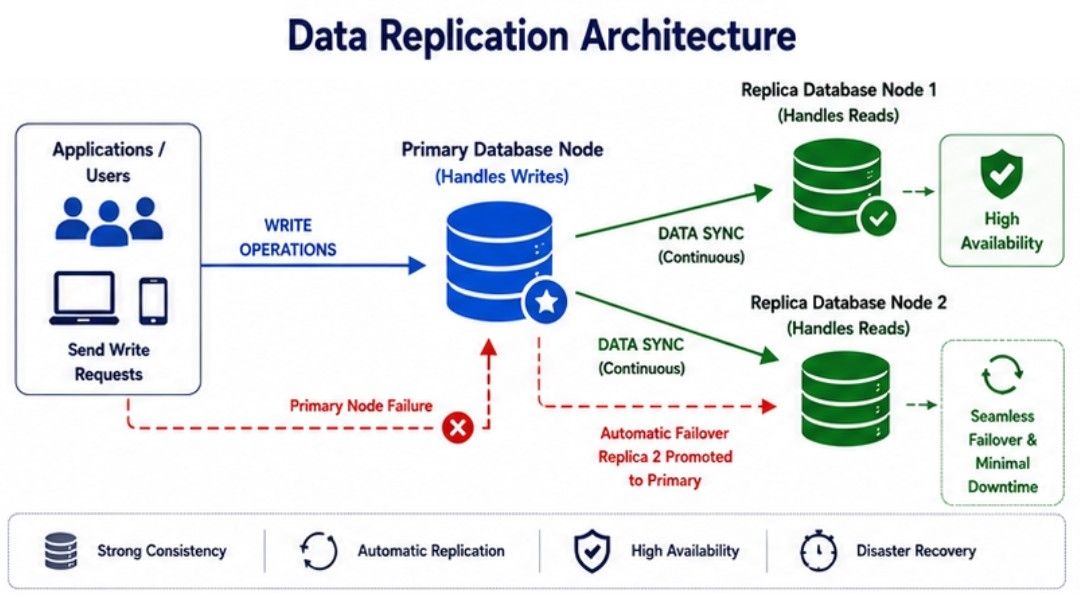
Data Replication provides several benefits for distributed database systems.
Improves High Availability – Data remains accessible even if one database server fails.
Provides Fault Tolerance – Reduces the impact of hardware or server failures.
Supports Disaster Recovery – Backup copies of data help restore the system after failures.
Improves Read Performance – Read requests can be distributed across replica databases.
Reduces Downtime – Applications continue running even during server maintenance or unexpected failures.
Although Data Replication improves reliability, it also has some limitations.
Data Synchronization May Be Delayed – Changes made on the primary database may take a short time to reach the replicas.
Requires More Storage – Multiple copies of the same data increase storage requirements.
Adds Infrastructure Complexity – Managing multiple database servers requires additional configuration and monitoring.
Maintaining Data Consistency Can Be Challenging – All replicas must stay synchronized to ensure users receive the latest data.
As the amount of data grows, storing everything in a single database or on one server can reduce performance and make the system harder to scale. Large tables also take longer to query and manage.
Data Partitioning is a technique that divides a large dataset into smaller parts called partitions. Each partition stores only a portion of the total data, making the database easier to manage and improving overall performance.
In simple words, Data Partitioning divides a large dataset into smaller parts so the database can handle data more efficiently.
Data Partitioning follows a simple process:
A large dataset is divided into multiple partitions.
Each partition stores a specific portion of the data.
Every partition is managed independently.
When a query is received, the database accesses only the relevant partition instead of searching the entire dataset.
This reduces the amount of data scanned and improves query performance.
Suppose a customer database contains 30 million records.
Instead of storing all records on one server:
Server 1: Customer IDs 1–10 million
Server 2: Customer IDs 10–20 million
Server 3: Customer IDs 20–30 million
Each server stores and manages only its assigned data, making the workload more balanced.
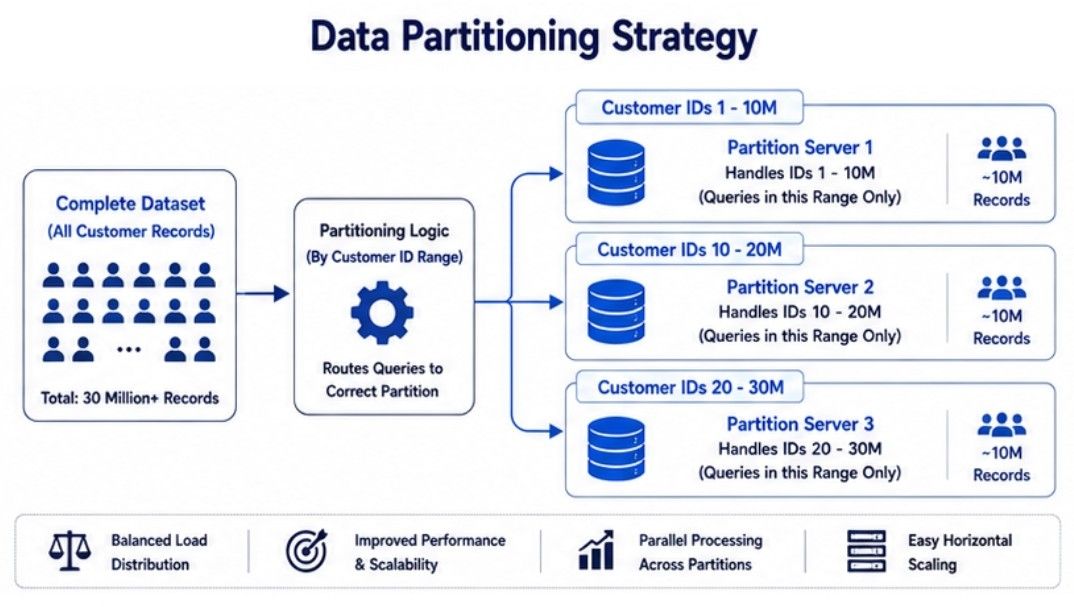
Data Partitioning provides several benefits for large database systems.
Supports Large Databases – Makes it easier to manage millions or billions of records.
Improves Query Performance – Queries access only the required partition instead of the entire dataset.
Reduces Server Load – The workload is distributed across multiple partitions.
Supports Horizontal Scaling – New servers can be added as the amount of data grows.
Simplifies Data Management – Smaller partitions are easier to maintain and optimize.
Although Data Partitioning improves scalability, it also has some limitations.
Cross-Partition Queries Can Be Slower – Queries that access multiple partitions are more complex.
Data Rebalancing Is Required – Partitions may need to be redistributed when new servers are added.
Adds Operational Complexity – Managing multiple partitions requires careful planning and monitoring.
Backup and Recovery Become More Complex – Each partition must be backed up and restored correctly.
In distributed systems, servers are added or removed as traffic changes. If all the data has to be redistributed every time the number of servers changes, the process becomes slow and can affect application performance.
Consistent Hashing is a data distribution technique that spreads data across multiple servers while minimizing data movement when servers are added or removed. Instead of moving all the data, only a small portion is reassigned to the affected server.
In simple words, Consistent Hashing distributes data efficiently and moves only the necessary data when the server configuration changes.
Consistent Hashing follows a simple process:
Data is distributed across multiple servers using a hashing algorithm.
Each server is responsible for storing a specific range of data.
When a new server is added, only a small portion of the data is moved to that server.
When a server is removed, only the data stored on that server is redistributed to the remaining servers.
Most of the existing data remains on the same servers, reducing unnecessary data movement.
Suppose a distributed cache stores user sessions across four servers.
When a fifth server is added, Consistent Hashing moves only the user sessions that belong to the new server. The remaining data stays on the existing servers, allowing the system to scale without redistributing all cached data.
Consistent Hashing provides several benefits for distributed systems.
Reduces Data Movement – Only a small portion of data is moved when servers are added or removed.
Makes Scaling Easier – New servers can be added without redistributing the entire dataset.
Improves Load Distribution – Data is spread more evenly across available servers.
Supports Dynamic Infrastructure – Handles server additions and removals with minimal disruption.
Widely Used in Distributed Systems – Commonly used in distributed caches, databases, and storage systems.
Although Consistent Hashing improves scalability, it also has some limitations.
More Complex to Implement – The hashing mechanism is more advanced than simple data distribution methods.
Load May Not Always Be Even – Additional techniques, such as virtual nodes, are often needed for better load balancing.
Requires Careful Configuration – Poor configuration can lead to uneven data distribution across servers.
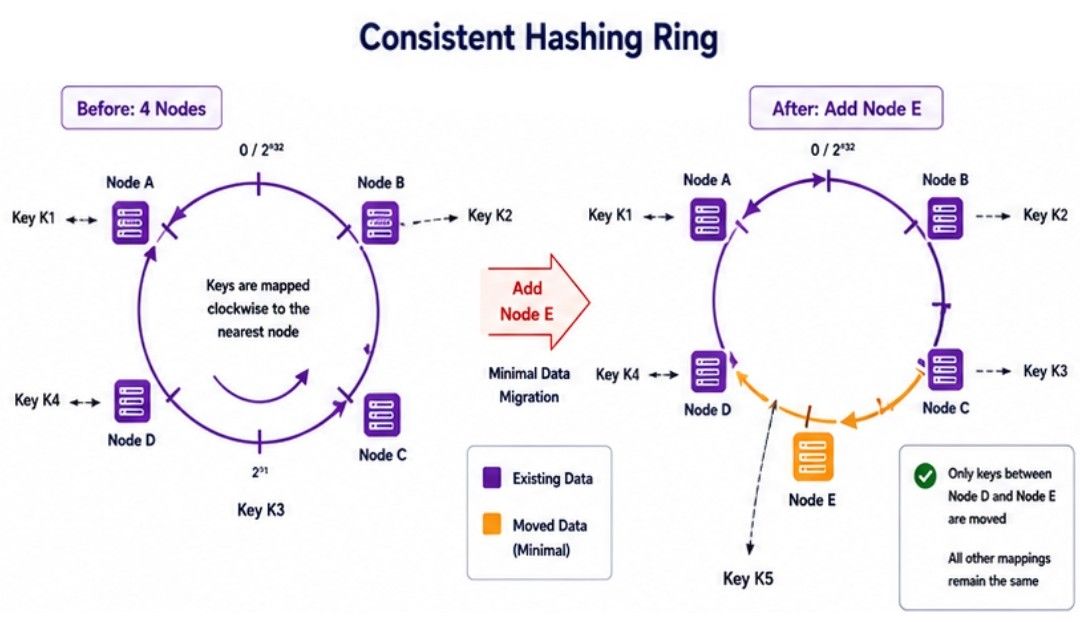
Data Replication | Data Partitioning |
|---|---|
Stores the same data on multiple database servers. | Stores different parts of the data on different database servers. |
Improves availability and fault tolerance. | Improves scalability and storage capacity. |
Primarily improves read performance by using replica servers. | Improves both read and write performance by distributing the workload. |
Requires additional storage because multiple copies of the data are maintained. | Uses storage more efficiently because each server stores only a portion of the data. |
Best suited for high availability, disaster recovery, and read-heavy applications. | Best suited for large datasets, high traffic, and write-intensive applications. |
In modern distributed systems, Data Replication and Data Partitioning are often used together. Partitioning distributes the workload across multiple servers, while Replication keeps copies of the data available to improve reliability and ensure the application remains accessible even if a server fails.
In distributed systems, data is often stored on multiple servers located in different regions. If users always access data from a distant server, network delays can increase and the application may become slower.
Data Locality is the practice of storing data close to the users or services that access it most frequently. By reducing the distance between the application and the data, the system can deliver faster responses and better overall performance.
In simple words, Data Locality means storing data near the users or applications that use it most often.
Data Locality follows a simple process:
The system identifies where users or services access the data most frequently.
The data is stored or replicated in a nearby data center or server.
User requests are routed to the closest available server.
The nearby server returns the requested data with lower network delay.
Users experience faster response times and smoother application performance.
Suppose a video streaming platform serves users around the world.
Instead of storing all videos in one country, the platform keeps copies of popular videos in data centers across different regions. A user in India receives videos from a nearby server instead of a server located in another country. This reduces loading time and provides a smoother streaming experience.
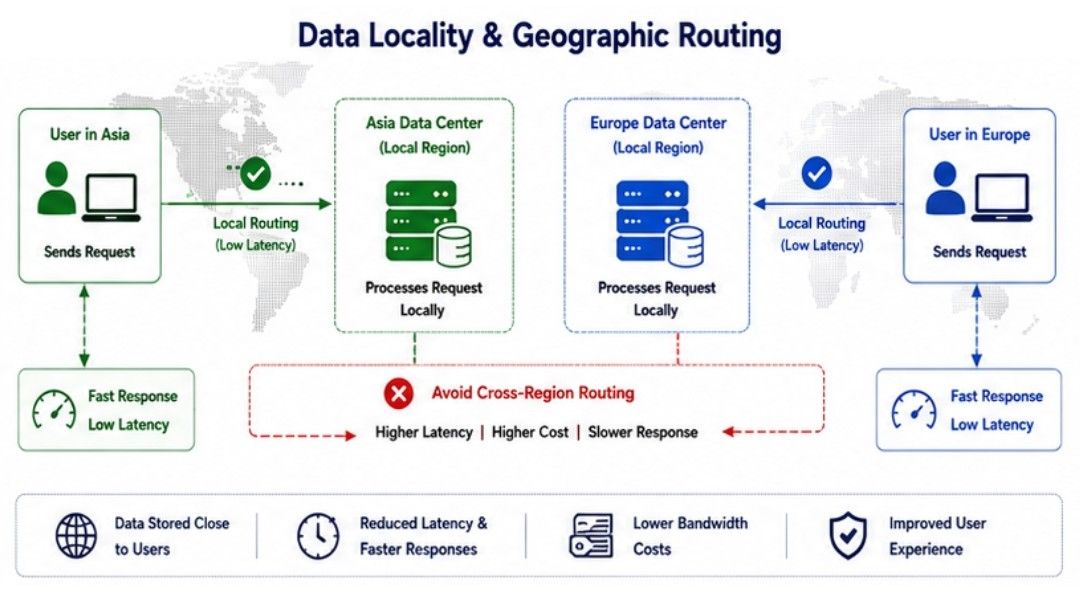
Data Locality provides several benefits for distributed applications.
Reduces Network Latency – Data travels a shorter distance, resulting in faster communication.
Improves Response Time – Users receive data more quickly from nearby servers.
Enhances User Experience – Faster loading improves the overall application experience.
Reduces Cross-Region Traffic – Less data travels across long-distance networks.
Improves System Performance – Nearby data access helps applications handle user requests more efficiently.
Although Data Locality improves performance, it also has some limitations.
Requires Additional Storage – Popular data may need to be stored in multiple locations.
Data Synchronization Can Be Challenging – Copies of data must remain consistent across different regions.
Increases Infrastructure Costs – Maintaining multiple regional servers requires additional resources.
Consider an e-commerce platform that serves millions of customers every day.
As the customer base grows, the platform uses Data Partitioning to divide customer records across multiple database servers based on customer IDs. This allows the database to handle large amounts of data and high traffic more efficiently.
To ensure high availability, each partition is protected using Data Replication. If one database server becomes unavailable, its replica can continue serving user requests without interrupting the application.
The platform also uses Consistent Hashing to distribute cached user sessions across multiple Redis servers. When new cache servers are added or existing ones are removed, only a small portion of the cached data is moved, making the system easier to scale.
To improve user experience, product images, banners, and other static content are stored in data centers close to users using Data Locality. This reduces network latency and helps pages load faster.
By combining Data Replication, Data Partitioning, Consistent Hashing, and Data Locality, the platform can efficiently manage large datasets, handle millions of user requests, and deliver fast, reliable, and highly available services.
Data Distribution is an important concept in System Design because it helps applications store and manage data across multiple servers instead of relying on a single database. This improves scalability, performance, availability, and reliability, allowing modern applications to handle large amounts of data and high user traffic.
The key concepts covered in this chapter include:
Data Distribution spreads data across multiple servers to improve performance and support application growth.
Data Replication stores multiple copies of the same data to improve availability, fault tolerance, and disaster recovery.
Data Partitioning divides large datasets into smaller partitions, making databases easier to scale and manage.
Consistent Hashing distributes data efficiently and minimizes data movement when servers are added or removed.
Data Locality stores data closer to users or applications to reduce network latency and improve response time.
Modern distributed systems often combine these techniques to build applications that are fast, scalable, and highly available.
