
Durgesh Tiwari
Author
Designing an Amazon-like e-commerce platform is a classic system design problem because it combines different workloads: product discovery, search, shopping carts, inventory, checkout, payments, orders, fulfillment, reviews, and recommendations.
The key challenge is that these workflows require different consistency guarantees.
Product descriptions, search results, recommendations, and review counts can tolerate brief staleness. But overselling inventory, creating duplicate orders, or charging a customer twice are correctness failures.
Scope: This is a conceptual Amazon-like e-commerce architecture for system design interviews. It does not describe Amazon's private production architecture.
At a high level, an e-commerce platform helps customers discover products and safely complete purchases.
Customer
   ↓
Browse / Search
   ↓
Product Details
   ↓
Add to Cart
   ↓
Checkout
   ↓
Reserve Inventory
   ↓
Create Order
   ↓
Process Payment
   ↓
Confirm Order
   ↓
Fulfillment
The main systems involved are:
Catalog
Search
Pricing
Cart
Inventory
Checkout
Orders
Payments
Fulfillment
Reviews
Recommendations
Notifications
The core transaction is:
Find a product → add it to the cart → safely reserve inventory → create a durable order → process payment.
The platform should support the core customer shopping journey.
Browse and search products.
View product details, prices, and availability.
Add, update, and remove cart items.
Checkout with shipping and payment information.
Place and pay for orders.
Track and cancel eligible orders.
View order history.
Support returns and refunds.
Marketplace extensions can include third-party sellers, reviews, wishlists, recommendations, coupons, and multiple warehouses.
The system should scale read-heavy workloads while protecting correctness-critical operations.
High availability and low browse/search latency.
High read scalability.
Correct inventory reservation.
Reliable and idempotent checkout and payments.
Durable order state.
Horizontal scalability and fault isolation.
Security and auditability.
Different workflows require different consistency guarantees:
Search / Recommendations / Reviews
→ Eventual consistency is usually acceptable

Inventory / Orders / Payments
→ Stronger correctness guarantees are requiredHypothetical numbers help identify the dominant workloads and potential bottlenecks.
Metric | Estimate |
|---|---|
Daily active users | 100 million |
Product views/user/day | 20 |
Searches/user/day | 5 |
Cart modifications/user/day | 2 |
Orders/day | 5 million |
Product views:
100M × 20
= 2 billion product views/day
≈ 23,000 reads/sec average
Searches:
100M × 5
= 500 million searches/day
≈ 5,800 searches/sec average
Orders:
5M / 86,400
≈ 58 orders/sec average
Peak traffic can be several times higher, especially during major sales and flash-sale events.
The system is massively read-heavy, while checkout has lower volume but much stricter correctness requirements.
The architecture separates read-heavy product discovery from correctness-heavy purchasing.
                         CUSTOMER
                            ↓
                       API GATEWAY
                            ↓
          +-----------------+-----------------+
          |          |          |            |
          ↓          ↓          ↓            ↓
       Catalog     Search      Cart       Checkout
       Service     Service    Service      Service
          ↓          ↓          ↓          |
     Catalog DB  Search Index Cart DB      |
                                           ↓
                                      Pricing Service
                                           ↓
                                     Inventory Service
                                           ↓
                                       Order Service
                                           ↓
                                      Payment Service
                                           ↓
                                        Order DB
Asynchronous workflows are decoupled:
Order Events
     ↓
Event Bus
  /    |        |          \
 ↓     ↓        ↓           ↓
Fulfillment  Notifications  Analytics  Recommendations
Optional systems should not unnecessarily block checkout.
A product contains common descriptive information.
Product
-------
product_id
title
description
brand
category_id
attributes
status
However, a product is not always the actual purchasable unit.
For example:
Phone
 ├── Black / 128 GB
 ├── White / 128 GB
 └── Black / 256 GB
Each purchasable variation is a SKU.
SKU
---
sku_id
product_id
attributes
Inventory and pricing normally operate at the SKU level.
For a marketplace, introduce an Offer:
Offer
-----
offer_id
sku_id
seller_id
price
condition
fulfillment_type
status
Multiple sellers can therefore sell the same SKU with different prices and fulfillment options.
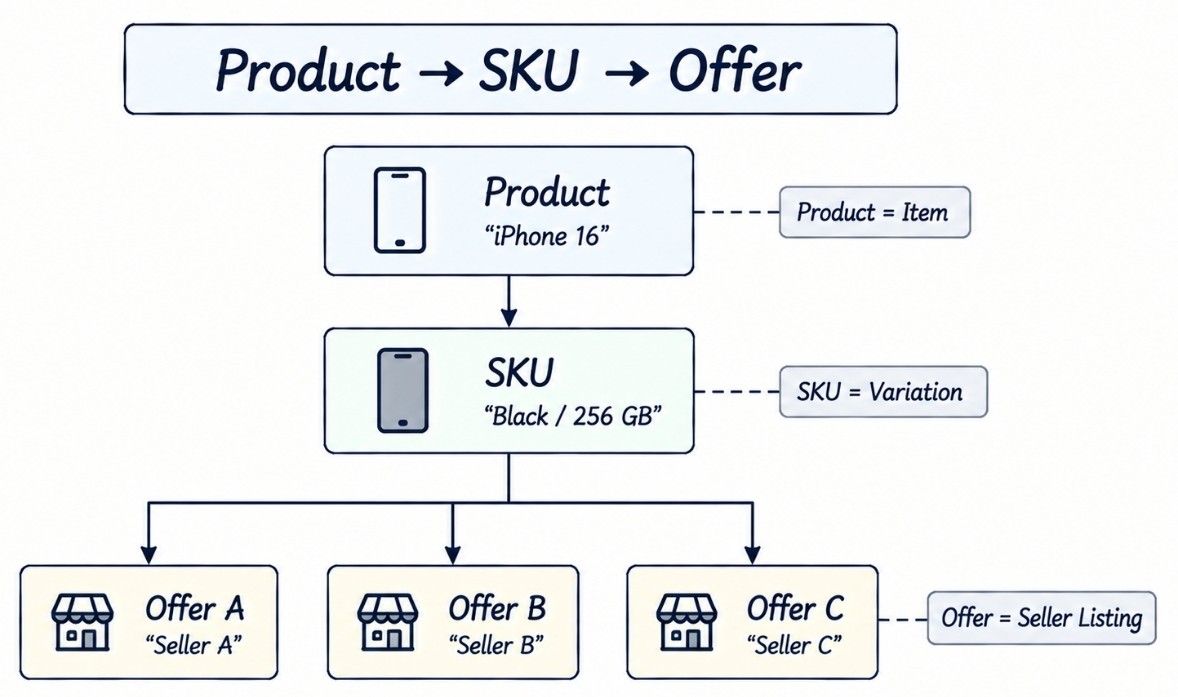
An e-commerce platform separates Product, SKU, and Offer because each represents a different level of what the customer sees and buys.
Product
   ↓
SKU
   ↓
Offer
Concept | What It Represents | Example | Mainly Used For |
|---|---|---|---|
Product | General information shared across variants | iPhone 16 | Title, description, brand, category, images |
SKU | A specific purchasable variation of the product | iPhone 16, Black, 256 GB | Variant identification and inventory |
Offer | A seller's listing for a particular SKU | Seller A → ₹80,000 | Seller, price, condition, fulfillment |
For example, one product can have multiple SKUs:
iPhone 16
   ├── Black / 128 GB
   ├── Black / 256 GB
   └── White / 256 GB
In a marketplace, the same SKU can also have multiple seller offers:
Black / 256 GB
   ├── Seller A → ₹80,000
   ├── Seller B → ₹79,500
   └── Seller C → ₹81,000
So the relationship is:
Product = what the item is → SKU = which variation → Offer = who is selling that variation and under what terms.
This separation allows catalog, inventory, pricing, and seller systems to evolve independently.
Catalog Service owns structured product information such as title, description, brand, category, attributes, images, and variants.
A typical API is:
GET /v1/products/{product_id}Conceptual response:
{
  "product_id": "P123",
  "title": "Wireless Headphones",
  "brand": "Example",
  "variants": []
}
Catalog data is read far more frequently than it changes, making it highly cacheable.
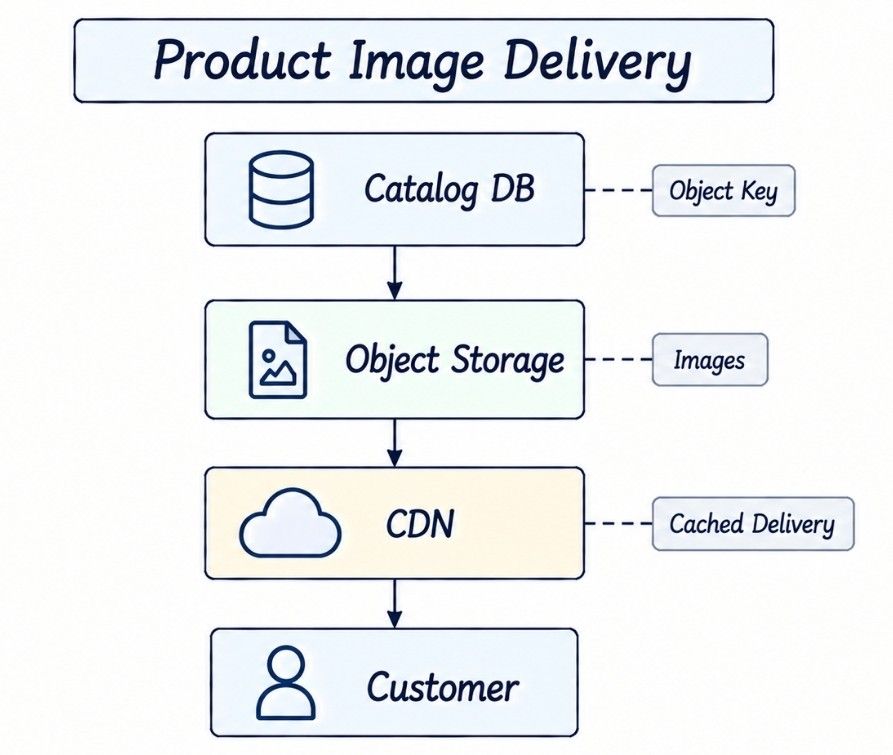
Product images should be stored in object storage rather than directly in the database.
Catalog DB
    ↓
Image Metadata / Object Key
    ↓
Object Storage
    ↓
CDN
    ↓
Customer
The database stores image metadata and object references, while object storage stores the actual images. A CDN delivers images closer to customers for faster loading and reduced backend load.
Database = metadata, Object Storage = images, CDN = fast delivery.
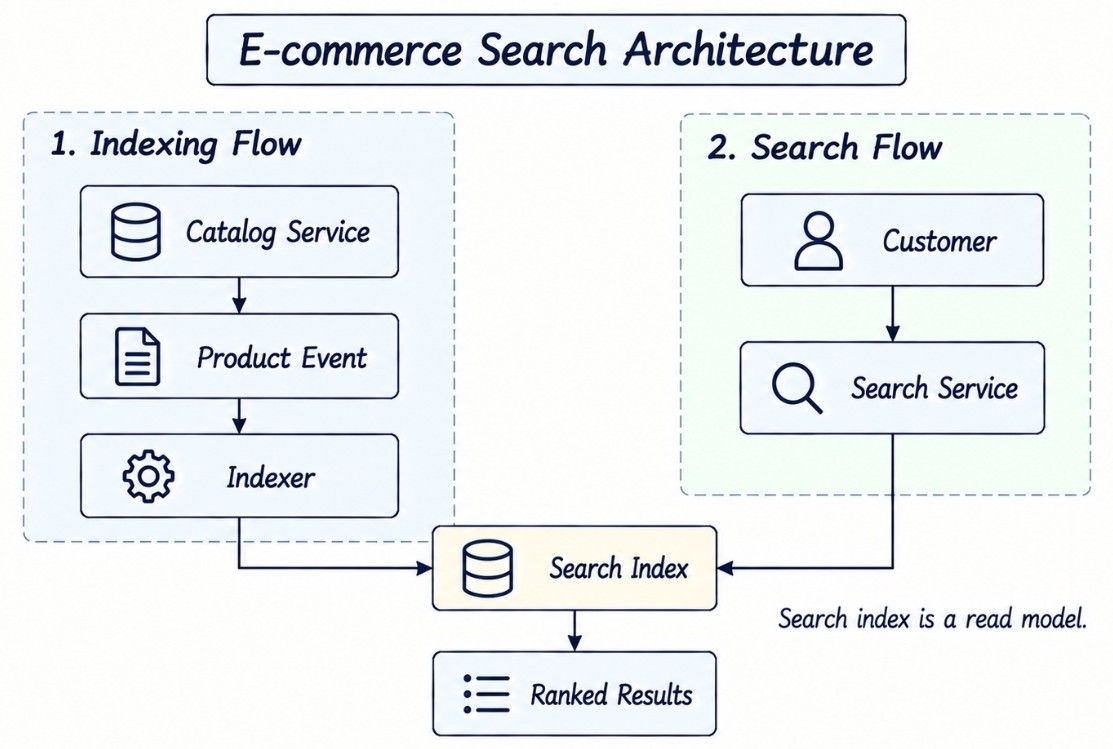
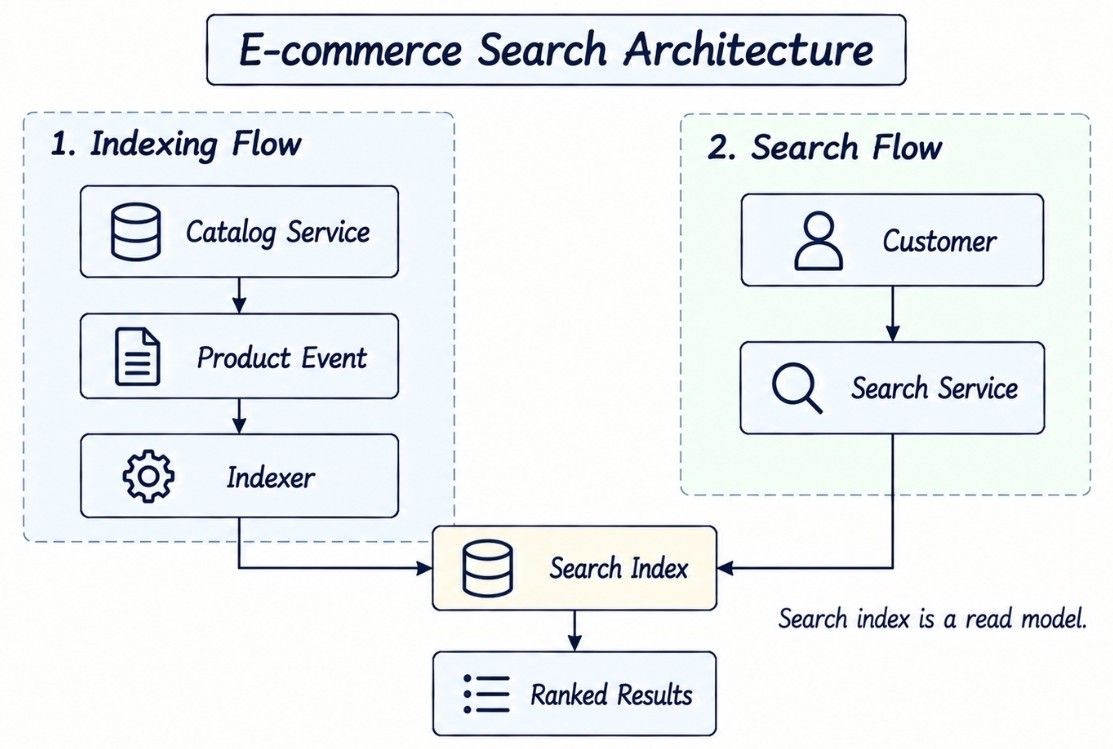
Search is a specialized read workload and should not depend on expensive full-text queries against the primary catalog database.
Catalog Change
      ↓
Change Event
      ↓
Search Indexer
      ↓
Search Index
The index can contain:
Title and description.
Brand and category.
Attributes and keywords.
Availability signals.
Price ranges.
Popularity and ranking signals.
Search therefore becomes an optimized read model derived from authoritative catalog data.
Suppose a seller changes a product title:
Catalog Updated
      ↓
Indexing Event
      ↓
Search Index Updated
For a short period:
Product API → New Title
Search      → Old Title
This brief inconsistency is usually acceptable.
Search should not be treated as the authoritative catalog database.
Search ranking can consider:
Query
 ↓
Candidate Retrieval
 ↓
Filtering
 ↓
Ranking
 ↓
Top K Products
Signals may include text relevance, availability, price, popularity, ratings, delivery speed, conversion signals, personalization, and seller quality.
A product page may need information from several services.
Information | Source |
|---|---|
Product details | Catalog |
Price | Pricing |
Availability | Inventory |
Reviews | Review Service |
Delivery estimate | Fulfillment |
Recommendations | Recommendation Service |
Instead of making the frontend coordinate many independent backend calls, a Product Page Service or BFF can aggregate them.
Client
  ↓
Product Page Service
  ├── Catalog
  ├── Pricing
  ├── Inventory
  ├── Reviews
  └── Recommendations
Dependencies should be classified as critical or optional. Recommendation failure, for example, should not prevent the product page from loading.
Catalog information is an excellent caching candidate.
Catalog Service
      ↓
    Cache
   /     \
 HIT     MISS
 ↓         ↓
Return   Catalog DB
Good cache candidates include product metadata, categories, seller metadata, and popular products.
Dynamic data such as inventory requires more care.
A cached In Stock label is useful for display, but checkout must still perform an authoritative inventory reservation.
The cart represents the customer's current purchase intent.
Typical APIs:
GET /v1/cart
POST /v1/cart/items
PATCH /v1/cart/items/{sku_id}
DELETE /v1/cart/items/{sku_id}
A simplified model:
Cart
----
cart_id
user_id
updated_at

CartItem
--------
sku_id
quantity
added_at
The most important rule is:
Adding an item to the cart normally does not reserve inventory.
If the last item were permanently reserved whenever someone added it to a cart, abandoned carts could prevent real customers from purchasing it.
Therefore:
Cart
≠
Inventory Reservation
Availability must be validated again during checkout.
Cart access is commonly keyed by user_id, making it a natural partition key.
A fast distributed key-value or document store can work well, but cart state should not automatically be treated as disposable cache data.
Users often expect their carts to survive restarts and remain available across devices.
An anonymous user's cart may later need to merge with their account cart.
Guest Cart
    +
Account Cart
    ↓
   Merge
Conflicts can include the same SKU, different quantities, changed prices, or unavailable products.
The exact merge policy is a product decision.
Pricing can vary by SKU, seller, region, promotions, coupons, customer eligibility, and currency.
The cart may store a price snapshot for display, but checkout should revalidate the current authoritative price unless a price lock is guaranteed.
Cart Price
→ Display Snapshot

Checkout Price
→ Authoritative Price
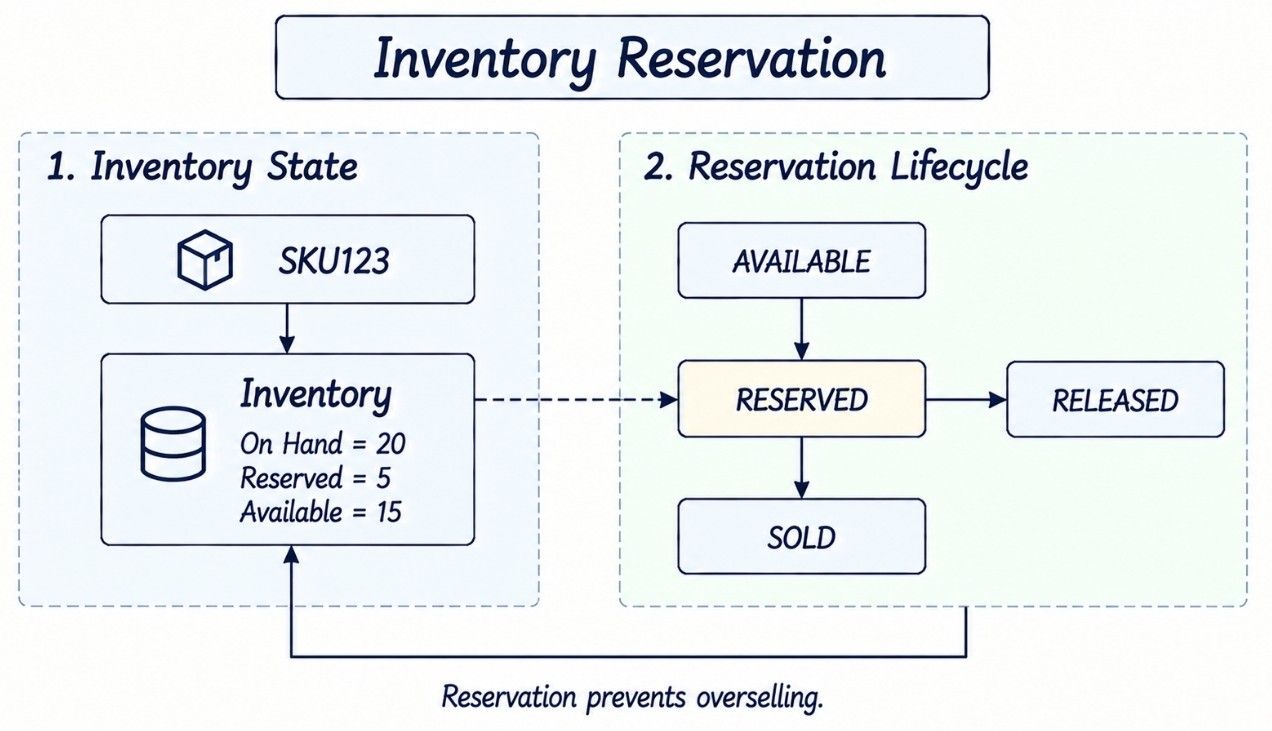
Inventory tracks available and reserved stock for each SKU, often across multiple warehouses.
Inventory
---------
sku_id
warehouse_id
on_hand
reserved
available = on_hand - reservedAt scale, the same SKU may exist in multiple fulfillment locations:
SKU123
 ├── Warehouse A → 10
 ├── Warehouse B → 7
 └── Warehouse C → 3
The system can select inventory based on availability, customer location, delivery time, and fulfillment cost.
Suppose only one unit remains and two customers attempt checkout simultaneously.
Customer A ──┐
             ├── Last Unit
Customer B ──┘
A naive read-then-write approach can allow both customers to observe stock as available.
Use an atomic conditional reservation instead.
UPDATE inventory
SET reserved = reserved + 1
WHERE sku_id = ?
  AND on_hand - reserved >= 1;
Only a successful reservation proceeds.
Optimistic concurrency or another serialization mechanism can also be used.
The important invariant is:
Never reserve more sellable units than inventory policy permits.
A queue alone does not automatically guarantee this invariant.
Checkout normally creates a temporary reservation.
AVAILABLE
    ↓
RESERVED
    ↓
SOLD
A reservation can contain:
reservation_id
order_id
sku_id
quantity
expires_at
This prevents another checkout from taking the inventory while payment is in progress.
Reservations must be bounded.
Reservation
     ↓
Payment Succeeds?
   /           \
 Yes            No
 ↓              ↓
Commit         Release
Stock          Reservation
If the customer disappears or payment permanently fails, the reservation eventually expires and stock becomes available again.
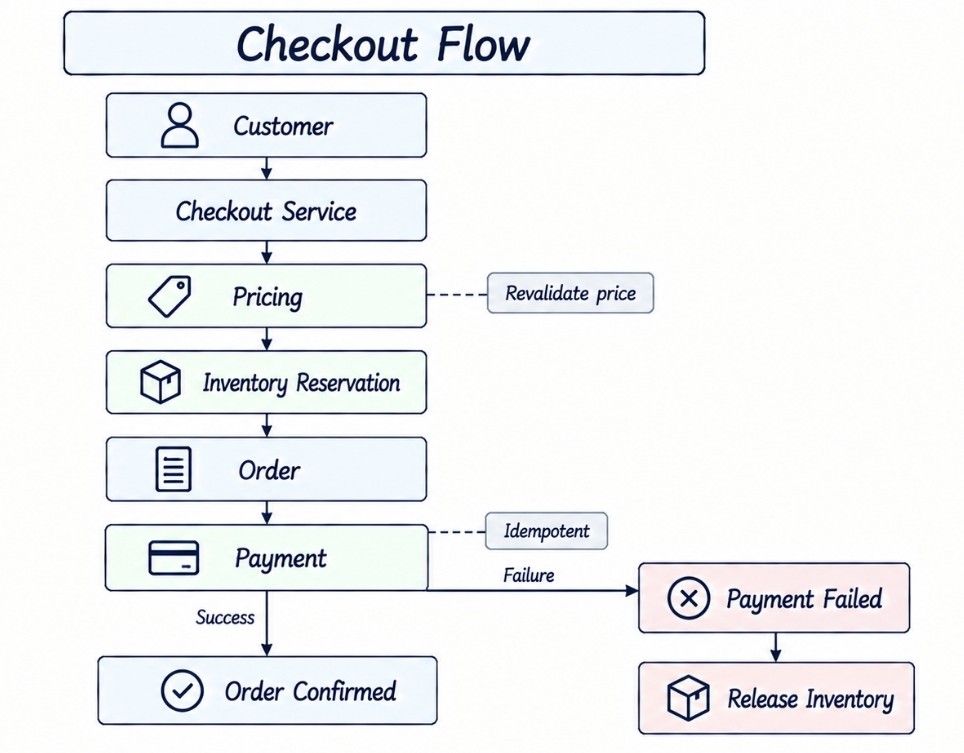
Checkout coordinates the purchase workflow.
Cart
 ↓
Validate Products
 ↓
Get Current Prices
 ↓
Validate Address
 ↓
Calculate Shipping / Tax
 ↓
Reserve Inventory
 ↓
Create Pending Order
 ↓
Process Payment
 ↓
Confirm Order
These steps span independent systems.
Trying to hold one giant distributed ACID transaction across inventory, orders, payments, coupons, and fulfillment would create tight coupling, long-lived locks, poor availability, and difficult recovery.
External payment providers may not participate in such a transaction at all.
A Saga-style workflow uses local transactions and explicit compensation.
Create Checkout
      ↓
Reserve Inventory
      ↓
Create Pending Order
      ↓
Process Payment
      ↓
Confirm Order
      ↓
Commit Reservation
If payment permanently fails:
Payment Failed
      ↓
Cancel Pending Order
      ↓
Release Inventory
Every step and compensation should be retryable and idempotent where appropriate.
Orders should use explicit states rather than loosely related Boolean flags.
PENDING
   ↓
PAYMENT_PROCESSING
   ↓
CONFIRMED
   ↓
FULFILLING
   ↓
SHIPPED
   ↓
DELIVERED
Alternative transitions include:
PENDING → CANCELLED

PAYMENT_PROCESSING → PAYMENT_FAILED

CONFIRMED → CANCELLATION_REQUESTED
Returns and refunds are better modeled as separate workflows rather than forcing every lifecycle into one status field.
A customer may tap Place Order, receive a network timeout, and retry even though the first request succeeded.
Without protection:
Retry
 ↓
Order 1 + Order 2
 ↓
Possible Duplicate Payment
Use an idempotency key:
POST /v1/orders
Idempotency-Key: checkout_xyz
Persist a mapping such as:
(customer_id, idempotency_key)
          ↓
       order_id
Repeated requests return the same logical result.
Payment should have its own stable identifiers.
order_id
payment_attempt_id
provider_reference
A payment timeout does not necessarily mean the payment failed.
Timeout
≠
Payment Failed
The provider may have processed the charge while the response was lost.
Before charging again:
Check Provider Status
        ↓
Reconcile
        ↓
Retry Safely If Needed
Never blindly retry monetary side effects.
Order and payment lifecycles should not be collapsed into one status.
Payment may have:
CREATED
AUTHORIZED
CAPTURED
FAILED
REFUNDED
PARTIALLY_REFUNDED
Order may have:
PENDING
CONFIRMED
SHIPPED
DELIVERED
CANCELLED
A state such as:
Order   = CANCELLED
Payment = REFUND_PENDING
can be completely valid while compensation is still running.
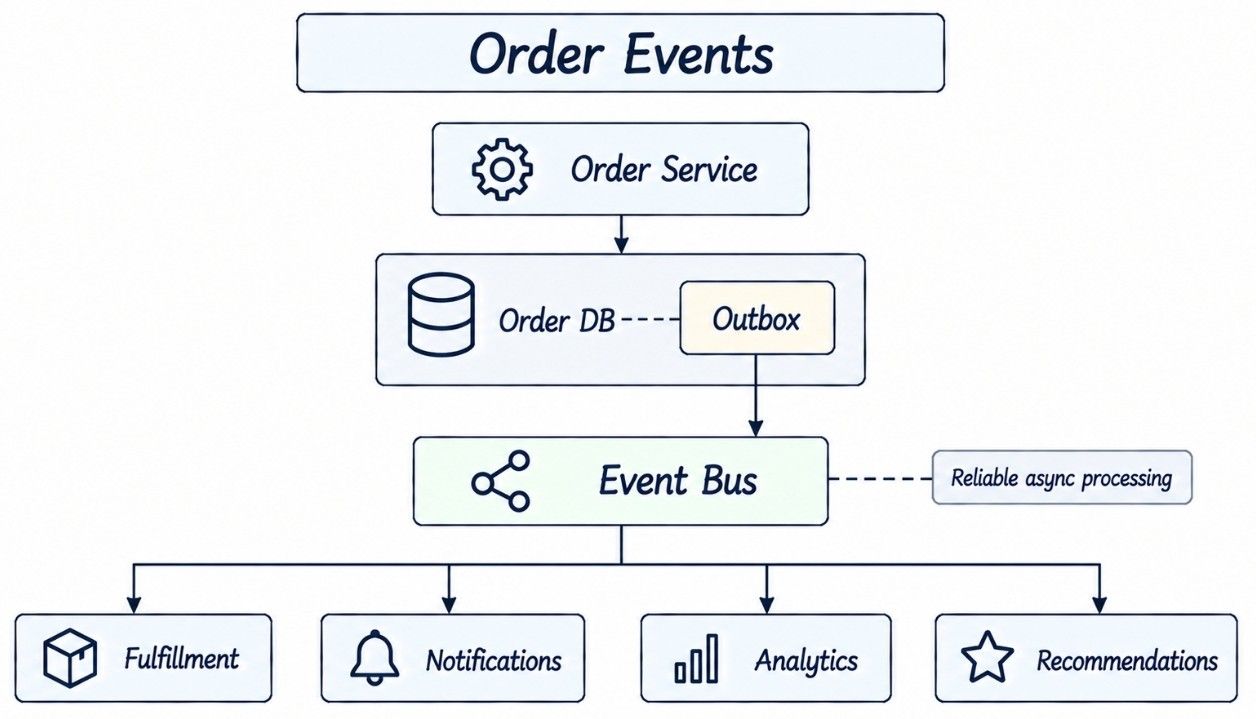
Suppose Order Service commits an order and then tries to publish an event.
Update Order
    ↓
Commit
    ↓
CRASH
    ↓
Publish Event Never Happens
Fulfillment may never learn about the confirmed order.
Use a transactional outbox:
BEGIN;

UPDATE orders
SET status = 'CONFIRMED';

INSERT INTO outbox
(event_id, type, payload)
VALUES (..., 'OrderConfirmed', ...);

COMMIT;
The order update and outbox event are committed in the same durable transaction.
An asynchronous publisher then sends the event to the broker.
Once an order is confirmed:
OrderConfirmed
      ↓
   Event Bus
  /    |       |          \
 ↓     ↓       ↓           ↓
Fulfillment  Notifications Analytics  Recommendations
This provides loose coupling, independent scaling, retryability, and failure isolation.
The order API does not need to wait for every downstream system.
Event delivery is commonly at least once, so consumers must tolerate duplicates.
OrderConfirmed(O123)
        ↓
Delivered More Than Once
        ↓
Idempotent Consumer
A fulfillment consumer can deduplicate by event_id or enforce a business invariant such as:
One fulfillment workflow per orderThis provides effectively-once business behavior over at-least-once delivery.
Inventory can exist across many warehouses.
The fulfillment system may choose between:
One Warehouse
→ Fewer packages

Multiple Warehouses
→ Potentially faster or more available fulfillment
Selection can consider:
Inventory availability.
Delivery ETA.
Shipping cost.
Warehouse capacity.
Number of packages.
Inventory balancing.
One customer order may therefore produce multiple shipments.
Order O123
   ├── Shipment S1 → SKU A
   └── Shipment S2 → SKU B, SKU C
Therefore:
Order
≠
Shipment
Fulfillment can publish events such as ShipmentCreated, ShipmentDispatched, and ShipmentDelivered, which Order Service consumes to expose customer-friendly status.
Cancellation is a distributed workflow rather than simple row deletion.
Cancellation Request
        ↓
Check Eligibility
        ↓
Stop Fulfillment
        ↓
Release Inventory
        ↓
Void / Refund Payment
        ↓
Update Order
Returns are a separate lifecycle:
Return Request
      ↓
Eligibility
      ↓
Return Authorization
      ↓
Item Returned
      ↓
Inspection
      ↓
Refund
      ↓
Inventory Disposition
Returned inventory may become sellable, damaged, refurbished, or discarded.
Flash sales create a very different workload.
Suppose millions of users attempt to buy the same limited-stock SKU simultaneously.
Problems include hot inventory keys, database contention, retry storms, bots, queue overload, and payment spikes.
Use admission control:
Millions of Requests
        ↓
Rate Limit / Bot Protection
        ↓
Waiting Room / Admission
        ↓
Reservation Workers
        ↓
Valid Winners
        ↓
Checkout
The goal is to prevent millions of concurrent requests from hammering the same scarce inventory resource.
A single popular SKU can become a hot key.
Possible mitigations include controlled inventory buckets or other specialized reservation strategies, but these make the global stock invariant harder to maintain.
Introduce them only when real contention justifies the complexity.
A waiting-room token should be short-lived, signed, and safe against replay. Admission alone should not imply guaranteed inventory unless it is explicitly tied to a reservation.
Recommendations are naturally asynchronous and should remain outside the critical checkout path.
User Events
    ↓
Event Stream
    ↓
Feature Pipeline
    ↓
Candidate Generation
    ↓
Ranking
    ↓
Recommendations
Signals can include product views, searches, purchases, cart additions, wishlists, and ratings.
Recommendation failure must not block product browsing or checkout.
Reviews can be handled by a separate service.
Review
------
review_id
product_id
user_id
rating
text
status
created_at
Aggregated ratings should not require scanning millions of reviews on every product-page request.
ReviewCreated
      ↓
Rating Aggregator
      ↓
Rating Summary
Review moderation can also run asynchronously:
SUBMITTED
    ↓
MODERATION
   /    \
  ↓      ↓
PUBLISHED REJECTEDOrder events can trigger asynchronous notifications.
OrderConfirmed
OrderShipped
OrderDelivered
RefundCompleted
       ↓
Notification Service
   /      |       \
 Push    Email     SMS
Notification failures should not roll back confirmed orders.
The same pattern can support back-in-stock and price-drop notifications with appropriate batching and rate control.
A large e-commerce platform should not force every workload into one database technology.
Workload | Suitable Storage Model |
|---|---|
Users, Orders, Payments | Transactional database |
Catalog | Relational/document/distributed store based on access patterns |
Search | Search/inverted index |
Cart | Durable KV/document store |
Inventory | Strongly controlled transactional store |
Product media | Object storage |
Cache | Distributed in-memory cache |
Events | Durable broker/event log |
Analytics | Warehouse/data lake |
Polyglot persistence should be driven by workload requirements, not technology fashion.
Partition keys should follow access patterns while avoiding hot spots.
Examples:
Data | Possible Partition Key |
|---|---|
Orders |
|
Catalog |
|
Cart |
|
Inventory |
|
Operational queries that do not align with the primary partition key may require secondary indexes or dedicated read models.
Different product fields need different freshness guarantees.
Description
→ TTL / Eventual Invalidation

Checkout Price
→ Revalidate

Inventory
→ Authoritative Reservation
A viral product can also cause a cache stampede when a popular cache entry expires.
Mitigations include:
Request coalescing.
Jittered TTLs.
Background refresh.
Stale-while-revalidate.
Hot-key replication.
The cache should improve performance, not become the source of truth for critical purchase decisions.
Optional dependencies should fail independently.
If recommendations fail:
Product Details ✓
Price           ✓
Inventory       ✓
Add to Cart     ✓
Recommendations ✗
The page should still work.
Similarly, delayed analytics or notification infrastructure should not make checkout unavailable.
Classify dependencies as critical or optional and define fallbacks accordingly.
Read-heavy systems such as catalog and search can be replicated geographically.
                   Global Routing
                         ↓
             +-----------+-----------+
             ↓                       ↓
          Region A                 Region B
             ↓                       ↓
      Catalog / Search        Catalog / Search
      Cart / APIs             Cart / APIs
Orders and especially inventory require more careful ownership.
Physical inventory naturally belongs to a fulfillment location.
Warehouse W1 Inventory
          ↓
Authoritative Region R1
Other regions may read cached availability, but final reservation can route to the authoritative inventory owner.
This avoids two independent regions selling the same final unit without coordination.
E-commerce systems handle sensitive customer and financial information.
Protect:
Account credentials.
Addresses.
Payment information.
Order history.
Seller data.
Inventory administration.
Use TLS, authentication, authorization, encryption at rest where appropriate, secure secret management, audit logging, rate limiting, fraud controls, and least privilege.
Minimize the payment data stored directly by the platform. Tokenization and payment-provider integrations can reduce exposure.
Monitor both technical health and business correctness.
Important signals include:
Search and product-page latency.
Search indexing lag.
Cache hit rate.
Checkout latency and failures.
Inventory reservation failures.
Reservation expiry rate.
Order creation success.
Payment failures and ambiguous payments.
Refund latency.
Broker lag and queue depth.
Database latency and hot partitions.
Regional error rates.
Business invariants are especially important.
For example:
Confirmed Quantity
must not exceed
Permitted Sellable InventoryThe browse path is optimized for fast reads and graceful degradation.
Customer
   ↓
Search Query
   ↓
Search Service
   ↓
Search Index
   ↓
Product IDs
   ↓
Product Page Service
   ├── Catalog
   ├── Pricing
   ├── Availability
   ├── Reviews
   └── Recommendations
   ↓
Product Page
Optional systems should have fallbacks.
The checkout path prioritizes correctness over pure read performance.
Customer
   ↓
Checkout
   ↓
Validate Cart
   ↓
Current Price + Address + Shipping
   ↓
Reserve Inventory
   ↓
Create PENDING Order
   ↓
Process Payment
   ↓
   +------ Failure ------> Cancel / Release Reservation
   |
 Success
   ↓
Confirm Order
   ↓
Commit Inventory
   ↓
OrderConfirmed Event
   ├── Fulfillment
   ├── Notifications
   └── Analytics
The exact order of payment authorization, order creation, inventory reservation, and payment capture can vary according to business requirements.
The important part is that failures and compensation are explicit.
A strong system design should explain recovery behavior, not only the happy path.
Failure | Correct Handling |
|---|---|
Payment succeeds but response is lost | Check provider state and reconcile before retrying |
Inventory reserved but payment fails | Cancel pending workflow and release reservation |
Order commits but event publishing fails | Transactional outbox retries event publication |
Search is unavailable | Preserve direct product, cart, order, and checkout paths where possible |
Recommendations fail | Use cached/popular fallback or omit recommendations |
Retries and compensations should themselves be idempotent.
A marketplace introduces sellers and offers.
Product
   ↓
  SKU
   ↓
+------+-------+------+
|      |       |      |
Seller A Seller B Seller C
₹999    ₹950    ₹1,050
Each offer may differ in price, stock, condition, delivery promise, seller quality, and fulfillment method.
Seller updates can publish events:
OfferUpdated
     ↓
Event Bus
 ├── Catalog Read Model
 ├── Search Index
 ├── Pricing
 └── Cache Invalidation
This extension adds substantial complexity beyond a single-retailer e-commerce system.
HLD focuses on the overall system architecture, while LLD focuses on internal objects, relationships, and behavior.
Aspect | High-Level Design (HLD) | Low-Level Design (LLD) |
|---|---|---|
Focus | Overall distributed architecture | Internal objects and behavior |
Components | Catalog, Search, Cart, Inventory, Orders, Payments | Product, SKU, Cart, Order, Payment |
Key Concerns | Scalability, storage, communication, failures | Classes, relationships, states, methods |
Example Question | How does checkout work across services? | How should an Order object be modeled? |
Interview Goal | Explain how the system works at scale | Explain internal implementation details |
For an Amazon system design interview, start with HLD and move into LLD only when the interviewer asks for deeper implementation details.
The architecture should become more complex only when traffic or correctness requirements justify it.
Stage | Architecture Change | Why |
|---|---|---|
Small Scale | Backend + relational DB + object storage | Simple starting architecture |
Growing Reads | Cache + CDN + search index | Scale product discovery |
Growing Checkout | Dedicated cart, inventory, order, payment services | Isolate transactional workloads |
More Workflows | Event bus + transactional outbox | Decouple downstream processing |
Marketplace Scale | Seller platform + multi-warehouse inventory | Support marketplace operations |
Traffic Spikes | Waiting room + admission control | Protect scarce inventory |
Global Scale | Regional ownership + multi-region reads | Reduce latency while preserving correctness |
Each new component should solve a concrete scaling, reliability, or correctness problem.
The main design decisions come from choosing where speed, availability, freshness, and correctness matter most.
Availability vs inventory correctness: Browse paths should remain highly available, while final reservation must protect stock invariants.
Freshness vs search performance: Search indexes scale retrieval but may briefly lag catalog changes.
Cart convenience vs stock utilization: Reserving at Add to Cart improves certainty but can lock scarce stock unnecessarily.
Synchronous vs asynchronous workflows: Events improve isolation and scalability but introduce eventual consistency and duplicate-delivery concerns.
Global writes vs regional ownership: Clear inventory ownership simplifies scarce-stock correctness but may require cross-region coordination.
These questions cover the most important e-commerce architecture decisions.
Separate read-heavy product discovery from transactional purchasing. Use catalog and search systems for discovery, durable carts for purchase intent, authoritative inventory reservations, checkout orchestration, durable orders, and idempotent payments.
Use atomic conditional inventory reservations or another serialization mechanism that guarantees reservations cannot exceed sellable stock.
Usually no. Cart represents purchase intent. Reserve inventory near checkout for a bounded period unless business requirements specify otherwise.
Both can attempt reservation, but the authoritative atomic inventory operation allows only one valid reservation to succeed.
They temporarily protect inventory while checkout and payment are in progress.
Release the quantity unless the order has already committed the reservation.
Use durable cart storage primarily keyed by user/account, support safe item updates, and revalidate price and availability at checkout.
Build a dedicated search index asynchronously from authoritative catalog changes.
Search engines are optimized for full-text retrieval, ranking, filtering, and faceting, while the catalog database is optimized for authoritative product data.
Treat cart prices as display snapshots and revalidate authoritative pricing during checkout unless a price lock is guaranteed.
Use a client/checkout idempotency key and persist its mapping to the resulting order.
Use payment-level idempotency and stable provider references. Reconcile ambiguous outcomes before retrying.
Treat the result as unknown, query/reconcile with the provider, and avoid blindly charging again.
It is a sequence of local transactions across services with compensating actions when later operations fail.
It creates tight coupling, long-lived locks, poor availability, and does not integrate cleanly with external payment providers.
Use rate limiting, bot protection, waiting rooms or admission control, queueing where appropriate, and carefully controlled inventory reservation.
Use CDN/cache for read traffic and introduce specialized contention controls for hot inventory only when needed.
Order Service consumes fulfillment and shipment events and exposes a customer-friendly order state.
Treat returns as a separate workflow covering eligibility, authorization, shipment, inspection, refund, and inventory disposition.
Choose storage according to workload. Orders and payments need transactional guarantees, search needs a search index, media belongs in object storage, and other workloads can use appropriate distributed stores.
Use idempotency, explicit state machines, reservations, durable orders, payment reconciliation, retryable workflows, transactional outbox, and idempotent consumers.
Track inventory by SKU and fulfillment location, then choose fulfillment based on availability, delivery promise, cost, and operational capacity.
Replicate read-heavy catalog and search data geographically while giving scarce physical inventory clear authoritative ownership.
Search indexes, recommendations, review aggregates, popularity counters, and some displayed availability signals can tolerate brief staleness.
Inventory reservation, order creation, payments, and critical order state transitions require stronger guarantees.
Avoid these common weaknesses in an Amazon system design interview:
Designing the platform as simple CRUD tables.
Reserving inventory indefinitely when an item enters the cart.
Trusting cached availability during checkout.
Ignoring concurrent purchases of the final unit.
Assuming a payment timeout means failure.
Retrying payments without idempotency.
Treating the search index as authoritative catalog storage.
Coupling notifications, recommendations, or analytics to checkout.
Using distributed transactions everywhere instead of explicit workflows.
Naming Kafka, Redis, Elasticsearch, or other technologies without explaining the problem they solve.
Technology choices should follow business invariants and workload requirements.
The final architecture separates product discovery, transactional purchasing, media delivery, and asynchronous workflows.
                         CUSTOMER
                            ↓
                       API GATEWAY
                            ↓
        +-------------------+-------------------+
        |          |           |               |
        ↓          ↓           ↓               ↓
     Catalog     Search       Cart          Checkout
        ↓          ↓           ↓               |
   Catalog DB  Search Index  Cart DB            |
                                               ↓
                                         Pricing Service
                                               ↓
                                        Inventory Service
                                               ↓
                                          Order Service
                                               ↓
                                         Payment Service
                                               ↓
                                           Order DB

PRODUCT MEDIA

Catalog
   ↓
Object Storage
   ↓
CDN
   ↓
Customer

RELIABLE ORDER EVENTS

Order Service
      ↓
Order DB + Outbox
      ↓
Outbox Publisher
      ↓
Event Bus
  /       |          |             \
 ↓        ↓          ↓              ↓
Fulfillment  Notifications  Analytics  Recommendations
     ↓
Warehouse / Shipment
The central design principle is:
Scale product discovery for availability and speed, but protect checkout with stronger correctness around inventory, orders, and money.
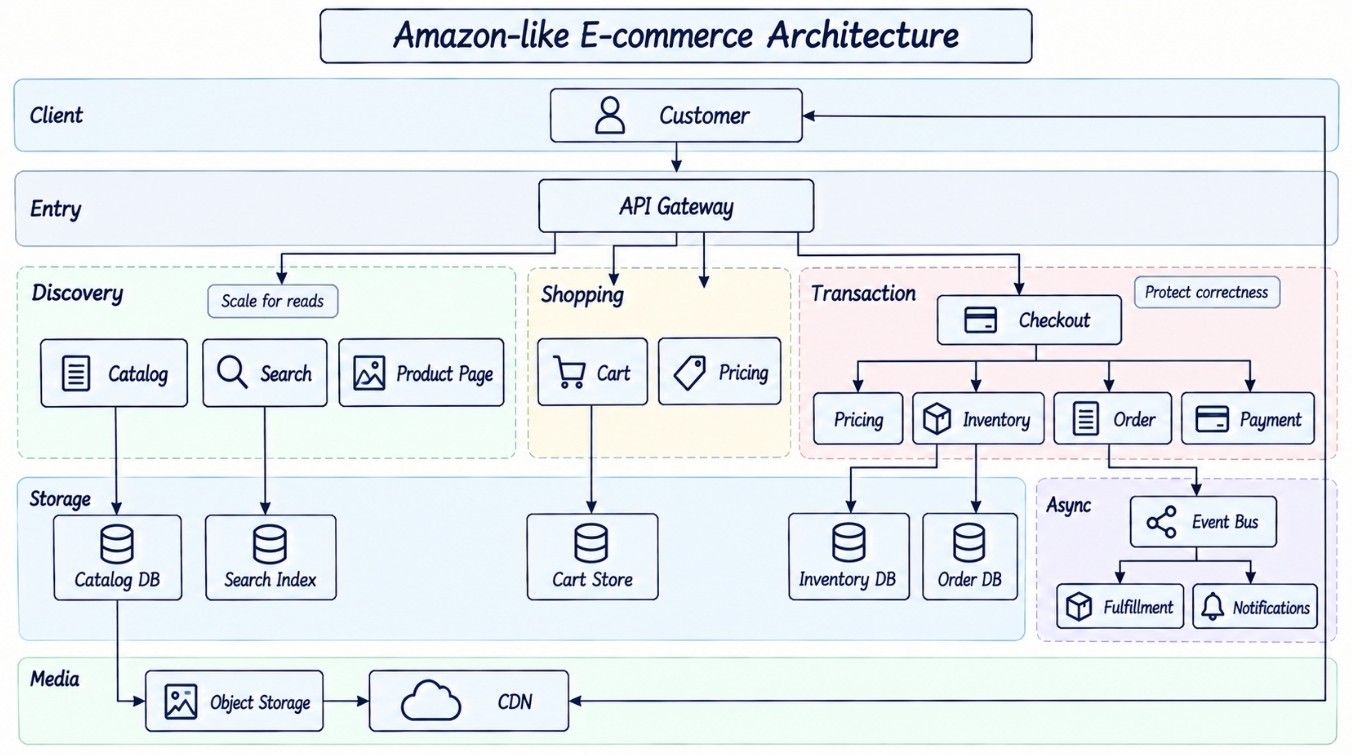
That separation is the foundation of a scalable and reliable Amazon-like e-commerce system design.
