
Durgesh Tiwari
Author
In a distributed system, an application runs on multiple servers instead of a single server. These servers work together to process user requests and provide one complete service.
Since every server works independently, they need a way to communicate and coordinate with each other. Without proper coordination, two servers might perform the same task, update the same data at the same time, or make different decisions. This can lead to incorrect results and data inconsistency.
This is where Distributed Coordination becomes important.
Distributed Coordination helps multiple servers work together in the correct order. It makes sure that tasks are completed safely, resources are shared properly, and all servers remain synchronized.
In simple words, Distributed Coordination helps multiple servers work together as one system without creating conflicts or duplicate work.
Distributed Coordination is an important concept in System Design because it is widely used in microservices, distributed databases, cloud applications, and other large-scale distributed systems.
As an application grows, more servers are added to handle increasing users and traffic. These servers process requests at the same time, so they must coordinate with each other to avoid conflicts.
For example, imagine two servers trying to process the same customer order at the same time. Without coordination, both servers may process the order, resulting in duplicate records or incorrect data.
Distributed Coordination solves these problems by making sure that every server knows what it should do and when it should do it.
Distributed Coordination is important because it:
Keeps servers synchronized – All servers work with the latest information.
Prevents duplicate work – The same task is not processed more than once.
Maintains data consistency – Every server stores correct and matching data.
Helps recover from failures – Other servers can continue working if one server fails.
Supports reliable communication – Services can exchange information safely.
Improves system stability – The application continues to work smoothly even as it grows.
Without proper coordination, a distributed application becomes difficult to manage, especially when it serves millions of users.
In a distributed system, many servers work together to complete different tasks. However, some tasks should be managed by only one server at a time. If multiple servers try to make the same decision, it can create conflicts and incorrect results.
This is where Leader Election is used.
Leader Election is the process of selecting one server as the leader, while the remaining servers work as followers. The leader manages important tasks and coordinates the other servers.
If the leader fails or becomes unavailable, another server is automatically selected as the new leader so the system can continue working without interruption.
In simple words, Leader Election chooses one server to manage important tasks while the other servers follow its instructions.
Leader Election usually follows these steps:
Multiple servers join the distributed system.
One server is selected as the leader.
The remaining servers become followers.
The leader coordinates important tasks and decisions.
If the leader fails, the system automatically elects a new leader.
This process keeps the system organized and prevents multiple servers from performing the same task.
Imagine a distributed database running on five servers.
The database needs one server to manage tasks such as writing data, assigning jobs, or coordinating updates.
Instead of allowing all five servers to make these decisions, one server is elected as the leader. The other servers follow the leader's instructions.
If the leader goes offline because of a hardware or network failure, one of the follower servers is automatically selected as the new leader. This allows the database to continue working without stopping the application.
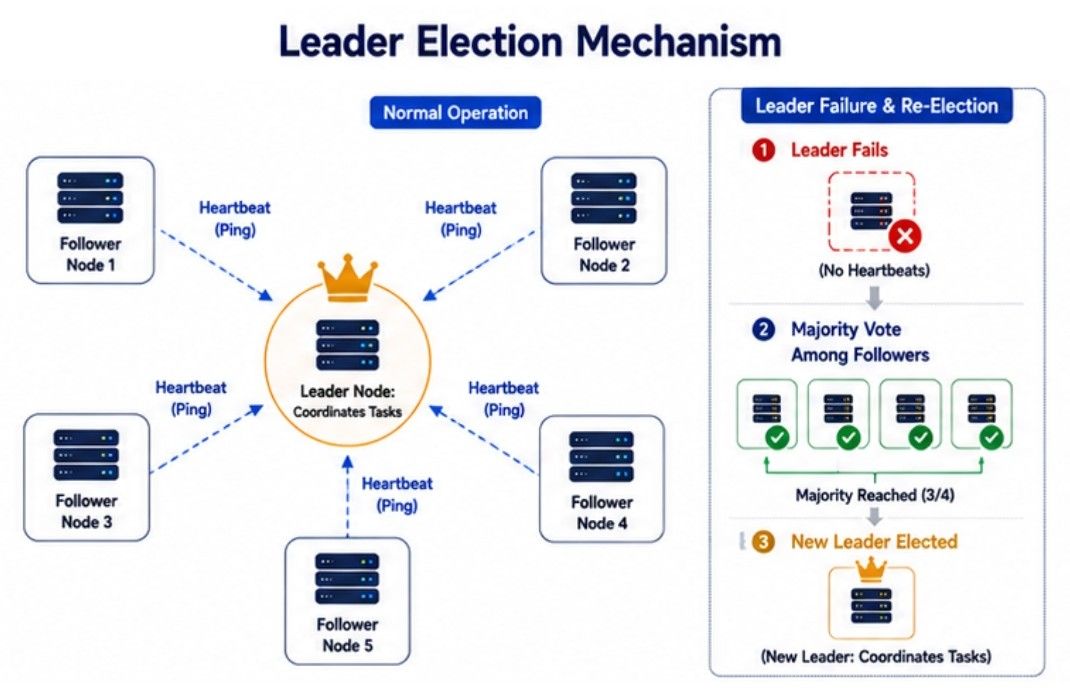
Leader Election helps distributed systems work more efficiently.
Prevents Conflicting Decisions – Only one server makes important decisions.
Avoids Duplicate Work – The same task is not performed by multiple servers.
Makes Coordination Easier – Servers work in an organized way.
Improves Fault Tolerance – The system continues working even if the leader fails.
Supports Automatic Recovery – A new leader is selected automatically when needed.
In a distributed system, multiple servers work together to store data and process requests. Before making an important change, all servers must agree on the same decision. If they do not agree, different servers may store different data, leading to inconsistency.
This is where Consensus Algorithms are used.
A Consensus Algorithm is a method that helps multiple servers agree on the same value or decision, even if some servers stop working or fail.
In simple words, a Consensus Algorithm helps all servers agree on one decision before moving forward.
A Consensus Algorithm usually follows these steps:
A server proposes a new change or value.
The other servers receive the proposal.
The servers communicate with each other and vote or agree on the proposal.
If enough servers approve the change, it is accepted.
Every server updates its data with the same result.
This process helps all servers keep the same data and prevents conflicting updates.
Imagine a distributed database that stores customer information on multiple servers.
When a new customer record is added, all servers first agree on the change. After reaching an agreement, every server saves the same data.
This ensures that users receive the same information, no matter which server handles their request.
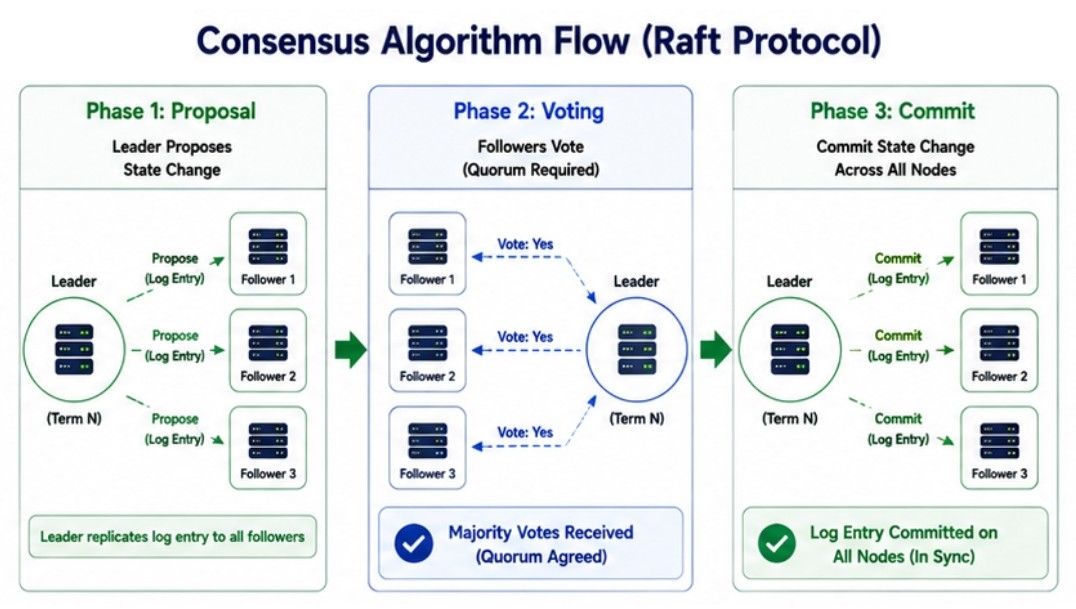
The following consensus algorithms are widely used in distributed systems.
Raft is a simple and easy-to-understand consensus algorithm. It uses a leader to coordinate decisions and is commonly used for leader election and data replication in modern distributed systems.
Paxos is a highly reliable consensus algorithm designed for distributed environments. It keeps data consistent even if some servers fail. However, it is more complex to understand and implement than Raft.
Consensus Algorithms help distributed systems make reliable decisions.
Maintains Data Consistency – All servers store the same data.
Handles Server Failures – The system continues working even if some servers fail.
Prevents Conflicting Updates – Different servers do not save different versions of the same data.
Improves System Reliability – Servers work together to make safe and accurate decisions.
In a distributed system, multiple servers can access the same data or resource at the same time. If two or more servers try to update the same resource together, it can create duplicate records, incorrect data, or unexpected results.
This is where Distributed Locks are used.
A Distributed Lock is a mechanism that allows only one server or service to access a shared resource at a time. Other servers must wait until the lock is released before they can perform the same task.
In simple words, a Distributed Lock makes sure that only one server performs an important task at a time.
A Distributed Lock usually follows these steps:
A server requests access to a shared resource.
The system grants the lock to one server.
That server completes its task while other servers wait.
After the task is finished, the server releases the lock.
Another waiting server can now acquire the lock and continue.
This process prevents multiple servers from changing the same data at the same time.
Imagine an online payment system where two servers receive the same payment request.
Without a Distributed Lock, both servers might process the payment, causing the customer to be charged twice.
With a Distributed Lock, only one server gets permission to process the payment. The second server waits until the first one finishes and releases the lock.
This prevents duplicate payments and keeps the transaction correct.
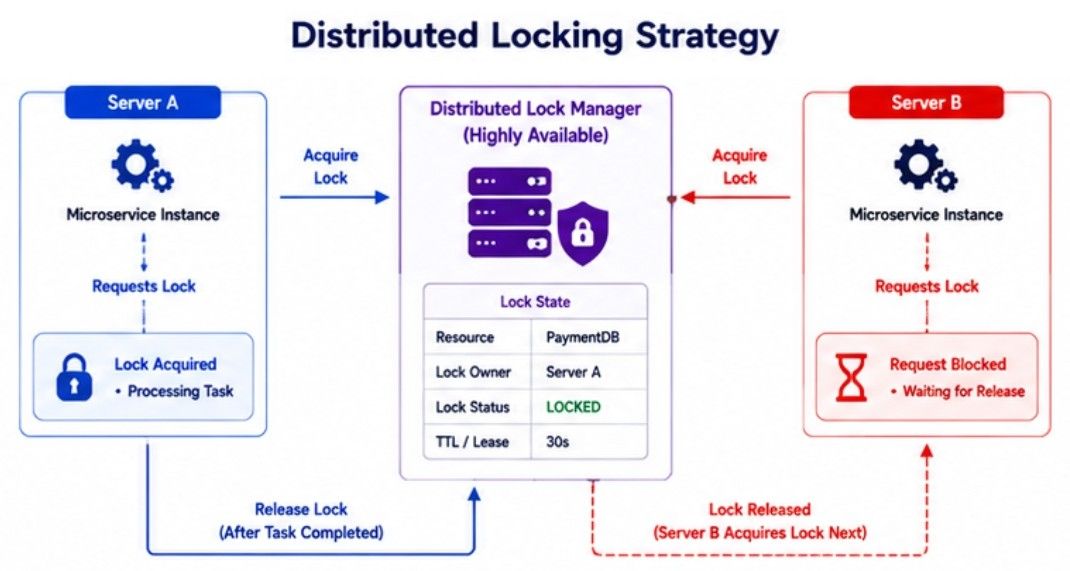
Distributed Locks help protect shared resources in distributed systems.
Prevents Duplicate Processing – The same task is completed only once.
Protects Shared Resources – Only one server can modify shared data at a time.
Maintains Data Consistency – Data remains accurate across all servers.
Avoids Race Conditions – Multiple servers cannot update the same resource simultaneously.
Improves Application Reliability – Critical operations are completed safely and correctly.
In a distributed system, multiple servers need to share information and work together. They must manage tasks such as leader election, service discovery, configuration management, and distributed locking.
Building these features from scratch can be difficult and time-consuming. This is why developers use Coordination Services.
A Coordination Service is a tool that helps distributed applications coordinate tasks, share configuration, elect leaders, and manage distributed locks. It provides a central place where all servers can exchange important information safely.
In simple words, a Coordination Service helps multiple servers communicate and work together without conflicts.
As distributed applications grow, more servers are added to handle users and data. These servers need a reliable way to share information and stay synchronized.
Coordination Services help by:
Sharing configuration across servers.
Selecting a leader when required.
Managing distributed locks.
Helping services discover each other.
Keeping the system organized and consistent.
ZooKeeper is a popular distributed coordination service used in many large-scale applications. It helps servers coordinate with each other and keeps important system information in one place.
ZooKeeper is widely used in technologies such as Apache Kafka and Apache Hadoop.
Leader Election – Selects one server to coordinate the system.
Service Discovery – Helps services find and communicate with each other.
Configuration Management – Stores and shares configuration data across servers.
Distributed Locking – Ensures that only one server accesses a shared resource at a time.
etcd is a distributed key-value store that stores configuration data and helps coordinate distributed applications.
It is mainly used in Kubernetes, where it stores cluster information and keeps the system state consistent.
Configuration Storage – Stores application and system settings.
Leader Election – Chooses a leader when multiple servers are available.
Service Discovery – Helps services locate each other.
Cluster Management – Maintains information about the servers in a cluster.
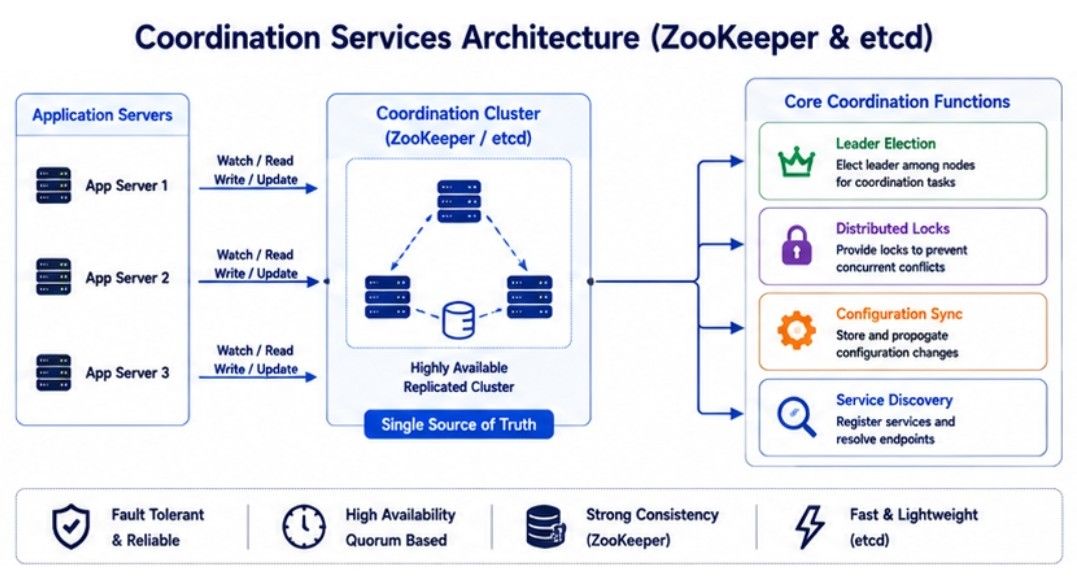
Coordination Services make distributed systems easier to manage.
Simplify Distributed Coordination – Servers can communicate and coordinate more easily.
Improve System Reliability – The system continues working even when failures occur.
Support Automatic Failover – Another server can take over if the leader fails.
Maintain Consistent Configuration – All servers use the same configuration data.
Manage Leader Election and Distributed Locks – Helps servers work together without conflicts.
Distributed Coordination is used in many modern distributed systems.
Microservices: Coordinates communication between multiple independent services.
Distributed Databases: Keeps data synchronized and consistent across multiple database servers.
Kubernetes: Manages containers, nodes, and cluster configuration using etcd.
Apache Kafka: Manages brokers, leader election, and cluster metadata using ZooKeeper or built-in coordination.
Online Payment Systems: Uses Distributed Locks to prevent duplicate payment processing.
Cloud Applications: Manages shared resources, leader election, and configuration across multiple servers.
Imagine an online banking application that runs on multiple servers to handle thousands of transactions every second.
When a customer transfers money, the system first uses a Distributed Lock to make sure that only one server updates the customer's account balance. This prevents duplicate transactions and keeps the account data accurate.
At the same time, the application uses Leader Election to choose one server for handling important background tasks, such as generating reports and managing scheduled jobs. If the leader server stops working, another server is automatically selected so the application continues running without interruption.
The banking system also stores its configuration and cluster information in etcd, allowing every server to use the same settings. Before saving important updates, Consensus Algorithms help all servers agree on the change. This ensures that every server stores the same data and the system remains consistent and reliable.
Distributed Coordination helps multiple servers work together smoothly in a distributed system. It makes sure that servers communicate properly, share resources safely, and complete tasks without creating conflicts or inconsistent data.
Here are the main concepts you learned:
Leader Election selects one server to manage important tasks while other servers follow its instructions.
Consensus Algorithms help all servers agree on the same decision before updating shared data.
Distributed Locks ensure that only one server can access or update a shared resource at a time, preventing duplicate processing.
Coordination Services such as ZooKeeper and etcd provide ready-made solutions for leader election, service discovery, configuration management, and distributed locking.
By using these distributed coordination techniques, developers can build scalable distributed systems, reliable cloud applications, and microservices that continue to work correctly even when servers fail or traffic increases.
