
Durgesh Tiwari
Author
Designing a Netflix-like platform is a classic system design interview problem because it combines global video streaming, large media files, adaptive bitrate streaming, CDN delivery, personalized recommendations, search, viewing history, and multi-device playback.
The main challenge is not simply handling API traffic. The system must efficiently prepare, protect, and deliver massive amounts of video data across different devices, networks, and geographical regions.
Important: This article designs a conceptual Netflix-like streaming platform for system design interviews. It does not claim to reproduce Netflix's private production architecture.
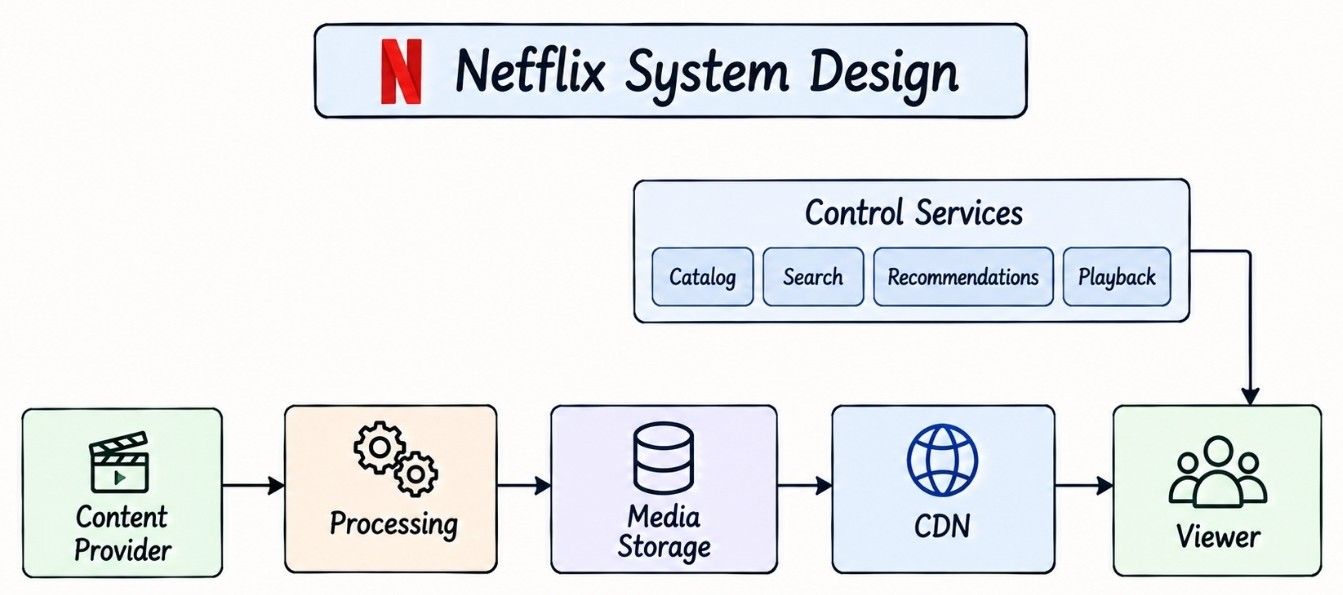
A Netflix-like system combines content preparation, content discovery, playback authorization, and large-scale video delivery.
At a high level:
Content Provider
      ↓
Content Ingestion
      ↓
Encoding
      ↓
Multiple Renditions
      ↓
Segmentation
      ↓
Object Storage
      ↓
CDN Distribution
      ↓
Viewer Playback
A streaming platform cannot simply store one large video file and send the same version to every viewer. Users have different devices, screen sizes, network speeds, locations, subscriptions, and playback conditions.
A useful way to understand the architecture is to separate it into two planes:
Plane | Responsibility |
|---|---|
Control Plane | Login, profiles, catalog, search, recommendations, playback authorization, viewing history |
Media Delivery Plane | Encoding, storage, manifests, video segments, CDN delivery |
The control plane decides what the user can watch, while the media delivery plane efficiently delivers the actual video data.
Requirements define the core scope before choosing databases, queues, caches, or other distributed components.
The platform should support:
Browse movies and shows
Search the content catalog
Personalized recommendations
Stream videos at multiple qualities
Pause and resume playback
Continue watching across devices
Multiple user profiles
Viewing history
Regional content availability
Offline downloads for eligible content
Billing, ads, games, ratings, social features, and live streaming can remain outside the core scope unless specifically required.
The most important system qualities are:
High availability
Low playback startup latency
Low rebuffering
Global scalability
High media durability
High streaming throughput
Fault tolerance
Device compatibility
Secure content delivery
Cost-efficient bandwidth usage
Eventual consistency is acceptable for many discovery and analytics workflows, while playback authorization, subscription entitlement, content rights, and security-sensitive operations require stronger correctness.
Scale estimation shows why bandwidth, media storage, and CDN delivery dominate the architecture of a Netflix-like platform.
Assume:
Metric | Estimate |
|---|---|
Daily active users | 100 million |
Average streaming | 2 hours/user/day |
Average delivered bitrate | 5 Mbps |
At an average bitrate of 5 Mbps:
5 Mbps × 3600 seconds
≈ 18,000 megabits/hour
≈ 2.25 GB/hour

2.25 GB × 2 hours
≈ 4.5 GB/user/day

4.5 GB × 100 million users
≈ 450 PB/day
These are hypothetical interview estimates, not Netflix production numbers. Actual delivered data varies significantly with video quality, device, network conditions, and viewing behavior.
The main scaling challenges are:
Network bandwidth
Media storage
CDN capacity
Video encoding compute
Global delivery efficiency
A Netflix-like system is not difficult only because of API QPS—the much larger challenge is efficiently delivering massive amounts of video data.
The architecture separates user-facing control services from the bandwidth-heavy media path.
                    Mobile / TV / Web
                           |
                           v
                      API Gateway
                           |
        +------------------+------------------+
        |          |           |             |
        v          v           v             v
     Profile     Catalog     Search     Recommendation
     Service     Service     Service       Service
        |          |           |             |
        +----------+-----------+-------------+
                           |
                           v
                    Playback Service
                           |
                           v
                 Authorization / DRM
                           |
                           v
                    Playback Manifest
                           |
                           v
                          CDN
                           |
                           v
                    Video Segments
                           |
                           v
                         Player
Content preparation runs through a separate asynchronous pipeline:
Studio / Content Provider
          ↓
       Ingestion
          ↓
   Master Media Storage
          ↓
    Processing Queue
          ↓
    Encoding Workers
          ↓
  Multiple Renditions
          ↓
     Media Storage
          ↓
          CDN
This separation allows APIs, media processing, and video delivery to scale independently.
Unlike a YouTube-like platform, a Netflix-like system primarily uses controlled content ingestion rather than massive user-generated uploads.
Conceptually:
Studio / Licensed Content
          ↓
   Controlled Ingestion
          ↓
 Content Processing Pipeline
A content package may include:
Master video
Multiple audio tracks
Subtitles
Artwork
Catalog metadata
Localization information
Licensing information
Because media assets can be extremely large, they should be stored durably before expensive encoding and processing begin.
Structured metadata and large media assets have very different storage and access requirements.
Aspect | Metadata Database | Object / Media Storage |
|---|---|---|
Stores | Structured content information | Large binary assets |
Examples | Title, genre, cast, availability | Video, audio, subtitles, artwork |
Typical Size | Small records | MB to many GB |
Access Pattern | Queries and updates | Large object reads |
Primary Goal | Structured data access | Durable, scalable media storage |
For example:
Metadata Database
    ├── title
    ├── description
    ├── cast
    ├── genre
    └── regional availability

Object Storage
    ├── master video
    ├── encoded video
    ├── audio tracks
    ├── subtitles
    └── artwork
Large movies should not be stored as ordinary relational database rows. The database stores structured metadata, while object storage stores the actual media assets.
A single video file is not enough because viewers have different devices, displays, and network conditions.
For example, one viewer may have a 4K TV with fast broadband, while another uses a phone on a slow mobile network. Sending the same high-bitrate stream to both would waste bandwidth and increase buffering.
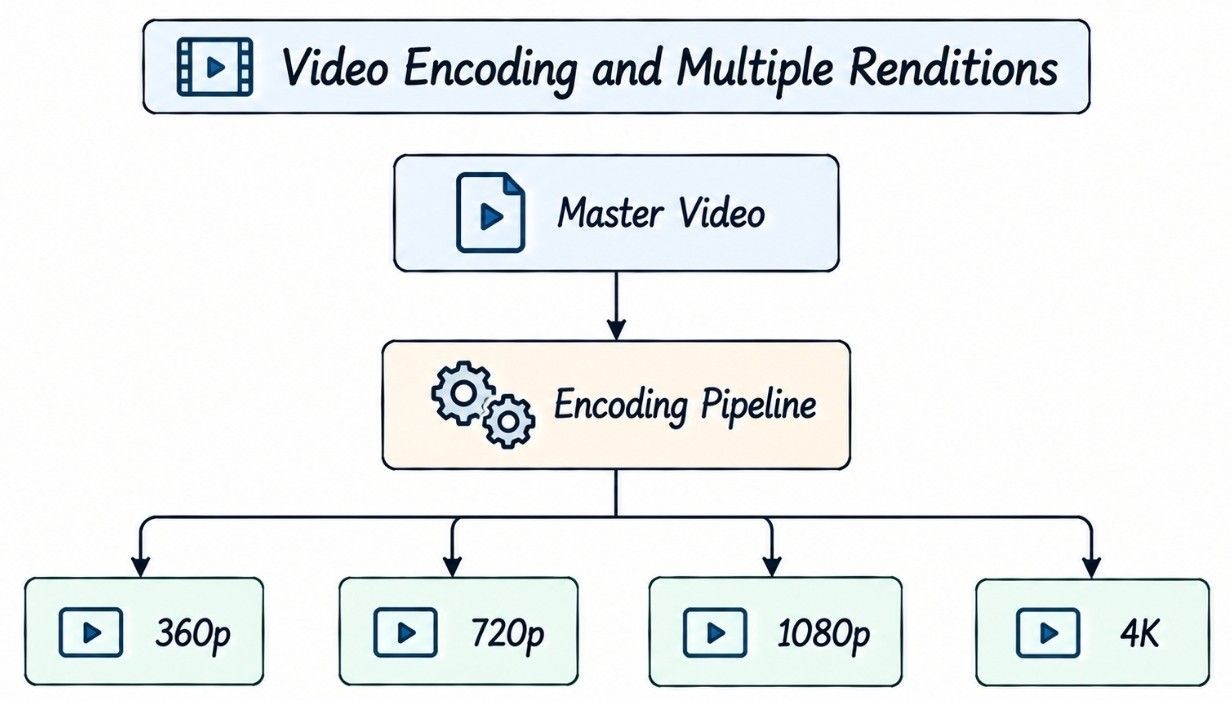
The master video is therefore encoded into multiple renditions:
Master Video
     |
     v
Encoding Pipeline
     |
     +──→ 360p
     +──→ 480p
     +──→ 720p
     +──→ 1080p
     └──→ 4K
Renditions can vary by:
Resolution
Bitrate
Codec
HDR format
Device compatibility
Audio and subtitle tracks can be processed separately.
The goal is to create multiple compatible streams so the player can select the most suitable one during playback.
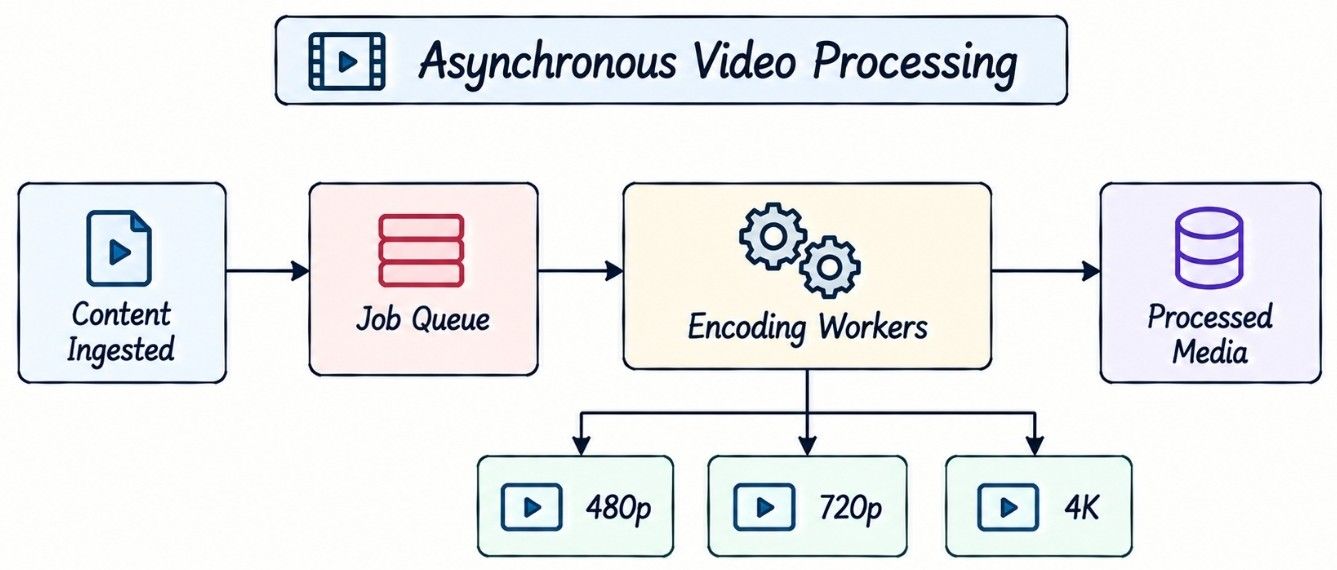
Encoding a long movie into multiple renditions is compute-intensive, so content ingestion should not wait for processing to finish.
Content Ingested
       ↓
 Processing Event
       ↓
   Job Queue
       ↓
 Encoding Workers
       ↓
 Processed Media
The queue helps with:
Burst absorption
Retries
Backpressure
Failure isolation
Independent worker scaling
Different renditions can be processed concurrently to reduce processing time.
                 Master Video
                      |
          +-----------+-----------+
          |           |           |
          v           v           v
      480p Worker  720p Worker  4K Worker
Processing can also be parallelized across stages or media sections when the pipeline supports it.
Encoding jobs must remain safe when workers crash or jobs are delivered more than once.
Use:
Idempotent processing
Deterministic output paths
Bounded retries with backoff
Job leases or visibility timeouts
Dead-letter queues for persistent failures
Processing-state tracking
If a worker crashes before completing a job, the job can be retried safely without creating inconsistent media assets.
Each encoded rendition is divided into smaller segments that the player can request independently.
For example:
720p Rendition
      |
      +── Segment 1
      +── Segment 2
      +── Segment 3
      +── Segment 4
      └── ...
Each rendition has its own compatible segment sequence:
480p:  A1  A2  A3  A4
720p:  B1  B2  B3  B4
1080p: C1  C2  C3  C4
Segmentation enables:
Adaptive quality switching
Efficient seeking
CDN caching
Client-side buffering
Smaller retries after network failures
It is the foundation of adaptive bitrate streaming.
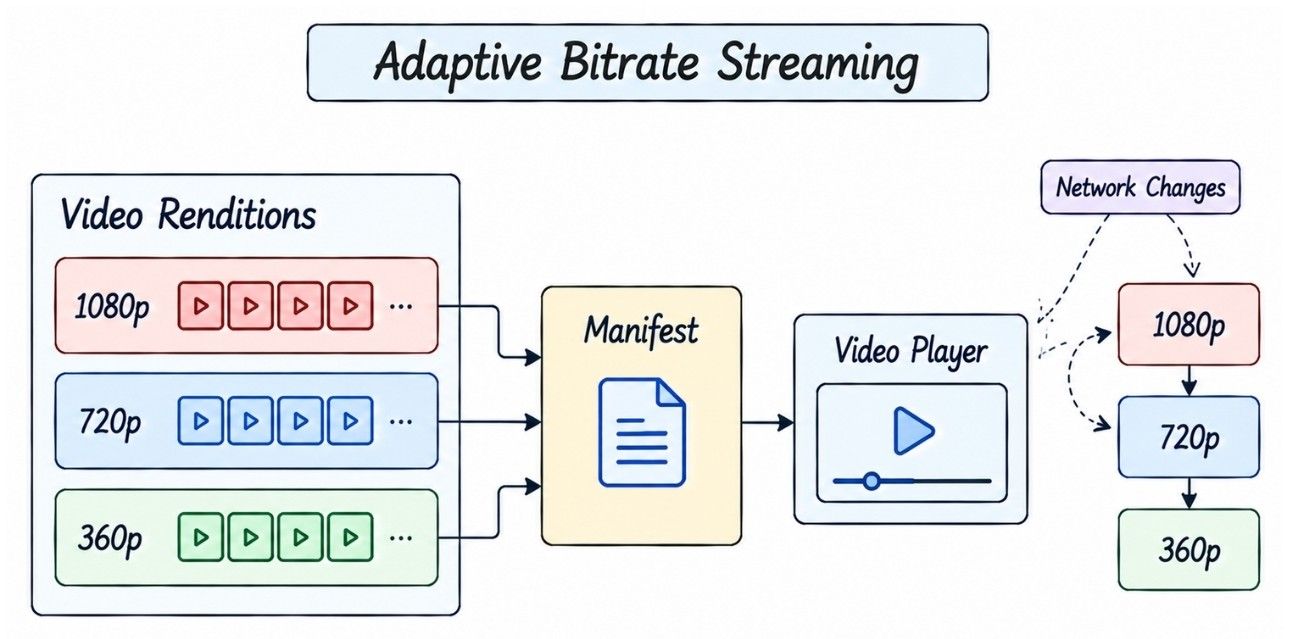
Adaptive Bitrate Streaming (ABR) allows the player to change video quality dynamically while playback continues.
For example:
Strong Network
     ↓
   1080p
     ↓
Network Slows
     ↓
    720p
     ↓
    480p
Instead of restarting the video, the player requests future segments from a lower-bitrate rendition. When network conditions improve, it can switch back to a higher quality.
The player can consider:
Available bandwidth
Buffer health
Recent throughput
Device and display capabilities
Subscription entitlement
The playback manifest describes the available renditions and their media segments.
Conceptually:
Manifest
   |
   +── 480p  → segments
   +── 720p  → segments
   +── 1080p → segments
   └── 4K    → segments
The player reads the manifest and selects appropriate segments as playback conditions change.
Segment duration affects adaptation speed, request overhead, and buffering behavior.
Aspect | Shorter Segments | Longer Segments |
|---|---|---|
Quality adaptation | Faster | Slower |
Seeking | More responsive | Less responsive |
Request count | Higher | Lower |
Protocol overhead | Higher | Lower |
Network adaptation | Faster | Slower |
There is no universally correct segment duration. The choice balances adaptability, latency, buffering, and delivery efficiency.
A CDN is essential because serving every video segment from central origin storage would create enormous bandwidth demand and increase playback latency.
Conceptually:
Without CDN:

Viewers → Origin Storage

With CDN:

                  Origin Storage
                       |
              +--------+--------+
              |        |        |
              v        v        v
           Edge A   Edge B   Edge C
              |        |        |
              v        v        v
           Viewers  Viewers  Viewers
A CDN provides:
Lower playback latency
Reduced origin bandwidth
Global delivery capacity
Better scalability for popular content
Delivery from infrastructure closer to viewers
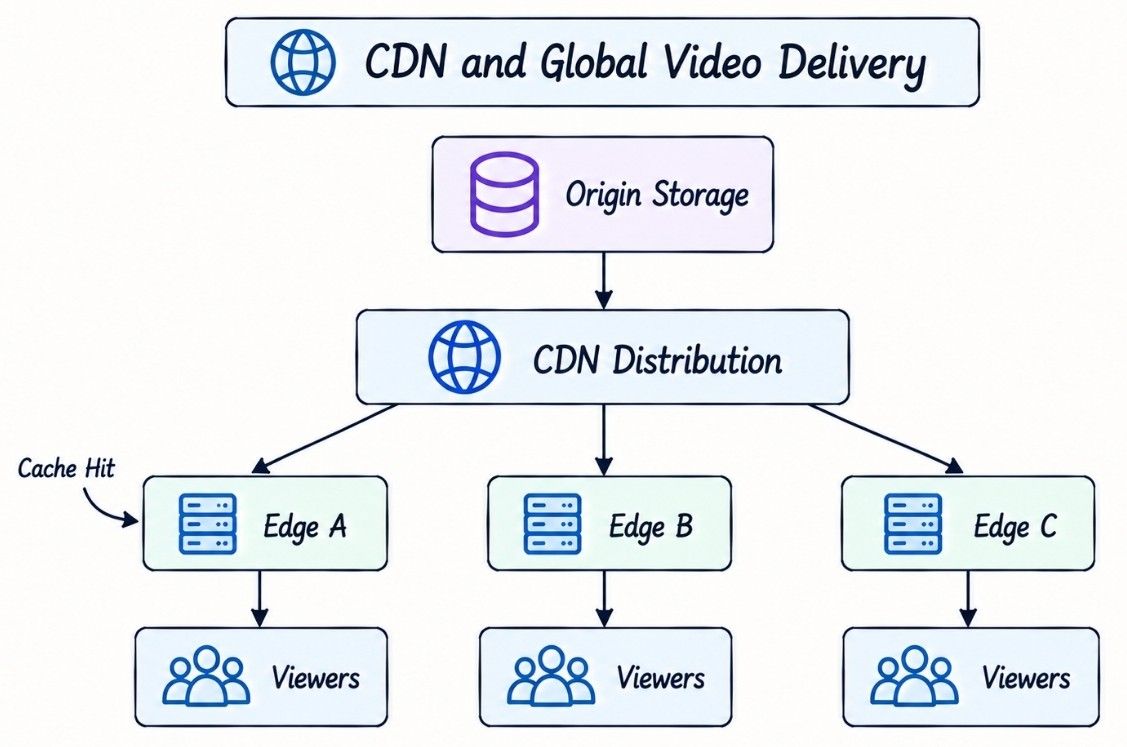
The CDN serves cached segments directly when possible and fetches missing segments from upstream storage.
Viewer
   ↓
CDN Edge
   |
   +── Cache Hit  → Serve Segment
   |
   └── Cache Miss → Origin
                       ↓
                  Cache at Edge
                       ↓
                  Serve Segment
Popular titles generate high cache reuse, allowing many viewers to receive the same segments from nearby CDN infrastructure instead of repeatedly reading them from the origin.
Streaming demand is highly uneven, so media delivery should consider content popularity.
Content | Delivery Strategy |
|---|---|
Hot Content | Keep popular segments widely cached across CDN edges |
Cold Content | Keep rarely requested assets in durable media storage and fetch them when needed |
Expected major releases can also be pre-positioned closer to viewers before predicted traffic spikes.
The trade-off is between distribution cost and playback latency.
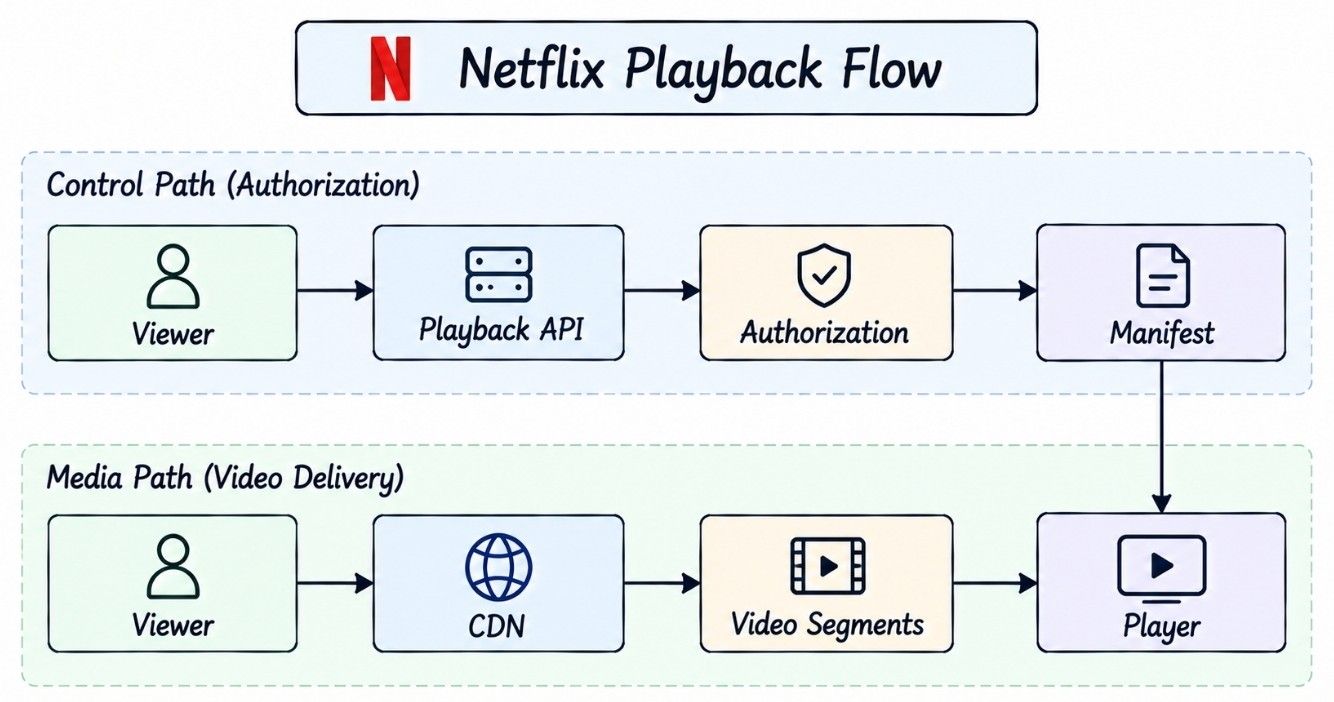
The backend decides whether and how playback is allowed, while the CDN delivers the bandwidth-heavy video segments.
Viewer
   ↓
Playback API
   ↓
Authentication
   ↓
Entitlement + Regional Rights
   ↓
Device / Playback Session
   ↓
Manifest
   ↓
CDN
   ↓
Video Segments
   ↓
Player Buffer
   ↓
Playback
Application servers should not continuously proxy the movie bytes.
Viewer → Backend → Metadata + Playback Authorization

Viewer → CDN     → Video Segments
This separation allows control-plane traffic and media-delivery traffic to scale independently.
The Catalog Service manages structured information about movies, shows, seasons, and episodes.
A title may contain:
title_id
title
description
type
genres
cast
release_year
maturity_rating
languages
artwork
availability
For episodic content:
Series
  |
  +── Season 1
  |      ├── Episode 1
  |      └── Episode 2
  |
└── Season 2Licensing may allow the same title in one country but prohibit it in another.
Availability data can include:
title_id
region
available_from
available_until
plan / entitlement
Playback authorization must check current regional and entitlement rules before issuing playable access.
A subscription account can contain multiple profiles, and personalization should generally operate at profile level.
Account
   |
   +── Profile: Alice
   +── Profile: Bob
   └── Profile: Kids
Important logical entities include:
Entity | Purpose |
|---|---|
Account | Subscription-level information |
Profile | Personalized viewing identity |
Device | Authorized playback device |
Title | Movie or show metadata |
PlaybackSession | Active playback context |
ViewingProgress | Resume position |
ViewingEvent | Playback activity |
Separating account and profile prevents one household member's viewing behavior from directly dominating another profile's recommendations.
Playback progress should be synchronized so a viewer can stop on one device and continue on another.
Store a checkpoint such as:
profile_id
title_id
position_ms
updated_at
The flow is:
TV Player
    ↓
Progress Event
    ↓
Viewing History Service
    ↓
Progress Store

Phone
    ↓
Read Latest Progress
    ↓
Resume PlaybackWriting progress every second would create unnecessary load.
Instead, checkpoint:
Every reasonable interval
On pause
On exit
After seek
On playback completion
The client can also batch or buffer appropriate progress events.
Different devices may produce updates that arrive out of order.
Include information such as:
playback_session_id
position_ms
event_timestamp
sequence
device_id
Conflict resolution should use session and ordering information rather than blindly accepting whichever request reaches the server last.
Search and catalog storage have different access patterns, so full-text search should use a dedicated index.
Catalog Update
      ↓
   Event Stream
      ↓
 Search Indexer
      ↓
  Search Index
The index may contain:
Titles
Actors
Directors
Genres
Descriptions
Localized names
Search indexing can usually be eventually consistent.
Recommendations predict which titles a particular profile is likely to watch.
A simplified pipeline is:
Viewing Events
      ↓
 Event Stream
      ↓
Feature Pipeline
      ↓
Profile + Content Features
      ↓
Candidate Generation
      ↓
Ranking
      ↓
Personalized ResultsRanking the entire catalog for every homepage request would be expensive.
Generate a smaller candidate set from sources such as:
Continue Watching
Trending
Similar titles
Genre affinity
Recently added
Popular in region
Because you watched X
Candidates can then be scored using signals such as:
Viewing history
Completion rate
Genre preference
Content similarity
Popularity
Recency
Language preference
Device and context
Previous interactions
A common approach is:
Precomputed Candidates
        +
Lightweight Online Reranking
        ↓
Personalized Results
This balances freshness, latency, and compute cost.
The homepage aggregates data from several independent systems.
Client
   ↓
Homepage Service
   |
   +── Continue Watching
   +── Recommendations
   +── Trending
   +── New Releases
   +── Genre Rows
   |
   ↓
Homepage Response
The Homepage Service should orchestrate these sources rather than own every dataset.
If a homepage contains 100 titles, avoid making 100 independent metadata calls.
Prefer:
BatchGetTitles([
  id1,
  id2,
  ...
  id100
])
Frequently requested title metadata can also be cached.
Caching reduces repeated database and service calls for frequently requested metadata and discovery results.
Good cache candidates include:
Popular title metadata
Homepage rows
Artwork metadata
Trending titles
Search suggestions
Safely cacheable configuration data
Major releases can create extremely hot cache keys. Useful protections include:
Distributed caching
Request coalescing
Replicated hot keys
Jittered expiration
Stale-while-revalidate
Background refresh
Security-sensitive data such as playback authorization and subscription entitlement must respect freshness and revocation requirements and should not rely on stale cache entries.
The cache improves performance, but it should never become the authoritative source of truth.
Offline downloads require authorization, licensing checks, and content protection rather than exposing unrestricted media files.
Conceptually:
Download Request
       ↓
Entitlement Check
       ↓
Download Authorization
       ↓
DRM License + Download Manifest
       ↓
Encrypted Media
       ↓
Authorized Device Storage
The platform may enforce:
Content rights
Download expiration
Device authorization
Subscription status
Download limits
Offline media should remain encrypted and playable only while the required license and content rights remain valid.
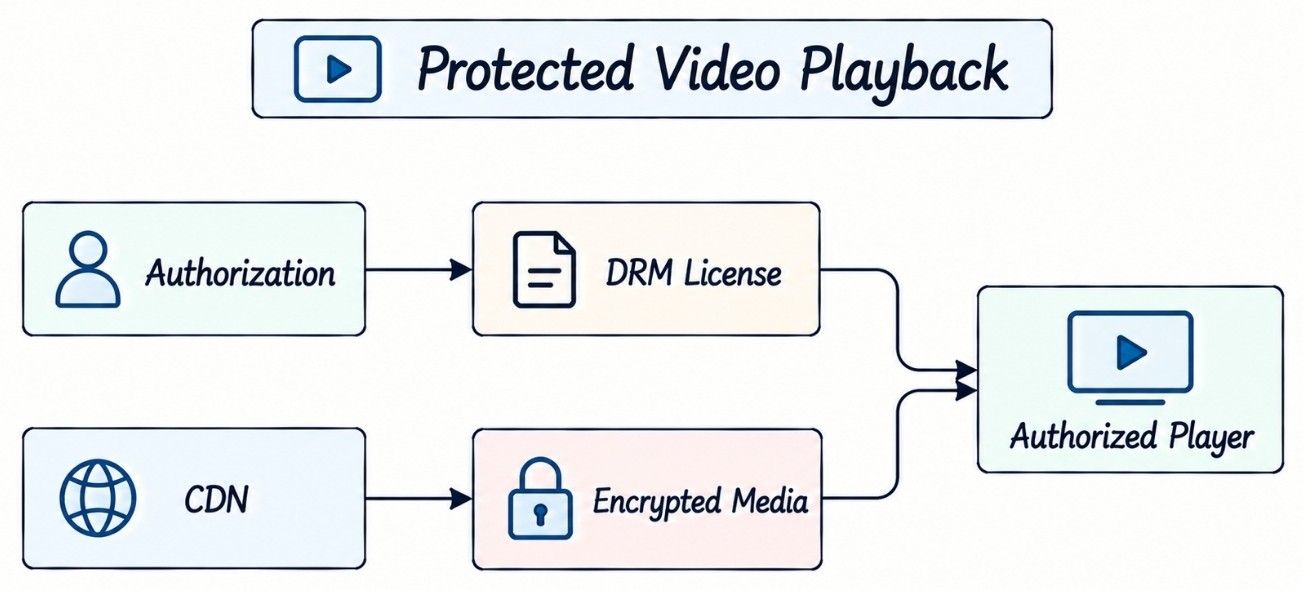
Premium licensed media requires stronger protection than ordinary public video delivery.
Conceptually:
Playback Request
       ↓
Authorization
       ↓
DRM / License Service
       ↓
Playback License

CDN
 ↓
Encrypted Media
 ↓
Authorized Player
The player uses the valid DRM license to decrypt and play the protected media.
Short-lived and scoped playback credentials can reduce the impact of leaked URLs or tokens.
CDN delivery does not replace playback authorization, entitlement checks, or DRM protection.
Movies and shows may contain multiple independent audio and subtitle tracks.
For example:
Video
 ├── English Audio
 ├── Hindi Audio
 ├── Spanish Audio
 ├── English Subtitles
 └── Hindi Subtitles
The playback manifest exposes compatible tracks, allowing the player to independently select:
Video rendition
Audio track
Subtitle track
This avoids creating a separate copy of the entire movie for every language combination.
A playback session provides context for authorization, concurrency control, synchronization, and monitoring.
For example:
session_id
profile_id
title_id
device_id
started_at
region
It can support:
Playback authorization
Concurrent-stream limits
Resume state
Playback telemetry
Quality-of-experience analytics
Fraud and security detection
Playback credentials associated with the session should be scoped and short-lived.
Playback generates large volumes of behavioral and quality events. These events should be processed asynchronously rather than making the playback API execute every downstream task.
Events may include:
play_started
play_paused
play_resumed
quality_changed
buffer_started
buffer_ended
play_completed
Publish them to an event stream:
Playback Events
      ↓
 Event Stream
      |
      +── Viewing History
      +── Analytics
      +── Recommendation Features
      └── QoE Monitoring
Independent consumers can process the same events without coupling their availability or processing latency to the playback path.
Server availability alone does not tell us whether viewers are having a good streaming experience.
Important Quality of Experience metrics include:
Metric | What It Measures |
|---|---|
Time to First Frame | Playback startup speed |
Rebuffering Ratio | Time lost to buffering |
Playback Failure Rate | Failed playback attempts |
Delivered Bitrate | Actual streaming quality |
Quality Switches | ABR behavior |
Segment Latency | Segment delivery performance |
CDN Hit Ratio | Edge-cache effectiveness |
Completion Rate | Whether viewers finish playback |
The player downloads video slightly ahead of the current position:
[Playing] [Buffered] [Buffered] [Future]Too little buffering makes network fluctuations cause stalls.
Too much buffering can waste bandwidth when the viewer exits or seeks elsewhere.
The player balances:
Startup latency
Buffer safety
Bandwidth usage
Video quality
If network throughput decreases while the playback buffer is shrinking:
Network Weakens
      ↓
Buffer Shrinks
      ↓
Lower Bitrate
      ↓
Faster Segment Download
      ↓
Avoid Playback Stall
Temporary quality reduction is often preferable to repeated buffering.
Failures should be isolated so secondary systems do not unnecessarily break playback.
Failure | Expected Behavior |
|---|---|
CDN edge fails | Route to another healthy edge or upstream path |
Recommendation service fails | Serve cached, trending, or generic content |
Viewing history fails | Continue playback and retry progress asynchronously |
Analytics consumer fails | Retain backlog while playback continues |
Encoding worker crashes | Retry the idempotent job after lease/visibility timeout |
Database replica fails | Route eligible reads to healthy replicas |
Backend region fails | Redirect appropriate traffic with capacity controls |
The most important principle is:
Secondary failures should not unnecessarily break the core playback path.
A global platform should keep latency-sensitive control-plane requests and media delivery reasonably close to users.
India Users
     ↓
Regional APIs
     ↓
Nearby CDN

Europe Users
     ↓
Regional APIs
     ↓
Nearby CDN

US Users
     ↓
Regional APIs
     ↓
Nearby CDN
Metadata can be replicated according to its consistency requirements, while media distribution relies heavily on object-storage policies and CDN caching.
If one backend region becomes unavailable, global traffic management can route eligible requests to another healthy region.
Failover still requires:
Capacity planning
Health checks
Regional isolation
Traffic shedding
Controlled fallback behavior
Blindly sending all failed-region traffic to another region can simply move the outage.
Different datasets should be partitioned according to their access patterns rather than forcing one partitioning strategy across the entire system.
Dataset | Possible Partition Key | Common Access Pattern |
|---|---|---|
Viewing progress |
| Continue Watching for a profile |
Catalog metadata |
| Fetch a specific title |
Profile events |
| Process activity for a viewer |
There is no single database or partition key that fits every Netflix-like workload.
Consistency requirements should also be chosen per workflow.
Stronger Correctness Required | Eventual Consistency Often Acceptable |
|---|---|
Subscription entitlement | Recommendations |
Account security | Trending |
Playback authorization | Search indexing |
Parental restrictions | Viewing analytics |
Regional and content rights | Popularity counters |
Correctness-sensitive operations should avoid stale decisions, while discovery and analytics workflows can often tolerate temporary inconsistency.
The key is to define consistency requirements per workflow instead of applying one consistency model to the entire system.
When content is no longer legally or commercially available, new playback must stop quickly.
First update the authoritative state:
Title Availability
       ↓
   UNAVAILABLE
Then asynchronously remove or update:
Search entries
Recommendation candidates
Cached metadata
Media copies where required
Secondary indexes
Security-sensitive playback authorization should not rely only on waiting for CDN cache expiration.
Large event or processing backlogs must not destabilize core playback.
For example:
Playback Events
      ↓
 Event Stream
      ↓
Analytics Consumers
If consumers fall behind, the queue can temporarily absorb work while playback remains independent.
Monitor:
Consumer lag
Oldest event age
Processing throughput
Error rate
Scale consumers or reduce non-critical work before backlog growth becomes uncontrolled.
Search and recommendations both help users discover titles, but they solve different problems.
Aspect | Search | Recommendations |
|---|---|---|
Intent | Explicit user intent | Predicted user interest |
Example | “crime thriller” | Titles the profile may enjoy |
Core Problem | Retrieval and relevance | Personalization and ranking |
Typical Data | Search index | Features, candidates, ranking models |
Search responds to what the user explicitly asks for, while recommendations predict what the user may want to watch.
Their architectures should remain logically separate even if both contribute content to the same homepage or discovery experience.
Netflix-like and YouTube-like systems share many video-platform fundamentals but have significantly different workloads.
Aspect | Netflix-Like Platform | YouTube-Like Platform |
|---|---|---|
Content Source | Controlled studio/licensed ingestion | Massive user-generated uploads |
Upload Volume | Relatively low | Extremely high |
Core Emphasis | Premium streaming and discovery | Creator uploads and streaming |
Content Protection | Strong DRM/licensing focus | Varies by content |
Regional Rights | Major concern | Product/content dependent |
Recommendations | Core discovery experience | Also important |
Upload Pipeline | Controlled ingestion | Resumable direct uploads at massive scale |
Shared Concepts | Encoding, segmentation, ABR, object storage, CDN | Encoding, segmentation, ABR, object storage, CDN |
This distinction is worth stating early if an interviewer asks how the two designs differ.
HLD explains how the distributed streaming platform works as a whole, while LLD focuses on internal component and data-model design.
Aspect | HLD | LLD |
|---|---|---|
Focus | Overall distributed architecture | Internal component design |
Examples | Playback Service, Catalog, CDN, Encoding Pipeline |
|
Main Question | How does the platform work and scale? | How is each component implemented? |
Interview Usage | Discuss first | Explore when deeper implementation is requested |
For a standard “Design Netflix” interview, begin with HLD and move into LLD only when needed.
A strong design starts simple and introduces distributed components as actual bottlenecks appear.
Stage | Architecture Change | Why It Is Added |
|---|---|---|
Early Product | Backend + SQL + Object Storage | Simple starting architecture |
Growing Playback | CDN | Reduce origin bandwidth and latency |
Multiple Devices | Encoding + Multiple Renditions | Support different devices and networks |
Better Streaming | Segmentation + ABR | Adapt quality during playback |
Discovery Scale | Search + Recommendations + Cache | Scale discovery and personalization |
Event Scale | Event Streaming | Decouple history, analytics, recommendations, and QoE |
Premium Platform | DRM + Regional Entitlements | Protect licensed content |
Global Scale | Multi-Region + Global CDN | Improve worldwide latency and availability |
The architecture should evolve from identified requirements and bottlenecks rather than starting with every possible distributed technology.
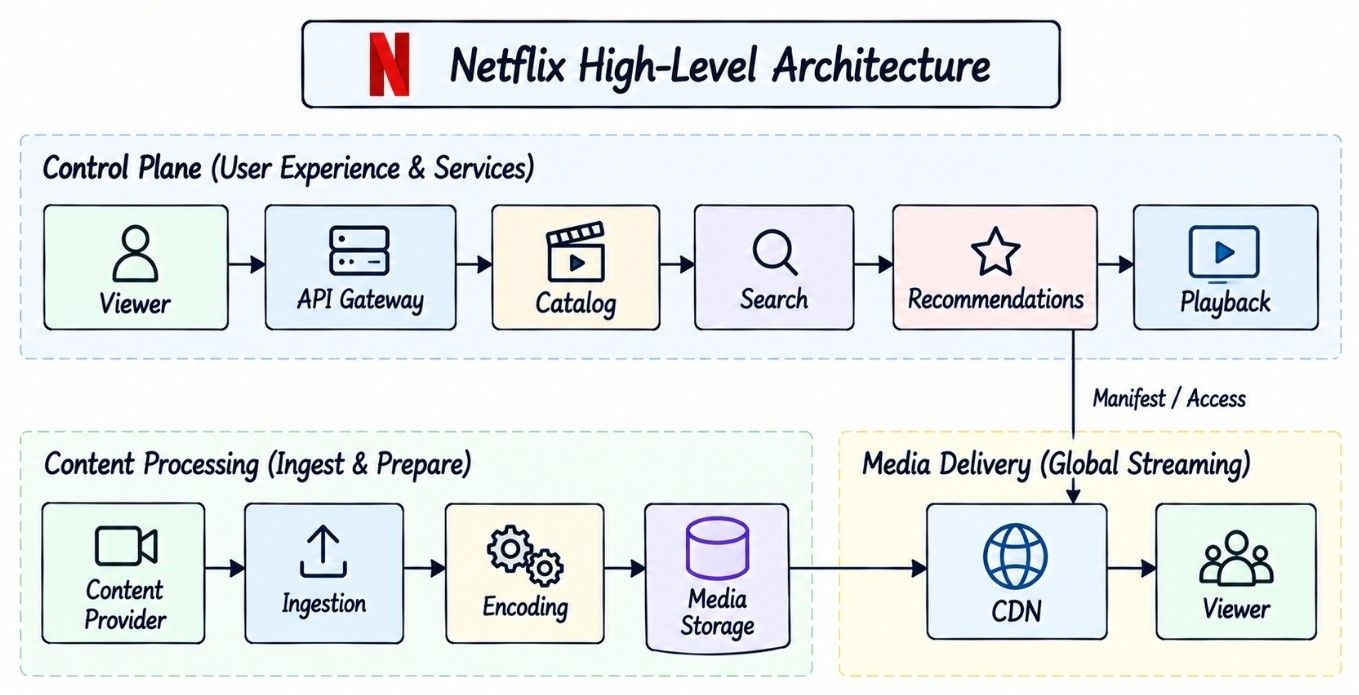
The final architecture separates the control plane, content-processing pipeline, media-delivery path, and asynchronous event consumers.
                         Web / TV / Mobile
                                |
                                v
                           API Gateway
                                |
          +---------------------+----------------------+
          |          |          |          |          |
          v          v          v          v          v
       Profile    Catalog     Search    RecSys      History
          |          |          |          |          |
          +----------+----------+----------+----------+
                                |
                                v
                        Playback Service
                                |
                                v
                      Authorization / DRM
                                |
                                v
                            Manifest
                                |
                                v
                               CDN
                                |
                                v
                         Video Segments
                                |
                                v
                              Player

CONTENT PIPELINE

Content Provider
      ↓
   Ingestion
      ↓
Master Storage
      ↓
Processing Queue
      ↓
Encoding Workers
      ↓
Multiple Renditions
      ↓
Media Storage
      ↓
     CDN

EVENT PIPELINE

Playback Events
      ↓
 Event Stream
      |
      +── Viewing History
      +── Analytics
      +── Recommendation Features
      └── QoE Monitoring
The critical playback path should remain as independent as possible from secondary systems such as analytics and recommendation processing.
These questions cover the concepts most likely to be explored after the initial high-level design.
Separate control-plane services from media delivery. Store large media in object storage, encode it into multiple representations, segment it, distribute it through a CDN, and use adaptive bitrate streaming. Keep catalog, profiles, search, recommendations, authorization, and viewing history as independently scalable components.
Streaming consumes enormous bandwidth. A CDN serves video segments close to viewers, reducing playback latency and preventing central origin infrastructure from handling every media request.
Store video, audio, subtitle, and artwork assets in object/blob storage. Store structured account, catalog, entitlement, and playback metadata in appropriate databases.
Application servers would become expensive bandwidth bottlenecks. They should authorize and coordinate playback while CDN/media infrastructure transfers the actual video bytes.
The video exists in multiple bitrate and resolution representations. The player dynamically selects future segments based on bandwidth, buffer health, device capabilities, and other playback conditions.
Use nearby CDN delivery, adaptive bitrate selection, client-side buffering, appropriate segment sizes, retries, and lower-quality segments when available throughput falls.
Periodically checkpoint playback progress using profile and title identifiers. When the viewer opens the title on another device, retrieve the latest valid checkpoint and resume near that position.
It creates unnecessary write volume. Periodic checkpoints plus important events such as pause, exit, seek, and completion provide sufficient accuracy at much lower cost.
Collect viewing signals, generate a smaller candidate set, rank those candidates using profile, content, and contextual features, and return the highest-ranked titles. Precomputation plus lightweight online reranking provides a useful latency/freshness balance.
Use CDN distribution heavily, pre-position expected hot media where appropriate, cache hot metadata, replicate hot keys, and protect caches from stampedes.
Generate suitable high-resolution and high-bitrate renditions and expose them only when device, display, subscription, and network conditions allow them.
Authorize the request, provide protected downloadable media and appropriate offline entitlement/license information, store it on the authorized device, and enforce expiration and content restrictions.
Store independent audio and subtitle tracks and expose compatible tracks through playback metadata rather than creating a separate full movie for every language combination.
Asynchronously index relevant catalog metadata into a dedicated search system optimized for full-text retrieval. Search can generally tolerate brief indexing delay.
Choose storage according to access patterns and correctness requirements. Account and entitlement data may need relational semantics, while search, high-volume events, caches, media assets, and some viewing workloads have different storage requirements.
Return cached recommendations, trending titles, or generic popular content. Recommendation failure should not prevent a user from playing an available title.
Maintain account and profile state centrally, synchronize playback progress through backend services, and issue device-appropriate playback authorization.
Use authentication, entitlement checks, encrypted media, DRM/license mechanisms, short-lived credentials, and device/content restrictions where appropriate.
Deploy control-plane services regionally, replicate appropriate metadata, distribute media through global CDN infrastructure, route users to healthy nearby systems, and design controlled regional failover.
Monitor time to first frame, rebuffering ratio, playback failures, delivered bitrate, segment latency, CDN hit ratio, origin traffic, API P95/P99 latency, recommendation latency, and event-consumer lag.
A Netflix-like architecture involves balancing playback quality, latency, reliability, and infrastructure cost.
Higher video quality improves visual experience but increases bandwidth, storage, and encoding cost.
More CDN replication improves latency and availability but increases distribution and storage cost.
More frequent progress updates improve resume accuracy but increase write load.
Shorter segments adapt faster but create more requests and protocol overhead.
More buffering protects against network fluctuations but can waste bandwidth.
Real-time recommendation computation improves freshness but costs more and may increase latency.
Stronger consistency improves correctness but may reduce availability or increase coordination cost.
A good system-design answer explains why a particular trade-off is acceptable for the workflow.
These mistakes usually make a Netflix system design incomplete or unnecessarily complicated.
Designing Netflix exactly like a user-generated video platform
Storing large movies in the primary relational database
Streaming video bytes through application servers
Forgetting CDN-based media delivery
Serving only one video quality
Ignoring segmentation and adaptive bitrate streaming
Writing playback progress every second
Making recommendations, analytics, or history hard dependencies of playback
Ignoring DRM, entitlement, and regional content restrictions
Adding Kafka, Redis, Cassandra, Kubernetes, or other technologies without explaining the bottleneck they solve
A Netflix-like platform can be understood through three major paths.
Path | Core Flow |
|---|---|
Content Preparation | Ingestion → Encoding → Renditions → Segmentation → Media Storage |
Playback | Authorization → Manifest → CDN → Video Segments → Adaptive Player |
Supporting Systems | Playback Events → History, Recommendations, Analytics, QoE |
The most important design ideas are:
Separate structured metadata from large media assets
Encode content into multiple representations
Segment media for adaptive streaming
Deliver video through CDN infrastructure
Keep control-plane services away from the bandwidth-heavy media path
Protect premium content with authorization and DRM
Synchronize viewing progress across devices
Decouple recommendations, analytics, and history from playback
Design for graceful degradation and regional failures
Choose consistency according to each workflow
The core principle is to keep the control plane responsible for deciding what the user can watch, while the media-delivery plane is optimized for moving enormous amounts of video efficiently.
