
Durgesh Tiwari
Author
Modern applications are often built using multiple services such as Order Service, Payment Service, Inventory Service, and Notification Service. These services need to exchange information to complete different tasks. If every service communicates directly with the others, the system becomes tightly connected, harder to manage, and more difficult to scale.
Messaging Systems solve this problem by allowing services to communicate through messages instead of making direct requests. This makes applications more scalable, reliable, and fault-tolerant. Today, messaging systems are widely used in distributed systems, microservices, cloud applications, and real-time data processing.
A Messaging System is a communication mechanism that allows different applications or services to exchange information by sending and receiving messages.
Instead of communicating directly, one service sends a message to the messaging system, and the receiving service processes that message whenever it is available.
In simple words, a Messaging System acts as a bridge that allows different services to communicate without depending on each other.
A Messaging System follows a simple process:
A service creates a message after completing a task.
The message is sent to the messaging system.
The messaging system stores and delivers the message.
The receiving service reads the message when it is ready.
The receiving service processes the task independently.
Suppose a customer places an order on an e-commerce website.
Instead of calling every service directly, the Order Service sends a message to the messaging system.
The Inventory Service updates the product stock.
The Payment Service processes the payment.
The Notification Service sends an email or SMS confirmation.
Each service works independently, making the application faster and easier to scale.
As applications grow, many services need to exchange data continuously. If every service depends on another service being available, failures in one service can affect the entire application.
A Messaging System removes this dependency by allowing services to communicate independently. This improves application performance, reliability, and scalability, especially in large distributed systems.
Messaging Systems provide several benefits for modern applications.
Reduces Service Dependencies – Services communicate through messages instead of direct connections.
Improves Scalability – New services can be added without affecting existing ones.
Supports Asynchronous Communication – Services can process messages at their own pace.
Increases System Reliability – Messages can be stored until the receiving service is available.
Handles Traffic Spikes Efficiently – Incoming messages can be queued during periods of heavy traffic.
Improves Fault Tolerance – Temporary service failures do not immediately affect other services.
Enables Independent Processing – Each service performs its own task without waiting for others.
Modern platforms such as Amazon, Netflix, Uber, and PayPal use Messaging Systems to build scalable, reliable, and high-performance distributed applications.
When different services in an application communicate, the receiving service may not always be ready to process a request immediately. If the sender has to wait, the application can become slow and less reliable.
A Message Queue solves this problem by temporarily storing messages until the receiving service is ready to process them. This allows both services to work independently without waiting for each other.
In simple words, a Message Queue temporarily stores messages and delivers them to the receiving service when it is ready.
A Message Queue follows a simple process:
A Producer creates and sends a message.
The message is stored in the Message Queue.
A Consumer reads the message from the queue when it is ready.
The consumer processes the message.
After successful processing, the message is removed from the queue.
Producer
    │
    ▼
Message Queue
    │
    ▼
ConsumerSuppose a customer uploads an image to a social media platform.
Instead of processing the image immediately, the application places the image processing request into a Message Queue. The upload finishes quickly, while a background service later retrieves the message, processes the image, and generates different image sizes without affecting the user's experience.
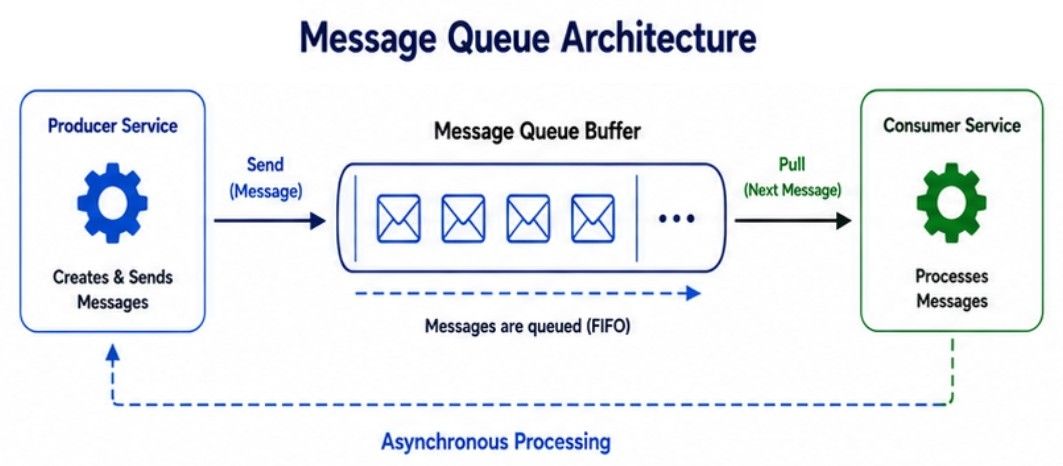
A Message Queue provides several benefits for distributed applications.
Supports Asynchronous Processing – Services can process tasks independently without waiting for each other.
Reduces Service Dependencies – Producers and consumers work independently, making the system more flexible.
Handles Traffic Spikes – Messages are stored safely until consumers are ready to process them.
Improves System Reliability – Messages remain in the queue even if a consumer is temporarily unavailable.
Improves Scalability – Additional consumers can be added to process more messages as traffic grows.
Although a Message Queue improves system performance, it also has some limitations.
Message Processing May Be Delayed – Messages wait in the queue until a consumer is available.
Requires Queue Management – Queues should be monitored to prevent message buildup.
Adds System Complexity – Managing producers, consumers, and queues increases the overall system architecture complexity.
In some applications, a message should be processed only once. For example, an order should not be processed multiple times because it can create duplicate records or incorrect results.
Point-to-Point Messaging is a messaging pattern where a Producer sends a message to a Message Queue, and only one Consumer receives and processes that message. After the message is processed successfully, it is removed from the queue.
In simple words, Point-to-Point Messaging ensures that one message is processed by only one consumer.
Point-to-Point Messaging follows a simple process:
A Producer sends a message to the Message Queue.
The message waits in the queue until a consumer is available.
One Consumer retrieves the message from the queue.
The consumer processes the message.
After successful processing, the message is removed from the queue.
Producer
    │
    ▼
Message Queue
    │
    ▼
ConsumerSuppose an e-commerce application receives a new customer order.
The Order Service sends the order details to a Message Queue. One Order Processing Service reads the message, processes the order, and removes it from the queue. No other consumer can process the same order, ensuring it is handled only once.
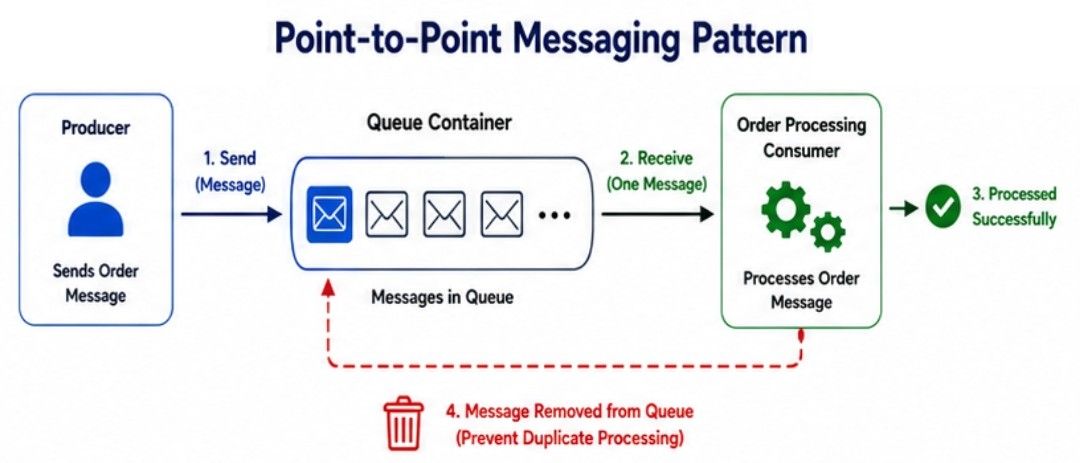
Point-to-Point Messaging provides several benefits for distributed applications.
Simple to Implement – Easy to set up and use for background processing.
Reliable Message Processing – Each message is processed by only one consumer.
Prevents Duplicate Processing – The same message cannot be processed multiple times.
Supports Background Tasks – Ideal for jobs such as order processing, email sending, and image processing.
Easy to Scale – Multiple consumers can be added to process different messages from the queue.
Although Point-to-Point Messaging is reliable, it also has some limitations.
Only One Consumer Receives Each Message – Other consumers cannot access the same message.
Not Suitable for Broadcasting – Multiple services cannot receive the same message simultaneously.
Message Processing May Wait – Messages remain in the queue until a consumer becomes available.
In many applications, the same event needs to be shared with multiple services at the same time. Sending separate messages to each service increases complexity and creates unnecessary dependencies.
Publish-Subscribe (Pub/Sub) is a messaging pattern where a Publisher sends a message to a Topic, and every Subscriber connected to that topic receives its own copy of the message. The publisher does not need to know who the subscribers are, making communication simple and scalable.
In simple words, Pub/Sub allows one service to send a message once, and multiple services receive and process it independently.
Publish-Subscribe follows a simple process:
A Publisher creates and publishes a message.
The message is sent to a Topic.
All subscribers connected to that topic receive a copy of the message.
Each subscriber processes the message independently.
Every service completes its own task without affecting the others.
              Publisher
                  │
                  ▼
             Topic (Pub/Sub)
        ┌─────────┼─────────┐
        ▼         ▼         ▼
 Inventory   Notification  Analytics
Service Service ServiceSuppose a customer places an order on an e-commerce website.
The Order Service publishes an Order Created event to a topic.
The subscribers receive the same event and perform their own tasks independently:
Inventory Service updates product stock.
Payment Service processes the payment.
Notification Service sends an order confirmation.
Analytics Service records the order for reporting.
Each service works independently without communicating directly with the others.
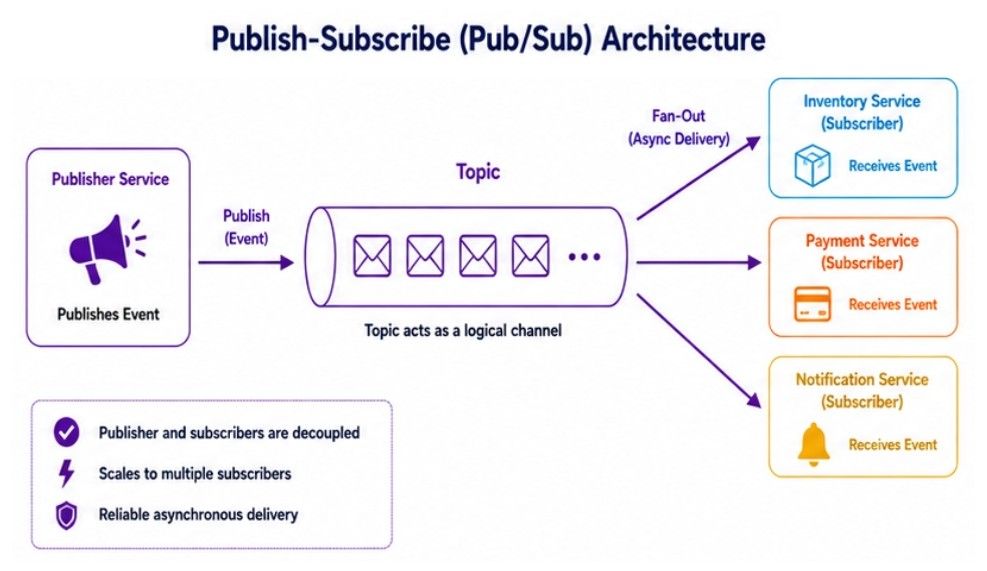
Publish-Subscribe provides several benefits for distributed applications.
Supports Multiple Subscribers – Multiple services can receive the same message at the same time.
Reduces Service Dependencies – Publishers do not need to know about subscribers.
Easy to Extend – New subscribers can be added without changing the publisher.
Improves Scalability – Supports large distributed systems with many services.
Ideal for Event-Driven Architectures – Makes it easy to distribute events across multiple services.
Although Publish-Subscribe is highly scalable, it also has some limitations.
Message Delivery Is More Complex – The messaging system must deliver messages to multiple subscribers.
Debugging Can Be Difficult – Tracking message flow across many services is more challenging.
Higher Infrastructure Requirements – Managing topics and multiple subscribers requires additional resources and monitoring.
Some applications generate a continuous flow of events every second. Instead of processing these events one by one and then deleting them, the system stores them so multiple services can read and process them whenever needed.
Event Streaming is a messaging approach where events are continuously generated, stored, and processed in real time. Unlike a Message Queue, events are retained for a configurable period, allowing multiple consumers to read the same event independently, even after it has been processed.
In simple words, Event Streaming continuously stores events so multiple services can process them in real time or read them later when needed.
Event Streaming follows a simple process:
A service generates an event.
The event is published to an Event Stream.
The event is stored for a configurable retention period.
Multiple consumers read the same event independently.
Each consumer processes the event according to its own requirements.
Suppose a payment platform processes thousands of transactions every second.
For every transaction, it generates events such as:
Payment Created
Payment Completed
Payment Failed
Different services read these events independently:
Fraud Detection Service checks for suspicious transactions.
Notification Service sends payment updates.
Analytics Service generates business reports.
Monitoring Service tracks system performance.
All services can process the same event without affecting one another.
Event Streaming provides several benefits for modern distributed applications.
Supports Real-Time Processing – Events are processed as soon as they are generated.
Highly Scalable – Can handle millions of events across multiple services.
Supports Multiple Consumers – Multiple services can read and process the same event independently.
Allows Event Replay – Stored events can be read again whenever required.
Ideal for Event-Driven Systems – Commonly used for analytics, monitoring, logging, and real-time data processing.
Although Event Streaming is powerful, it also has some limitations.
More Complex to Manage – Setting up and maintaining event streams requires careful planning.
Higher Storage Requirements – Events are retained for a period instead of being deleted immediately.
Requires Specialized Platforms – Event streaming systems need dedicated tools and infrastructure for reliable operation.
There is no single messaging pattern that works for every application. The right choice depends on how services communicate, how messages are processed, and what the application needs.
Let's understand when each messaging pattern is the best choice.
Choose a Message Queue when a task needs to be processed independently in the background and does not require an immediate response.
Best suited for:
Background task processing.
Tasks that should be completed once.
Applications where services should work independently.
Examples:
Email sending
Image processing
Order processing
Choose Point-to-Point Messaging when each message should be processed by only one consumer.
This ensures that the same task is not processed multiple times.
Best suited for:
Tasks that must be processed only once.
Applications where duplicate processing should be avoided.
Background job processing.
Examples:
Payment processing
Invoice generation
Job scheduling
Choose Publish-Subscribe (Pub/Sub) when the same event needs to be delivered to multiple services at the same time.
Each subscriber receives and processes its own copy of the message independently.
Best suited for:
Event-driven applications.
Systems where multiple services need the same event.
Applications that may add new subscribers in the future.
Examples:
Order events
User registration events
Notification systems
Choose Event Streaming when events need to be processed in real time and stored for future analysis or replay.
Multiple services can read the same event independently whenever needed.
Best suited for:
Real-time event processing.
Applications that need to retain event history.
Systems where multiple services analyze the same stream of events.
Examples:
Fraud detection
IoT sensor data
Financial transactions
Log processing
Messaging Pattern | Primary Purpose | Who Processes the Message? | Message Availability |
|---|---|---|---|
Message Queue | Background task processing | One consumer | Stored until it is successfully processed |
Point-to-Point Messaging | Process a task exactly once | One consumer | Removed after successful processing |
Publish-Subscribe (Pub/Sub) | Share the same event with multiple services | Multiple subscribers | Delivered to all subscribers, usually not retained for long |
Event Streaming | Process and analyze real-time events | Multiple consumers | Events are retained for a configurable period and can be replayed |
Consider an e-commerce platform where thousands of customers place orders every day.
When a customer places an order, the Order Service publishes an Order Created event. Multiple services receive this event and perform their own tasks independently. The Inventory Service updates product stock, the Payment Service processes the payment, and the Notification Service sends an order confirmation to the customer.
At the same time, background tasks such as invoice generation and email delivery are processed through Message Queues, allowing the customer to receive an immediate response without waiting for these tasks to finish.
The platform also uses Event Streaming to continuously process customer activities, helping analytics, reporting, fraud detection, and recommendation systems generate real-time insights.
By combining Message Queues, Point-to-Point Messaging, Publish-Subscribe, and Event Streaming, the platform can process millions of events efficiently while remaining scalable, reliable, and highly available.
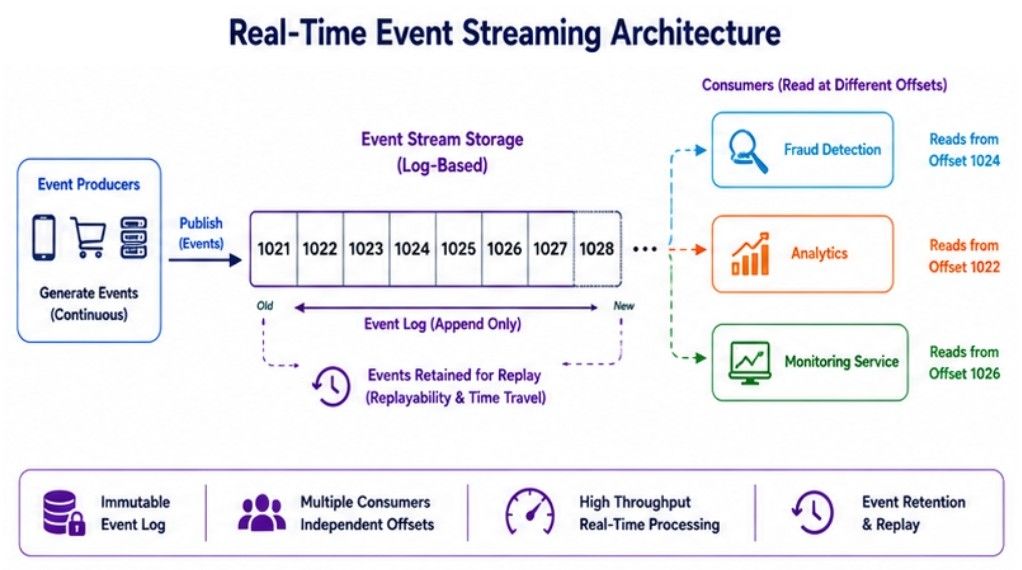
Messaging Systems are an important part of System Design because they allow different services to communicate without depending on each other directly. By exchanging messages instead of making direct requests, applications become more scalable, reliable, and fault-tolerant.
The key concepts covered in this chapter include:
Messaging Systems enable services to exchange data through messages, improving communication in distributed applications.
Message Queues temporarily store messages until a consumer is ready to process them.
Point-to-Point Messaging ensures that each message is processed by only one consumer.
Publish-Subscribe (Pub/Sub) allows multiple services to receive and process the same event independently.
Event Streaming supports continuous real-time event processing and allows events to be stored and replayed when needed.
The right messaging pattern depends on the application's communication requirements, processing model, and scalability needs.
