
Durgesh Tiwari
Author
Modern applications generate and process a huge amount of data every day. They need to store data correctly, process user requests quickly, and keep multiple services synchronized. As the application grows, using the same method for reading, writing, and managing data is often not enough.
This is where Data Patterns become important.
Data Patterns are common design techniques that help applications manage data more efficiently. They improve performance, scalability, data consistency, and system reliability while making applications easier to build and maintain.
These patterns are widely used in microservices, cloud applications, financial systems, and large-scale distributed systems where data is shared across multiple services.
Data Patterns are proven design approaches for storing, updating, and synchronizing data in a distributed system.
They help applications organize data, separate different types of operations, and make sure important business events are handled correctly.
As the amount of data and the number of users increase, these patterns help the application continue working efficiently without affecting performance.
In simple words, Data Patterns provide smart ways to manage data as an application grows.
Imagine an e-commerce application where a customer places an order.
The application needs to create the order, process the payment, update the product inventory, and send a confirmation message.
Data Patterns help these services exchange and manage data correctly, so the same order is not processed twice and no important information is lost.
In a distributed system, an application performs two main types of operations. One operation updates data, and the other reads data. As the number of users grows, handling both operations with the same model can reduce performance.
This is where CQRS (Command Query Responsibility Segregation) becomes useful.
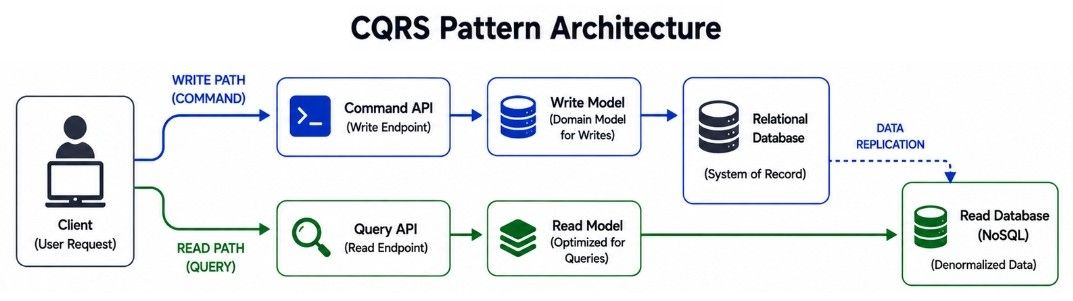
CQRS is a design pattern that separates write operations (Commands) from read operations (Queries). Instead of using one model for both tasks, it uses separate models for writing and reading data.
This allows each model to be optimized for its specific job.
In simple words, CQRS separates data updates from data retrieval.
The process is simple:
A Command receives requests that create, update, or delete data.
The write model processes the request and saves the changes.
A Query handles requests that only read data.
The read model returns the requested information without modifying the data.
Since both models work independently, read and write operations can be scaled separately.
Imagine an e-commerce application.
When a customer places an order, the Command creates the new order and stores it in the database.
Later, when the customer opens the Order History page, the Query retrieves the order details without changing any data.
This means the service that creates orders is different from the service that displays order information.
CQRS provides several benefits:
Improves Application Performance – Read and write operations are optimized separately.
Supports Independent Scaling – Read and write workloads can be scaled based on demand.
Handles Complex Business Logic – Commands and queries remain separate, making the application easier to manage.
Reduces Database Load – Read requests do not interfere with write operations.
CQRS also has some challenges:
Increases Application Complexity – Separate models are needed for reading and writing.
Requires Data Synchronization – The read model must stay updated with the latest changes.
Needs More Development Effort – Maintaining two models requires additional planning and implementation.
In a distributed system, data changes frequently. Most applications save only the latest version of the data. As a result, older changes are lost, making it difficult to track what happened in the past.
This is where Event Sourcing becomes useful.
Event Sourcing is a design pattern that stores every change as an event instead of saving only the current state. The application can recreate the latest state by replaying all the stored events in the correct order.
In simple words, Event Sourcing stores every action that happens in the system instead of only the final result.
The process is simple:
A user performs an action.
The application records the action as an event.
Every new change is stored as another event instead of replacing the previous data.
When needed, the application rebuilds the current state by replaying all the stored events.
This creates a complete history of every change made in the system.
Imagine a customer updating their profile in an e-commerce application.
Instead of saving only the latest profile information, the application stores each update as a separate event, such as:
Profile Created
Address Updated
Phone Number Changed
Email Updated
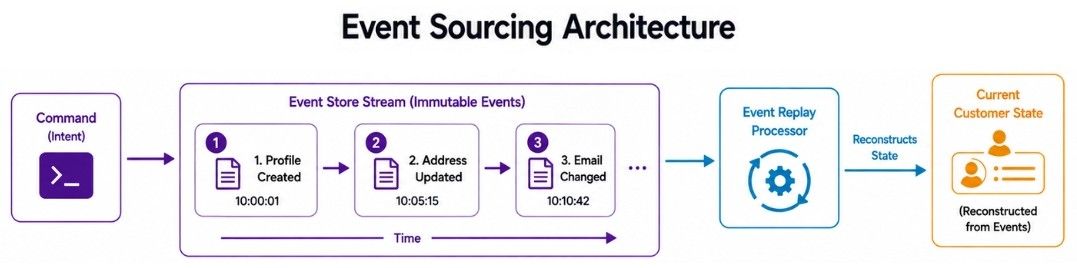
By replaying these events in order, the application can recreate the customer's current profile and also view the complete history of changes.
Event Sourcing provides several benefits:
Maintains Complete History – Every change is stored as an event.
Simplifies Auditing – Makes it easy to see who changed what and when.
Supports Event Replay – The current state can be recreated from stored events.
Improves Debugging – Developers can trace the sequence of events to find issues.
Event Sourcing also has some challenges:
Requires More Storage – Every event must be stored instead of only the latest data.
Makes the Architecture More Complex – Managing events requires additional design.
Rebuilding Data Takes Time – Replaying many events can increase processing time.
In a microservices architecture, one business action often needs to update the database and send an event to other services. If one of these steps succeeds and the other fails, the application can end up with inconsistent data.
This is where the Transactional Outbox Pattern becomes useful.
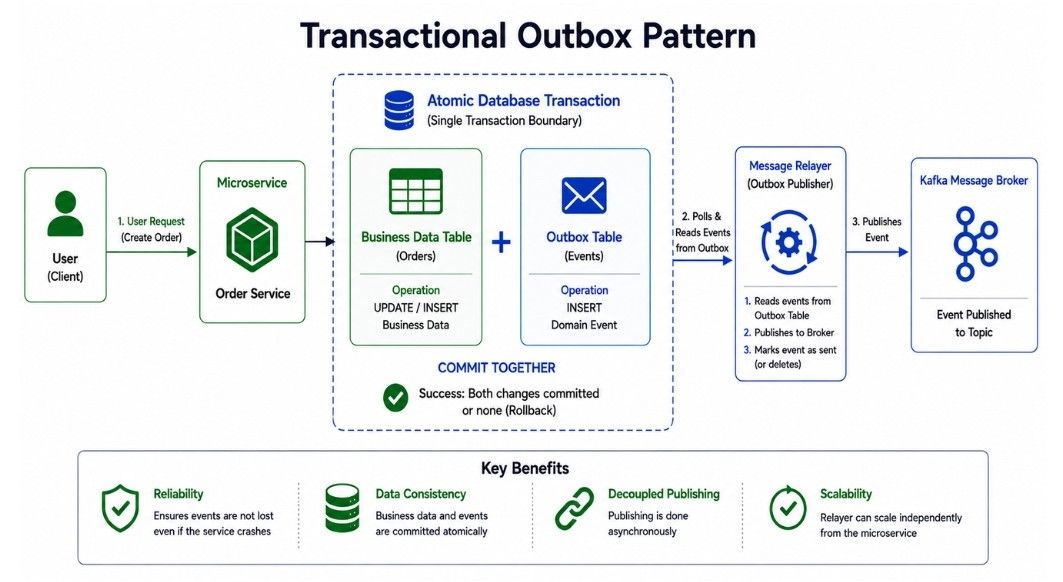
The Transactional Outbox Pattern makes sure that database updates and event publishing happen reliably. Instead of sending an event immediately after updating the database, the application first stores the event in a special Outbox Table as part of the same database transaction.
A background process later reads the Outbox Table and publishes the event to a message broker such as Kafka or RabbitMQ.
In simple words, the Transactional Outbox Pattern saves the event in the database first and publishes it later, so no event is lost.
The process is simple:
The application receives a business request.
It updates the database.
It stores the related event in the Outbox Table during the same transaction.
A background service continuously checks the Outbox Table.
The background service publishes the event to the message broker.
Other services receive and process the event.
This approach ensures that the database update and the event remain consistent.
Imagine a customer places an order on an e-commerce application.
The application performs these steps:
It saves the new order in the database.
It stores an Order Created event in the Outbox Table.
A background service reads the event and publishes it to Kafka or RabbitMQ.
The Inventory Service updates the product stock, and the Notification Service sends the order confirmation.
Even if the application stops working after saving the order, the event remains in the Outbox Table and will be published when the background service starts again.
The Transactional Outbox Pattern provides several benefits:
Prevents Message Loss – Events are safely stored before they are published.
Keeps Data Consistent – Database updates and events stay synchronized.
Improves Application Reliability – Reduces the risk of missing important events.
Works Well with Microservices – Helps services communicate reliably through events.
The Transactional Outbox Pattern also has some challenges:
Requires an Outbox Table – An additional table is needed to store events.
Needs a Background Process – A separate service must publish the stored events.
Events Are Not Published Instantly – There may be a small delay before other services receive the event.
Although CQRS and Event Sourcing are often used together, they solve different problems.
CQRS | Event Sourcing |
|---|---|
Separates read and write operations. | Stores every data change as an event. |
Improves application performance and scalability. | Maintains a complete history of all data changes. |
Uses separate models for Commands and Queries. | Rebuilds the current application state by replaying stored events. |
Read and write databases can be different. | The Event Store becomes the main source of truth. |
Can be implemented without Event Sourcing. | Can also be implemented without CQRS. |
Each Data Pattern is designed to solve a different problem in a distributed system. Choosing the right pattern depends on how your application stores, reads, and shares data.
Read and write operations have different workloads.
The application receives a large number of read requests.
Read performance needs to be improved.
Examples:
E-commerce websites
Banking dashboards
Reporting systems
Every data change needs to be recorded.
A complete audit history is required.
Events need to be replayed to rebuild data.
Examples:
Banking systems
Financial applications
Inventory management
Order tracking systems
Database updates and event publishing must stay consistent.
The application uses a microservices architecture.
Events are published through a message broker such as Kafka or RabbitMQ.
Examples:
Order processing
Payment systems
Inventory updates
Notification services
Imagine an e-commerce application where a customer places an order.
The application uses CQRS to separate order creation from order viewing, allowing both operations to be managed independently for better performance.
Every important action, such as Order Created, Payment Completed, and Order Shipped, is stored using Event Sourcing. This gives the application a complete history of the order and makes it easy to track every change.
After the order is saved, the application uses the Transactional Outbox Pattern to store the event safely before publishing it to a message broker like Kafka or RabbitMQ. The Inventory Service, Payment Service, and Notification Service then receive the event and perform their respective tasks.
By combining these Data Patterns, the application can improve performance, maintain a complete event history, and ensure that important events are delivered reliably without losing data.
Data Patterns help applications store, manage, and share data efficiently in distributed systems. They improve performance, keep data consistent, and make applications easier to scale as user traffic grows.
CQRS (Command Query Responsibility Segregation) separates read and write operations, allowing each one to be optimized independently for better performance.
Event Sourcing stores every data change as an event, making it easy to track the complete history of changes and rebuild the current state whenever needed.
Transactional Outbox Pattern ensures that database updates and event publishing remain consistent by storing events in an Outbox Table before they are sent to a message broker.
