
Durgesh Tiwari
Author
API Design is the process of defining how an API should be structured so that different applications can communicate efficiently. It involves deciding how clients will send requests, how the server will return responses, and how the API will evolve over time.
A well-designed API is easy to understand, consistent, secure, and scalable. It makes integration simpler for developers and reduces maintenance as the application grows.
When designing an API, developers should focus on:
Clear and meaningful endpoints
Consistent request and response formats
Proper API versioning
Pagination for large datasets
Filtering and sorting data
Well-defined API contracts
Meaningful HTTP status codes and error messages
These practices make APIs easier to use, maintain, and extend.
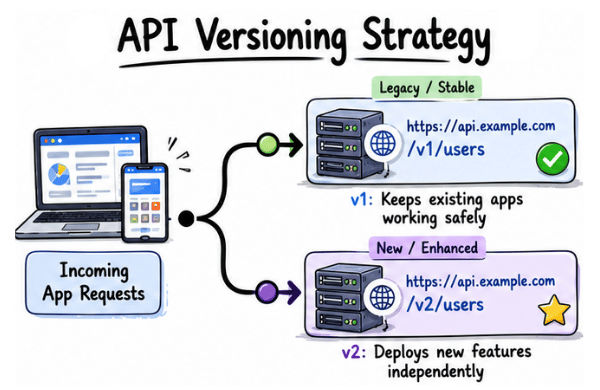
API Versioning is the practice of managing changes to an API without breaking existing applications that depend on it.
As applications evolve, developers may add new features, modify existing endpoints, or remove outdated functionality. Instead of forcing every client to update immediately, a new version of the API is released while the older version continues to work.
This approach allows developers to introduce improvements without affecting existing users.
A common way to version an API is by including the version number in the URL.
<https://api.example.com/v1/users>After introducing new features or changes:
<https://api.example.com/v2/users>Applications using v1 continue to work without modification, while new applications can start using v2.
Prevents breaking existing applications.
Maintains backward compatibility.
Allows new features to be introduced safely.
Gives developers time to migrate to newer versions.
Makes API maintenance and evolution easier.
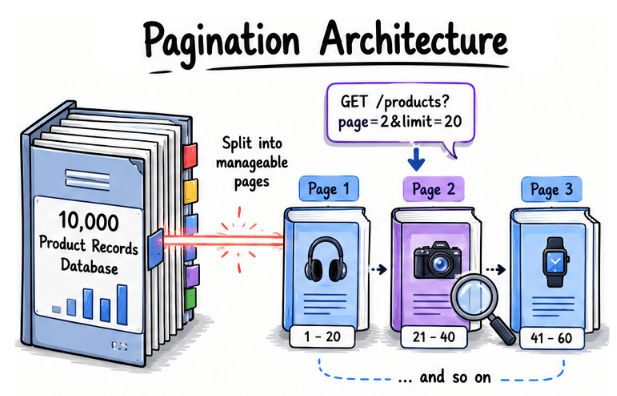
Pagination is a technique used to split a large collection of data into smaller, manageable pages instead of returning everything in a single API response.
Returning a huge amount of data at once can increase response time, consume more bandwidth, and put unnecessary load on the server. Pagination solves this problem by returning only a limited number of records in each request.
Pagination is commonly used in applications that display large datasets, such as e-commerce websites, social media feeds, search results, and user lists.
Suppose an online store contains 10,000 products. Instead of returning all products in one response, the API returns 20 products per page.
Example request:
GET /products?page=2&limit=20This request returns the second page, containing 20 products.
Improves API performance by returning fewer records.
Reduces server load and bandwidth usage.
Makes API responses faster.
Improves the user experience by loading data in smaller chunks.
Helps applications handle large datasets efficiently.
Method | Description | Example |
|---|---|---|
Offset-based Pagination | Retrieves data using page numbers or offsets. |
|
Cursor-based Pagination | Retrieves data using a cursor that points to the last returned record. It performs better for large and frequently changing datasets. |
|
Filtering is a technique that allows clients to retrieve only the data that matches specific conditions instead of returning all available records.
Without filtering, an API may return a large amount of unnecessary data. By applying filters, clients receive only the information they need, making the API more efficient and reducing data transfer.
Filtering is commonly used in e-commerce applications, search systems, booking platforms, and reporting dashboards.
Suppose an online shopping application contains thousands of products.
If a user wants to view only products in the Electronics category, the API request might look like this:
GET /products?category=electronicsThe API returns only products that belong to the Electronics category.
Filtering can also be combined with multiple conditions. For example:
GET /products?category=electronics&brand=appleThis request returns only Apple electronics.

Returns only relevant data.
Reduces unnecessary data transfer.
Improves API performance.
Makes searching faster and more efficient.
Provides a better user experience.
Filter | Example |
|---|---|
Category |
|
Brand |
|
Price Range |
|
Availability |
|
Sorting is a technique used to arrange API data in a specific order, such as ascending or descending. It helps users view information in the order that is most useful to them.
Without sorting, data is usually returned in its default order, which may not always be meaningful. Sorting allows clients to organize results based on fields such as price, date, name, rating, or popularity.
Sorting is commonly used in e-commerce applications, search results, dashboards, and reporting systems.
Suppose an online shopping application allows users to sort products by price.
To display products from low to high price:
GET /products?sort=price&order=ascTo display the newest products first:
GET /products?sort=createdAt&order=descSorting can also be applied to other fields, such as product ratings or names.
Organizes data in a meaningful order.
Makes searching and browsing easier.
Improves the user experience.
Helps users find relevant information more quickly.
Sort By | Example |
|---|---|
Price (Low to High) |
|
Price (High to Low) |
|
Newest First |
|
Name (A–Z) |
|
Rating (Highest First) |
|

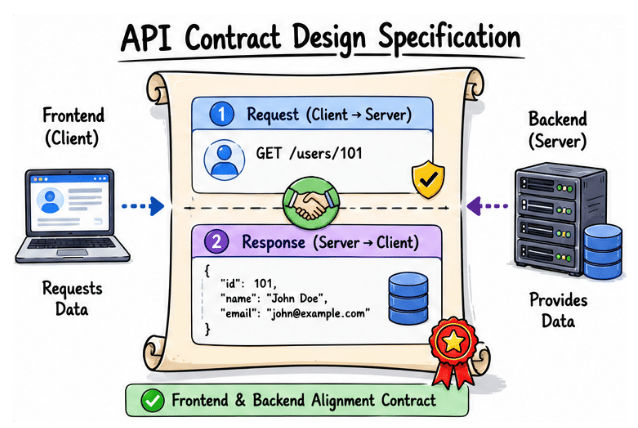
An API Contract is a specification that defines how clients and servers communicate with each other. It clearly describes what requests a client can send and what responses the server will return.
In simple terms, an API contract acts as an agreement between the frontend and backend. As long as both follow the same contract, they can work independently without confusion.
A well-defined API contract makes APIs easier to develop, test, document, and maintain.
An API contract typically defines:
API endpoints
HTTP methods
Request parameters
Request body
Response format
HTTP status codes
Authentication and authorization requirements
Error responses
Request
GET /users/101Response
{
  "id":101,
  "name":"Rahul",
  "email":"[email protected]"
}
From this contract, developers know:
Which endpoint to call.
Which HTTP method to use.
What the response will look like.
What data the application can expect.
Improves communication between frontend and backend teams.
Reduces integration and development errors.
Makes APIs easier to test and document.
Ensures consistent request and response formats.
Simplifies API maintenance as applications grow.
Some commonly used tools for defining and documenting API contracts include:
OpenAPI Specification (Swagger)
Postman
API Blueprint
API design helps developers build APIs that are easy to understand, maintain, and scale.
API Versioning allows APIs to evolve without breaking existing applications.
Pagination divides large datasets into smaller, manageable pages.
Filtering returns only the data that matches specific conditions.
Sorting organizes data in a meaningful order to improve usability.
API Contract Design defines how clients and servers communicate by specifying requests and responses.
By following these API design principles, developers can build reliable, scalable, and developer-friendly APIs that are easier to integrate, test, and maintain.
