
Durgesh Tiwari
Author
Modern applications such as Amazon, Netflix, Flipkart, Uber, and Paytm serve millions of users every day. These applications are built using multiple independent services, each responsible for a specific task. To complete a user request, these services need to communicate with one another. This interaction is known as service communication.
In this article, you will learn what service communication is, why it is important, and how services communicate in modern distributed systems.
Service communication is the process through which two or more services exchange information to complete a business operation.
Unlike a monolithic application, where components communicate through internal function calls, microservices communicate over a network using APIs, messages, or events. This allows each service to remain independent while still collaborating to complete user requests.
Service communication is the exchange of requests, responses, messages, or events between services in a distributed system to complete a business operation.
When a customer places an order on an e-commerce website:
The Order Service creates the order.
The Payment Service processes the payment.
The Inventory Service updates the product stock.
The Shipping Service prepares the delivery.
The Notification Service sends an email or SMS confirmation.
Together, these services complete the customer's order.
In a microservices architecture, each service is responsible for a specific task. To complete a business operation, these services need to communicate and share information. Without service communication, individual services would operate independently, making it impossible to process complete user requests.
Enables services to work together.
Supports independent development and deployment.
Improves scalability.
Increases reliability.
Helps isolate failures.
Supports cloud-native applications.
Improves flexibility and maintainability.
When a user performs an action, multiple services work together to complete the request.
For example, when a customer clicks the Place Order button on an e-commerce website, the workflow is:
The customer places an order.
The Order Service receives the request.
The Payment Service processes the payment.
The Inventory Service updates the product stock.
The Shipping Service creates the delivery request.
The Notification Service sends an order confirmation.
The customer receives a successful response.
Although the customer performs a single action, multiple services work together behind the scenes to complete the order.
The following diagram shows a simple communication flow in a microservices application.
                User
                  |
            API Gateway
                  |
      -------------------------
      |           |           |
 Order Service  User Service Product Service
      |
 Payment Service
      |
 Inventory Service
      |
Notification ServiceThe User sends a request to the API Gateway.
The API Gateway forwards the request to the appropriate service.
The Order Service calls the Payment Service.
The Payment Service updates the Inventory Service.
The Notification Service sends the order confirmation to the customer.
This entire process happens automatically within a few milliseconds.
An effective service communication system should have the following characteristics:
Reliability: Ensures messages are delivered correctly, even during temporary failures.
Scalability: Handles increasing traffic as the number of users and services grows.
Availability: Keeps services accessible even if some servers fail.
Security: Protects sensitive data using authentication, authorization, and encryption.
Fault Tolerance: Continues operating even when one or more services become unavailable.
Loose Coupling: Keeps services independent so changes in one service have minimal impact on others.
Services can communicate in different ways. In System Design, the two most common communication methods are:
Synchronous Communication
Asynchronous Communication
Synchronous communication is a method in which one service sends a request and waits for a response before continuing its work.
In simple words,
The sender waits for the receiver's response before proceeding.
It follows a request-response model and is commonly used when an immediate response is required.
The workflow is simple:
A client sends a request.
The service receives and processes the request.
The service sends a response.
The client continues after receiving the response.
Diagram
Client
   |
HTTP Request
   |
User Service
   |
Database
   |
HTTP Response
   |
Client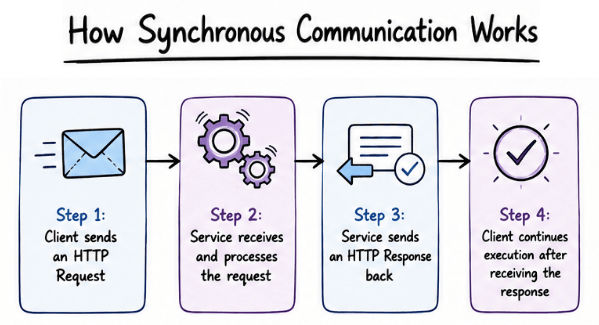
Suppose you withdraw money from an ATM.
The ATM sends your request to the bank server.
The bank verifies your account balance.
The ATM waits for the server's response.
After approval, the ATM dispenses the cash.
This is synchronous communication because the ATM waits for the bank's response before dispensing cash.
Easy to understand and implement.
Immediate response.
Strong data consistency.
Suitable for real-time applications.
Easy to debug.
Higher response time.
A slow service delays the entire request.
Tight coupling between services.
Service failures can affect dependent services.
REST API
HTTP
HTTPS
SOAP
gRPC
Synchronous communication is suitable when an immediate response is required, such as:
User login
Payment verification
OTP verification
Online banking transactions
Product search
Flight booking
Railway reservation
Asynchronous communication is a communication method in which the sender does not wait for an immediate response.
Instead, it sends a message to a message queue or event broker and continues its work. The receiving service processes the message later whenever it becomes available.
In simple words,
The sender sends a message and continues working without waiting for a response.
A simple example is sending an email. After sending it, you continue your work without waiting for the recipient to read or reply.
The communication typically follows these steps:
A service creates a message or event.
The message is sent to a message queue or event broker.
The sender continues its work immediately.
The receiving service reads the message.
The receiving service processes the request.
Diagram
Order Service
      |
 Message Queue
      |
Notification Service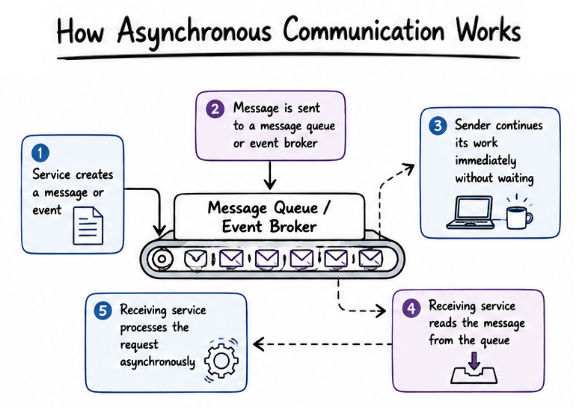
Suppose you upload a video to YouTube.
After the upload completes, YouTube processes the video in the background by generating different resolutions, creating thumbnails, and sending notifications.
This is asynchronous communication because these tasks continue in the background while you can keep using the application.
Faster response times.
Better scalability.
Services work independently.
Improves fault tolerance.
Suitable for background processing.
More difficult to implement and debug.
Eventual consistency instead of immediate consistency.
Messages may require retries if processing fails.
Monitoring and tracking are more complex.
Developers commonly use the following technologies for asynchronous communication:
Apache Kafka
RabbitMQ
Apache ActiveMQ
Amazon SQS
Google Pub/Sub
Asynchronous communication is commonly used for background tasks and event-driven applications.
Examples include:
Email notifications
SMS notifications
Order processing
Video processing
Log processing
Event-driven systems
Background jobs
The Request-Response Pattern is one of the most common communication patterns used in distributed systems and microservices. In this pattern, a client sends a request to a server and waits for a response before continuing.
In simple words,
The client sends a request, waits for the response, and continues only after receiving it.
A common example is searching for a product on an e-commerce website. Your browser sends a request to the Product Service, which searches the database and returns the matching products.
The communication follows these steps:
The client sends a request.
The server receives and processes the request.
The server sends a response.
The client continues after receiving the response.
Workflow
Client
   │
   │ Request
   ▼
Server
   │
Process Request
   │
   ▼
Response
   │
   ▼
ClientImagine you visit a restaurant.
You order a cup of coffee.
The waiter takes your order to the kitchen.
The kitchen prepares the coffee.
The waiter brings the coffee back to you.
You wait until your coffee arrives before continuing, just like a client waits for a server's response.
Simple to understand and implement.
Provides an immediate response.
Suitable for real-time applications.
Easy to monitor and debug.
Ideal for CRUD operations.
The client must wait for the response.
Slow services increase response time.
Heavy traffic can overload the server.
Not suitable for long-running tasks.
The Request-Response pattern is commonly used in:
User login
Payment verification
Product search
Online banking
Weather applications
Student management systems
Hospital management systems
Event-Based Communication is a communication pattern in which services communicate by publishing and consuming events instead of calling each other directly.
An event represents something important that has happened in the system, such as:
Order Created
Payment Completed
User Registered
Product Added
Ticket Booked
When an event occurs, it is published to an event broker, which delivers it to all interested services.
In simple words, one service publishes an event, and other interested services process it independently.
Direct communication creates tight coupling, where one service depends on another.
Event-Based Communication solves this problem by allowing a service to publish an event without knowing which services will receive it. This keeps services independent and makes the system easier to scale and maintain.
The communication process typically follows these steps:
A service performs an action.
It publishes an event.
The event broker receives the event.
Interested services subscribe to and receive the event.
Each service processes the event independently.
Workflow
             Order Service
                  │
      Publish "Order Created"
                  │
                  ▼
            Event Broker
      ┌─────────┼─────────┐
      ▼         ▼         ▼
Inventory   Notification  Billing
 Service       Service     Service
The publishing service does not need to know which services consume the event.
Suppose a customer places an order on an e-commerce website.
The Order Service publishes an Order Created event. Services that subscribe to this event perform their tasks independently:
Inventory Service updates the product stock.
Billing Service generates the invoice.
Notification Service sends an email or SMS.
Analytics Service records the order for reporting.
The Order Service does not communicate directly with these services.
Loose coupling between services.
Easy to add new services.
Highly scalable.
Better fault tolerance.
Supports asynchronous processing.
More complex architecture.
Debugging and monitoring are harder.
Events may be processed with some delay.
Maintaining data consistency can be challenging.
Common event brokers include:
Apache Kafka
RabbitMQ
Amazon EventBridge
Azure Event Grid
Apache Pulsar
An API Gateway is a single entry point for all client requests in a microservices architecture.
Instead of communicating directly with individual services, clients send requests to the API Gateway, which forwards them to the appropriate service.
An API Gateway is a single entry point that receives client requests and forwards them to the appropriate microservice.
In a microservices architecture, different functionalities are handled by separate services, such as:
User Service
Product Service
Order Service
Payment Service
Notification Service
Without an API Gateway, clients must communicate with each service separately, making the application more complex.
An API Gateway simplifies this by providing a single endpoint for all client requests.
The communication process is simple:
The client sends a request to the API Gateway.
The API Gateway authenticates and validates the request.
It routes the request to the appropriate service.
The service processes the request.
The API Gateway returns the response to the client.
Workflow
Client
   │
   ▼
API Gateway
   │
 ┌─┼──────────┐
 ▼ ▼          ▼
User Product Order
Service Service ServiceAn API Gateway performs several important tasks:
Request Routing: Routes requests to the appropriate service.
Authentication: Verifies the user's identity.
Authorization: Checks user permissions.
Rate Limiting: Prevents excessive requests.
Load Balancing: Distributes requests across multiple service instances.
Logging and Monitoring: Tracks requests for monitoring and debugging.
Response Aggregation: Combines responses from multiple services into a single response.
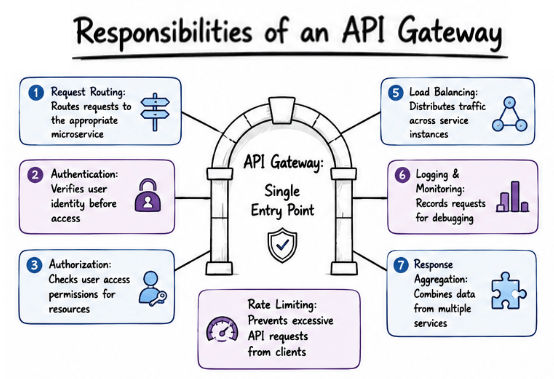
Provides a single entry point for clients.
Simplifies client communication.
Improves security through centralized authentication and authorization.
Supports load balancing and rate limiting.
Simplifies monitoring and logging.
Supports API versioning.
Adds an extra network hop, which can slightly increase latency.
Can become a bottleneck if not properly scaled.
Introduces an additional component to manage and maintain.
Some commonly used API Gateway solutions include:
Spring Cloud Gateway
Kong
NGINX
Amazon API Gateway
Azure API Management
Traefik
Imagine visiting a large hospital.
Instead of going directly to different departments, you first visit the reception desk. The receptionist understands your request and directs you to the appropriate department.
Similarly, an API Gateway receives client requests and forwards them to the appropriate microservice.
In a microservices architecture, services run independently and can be deployed across different servers or containers. As applications grow, new service instances are added, existing ones are removed, and some may restart due to updates or failures.
Since a service's IP address and port can change over time, other services cannot rely on fixed addresses. Service Discovery solves this problem by enabling services to locate each other dynamically.
Service Discovery is the process of automatically locating available service instances in a distributed system.
Consider an online shopping application with multiple instances of the Payment Service.
Payment Service – Instance 1
Payment Service – Instance 2
Payment Service – Instance 3
If one instance fails or a new instance is added to handle increased traffic, other services must still be able to communicate with an available instance.
Without Service Discovery, service addresses would need to be updated manually whenever changes occur, which is difficult in large-scale applications.
Service Discovery automatically maintains the latest service locations, allowing services to communicate without using fixed addresses.
The process works as follows:
A service starts and registers itself with the Service Registry.
The Service Registry stores the service's IP address and port number.
Another service needs to communicate with it.
The requesting service queries the Service Registry.
The Service Registry returns an available service instance.
The two services communicate directly.
Workflow
Order Service
      │
      │ Request Payment Service
      ▼
Service Registry
      │
Returns Available Instance
      ▼
Payment Service
The entire process happens automatically and usually takes only a few milliseconds.
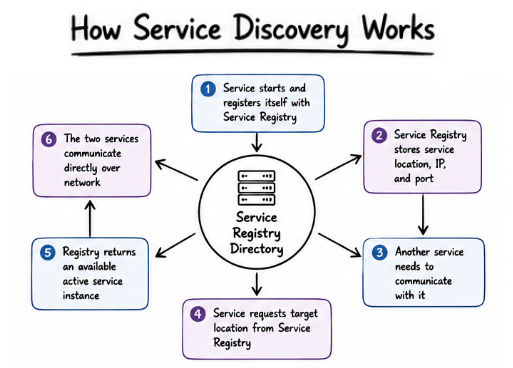
There are two common approaches to service discovery.
In Client-Side Service Discovery, the client is responsible for locating an available service instance.
The client queries the Service Registry, receives a list of available service instances, selects one (usually using a load-balancing algorithm), and sends the request directly.
Better control over service selection.
Supports custom load-balancing strategies.
Reduces dependency on intermediary components.
Increases client complexity.
Every client must communicate with the Service Registry.
In Server-Side Service Discovery, the client does not communicate with the Service Registry directly.
Instead, it sends the request to a Load Balancer or API Gateway, which retrieves an available service instance from the Service Registry and forwards the request.
Simpler client applications.
Centralized service discovery and load balancing.
Easier to manage in large systems.
Requires an additional infrastructure component.
Can introduce a small amount of network overhead.
Suppose you book a ride using a ride-sharing app.
You don't search for nearby drivers yourself. Instead, the application automatically finds an available driver and connects you to them.
Similarly, Service Discovery automatically finds an available service instance, allowing services to communicate without using fixed IP addresses.
A Service Registry is a central directory that stores information about all available services in a microservices architecture.
When a service starts, it registers itself with the registry. When it stops or becomes unavailable, it is removed from the registry.
Instead of using fixed IP addresses, services query the registry to find the current location of other services.
A Service Registry is a central directory that maintains information about available service instances, allowing services to discover and communicate with each other dynamically.
In a distributed system, service instances can start, stop, restart, or scale dynamically, causing their IP addresses and ports to change.
A Service Registry keeps track of active service instances, allowing services to discover each other without using fixed addresses.
A Service Registry typically stores:
Service Name
IP Address
Port Number
Health Status
Service Version
Metadata
A service starts and registers itself with the Service Registry.
The registry stores the service information.
Another service requests the location of a required service.
The registry returns an available service instance.
The services communicate directly.
Workflow
Payment Service
      │
  Register
      ▼
Service Registry
      ▲
    Query
      │
Order ServiceSome commonly used Service Registry solutions include:
Netflix Eureka
Consul
Apache ZooKeeper
etcd
Kubernetes Service Discovery
These tools provide service registration, service discovery, and health monitoring.
Many beginners confuse these two concepts, but they are different.
Service Discovery | Service Registry |
|---|---|
Finds available services. | Stores information about services. |
Used by applications to locate services. | Maintains the list of active services. |
Helps services communicate. | Helps services register and update their information. |
Uses the registry to locate services. | Acts as the database for service information. |
Services communicate using different protocols based on application requirements.
HTTP/HTTPS
HTTP is the standard protocol used for communication over the internet.
Most REST APIs use HTTP or HTTPS to exchange data between services.
HTTPS encrypts data, making communication more secure.
REST API
REST (Representational State Transfer) is an architectural style that uses HTTP methods such as GET, POST, PUT, and DELETE.
REST APIs are simple, lightweight, and widely used for communication between services.
gRPC
gRPC is a high-performance communication framework developed by Google.
It uses Protocol Buffers (Protobuf) instead of JSON, making communication faster and more efficient.
WebSocket
WebSocket provides two-way communication between the client and the server over a persistent connection.
It enables real-time data exchange without repeatedly creating new connections.
AMQP
AMQP (Advanced Message Queuing Protocol) is a messaging protocol designed for reliable asynchronous communication.
It is commonly used with message brokers such as RabbitMQ.
MQTT
MQTT is a lightweight messaging protocol designed for devices with limited resources.
It is widely used in IoT applications.
Apache Kafka
Apache Kafka is a distributed event streaming platform used for processing real-time data.
It stores events in topics, allowing multiple services to publish and consume events independently.
The choice of a communication protocol depends on the application's requirements.
REST is suitable for simple web APIs.
gRPC is ideal for high-performance communication.
Kafka and RabbitMQ are commonly used for event-driven communication.
WebSocket is suitable for real-time applications.
MQTT is designed for IoT devices.
Choosing the right protocol helps improve the performance, scalability, and reliability of a distributed system.
Designing effective communication between services improves the performance, reliability, and scalability of distributed systems. The following best practices help build efficient and maintainable applications.
Keep Services Loosely Coupled: Minimize dependencies between services so changes in one service have minimal impact on others.
Choose the Right Communication Pattern: Use synchronous or asynchronous communication based on the application's requirements.
Secure Service Communication: Protect data using authentication, authorization, and encryption.
Configure Timeouts: Set appropriate time limits to prevent services from waiting indefinitely for responses.
Implement Retry Mechanisms: Retry failed requests to handle temporary failures.
Monitor Services: Monitor service health and performance to identify issues early.
Version APIs: Use API versioning to support changes without breaking existing clients.
Prepare for Failures: Design services to handle failures gracefully using techniques such as circuit breakers, fallbacks, and redundancy.
Service communication enables independent services to work together in a distributed system. By choosing the right communication method and protocol, applications can achieve better performance, scalability, and reliability.
Components such as the API Gateway, Service Discovery, and Service Registry simplify communication between services and make microservices easier to manage.
Understanding service communication is essential for designing scalable, reliable, and maintainable distributed systems, and it provides a strong foundation for learning advanced microservices and system design concepts.
