
Durgesh Tiwari
Author
Modern web applications receive millions of requests every day. Managing these requests efficiently while maintaining security, performance, and reliability is an important part of System Design.
To achieve these goals, many applications use Proxy Servers. They help improve security, reduce server load, manage network traffic, and enhance application performance. Proxy servers are widely used in web applications, enterprise networks, cloud platforms, and content delivery systems.
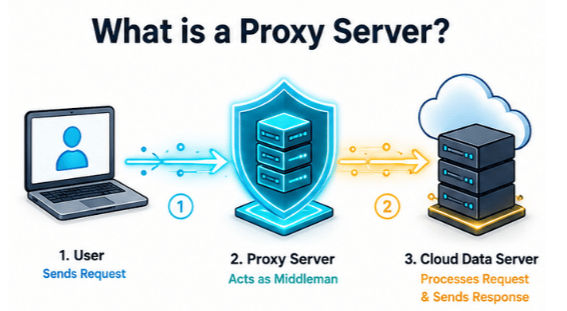
A Proxy Server is a server that acts as an intermediary between a client and a destination server. It receives requests from clients, forwards them to the destination server, receives the response, and then sends it back to the client.
In simple words, a Proxy Server acts as a middle layer between users and web servers.
Proxy servers are commonly used to:
Improve security.
Hide client information.
Cache frequently accessed data.
Control internet access.
Improve application performance.
Example
Suppose a user wants to access www.example.com
Instead of connecting directly to the web server:
The client sends a request to the Proxy Server.
The Proxy Server receives and checks the request.
It forwards the request to the destination server.
The destination server processes the request.
The response is returned to the Proxy Server.
The Proxy Server forwards the response to the client.
The client communicates with the Proxy Server instead of directly communicating with the destination server.
Proxy servers provide several advantages in modern distributed systems. They improve security, enhance performance, and reduce the workload on backend servers.
Some common reasons for using a proxy server include:
Improve application security.
Hide the client's IP address.
Cache frequently requested content.
Reduce server load.
Filter malicious requests.
Control internet access.
Improve application performance.
Monitor network traffic.
Large organizations and cloud applications rely on proxy servers to manage traffic efficiently.
Proxy servers can be classified into different types based on how they handle requests and where they are deployed. Each type serves a specific purpose and is used in different networking and application scenarios.
The most commonly used types of proxy servers are:
Forward Proxy
Reverse Proxy
Transparent Proxy
Anonymous Proxy

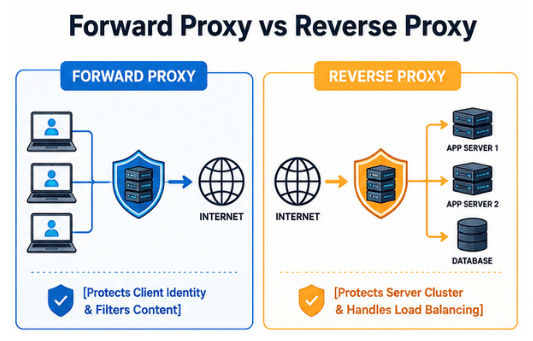
A Forward Proxy is a proxy server that acts on behalf of the client. Instead of sending requests directly to the destination server, the client first sends the request to the Forward Proxy, which then forwards it to the internet.
In simple words, a Forward Proxy represents the client when communicating with external servers.
Hiding the client's IP address.
Content filtering.
Internet access control.
Improving privacy.
Example
Many schools, colleges, and offices use Forward Proxies to block access to specific websites and control internet usage.
A Reverse Proxy is a proxy server that acts on behalf of one or more backend servers. Clients send requests to the Reverse Proxy, which forwards them to the appropriate server and returns the response to the client.
In simple words, a Reverse Proxy represents the server instead of the client.
Load balancing.
SSL termination.
Caching.
Security.
Traffic routing.
Example
An e-commerce application can use a Reverse Proxy to distribute incoming requests across multiple web servers, improving performance and availability.
Popular Reverse Proxy software includes NGINX and HAProxy.
A Transparent Proxy is a proxy server that intercepts client requests without requiring any configuration on the client device. Users can access the internet normally without knowing that their requests are passing through a proxy server.
In simple words, a Transparent Proxy works in the background without the user's knowledge.
Content filtering.
Network monitoring.
Bandwidth management.
Caching.
Example
Internet Service Providers (ISPs), schools, and organizations often use Transparent Proxies to filter web content and monitor network traffic.
An Anonymous Proxy is a proxy server that hides the client's IP address while accessing websites. Although it identifies itself as a proxy, it does not reveal the client's actual identity.
In simple words, an Anonymous Proxy hides the user's IP address to provide a basic level of privacy.
Online privacy.
Anonymous browsing.
Basic identity protection.
Example
A user who wants to hide their IP address while browsing the internet can use an Anonymous Proxy to improve privacy.
Forward Proxy | Reverse Proxy |
|---|---|
Represents the client. | Represents the server. |
Located between the client and the internet. | Located between the internet and backend servers. |
Protects client identity. | Protects server infrastructure. |
Used for privacy and content filtering. | Used for load balancing, security, and caching. |
Commonly used by organizations and users. | Commonly used in web applications and cloud platforms. |
Proxy servers improve security, performance, privacy, and traffic management. They are widely used in web applications, enterprise networks, and cloud environments.
Improves security by filtering malicious requests.
Hides the client's IP address for better privacy.
Caches frequently accessed content to improve performance.
Reduces the load on backend servers.
Controls internet access and content filtering.
Monitors network traffic and user activity.
Improves request handling in distributed systems.
Different types of proxy servers are used in different scenarios.
Proxy Type | Common Use Cases |
|---|---|
Forward Proxy | Privacy, content filtering, internet access control |
Reverse Proxy | Load balancing, caching, SSL termination, security |
Transparent Proxy | Network monitoring, bandwidth management, content filtering |
Anonymous Proxy | Anonymous browsing and hiding the client's IP address |
Although proxy servers offer many benefits, they also have some challenges.
Additional Infrastructure: Proxy servers add another component that must be deployed and maintained.
Performance Overhead: Every request passes through the proxy server, which can slightly increase response time.
Single Point of Failure (SPOF): If only one proxy server is used, its failure can make the application unavailable.
Configuration Complexity: Proper configuration is required for routing, caching, security, and access control.
Cache Management: Cached data must be updated regularly to avoid serving outdated content.
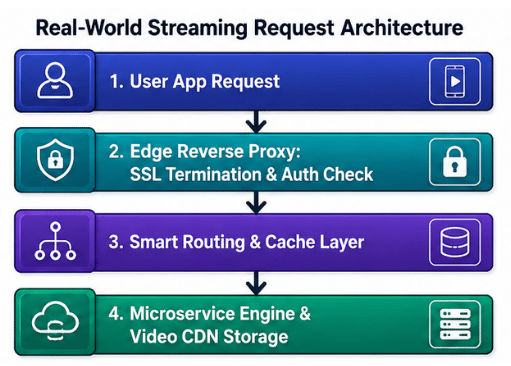
Netflix uses Reverse Proxy Servers to manage millions of user requests every day.
When a user opens the Netflix application:
The request first reaches the Reverse Proxy.
The Reverse Proxy performs SSL termination, request routing, caching, and load balancing.
The request is forwarded to the appropriate backend service.
The response is returned to the user.
This helps Netflix deliver fast, secure, and reliable streaming even during periods of high traffic.
A Proxy Server acts as an intermediary between clients and servers.
Proxy servers improve security, performance, privacy, and traffic management.
The main types of proxy servers are Forward Proxy, Reverse Proxy, Transparent Proxy, and Anonymous Proxy.
Forward Proxy is mainly used for privacy and internet access control.
Reverse Proxy is widely used for load balancing, caching, SSL termination, request routing, and protecting backend servers.
Proxy servers are an important component of modern System Design and help build scalable, secure, reliable, and high-performing applications.
