
Durgesh Tiwari
Author
Caching is one of the most effective ways to improve application performance and reduce database load. However, it also introduces several challenges that developers need to manage carefully.
As an application grows and serves millions of users, keeping cached data accurate, up to date, and synchronized with the database becomes more difficult. If these challenges are not handled properly, users may receive outdated data, the database may experience unnecessary load, and the overall application performance can be affected.
Understanding these cache challenges helps developers choose the right caching approach, maintain data consistency, and build fast, reliable, and scalable applications.
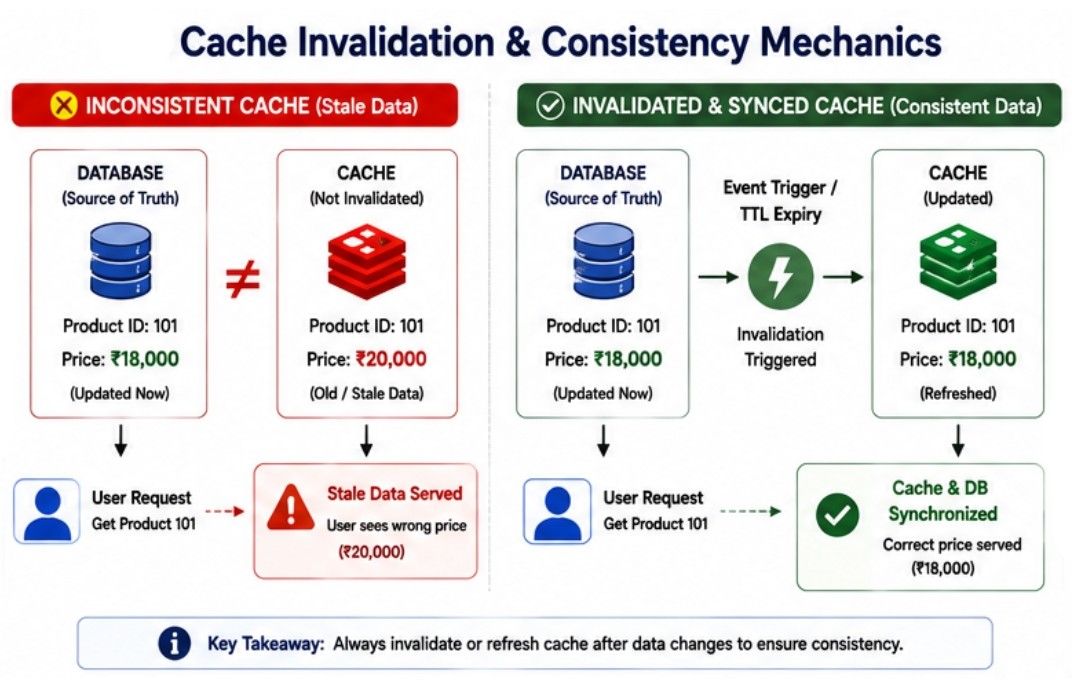
Cache Invalidation is the process of removing or updating cached data whenever the original data in the database changes. This ensures that users always receive the most recent and accurate information.
If the cache is not updated after database changes, it may continue serving outdated data, leading to incorrect results and a poor user experience.
In simple words, Cache Invalidation keeps the cache synchronized with the database so users always see the latest data.
Example
Suppose an e-commerce website changes the price of a mobile phone from ₹20,000 to ₹18,000.
If the cached product information is not updated, customers will continue to see the old price instead of the new one.
To prevent this, the outdated cache entry is either removed or updated as soon as the price changes.
Applications use different techniques to keep cached data up to date. Some of the most common cache invalidation methods are:
Time-To-Live (TTL) – Cached data is automatically removed after a predefined time.
Manual Cache Deletion – The application explicitly removes outdated cache entries when the data changes.
Event-Based Invalidation – The cache is updated or cleared automatically when a specific event, such as a database update, occurs.
Write-Through Updates – The cache and the database are updated together, ensuring both always contain the latest data.
Cache Consistency is the process of keeping the cache and the database synchronized so that both always contain the same data.
Whenever data is updated in the database, the corresponding data in the cache should also be updated. This ensures that users always receive the latest and most accurate information.
If the cache and the database contain different values, the application may return outdated or incorrect data, leading to an inconsistent user experience.
In simple words, Cache Consistency ensures that the data stored in the cache always matches the data stored in the database.
Example
Suppose a customer updates their delivery address in an e-commerce application.
The new address is successfully saved in the database, but the cache still stores the old address.
Until the cache is updated, the application may continue showing the old address, even though the database contains the latest information.
Maintaining cache consistency helps applications provide accurate and reliable data. Some of its key benefits are:
Prevents users from seeing outdated data.
Improves data accuracy across the application.
Maintains synchronization between the cache and the database.
Provides a consistent and reliable user experience.
Builds user trust by displaying the latest information.
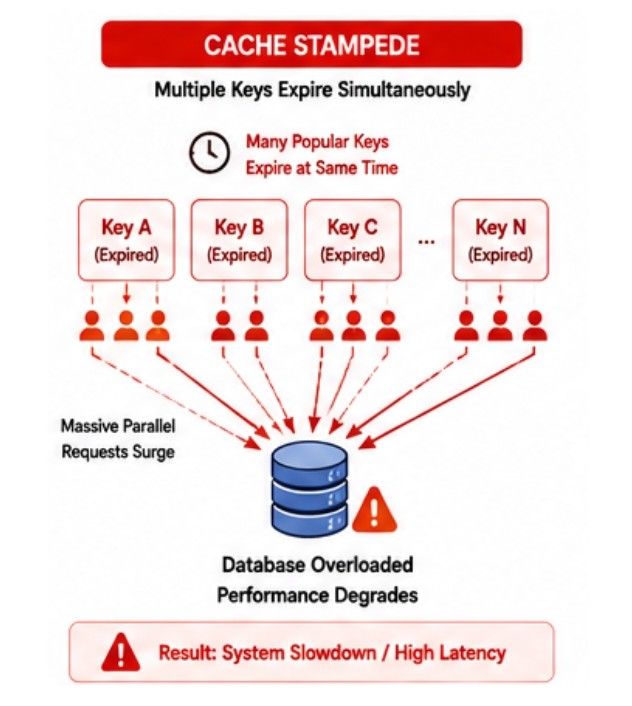
A Cache Stampede happens when a popular cache entry expires, and many users request the same data at almost the same time.
Since the requested data is no longer available in the cache, every request is sent to the database. As a result, the database receives a large number of identical queries simultaneously, which can increase server load and slow down the application.
If this situation is not handled properly, it may reduce application performance or even overload the database.
In simple words, a Cache Stampede occurs when multiple users miss the same cache entry at the same time, causing a sudden spike in database requests.
Example
Suppose a live cricket score page is cached for 10 minutes.
When the cache expires, thousands of users refresh the page at the same moment.
Because the cached data is no longer available, all requests are sent directly to the database, creating a sudden increase in database traffic and slowing down the application.
Several techniques can be used to prevent a cache stampede and reduce unnecessary database load:
Cache Locking – Allows only one request to rebuild the expired cache while other requests wait for the updated data.
Refresh Before Expiration – Updates frequently accessed cache entries before they expire, reducing cache misses.
Randomized Cache Expiration – Assigns different expiration times to cache entries so they do not expire simultaneously.
Asynchronous Cache Rebuilding – Refreshes expired cache data in the background without making users wait for the database response.
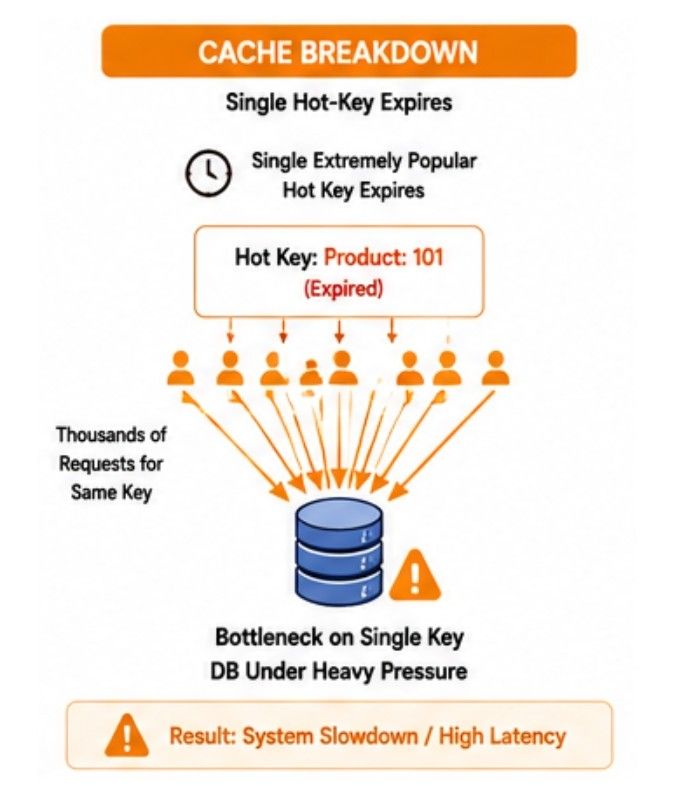
A Cache Breakdown occurs when a popular cache entry expires. This causes many requests for that data to go straight to the database.
A Cache Breakdown is different from a Cache Stampede which can involve several expired cache entries since it generally impacts one very popular item of data, known as hot data. The reason for this is that many users request this data at the same time and as a result the database suffers a sudden rise in traffic until the cache is rebuilt.
If not managed properly, a cache breakdown can increase response time and reduce application performance.
In simple words, a Cache Breakdown happens when the cache for a highly popular data item expires, forcing many users to access the database at the same time.
Example
Suppose a trending product on an e-commerce website receives thousands of requests every minute.
If the cached product information expires, every incoming request is sent directly to the database until the cache is generated again. This creates unnecessary database load and may slow down the application.
Applications use several techniques to prevent cache breakdown and protect the database from excessive requests:
Keep Hot Data in the Cache Longer – Frequently accessed data can be given a longer expiration time to reduce the chances of cache expiration.
Use Mutex (Locking) Mechanisms – Allow only one request to rebuild the expired cache while other requests wait for the updated data.
Refresh Important Cache Entries Automatically – Update popular cache entries before they expire so users continue receiving data from the cache.
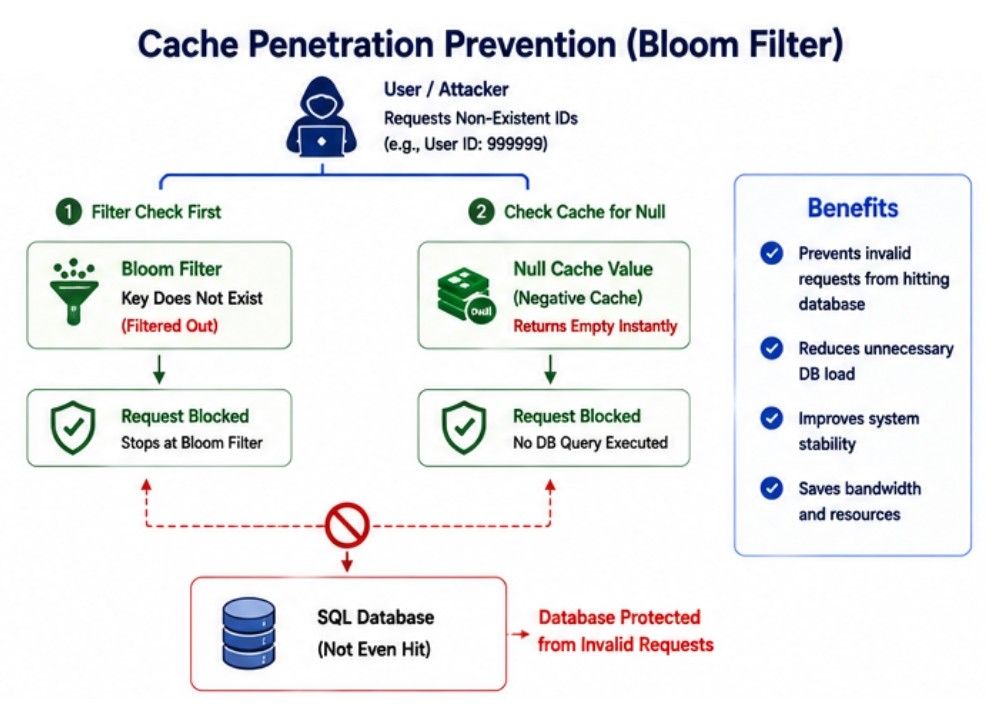
A Cache Penetration occurs when an application receives repeated requests for data that does not exist in either the cache or the database.
Since the requested data is unavailable, the cache cannot return a result, and every request is forwarded to the database. Repeated requests for invalid data create unnecessary database queries, increase server load, and may affect application performance.
In some cases, attackers intentionally generate such requests to overload the database and degrade the application's performance.
In simple words, Cache Penetration happens when requests for non-existent data continuously bypass the cache and reach the database.
Example
Suppose a user repeatedly requests a product using an invalid Product ID.
Because the product does not exist, the cache cannot return any data. As a result, every request is sent to the database, even though the same request has already failed before.
This creates unnecessary database traffic and wastes server resources.
Applications use several techniques to prevent cache penetration and reduce unnecessary database requests:
Cache Null or Empty Results – Store the result of invalid requests for a short time so repeated requests do not reach the database.
Validate User Input – Verify request parameters before querying the cache or database.
Use Bloom Filters – Quickly identify invalid requests before they reach the database.
Apply Rate Limiting – Restrict the number of repeated requests from the same user or IP address to prevent abuse.
Cache Warming is the process of loading frequently accessed data into the cache before users request it. Instead of waiting for the first user request to populate the cache, the application stores important data in advance so it is ready to be served immediately.
This helps reduce the initial response time and improves application performance, especially during periods of high traffic.
In simple words, Cache Warming means filling the cache with frequently used data before users request it, so the application can respond faster.
Example
Suppose an e-commerce website is preparing for a major shopping sale.
Before the sale starts, the application loads popular products, category pages, promotional banners, and special offers into the cache.
When thousands of customers visit the website, the required data is already available in the cache. As a result, pages load faster, the database receives fewer requests, and the application can handle heavy traffic more efficiently.
Cache Warming provides several advantages for high-traffic applications:
Reduces the response time for the first user request.
Minimizes cache misses by preloading frequently accessed data.
Reduces database load during peak traffic.
Improves overall application performance.
Provides a faster and smoother user experience.
A Multi-Level Cache is a caching technique that uses multiple cache layers to retrieve data more efficiently. Instead of relying on a single cache, the application checks different cache levels in a specific order before accessing the database.
Each cache layer has a different purpose. Faster caches store the most frequently accessed data, while slower caches store larger amounts of data. This approach reduces response time and minimizes database queries.
In simple words, a Multi-Level Cache stores data in multiple cache layers, allowing the application to find data quickly before accessing the database.
A typical multi-level cache architecture consists of three layers:
Level 1 (L1): Local Cache – Stores frequently accessed data in the application's memory, providing the fastest access.
Level 2 (L2): Distributed Cache – Uses a shared cache, such as Redis, to store data that can be accessed by multiple application servers.
Level 3 (L3): Database – Stores the original data and is accessed only when the required data is not available in either cache layer.
When a user requests data, the application searches each level in sequence until the data is found.
Example
Suppose an e-commerce application needs to display product details.
The application first checks the Local Cache (L1). If the data is not available, it checks the Distributed Cache (L2), such as Redis. If the data is still not found, it retrieves the information from the database (L3) and updates both cache layers for future requests.
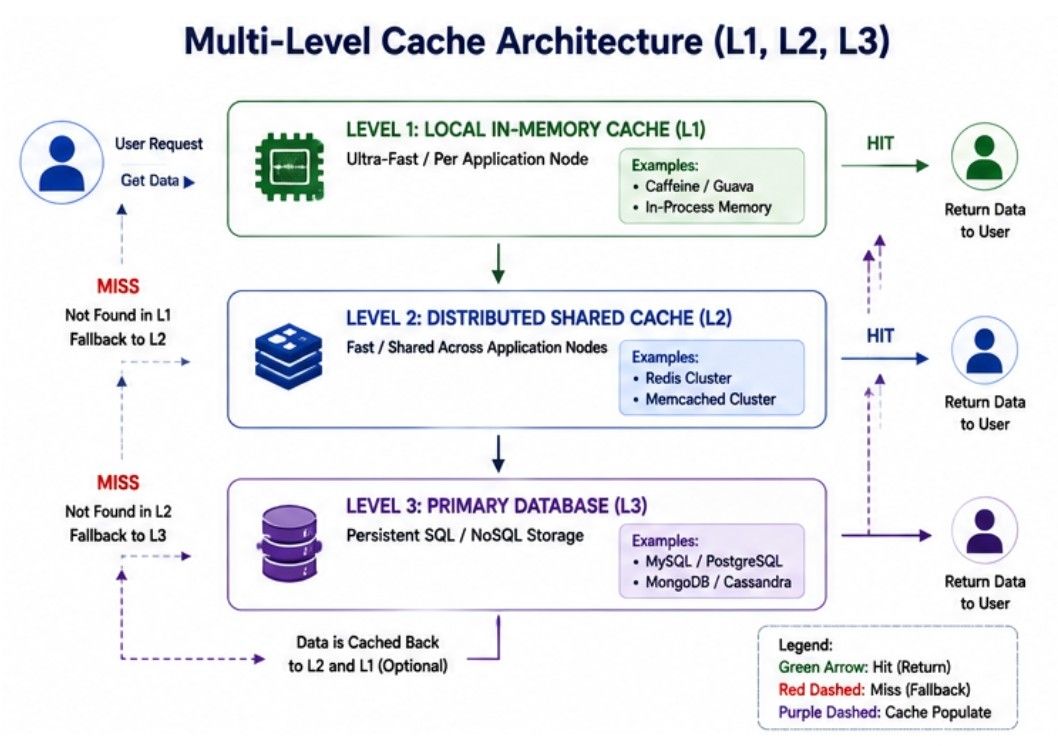
A Multi-Level Cache offers several advantages that help modern applications deliver better performance and handle large numbers of users efficiently.
Faster Response Time – Retrieves data from the fastest available cache layer before accessing slower storage.
Reduced Database Load – Minimizes the number of database queries by serving frequently accessed data from the cache.
Improved Application Performance – Delivers faster and more consistent performance, even during periods of high traffic.
Better Scalability – Distributes cached data across multiple cache layers, allowing the application to support more users and requests.
Efficient Resource Utilization – Makes effective use of both local and distributed cache resources to optimize memory and reduce unnecessary database access.
A Distributed Cache stores cached data across multiple cache servers, allowing applications to handle more users and larger workloads. While this improves performance, scalability, and availability, it also introduces several challenges that developers need to manage carefully.
If these challenges are not handled properly, they can lead to outdated data, slower responses, or reduced application reliability.
The following are some common challenges of a distributed cache.
Data Consistency: When data is updated, all cache servers should reflect the latest changes. Maintaining the same data across multiple cache nodes is known as Data Consistency.
Cache Synchronization: All cache nodes should stay synchronized so that every server returns the same and most up-to-date data to users.
Network Latency: Since cache servers communicate over a network, data synchronization and cache requests may experience small delays, especially in distributed environments.
Node Failure: If one cache server becomes unavailable, the remaining cache servers should continue serving requests without affecting the application's availability.
Data Partitioning: Cached data should be distributed evenly across multiple cache servers. This helps balance the workload, prevents individual servers from becoming overloaded, and improves overall performance.
Applications use several techniques to overcome these challenges and maintain a reliable distributed cache:
Use Data Replication – Store copies of cached data on multiple cache servers to improve availability.
Apply Consistent Hashing – Distribute data evenly across cache nodes while minimizing data movement when servers are added or removed.
Monitor Cache Servers – Continuously monitor cache health and performance to detect issues early.
Configure Automatic Failover – Automatically redirect requests to healthy cache servers if a node fails.
Use Reliable Distributed Cache Systems – Solutions such as Redis Cluster provide built-in support for scalability, replication, and fault tolerance.
Consider an e-commerce platform during a major festive sale, where millions of users browse products and place orders at the same time.
To deliver fast responses, the application uses a Multi-Level Cache, allowing data to be retrieved from the nearest available cache before accessing the database. Frequently viewed products are preloaded using Cache Warming, helping users experience faster page loads from the very beginning.
As product prices, stock levels, and offers change throughout the sale, Cache Invalidation and Cache Consistency ensure that customers always receive the latest information. At the same time, techniques such as cache locking, automatic cache refresh, and consistent hashing help prevent cache-related issues like Cache Stampede, Cache Breakdown, and uneven load distribution across cache servers.
By combining these caching techniques, the platform delivers fast performance, accurate data, and high scalability, even during periods of heavy traffic.
Caching is one of the most effective techniques for improving application performance, reducing database load, and handling high user traffic. However, to use caching effectively, developers must also understand the challenges that come with it.
Some of the most common caching challenges include:
Cache Invalidation – Ensures outdated cache entries are removed or updated when data changes.
Cache Consistency – Keeps the cache synchronized with the database so users always receive the latest data.
Cache Stampede – Prevents a sudden surge of database requests when popular cache entries expire.
Cache Breakdown – Handles heavy traffic for highly popular data when its cache expires.
Cache Penetration – Prevents repeated requests for non-existent data from reaching the database.
Cache Warming – Preloads frequently accessed data into the cache before users request it.
Multi-Level Cache – Uses multiple cache layers to improve response time and reduce database access.
Distributed Cache – Stores cached data across multiple servers to improve scalability, availability, and fault tolerance.
