
Durgesh Tiwari
Author
API Security is the process of protecting APIs from unauthorized access, cyberattacks, and data breaches.
Since APIs allow different applications to communicate and exchange data, securing them is essential to protect users and business data.
A secure API ensures that only authenticated and authorized users or applications can access its resources. It also helps protect sensitive information and defend against common security threats.
API security is widely used in web applications, mobile applications, cloud services, and REST APIs to protect user information and business data from unauthorized access.
An API Key is a unique code that identifies an application when it requests access to an API. It helps the server recognize which application is making the request.
When an application sends a request, it includes the API key. The server verifies the key before allowing access to the requested resource.
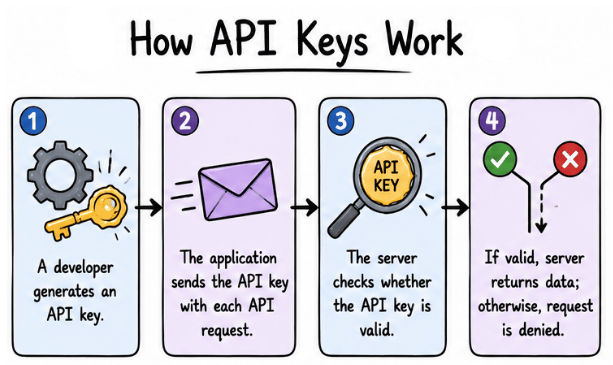
The API key process works in these simple steps:
A developer generates an API key.
The application sends the API key with each API request.
The server checks whether the API key is valid.
If the key is valid, the server returns the requested data. Otherwise, the request is denied.
Suppose a weather application needs the latest weather information. It sends a request to a weather API along with its API key. The server verifies the key and returns the weather data. If the API key is invalid or missing, the server rejects the request.
To keep API keys secure, follow these best practices:
Keep API keys private.
Never include API keys in public code repositories.
Rotate API keys regularly.
Always use HTTPS to protect API requests during transmission.
Token Management is the process of securely creating, storing, validating, renewing, and revoking authentication tokens. It helps applications manage user sessions without requiring users to log in for every request.
After a user signs in successfully, the server generates an access token. The application stores this token securely and includes it with future API requests. The server verifies the token before allowing access to protected resources.
Proper token management improves security and helps prevent unauthorized access.
Follow these best practices to keep authentication tokens secure:
Use short-lived access tokens.
Store tokens in a secure location.
Use refresh tokens to obtain new access tokens when needed.
Revoke tokens immediately if they are compromised.
Always transmit tokens over HTTPS.
When you log in to a mobile banking application, the server generates an access token, and the application stores it securely. The application includes this token with future API requests, so you don't need to enter your password every time. When the access token expires, the application uses a refresh token to obtain a new access token without requiring you to log in again.
Cross-Origin Resource Sharing (CORS) is a browser security feature that controls whether a website can access resources from another website or API.
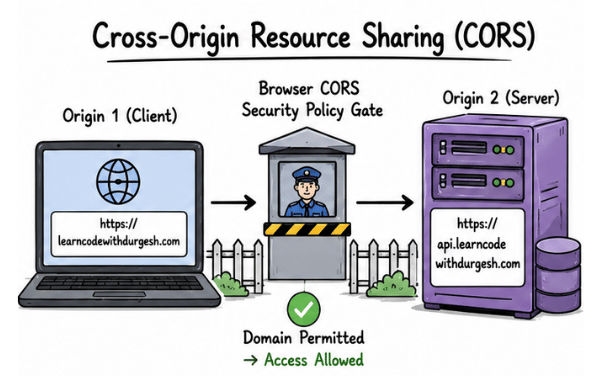
By default, web browsers block requests made from one domain to another. CORS allows the server to specify which domains are permitted to access its resources.
Suppose your frontend is hosted on:
<https://learncodewithdurgesh.com>and your API is hosted on:
<https://api.learncodewithdurgesh.com>If the API allows requests from https://learncodewithdurgesh.com, the browser permits the communication. Otherwise, the request is blocked.
CORS helps improve API security by:
Allowing access only from trusted domains.
Preventing unauthorized websites from accessing API resources.
Helping protect sensitive user data.
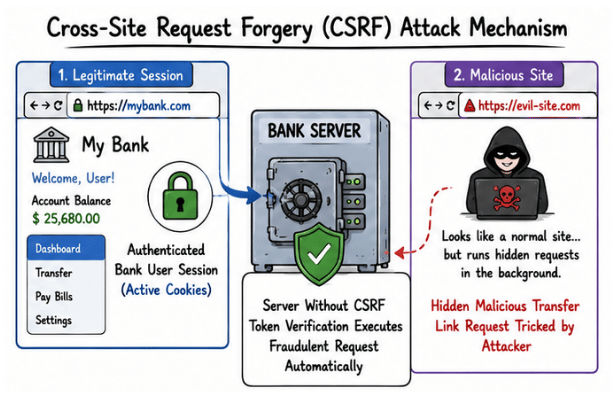
Cross-Site Request Forgery (CSRF) is a web security attack in which a malicious website tricks a logged-in user into sending unwanted requests to another website without their knowledge.
Since the user is already authenticated, the browser may automatically include the user's session cookies with the request. If the server does not verify the request properly, the action may be performed as if it came from the legitimate user.
Suppose you are logged in to your online banking account.
While browsing another website, you click a malicious link or visit a malicious page. It secretly sends a money transfer request to your bank using your active session.
If the bank does not have proper CSRF protection, the request may be processed without your permission.
You can reduce the risk of CSRF attacks by following these security practices:
Use CSRF tokens to verify requests.
Enable SameSite cookies.
Validate the Origin and Referer headers.
Ask users to confirm sensitive actions before processing them.
Cross-Site Scripting (XSS) is a security vulnerability that allows attackers to inject malicious JavaScript code into a website. When another user visits the affected page, the malicious script runs in their browser.
Attackers can use XSS to steal cookies, session tokens, or other sensitive information, making it one of the most common web security vulnerabilities.
Suppose a website allows users to post comments without properly validating or sanitizing the input.
An attacker submits a comment containing malicious JavaScript code. When other users view the comment, the script runs automatically in their browsers and may steal cookies, session information, or other sensitive data.
Follow these best practices to protect your application from XSS attacks:
Validate and sanitize all user input.
Escape HTML output before displaying user data.
Use Content Security Policy (CSP).
Never insert untrusted data directly into web pages.
SQL Injection (SQLi) is a common web security attack in which an attacker inserts malicious SQL code into an application's input fields. If the application does not handle user input securely, the attacker may manipulate database queries.
A successful SQL Injection attack can allow attackers to view, modify, or delete data stored in the database.
Suppose a login form uses user input directly in a SQL query without proper validation.
Instead of entering a valid username, an attacker enters a malicious SQL statement. If the application is vulnerable, the attacker may bypass the login process or gain unauthorized access to sensitive database information.
You can protect your application from SQL Injection by following these security practices:
Use prepared statements (parameterized queries).
Validate and sanitize all user input.
Use ORM (Object-Relational Mapping) frameworks whenever possible.
Apply the principle of least privilege for database users.
Rate Limiting is a security technique that restricts the number of API requests a user or application can make within a specific time period.
It helps protect APIs from excessive requests, brute-force attacks, and misuse. By limiting the request rate, applications can improve security, maintain performance, and ensure fair usage for all users.
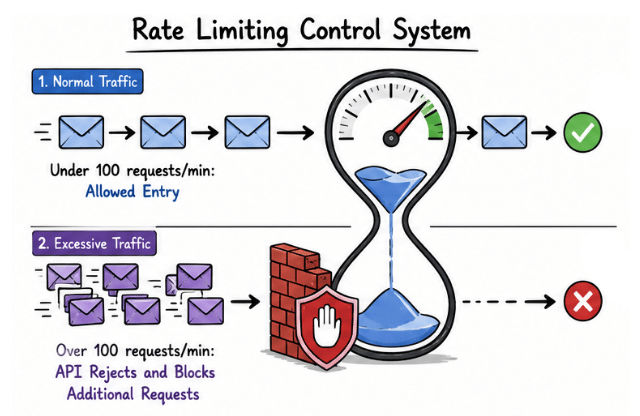
Suppose an API allows a maximum of 100 requests per minute for each user.
If a user sends more than 100 requests within one minute, the API temporarily rejects the additional requests. Once the time limit resets, the user can send requests again.
Rate limiting provides several security and performance benefits:
Prevents brute-force attacks.
Reduces API abuse and misuse.
Protects server resources from excessive traffic.
Improves API performance and stability.
Input Validation is the process of checking user input before it is processed by an application or API. It ensures that only valid and expected data is accepted.
Proper input validation helps protect applications from invalid data and reduces the risk of common security vulnerabilities.
Follow these best practices when validating user input:
Validate all user input.
Accept only the expected data format and values.
Reject invalid or unexpected input.
Never trust user input without validation.
By implementing proper input validation, you can help prevent security attacks such as SQL Injection (SQLi) and Cross-Site Scripting (XSS).
Following API security best practices helps protect APIs, applications, and user data from unauthorized access and common security threats.
Use the following security practices when building or managing APIs:
Always use HTTPS to secure API communication.
Keep API keys private and never expose them publicly.
Store authentication tokens securely.
Validate and sanitize all user input.
Implement rate limiting to prevent API abuse.
Use strong authentication and proper authorization.
Rotate API keys and tokens regularly.
Monitor API activity to detect suspicious requests and unusual behavior.
API security is essential for protecting APIs, applications, and user data from unauthorized access, cyberattacks, and data breaches. By implementing the right security measures, developers can build reliable and secure applications.
Here are the key points to remember:
API Keys identify applications that request access to an API.
Token Management ensures authentication tokens are created, stored, and used securely.
CORS (Cross-Origin Resource Sharing) controls which websites can access API resources.
CSRF (Cross-Site Request Forgery) helps prevent unauthorized requests made using a user's active session.
XSS (Cross-Site Scripting) protects applications from malicious scripts injected into web pages.
SQL Injection (SQLi) prevents attackers from manipulating database queries through unsafe user input.
Rate Limiting restricts excessive API requests to prevent abuse and brute-force attacks.
Input Validation ensures that only valid and expected user input is processed by the application.
Understanding these API security concepts and following security best practices helps developers build secure APIs, protect sensitive data, and reduce the risk of common web security attacks.
