
Durgesh Tiwari
Author
Caching helps applications respond faster by storing frequently accessed data in memory. However, simply adding a cache is not enough. Developers also need to decide how data should be stored, updated, and retrieved between the cache and the database. This approach is known as a Cache Strategy.
The right cache strategy helps improve performance, reduce database load, and keep data as accurate as possible. Since every application has different read and write patterns, choosing the appropriate strategy is an important part of System Design.
Different applications have different caching requirements. Some applications receive mostly read requests, while others frequently update data. Using the wrong cache strategy can lead to outdated data, unnecessary database queries, or poor performance.
A well-designed cache strategy helps to:
Improve application performance.
Reduce database load.
Serve data with lower response time.
Keep cached data synchronized with the database.
Handle high user traffic efficiently.
Improve application scalability.
Deliver a better user experience.
Choosing the right cache strategy ensures that the application remains fast, scalable, and reliable as traffic grows.
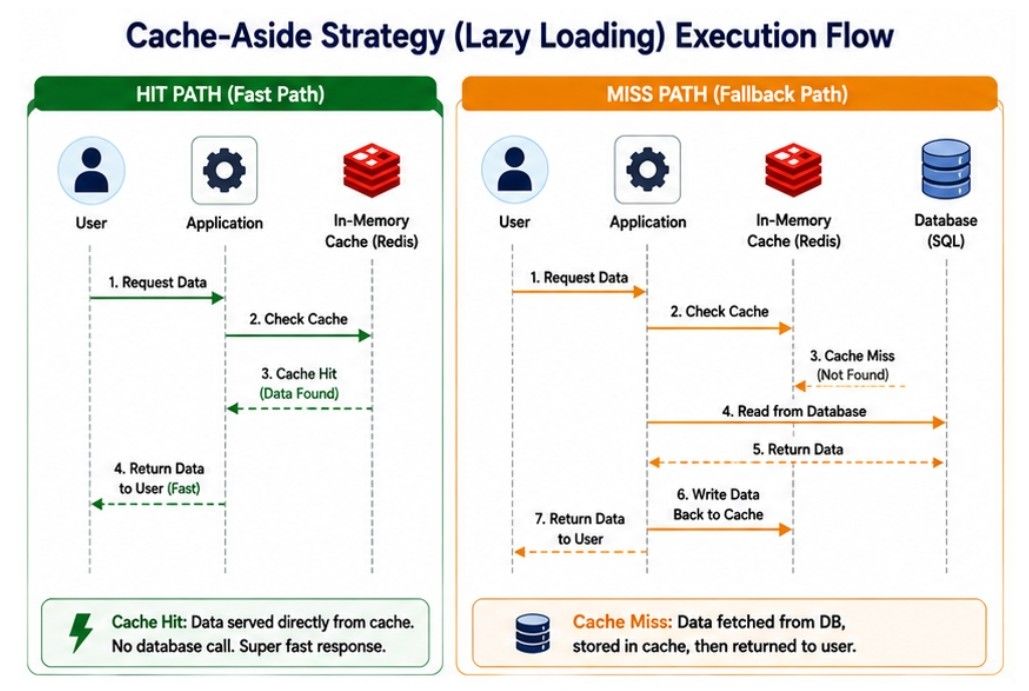
Cache-Aside, also known as Lazy Loading, is one of the most commonly used caching strategies in modern applications.
In this strategy, the application checks the cache before accessing the database. If the requested data is available in the cache, it is returned immediately. Otherwise, the application fetches the data from the database, stores it in the cache, and then returns it to the user.
The cache is updated only when the data is requested, which is why this strategy is called Lazy Loading.
In simple words, Cache-Aside loads data into the cache only when it is needed for the first time.
The Cache-Aside strategy follows these steps:
The user requests data.
The application checks the cache.
If the data is found (Cache Hit), it is returned immediately.
If the data is not found (Cache Miss), the application retrieves it from the database.
The retrieved data is stored in the cache.
The data is returned to the user.
User
  │
  ▼
Application
  │
  ▼
Check Cache
  │
 ┌───────┴────────┐
 │                │
Hit             Miss
 │                │
 ▼                ▼
Return       Read Database
Data              │
                  ▼
            Store in Cache
                  │
                  ▼
             Return Data
This approach ensures that future requests for the same data are served directly from the cache instead of the database.
Simple and easy to implement.
Reduces database queries.
Improves application performance.
Works well for read-heavy applications.
Stores only frequently requested data in the cache.
The first request is slower because the cache is empty.
Stale data can occur if the cache is not updated after database changes.
The application is responsible for managing cache updates and invalidation.
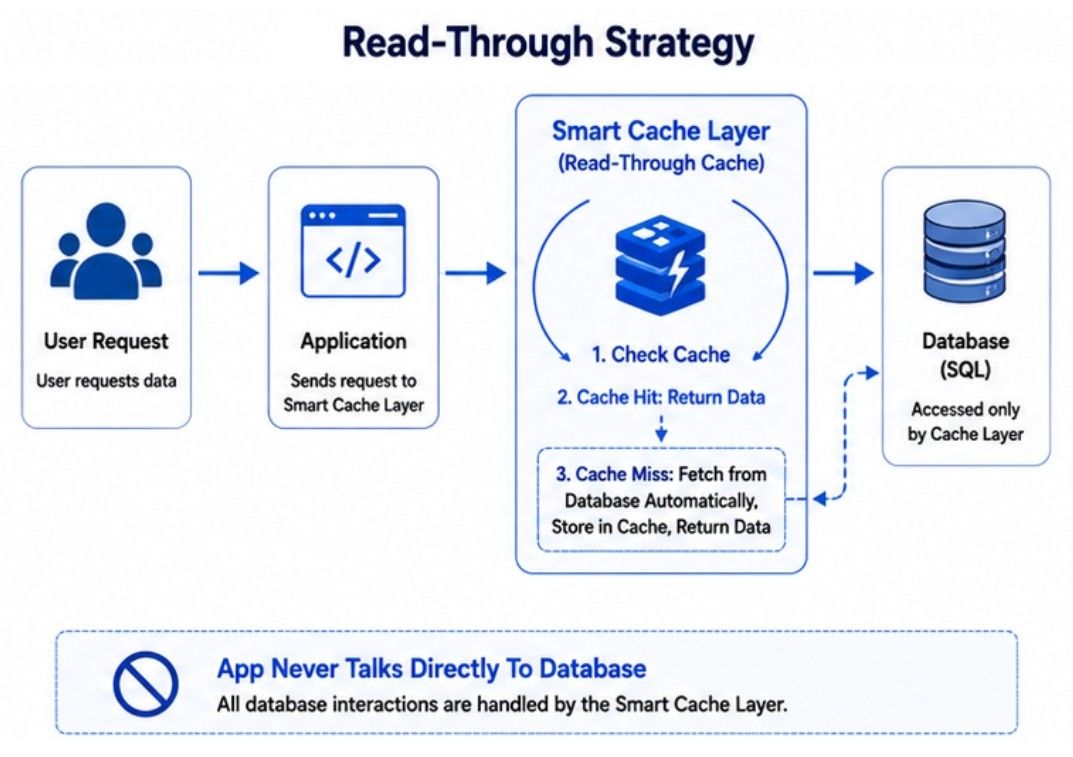
Read-Through is a caching strategy in which the application always requests data from the cache. If the requested data is not available, the cache automatically retrieves it from the database, stores it, and then returns it to the application.
Unlike Cache-Aside, the application never communicates directly with the database. The cache is responsible for loading and storing the data whenever a cache miss occurs.
In simple words, the application only talks to the cache, and the cache automatically fetches missing data from the database.
The user requests data.
The application sends the request to the cache.
If the data is available (Cache Hit), the cache returns it immediately.
If the data is not available (Cache Miss), the cache retrieves it from the database.
The cache stores the retrieved data.
The cache returns the data to the application.
User
  │
  ▼
Application
  │
  ▼
Cache
  │
 ┌───────┴────────┐
 │                │
Hit             Miss
 │                │
 ▼                ▼
Return      Read Database
Data              │
                  ▼
            Store in Cache
                  │
                  ▼
Return DataKeeps application code simple.
Reduces direct database access.
Automatically loads missing data into the cache.
Improves read performance for frequently accessed data.
Requires a more advanced cache system.
Gives developers less control over cache behavior.
A cache miss can still increase the response time because the cache must first fetch data from the database.
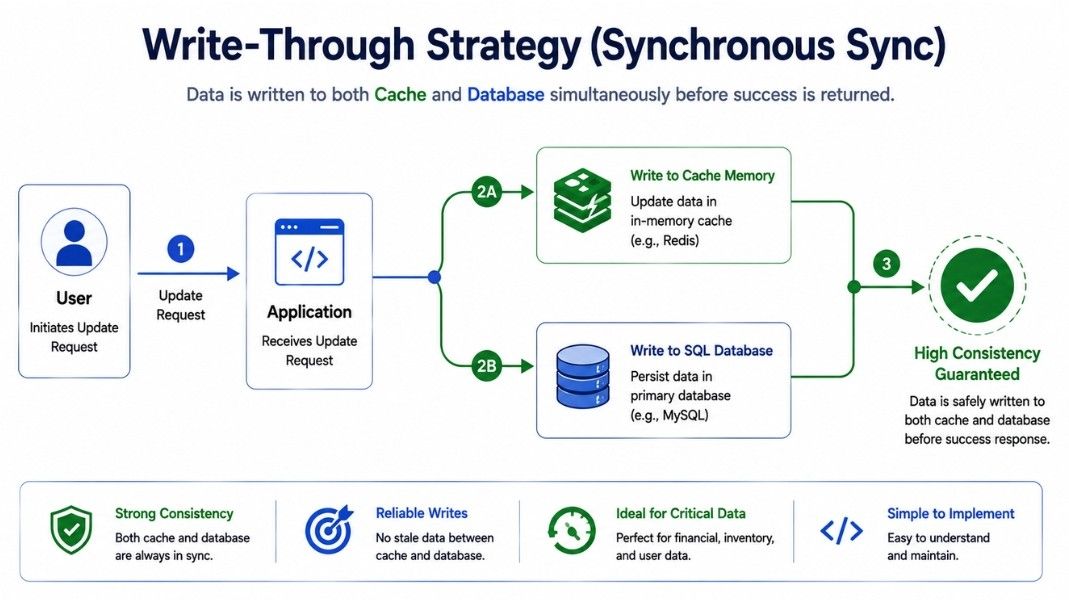
Write-Through is a caching strategy in which every write operation updates both the cache and the database at the same time.
Whenever data is modified, it is written to the cache first and then immediately saved to the database. This ensures that both always contain the latest and consistent data.
In simple words, Write-Through updates the cache and the database together, so both always stay synchronized.
Example
Suppose a user changes their profile information.
With the Write-Through strategy, the updated information is written to the cache and immediately saved to the database. This ensures that future requests always return the latest data.
A user updates the data.
The application writes the data to the cache.
The cache immediately writes the same data to the database.
Both the cache and the database are updated successfully.
User
  │
  ▼
Application
  │
  ▼
Write to Cache
  │
  ▼
Write to Database
  │
  ▼
Data UpdatedKeeps the cache and database synchronized.
Provides high data consistency.
Reduces the chances of stale data.
Improves read performance after updates.
Slower write operations because data is written twice.
May cache data that is rarely read, increasing memory usage.
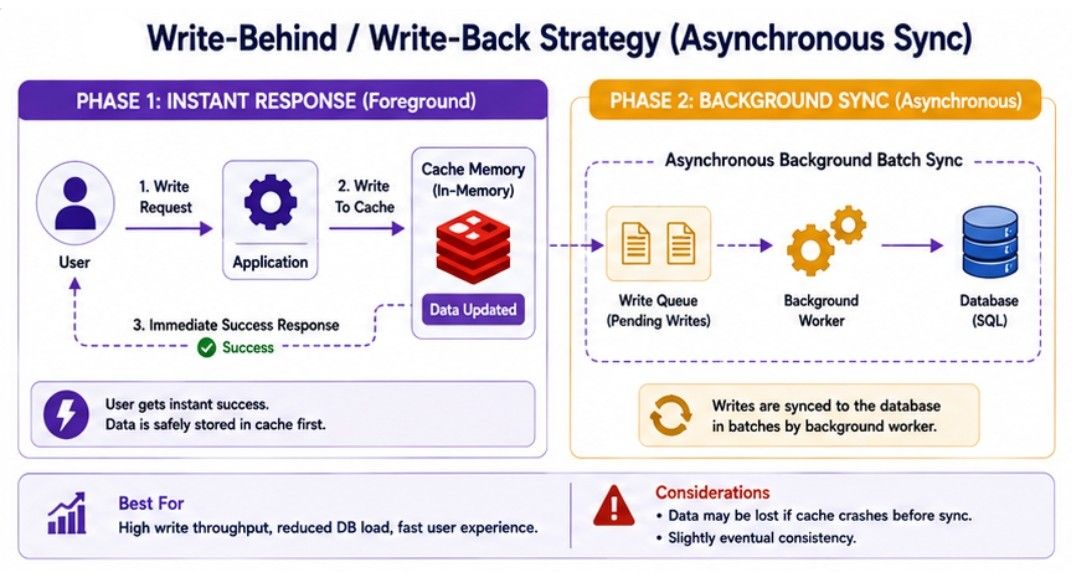
Write-Behind, also known as Write-Back, is a caching strategy in which data is written to the cache immediately, while the database is updated later in the background.
Since the application does not wait for the database update, write operations are much faster. This strategy is commonly used in applications that handle a large number of write requests.
In simple words, Write-Behind updates the cache immediately and saves the data to the database later.
A user updates the data.
The application writes the data to the cache.
The user receives an immediate response.
The cache updates the database in the background after a short delay.
User
  │
  ▼
Application
  │
  ▼
Write to Cache
  │
  ▼
Return Response
  │
  ▼
Update Database
(Background)
Example
Suppose a user likes a post on a social media platform.
The application updates the cache immediately and returns the response to the user without waiting for the database update. The database is updated in the background a short time later, allowing the application to handle millions of likes efficiently.
Provides very fast write performance.
Reduces database workload.
Suitable for write-heavy applications.
Improves overall application performance.
Risk of data loss if the cache fails before updating the database.
More complex to implement and manage.
Temporary inconsistency may exist between the cache and the database.
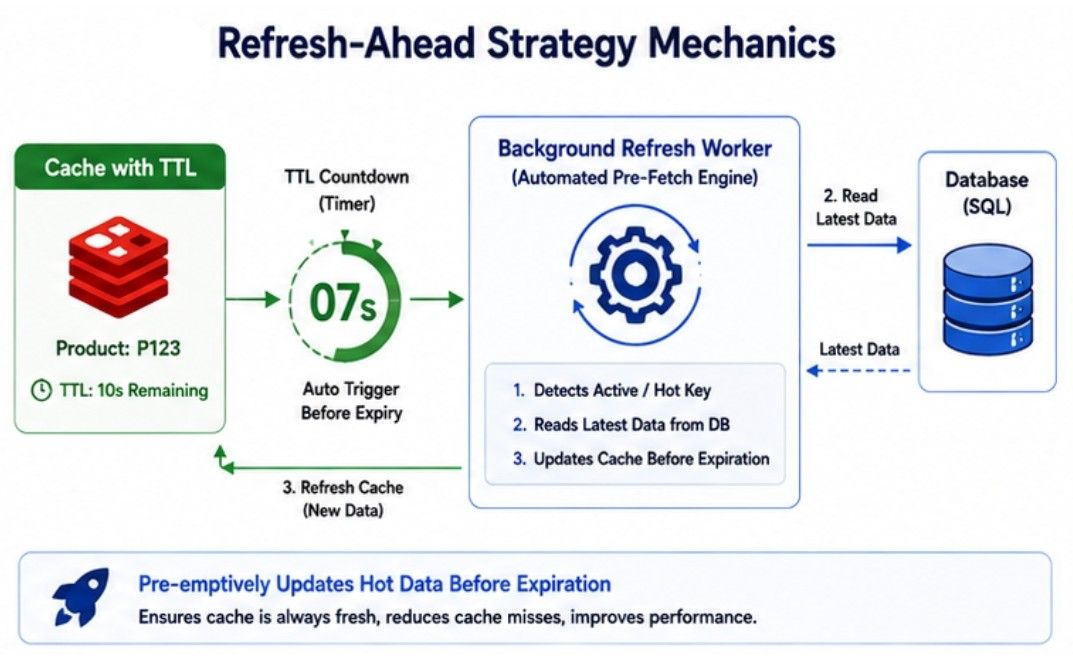
Refresh-Ahead is a caching strategy in which frequently accessed data is refreshed automatically before it expires.
Instead of waiting for a user request after the cache expires, the cache updates popular data in the background. This helps keep the data fresh and reduces delays caused by cache misses.
In simple words, Refresh-Ahead updates frequently used cached data before it expires, so users continue receiving the latest data without waiting.
Frequently accessed data is stored in the cache.
Before the cached data expires, the cache refreshes it automatically.
The updated data replaces the old cache entry.
Users receive the latest data directly from the cache.
User Requests
      │
      ▼
 Cached Data
      │
      ▼
Before Expiration
      │
      ▼
Refresh in Background
      │
      ▼
Updated Cache
      │
      ▼
Return Fresh Data
Example
Suppose a weather application displays the latest weather updates.
Instead of waiting for users to request expired data, the cache refreshes the weather information automatically at regular intervals. As a result, users always receive the latest forecast with a fast response time.
Reduces cache misses.
Keeps frequently accessed data up to date.
Improves response time.
Provides a better user experience.
May refresh data that is no longer needed.
Uses additional system resources.
Can increase unnecessary background operations.
There is no single caching strategy that works for every application. The right choice depends on factors such as read and write patterns, data consistency requirements, and application performance goals.
You can choose a caching strategy based on your application's needs:
Cache-Aside – Best for read-heavy applications where data is read frequently but updated occasionally.
Read-Through – Suitable when you want the cache to automatically load data from the database.
Write-Through – Best for applications that require strong data consistency between the cache and the database.
Write-Behind (Write-Back) – Ideal for write-heavy applications where faster write performance is more important than immediate database updates.
Refresh-Ahead – Suitable for frequently accessed data that should remain fresh in the cache.
Strategy | Read Behavior | Write Behavior | Data Consistency | Best Use Case |
|---|---|---|---|---|
Cache-Aside | Reads from the cache if available; otherwise loads data from the database | Application updates the database and manages the cache separately | Medium | Read-heavy applications |
Read-Through | Cache automatically loads missing data from the database | Writes are handled separately | High | Automatic cache management |
Write-Through | Reads the latest data from the cache | Updates both the cache and the database together | Very High | Banking and financial systems |
Write-Behind (Write-Back) | Reads data from the cache | Updates the cache first and the database later | Medium | Analytics and logging systems |
Refresh-Ahead | Serves fresh data from the cache | Cache refreshes data automatically before it expires | High | Frequently accessed data |
Consider an e-commerce application that uses different caching strategies for different types of data.
Cache-Aside is used to cache product details because they are viewed frequently but updated less often.
Write-Through is used to update inventory information after a purchase, ensuring that the cache and database always contain the latest stock details.
Write-Behind (Write-Back) is used to store user activity, click events, and analytics, allowing the application to handle a large number of write operations efficiently.
Refresh-Ahead is used for trending products, homepage banners, and featured offers, keeping frequently accessed content fresh before the cache expires.
By using the right caching strategy for different use cases, the application delivers faster responses, reduces database load, maintains data consistency, and handles high traffic efficiently.
A Cache Strategy defines how data is stored, retrieved, and updated between the cache and the database.
Choosing the right caching strategy helps improve application performance, reduce database load, maintain data consistency, and support high user traffic.
Cache-Aside and Read-Through are commonly used to improve read performance.
Write-Through and Write-Behind (Write-Back) manage write operations in different ways based on consistency and performance requirements.
Refresh-Ahead keeps frequently accessed data fresh by updating it before the cache expires.
Each caching strategy has its own advantages, limitations, and best use cases.
Selecting the appropriate caching strategy—or combining multiple strategies—helps build fast, scalable, and reliable applications while delivering a better user experience.
