
Durgesh Tiwari
Author
Reliable APIs provide consistent, secure, and predictable responses, even under heavy traffic or unexpected situations. They help applications perform smoothly, improve the user experience, and reduce errors.
To build reliable APIs, developers should focus on idempotency, proper error handling, and following API best practices.
A reliable API should behave consistently under normal as well as unexpected situations. Developers should be able to trust the API to return predictable responses, handle failures gracefully, and continue serving requests whenever possible.
A reliable API should have the following characteristics:
Consistency – Similar requests should always return predictable responses.
Availability – The API should remain accessible even during high traffic or partial failures.
Performance – The API should respond quickly with minimal latency.
Security – Only authenticated and authorized users should access protected resources.
Scalability – The API should handle increasing traffic without significant performance degradation.
Maintainability – The API should be easy to update without breaking existing clients.
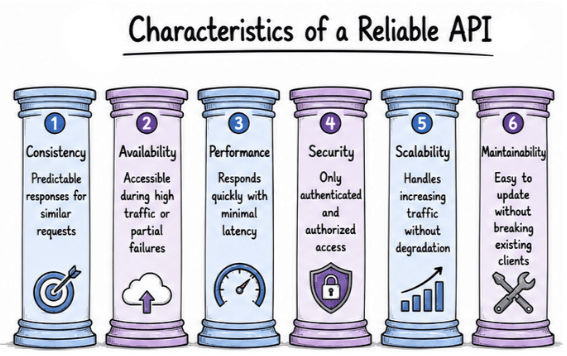
These characteristics help developers build APIs that are dependable and easy to integrate.
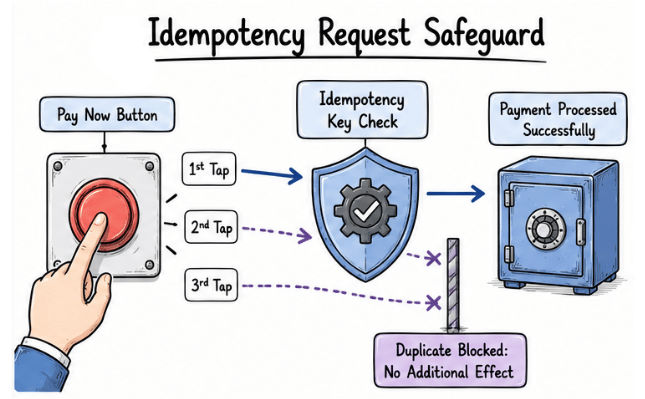
Idempotency means that sending the same API request multiple times produces the same result without creating unintended changes.
This is especially useful when requests are retried due to network failures, timeouts, or accidental duplicate submissions.
Imagine you click the "Pay Now" button, but your internet connection becomes slow.
Since you're unsure whether the payment was successful, you click the button again.
If the payment API is idempotent, the payment is processed only once, even if the server receives the same request multiple times.
GET – Retrieves data without modifying it.
PUT – Updates or replaces a resource. Repeating the request produces the same final result.
DELETE – Removes a resource. Repeating the request has no additional effect after the resource is deleted.
Note: POST is generally not idempotent because sending the same request multiple times can create multiple resources unless the API implements idempotency using techniques such as Idempotency Keys.
Prevents duplicate requests.
Avoids duplicate payments or orders.
Improves API reliability.
Handles network retries safely.
Error handling is the process of returning clear and meaningful responses when an API cannot process a request successfully.
Instead of returning vague or confusing responses, a well-designed API uses appropriate HTTP status codes and descriptive error messages to help clients understand what went wrong.
Status Code | Meaning |
|---|---|
200 OK | The request was processed successfully. |
201 Created | A new resource was created successfully. |
400 Bad Request | The request contains invalid or missing data. |
401 Unauthorized | Authentication is required or has failed. |
403 Forbidden | The client is authenticated but does not have permission to access the resource. |
404 Not Found | The requested resource does not exist. |
500 Internal Server Error | An unexpected error occurred on the server. |
Most APIs return both an appropriate HTTP status code and a response body describing the error.
If a user requests a product that does not exist, the API might return:
{
  "status": 404,
  "error": "Product not found"
}
along with the 404 Not Found status code.
A well-designed API should return structured and consistent error responses instead of generic messages. This makes it easier for developers to understand, debug, and handle errors programmatically.
A good error response may include:
HTTP Status Code – Indicates the type of error.
Error Message – A clear description of what went wrong.
Error Code (Optional) – A unique code that helps identify a specific error.
Timestamp (Optional) – Shows when the error occurred.
Request ID (Optional) – Helps trace the request in server logs for debugging.
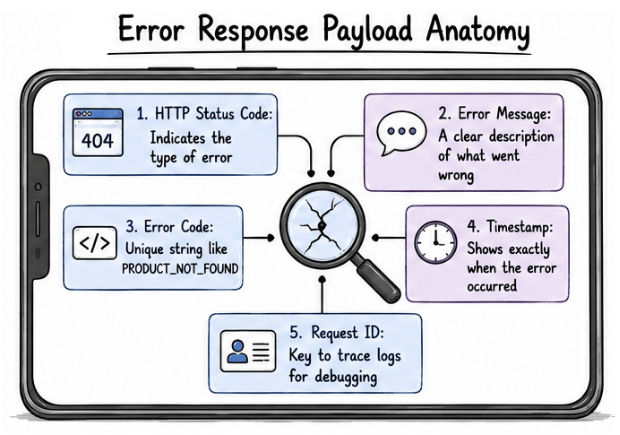
Example
{
  "status": 404,
  "error": "Product not found",
  "code": "PRODUCT_NOT_FOUND"
}
Using a consistent error response format makes APIs easier to debug, integrate, and maintain.
Makes debugging easier.
Helps developers identify problems quickly.
Improves the user experience.
Makes APIs more reliable and easier to integrate.
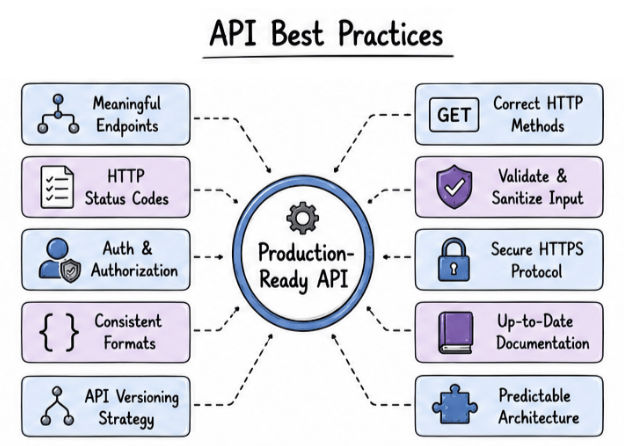
Following API best practices helps developers build APIs that are secure, reliable, scalable, and easy to maintain. Well-designed APIs are easier to understand, integrate, and maintain throughout their lifecycle.
Use clear and meaningful endpoint names.
Use the correct HTTP methods (GET, POST, PUT, DELETE).
Return appropriate HTTP status codes.
Validate and sanitize all user input.
Use authentication and authorization to protect resources.
Secure API communication using HTTPS.
Keep request and response formats consistent.
Write clear and up-to-date API documentation.
Version APIs before introducing breaking changes.
Design APIs to be simple, predictable, and developer-friendly.
Suppose you are building an online shopping API.
A well-designed API should:
Use endpoints such as /products, /orders, and /users that clearly describe the resources.
Return appropriate HTTP status codes, such as 200 OK, 201 Created, or 404 Not Found.
Validate user input before processing requests to prevent invalid or malicious data.
Protect sensitive operations using authentication and authorization.
Return responses in a consistent JSON format across all endpoints.
By following these best practices, developers can build APIs that are easier to use, integrate, maintain, and scale as applications grow.
Building reliable APIs helps applications perform better, handle errors correctly, and provide a better experience for users.
Idempotency prevents duplicate actions when the same request is sent multiple times.
Error Handling returns clear error messages and appropriate HTTP status codes.
API Best Practices help developers build secure, reliable, and easy-to-maintain APIs.
By following these principles, developers can create APIs that are scalable, user-friendly, and reliable for real-world applications.
