
Durgesh Tiwari
Author
When designing a software system, there is rarely a single "best" solution. Every architecture decision comes with both benefits and drawbacks. Improving one part of the system often means making a compromise somewhere else.
For example, adding more servers can improve performance, but it also increases infrastructure costs. Keeping frequently accessed data in memory makes an application faster, but memory is much more expensive than disk storage.
This balancing act is called Trade-off Analysis.
In System Design, making the right trade-offs is more important than choosing the latest technology. A good architecture balances performance, scalability, reliability, cost, and business requirements instead of trying to optimize everything.
During System Design interviews, interviewers usually care more about your reasoning behind a design decision than the technology itself.
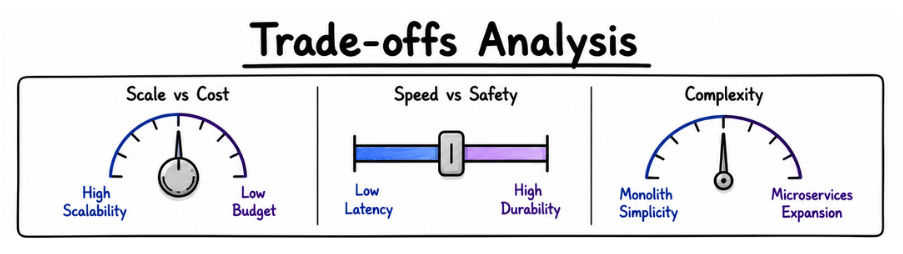
The right architecture always depends on the application's requirements.
For example, a startup with a few thousand users may choose a monolithic architecture because it is simple, faster to build, and easier to maintain. On the other hand, a global platform serving millions of users may require load balancers, distributed databases, caching, and microservices to handle large-scale traffic.
Both approaches are correct because they solve different problems.
Before choosing an architecture, engineers usually ask questions like:
How many users will use the application?
What response time is acceptable?
Is consistency more important than availability?
How quickly is the system expected to grow?
What is the infrastructure budget?
The answers to these questions help engineers choose the right trade-offs for the system.
Almost every large-scale application faces similar design decisions. Understanding these trade-offs will help you choose the right architecture and explain your decisions during interviews.
Every application should be fast, but improving performance usually costs more money.
For example, adding load balancers, Redis, CDNs, read replicas, or auto scaling can make an application much faster. However, these improvements also increase infrastructure, deployment, and maintenance costs.
A small startup may choose a simple setup to save money, while a large application with millions of users may invest more in performance to provide a better user experience.
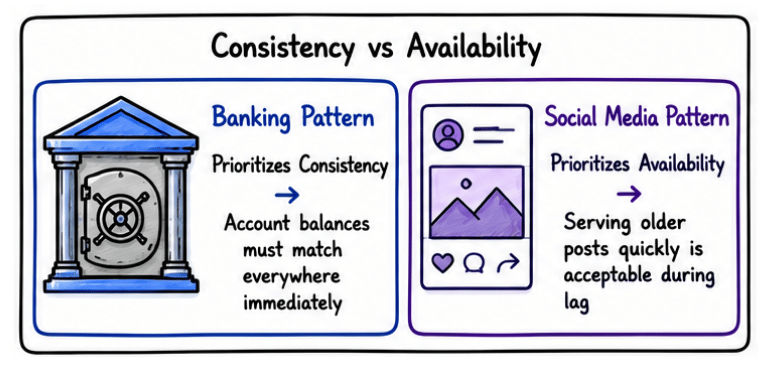
In distributed systems, it's not always possible to provide both perfect consistency and high availability, especially during network failures.
A consistent system always returns the latest data. A highly available system keeps serving users even if the data is temporarily outdated.
For example, a banking application prioritizes consistency because account balances must always be accurate. A social media platform usually prioritizes availability because showing a slightly older post is acceptable.
The right choice depends on what is more important for the application.
Users expect applications to respond quickly, but storing data safely usually takes more time.
For example, a payment system waits until a transaction is securely stored before confirming success. A chat application may show the message immediately and complete some storage tasks in the background.
Applications that handle critical data usually prioritize durability, while real-time applications often focus on lower latency.
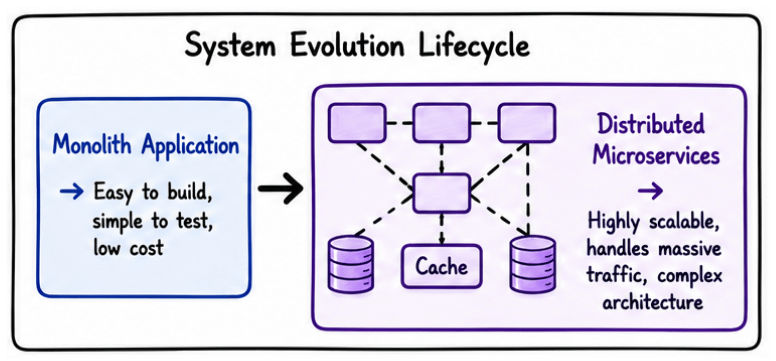
A simple architecture is easier to build, test, and maintain. As an application grows, it often needs a more scalable architecture to handle increasing traffic.
For example, many products start with a monolithic application. As the number of users grows, they gradually adopt microservices, distributed databases, caching, and message queues.
Building a complex architecture too early often increases development effort without providing much benefit.
Some applications perform more read operations, while others handle more writes. Optimizing one often affects the other.
For example, adding multiple database indexes makes search queries faster, but inserts and updates become slower because every index also needs to be updated.
The best approach depends on whether the application is read-heavy or write-heavy.
Reading data from memory is much faster than reading it from disk, but memory is also much more expensive.
For this reason, applications usually keep frequently accessed (hot) data in Redis or Memcached, while storing the remaining data in the main database.
This provides a good balance between speed and infrastructure cost.

Adding stronger security helps protect user data, but it can also make the application less convenient to use.
For example, Multi-Factor Authentication (MFA) adds an extra verification step during login. This improves security but also takes a little more time for users.
Banking applications usually prioritize security, while entertainment or social media platforms often focus on providing a smoother user experience.
Imagine you're designing a video streaming platform.
The application should:
Support millions of users
Start videos quickly
Keep infrastructure costs under control
Deliver smooth video playback
To achieve these goals, you'll need to make several trade-offs.
Using a CDN reduces latency but increases infrastructure costs.
Storing videos in multiple resolutions improves user experience but requires more storage.
Caching popular videos improves performance but uses more memory.
Replicating data across multiple regions improves availability but also increases operational complexity.
There is no single perfect solution. The best architecture is the one that balances performance, scalability, reliability, user experience, and cost based on the application's requirements.
In a System Design interview, don't just name a technology. Explain why you're choosing it.
A simple approach is:
Understand the requirements.
List the possible solutions.
Explain the advantages and disadvantages of each option.
Choose the best solution.
Explain why it fits the requirements.
Example
"We can use database replication to improve read performance. It reduces read latency but increases infrastructure cost and replication complexity. Since this application is read-heavy, database replication is the better choice."
This shows that your decisions are based on the application's requirements, not just the technology.
Many beginners focus only on technologies instead of understanding the application's requirements.
Avoid these common mistakes:
Choosing technologies without explaining why.
Trying to optimize everything at the same time.
Using complex architectures for small applications.
Ignoring business requirements and budget.
Discussing only the advantages while ignoring the trade-offs.
A good System Design is not about using the most advanced architecture. It's about choosing the solution that best fits the problem.
