
Durgesh Tiwari
Author
Real-time communication is a technique that allows applications to send and receive data instantly, so users can see updates as soon as they happen without manually refreshing the page.
In a traditional request-response model, the client sends a request and waits for the server's response. If new information becomes available later, the client must send another request to fetch it. In contrast, real-time communication enables the server to deliver updates immediately whenever new data is available.
Real-time communication improves user experience by reducing delays and ensuring that all users see the latest information almost instantly.
It is widely used in applications such as chat applications, live notifications, online gaming, video conferencing, collaborative editing tools, stock market platforms, live dashboards, and real-time location tracking.
There are several techniques for implementing real-time communication, each with its own advantages, limitations, and use cases. The most common techniques are:
WebSockets
Server-Sent Events (SSE)
Long Polling
Short Polling
In the following sections, you'll learn how each technique works, where it is commonly used, and when to choose one over another.
WebSockets are a communication protocol that provides a persistent, full-duplex (two-way) communication channel between a client and a server. Once the connection is established, both the client and the server can send and receive data at any time without creating a new HTTP request for every message.
Unlike traditional HTTP communication, where each request requires a new connection, WebSockets keep the connection open. This makes them much faster and more efficient for applications that require continuous, real-time communication.
The communication process works as follows:
The client sends an HTTP request asking to upgrade the connection to WebSocket.
The server accepts the upgrade request.
A persistent WebSocket connection is established.
The client and server exchange data in both directions whenever needed.
The connection remains open until either the client or the server closes it.
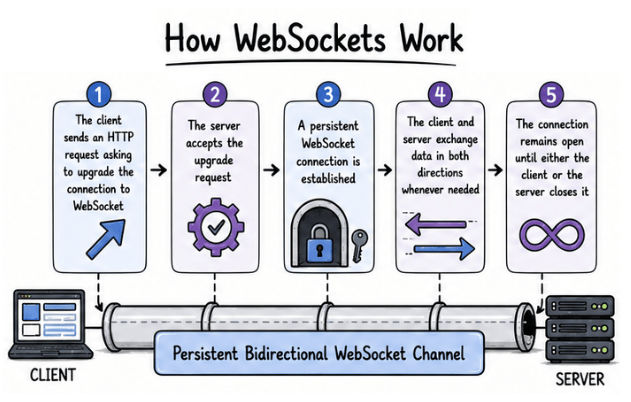
Imagine you are chatting with a friend on WhatsApp.
When your friend sends a message, it appears instantly on your screen without refreshing the application.
Similarly, if you start typing, the other person can immediately see a "Typing..." indicator.
This real-time, two-way communication is made possible using WebSockets.
Chat applications
Online gaming
Live sports score updates
Stock market dashboards
Video conferencing
Collaborative editing tools
Real-time notifications
Supports full-duplex (two-way) communication.
Delivers real-time updates with very low latency.
Eliminates repeated HTTP requests after the connection is established.
Reduces network overhead and improves performance.
Ideal for applications that require continuous communication.
More complex to implement than traditional REST APIs.
The server must maintain active connections for connected clients.
Can consume more server memory and resources with a large number of concurrent users.
Not suitable for simple request-response APIs where real-time communication is unnecessary.
Server-Sent Events (SSE) is a technology that allows a server to send real-time updates to a client over a single, long-lived HTTP connection.
Unlike WebSockets, which support two-way communication, SSE supports one-way communication only, meaning the server can continuously send data to the client, but the client cannot send data back through the same connection. If the client needs to send information, it must make a separate HTTP request.
Because of its simplicity, SSE is a good choice for applications where the server only needs to push updates to users.
The communication process works as follows:
The client sends an HTTP request to the server.
The server accepts the request and keeps the HTTP connection open.
Whenever new data becomes available, the server automatically pushes it to the client.
The client receives the update and displays the latest information.
The connection remains open until it is closed by either the client or the server.
If the connection is interrupted, most browsers automatically try to reconnect to the server.
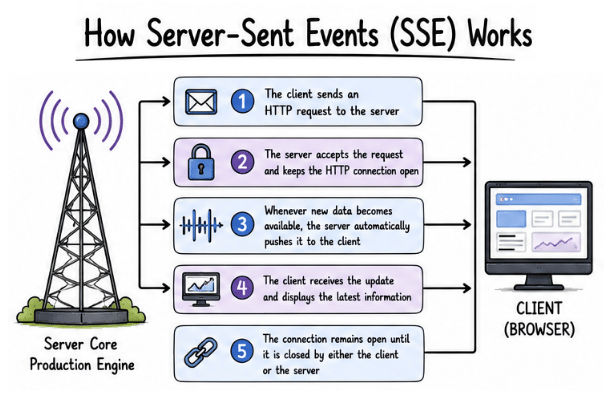
Imagine you are reading a live news website.
Whenever breaking news is published, the server immediately sends the latest update to your browser, and the page displays it automatically without requiring you to refresh.
Similarly, live sports score websites continuously update the scoreboard using server-sent events.
Live news updates
Live sports scores
Weather alerts
Stock market price updates
Live dashboards
Social media notifications
Monitoring and analytics dashboards
Easy to implement compared to WebSockets.
Uses the standard HTTP protocol.
Automatically reconnects if the connection is lost.
Efficient for one-way real-time updates.
Requires less overhead than WebSockets for server-to-client communication.
Supports only one-way communication (server to client).
The client cannot send data through the same connection.
Not suitable for chat applications, online gaming, or other applications that require two-way communication.
Primarily supported over HTTP and mainly intended for browser-based applications.
Long Polling is a communication technique that provides near real-time updates using standard HTTP requests. Instead of responding immediately, the server keeps the client's request open until new data becomes available or a timeout occurs.
Once the server sends a response, the client immediately creates a new request to continue waiting for future updates. This cycle repeats continuously, allowing the client to receive updates with minimal delay.
Long Polling is often used when WebSockets or Server-Sent Events (SSE) are not available or supported.
The communication process works as follows:
The client sends an HTTP request to the server.
The server keeps the request open while waiting for new data.
When new data becomes available (or the request times out), the server sends a response.
The client processes the response and immediately sends another request.
This process repeats continuously to receive future updates.
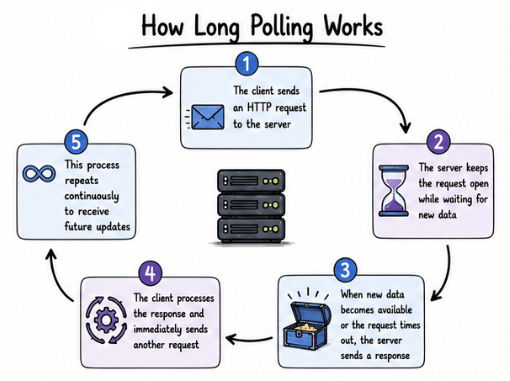
Imagine a customer support website where users are waiting for a reply from a support agent.
The browser sends a request to the server and waits for a response. Instead of replying immediately, the server keeps the request open until the support agent sends a message. Once the message is available, the server returns the response, and the browser immediately sends another request to wait for future messages.
Chat applications (legacy systems)
Customer support messaging
Notification systems
Live status updates
Monitoring dashboards
Uses the standard HTTP protocol.
Easy to implement without additional protocols.
Works well with older browsers and existing infrastructure.
Provides near real-time communication.
Creates repeated HTTP requests, increasing network overhead.
Consumes more server resources than WebSockets or SSE.
Introduces higher latency due to repeated request-response cycles.
Not suitable for applications with very frequent updates or a large number of concurrent users.
Short Polling is a communication technique in which the client sends HTTP requests to the server at regular time intervals to check whether new data is available.
Unlike Long Polling, the server does not wait for new data. Instead, it immediately responds with the current information, even if nothing has changed. After a fixed interval, the client sends another request, and this process continues repeatedly.
Short Polling is simple to implement but can generate many unnecessary requests when data changes infrequently.
The communication process works as follows:
The client sends an HTTP request to the server.
The server immediately returns the current data.
The client waits for a fixed time interval.
The client sends another request to check for updates.
This process repeats continuously.
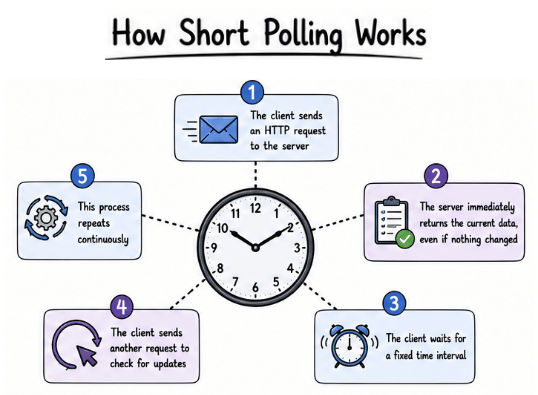
Imagine an order management dashboard that checks every 10 seconds for new customer orders.
The application sends a request every 10 seconds, regardless of whether any new orders have been placed. If new orders exist, the server returns them; otherwise, it returns the current data or an empty response.
Simple dashboards
Basic monitoring systems
Small internal applications
Applications that do not require instant updates
Periodic status checking
Very easy to implement.
Uses the standard HTTP protocol.
Works with existing web infrastructure.
Suitable for applications with infrequent data updates.
Sends unnecessary requests even when no new data is available.
Increases network traffic and server load.
Higher response latency because updates are received only at the next polling interval.
Not suitable for high-performance or large-scale real-time applications.
Feature | WebSockets | Server-Sent Events (SSE) | Long Polling | Short Polling |
|---|---|---|---|---|
Communication | Two-way communication between client and server | One-way communication from server to client | Client repeatedly sends requests; server waits before responding | Client sends requests at fixed time intervals |
Connection Type | Persistent WebSocket connection | Persistent HTTP connection | New HTTP connection after each response | New HTTP connection for every polling interval |
Real-Time Capability | Best suited for real-time communication | Excellent for server-to-client live updates | Provides near real-time updates | Suitable only for periodic updates |
Protocol | Starts with HTTP, then upgrades to the WebSocket protocol | Standard HTTP | Standard HTTP | Standard HTTP |
Server Push Support | Server can send data whenever needed | Server can send data whenever needed | Server sends data only when new information becomes available | Server responds only after receiving a client request |
Client Push Support | Client can send data at any time | Not supported | Client sends a new request after every response | Client sends requests at fixed intervals |
Network Usage | Most efficient because the connection remains open | Efficient because a single HTTP connection is reused | Moderate due to repeated HTTP requests | Least efficient because many unnecessary requests may be sent |
Response Latency | Very low | Very low | Moderate | Depends on the polling interval |
Scalability | Well suited for large real-time applications | Well suited for applications requiring server push | Suitable for medium-scale applications | Better suited for small-scale applications |
Implementation Complexity | More complex to implement and manage | Relatively simple to implement | Moderately simple to implement | Very simple to implement |
Common Use Cases | Chat applications, online gaming, collaborative editing, video conferencing | Live notifications, news feeds, stock prices, dashboards | Legacy real-time applications, notification systems | Monitoring dashboards, status updates, periodic data checks |
Different communication methods are suitable for different application requirements.
Use WebSockets when your application requires continuous two-way communication, such as chat applications, online gaming, collaborative editing, or video conferencing.
Use Server-Sent Events (SSE) when only the server needs to push real-time updates to clients, such as live news feeds, stock price updates, weather alerts, or notification systems.
Use Long Polling when WebSockets or SSE are not available but your application still requires near real-time communication using standard HTTP.
Use Short Polling when data changes infrequently and checking for updates at fixed intervals is sufficient, such as monitoring dashboards, status pages, or periodic reporting systems.
Selecting the appropriate communication method depends on your application's requirements.
Choose WebSockets for highly interactive applications that require instant, two-way communication.
Choose SSE for applications that primarily deliver live updates from the server to the client.
Choose Long Polling when compatibility with older systems is important and real-time communication is still required.
Choose Short Polling for simple applications where implementation simplicity is more important than real-time performance.
Real-time communication enables applications to exchange data quickly and keep users updated without requiring manual page refreshes.
WebSockets provide persistent, bidirectional communication and are ideal for highly interactive applications.
Server-Sent Events (SSE) provide efficient one-way communication for delivering live updates from the server.
Long Polling provides near real-time communication by keeping client requests open until new data is available.
Short Polling periodically checks the server for updates and is suitable for applications that do not require instant communication.
Each communication method offers different trade-offs in terms of performance, scalability, latency, implementation complexity, and resource usage. Understanding these differences helps developers choose the most appropriate approach for building responsive, reliable, and scalable modern applications.
