
Durgesh Tiwari
Author
A Job Scheduler / Task Queue sounds simple at first:
“Put a task in a queue and let a worker execute it.”
That works until the system has millions of tasks, thousands of workers, scheduled jobs, retries, priorities, worker crashes, duplicate execution, dependencies, and large traffic spikes.
At that point, it becomes a distributed systems problem.
In this guide, we will design a scalable Job Scheduler and Distributed Task Queue System and understand task queues, workers, scheduling, retries, idempotency, priorities, leases, failure recovery, backpressure, partitioning, and important system design trade-offs.
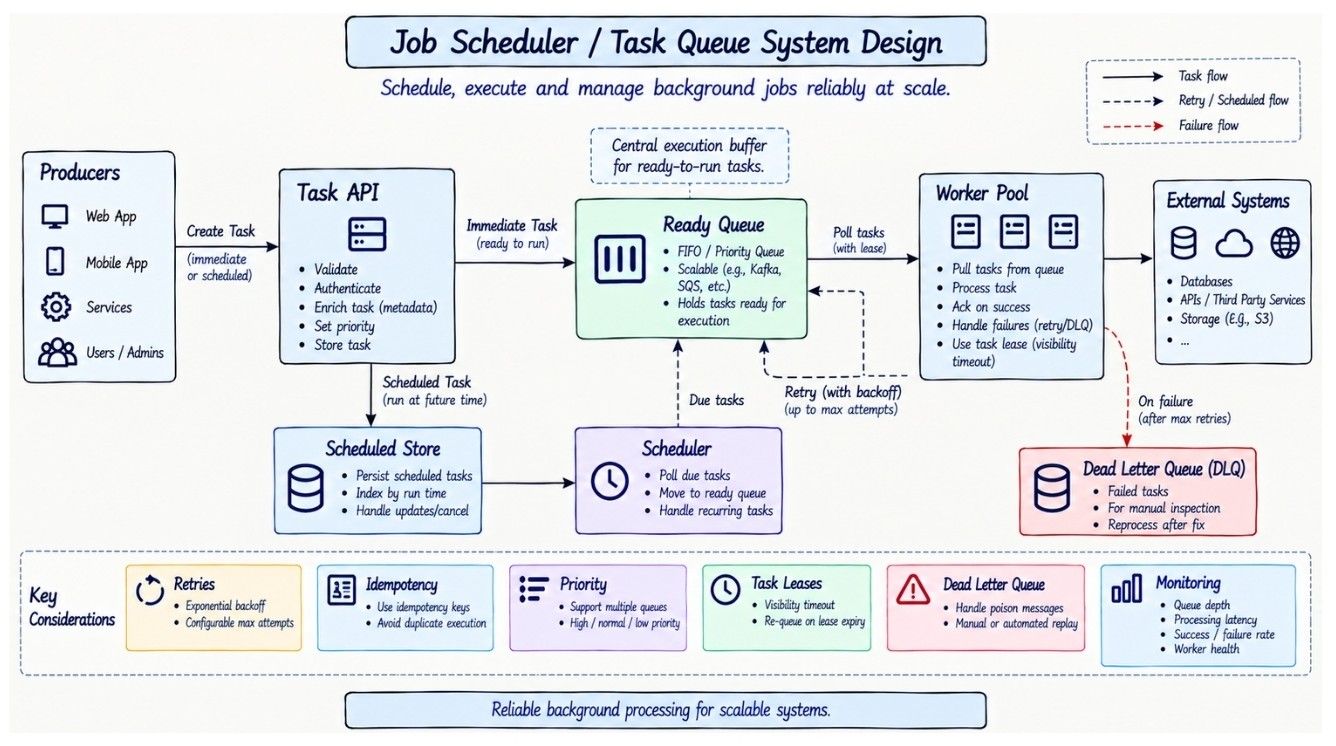
A Task Queue stores work that should be executed asynchronously by workers.
Consider an e-commerce application.
After an order is created, the system may need to:
Send a confirmation email
Generate an invoice
Notify the warehouse
Update analytics
Send a push notification
The customer should not wait for all of these operations.
Instead:
Application
    ↓
Task Queue
    ↓
Workers
The application submits tasks and returns quickly.
Workers execute those tasks independently.
A Job Scheduler decides when a job should become eligible for execution.
Examples:
Send report at 9:00 AM
Run backup every night
Process invoice after 30 minutes
Delete expired sessions every hour
A Task Queue mainly answers:
What work should be executed?
A Job Scheduler mainly answers:
When should the work become eligible for execution?
The two are commonly combined:
Scheduler
    ↓
Ready Queue
    ↓
Workers
When a scheduled task becomes due, the scheduler makes it available to workers.
The terms job and task are sometimes used interchangeably, but in this design we can use the following distinction:
Aspect | Job | Task |
|---|---|---|
Meaning | A higher-level unit of work or a scheduled/recurring definition | A concrete executable unit of work |
Scope | Can represent a larger business operation | Usually represents one specific operation |
Execution | May create one or many tasks | Executed directly by a worker |
Scheduling | Often contains schedule information such as | Usually becomes eligible for immediate or delayed execution |
Lifecycle | Can remain active across many executions | Usually has one execution lifecycle |
Worker Processing | Workers normally do not execute the job definition directly | Workers consume and execute tasks |
Retries | Retry behavior is usually applied to generated task instances | A failed task can be retried individually |
Example | Generate monthly invoices | Generate invoice for customer 123 |
The system should support the core operations required to schedule and execute background work:
Submit Immediate Tasks: Tasks that should become eligible for execution immediately.
Schedule Future Tasks: Execute tasks at or after a specified run_at time.
Recurring Jobs: Support cron-like or periodic schedules.
Task Priorities: Support high, normal, and low-priority work.
Retries: Retry temporary failures using configurable retry policies.
Task Status: Track states such as SCHEDULED, QUEUED, RUNNING, SUCCESS, and FAILED.
Cancellation: Allow tasks that have not completed to be cancelled when supported.
Worker Failure Recovery: Reassign tasks when a worker crashes or loses its lease.
Example task submission:
{
  "type": "GENERATE_REPORT",
  "run_at": "2026-09-15T09:00:00Z",
  "priority": "HIGH"
}
The main focus is reliable task scheduling and execution.
The system should provide:
Scalability: Handle increasing task volume by scaling schedulers, queues, and workers horizontally.
Durability: Once a task is durably accepted, it should not be silently lost because of a server failure.
High Availability: Task submission and processing should continue despite individual service failures.
Fault Tolerance: Recover safely from worker, scheduler, queue, and network failures.
Low Scheduling Delay: Due tasks should become available to workers with minimal delay.
At-Least-Once Processing: Tasks may be retried after failures, so duplicate execution must be expected.
Observability: Monitor queue depth, task age, execution latency, failures, retries, and DLQ growth.
The design should prioritize durability and safe recovery over assuming exactly-once execution.
Suppose the system receives:
100 million tasks/dayAverage task submission rate:
100,000,000 / 86,400
≈ 1,157 tasks/second
But average throughput is not enough for capacity planning.
A batch process may suddenly create:
5 million tasks
within a few minutes
During such traffic spikes, the queue should absorb the backlog even if workers cannot process tasks at the same rate.
For example:
Task Creation Rate   = 10,000 tasks/sec
Task Processing Rate = 6,000 tasks/sec

Backlog Growth       = 4,000 tasks/sec
This separates two important metrics:
Task Creation Rate: How quickly producers submit new tasks.
Task Processing Rate: How quickly workers complete tasks.
The system should therefore be designed for peak traffic and backlog recovery, not only average throughput.
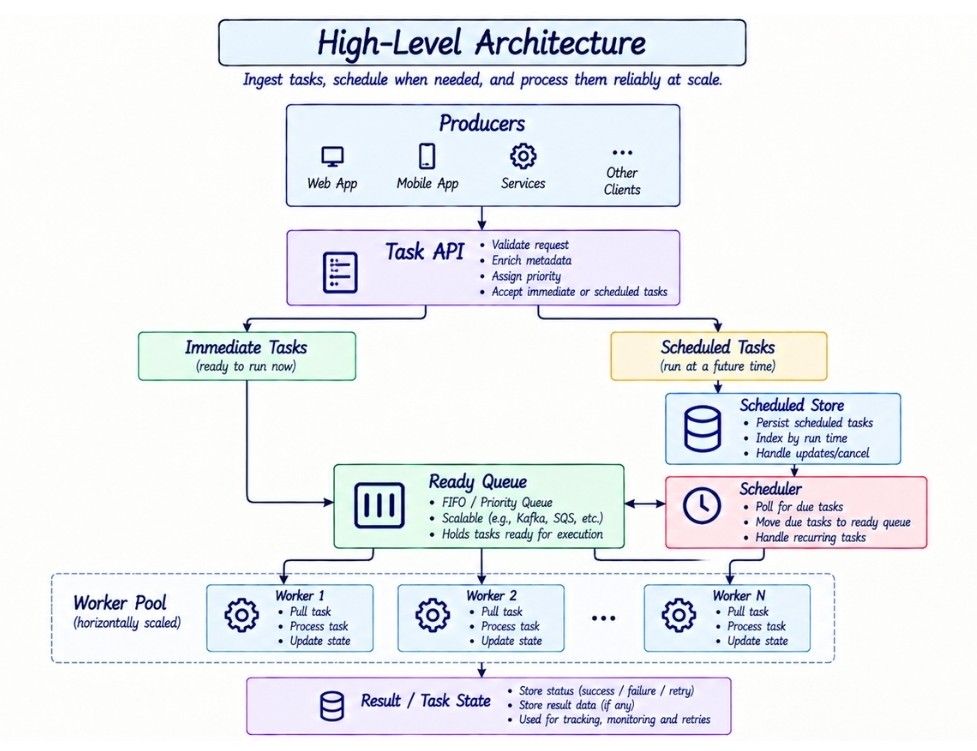
A scalable Job Scheduler / Task Queue System can separate immediate tasks from scheduled tasks while using a common Ready Queue for execution.
                       Producers
                           ↓
                     +-----------+
                     | Task API  |
                     +-----+-----+
                           |
               +-----------+-----------+
               |                       |
               v                       v
        Immediate Tasks         Scheduled Tasks
               |                       |
               |                       v
               |               +---------------+
               |               |Scheduled Store|
               |               +-------+-------+
               |                       |
               |                       v
               |                 +-----------+
               |                 | Scheduler |
               |                 +-----+-----+
               |                       |
               +-----------+-----------+
                           |
                           v
                     +-----------+
                     |Ready Queue|
                     +-----+-----+
                           |
              +------------+------------+
              |            |            |
              v            v            v
           Worker 1     Worker 2     Worker N
              |            |            |
              +------------+------------+
                           |
                           v
                  Result / Task State
The main components are:
Task API: Accepts immediate and scheduled tasks.
Scheduled Store: Durably stores tasks that are not yet eligible for execution.
Scheduler: Finds due tasks and moves them toward execution.
Ready Queue: Contains tasks currently eligible for workers.
Workers: Claim and execute tasks.
Task Metadata Store: Tracks task status, attempts, timestamps, and results.
Supporting components may include:
Retry / Delayed Queue
Dead Letter Queue
Priority Queues
Task Metadata Store
Rate Limiter
Object Storage
Monitoring
Immediate tasks can enter the Ready Queue directly.
Scheduled tasks remain in durable scheduled storage until their run_at time arrives. The scheduler then makes them available in the Ready Queue.
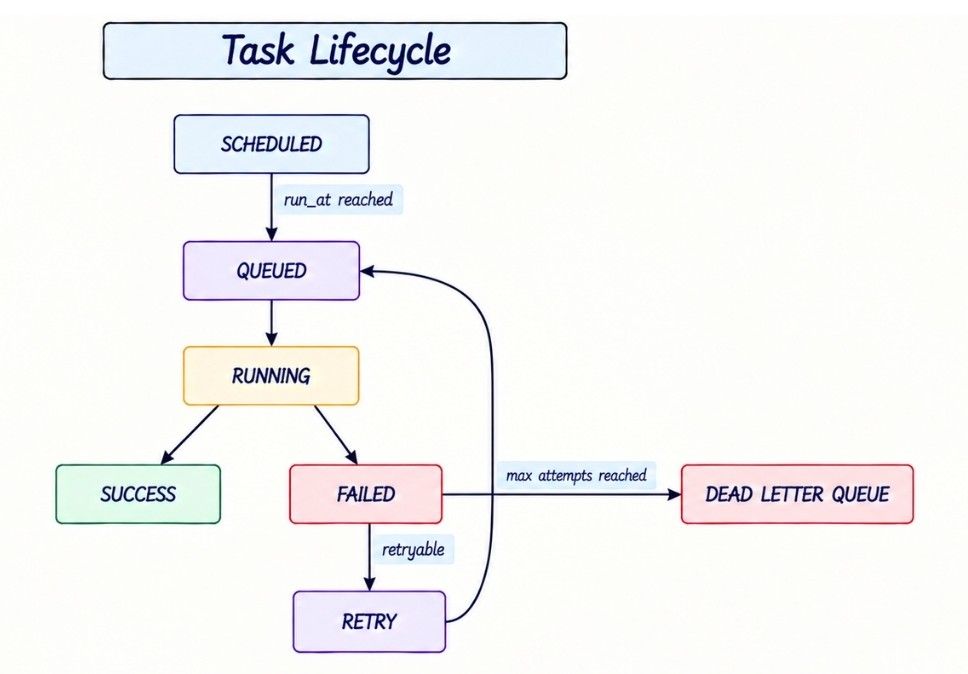
A task moves through different states during scheduling and execution.
SCHEDULED
    |
    | run_at reached
    v
QUEUED
    |
    | worker claims task
    v
RUNNING
   /    \
  v      v
SUCCESS FAILED
          |
          | retryable + attempts remaining
          v
        RETRY
          |
          | backoff / delay expires
          v
        QUEUED
If the task keeps failing and reaches its retry limit:
FAILED
   |
   | max attempts reached
   v
DEAD LETTER QUEUE
A task record may contain:
task_id
task_type
payload
status
priority
run_at
attempt_count
max_attempts
created_at
started_at
completed_at
For example:
{
  "task_id": "task_123",
  "task_type": "SEND_EMAIL",
  "status": "QUEUED",
  "priority": "HIGH",
  "attempt_count": 1,
  "max_attempts": 5
}
State transitions should be performed safely because worker crashes, retries, and concurrent processing can otherwise produce duplicate or inconsistent task state.
A simple API may be:
POST /tasksExample immediate task:
{
  "type": "SEND_EMAIL",
  "payload": {
    "user_id": "123",
    "template": "welcome"
  },
  "priority": "HIGH"
}
Scheduled task:
{
  "type": "GENERATE_REPORT",
  "run_at": "2026-09-15T09:00:00Z",
  "payload": {
    "report_id": "report_123"
  }
}
For important task creation APIs, an idempotency key can prevent client retries from accidentally creating multiple logical tasks.
Suppose an HTTP request directly performs a 30-second video-processing operation.
User
 ↓
API
 ↓
Process Video
 ↓
30 Seconds
 ↓
Response
The API request remains open and consumes server resources.
Instead:
User
 ↓
API
 ↓
Create Task
 ↓
Ready Queue
 ↓
Return task_id
A worker executes the expensive work independently.
The API remains responsive and worker capacity can scale separately.
The service creating work is the producer.
The worker executing it is the consumer.
Producer
   ↓
Queue
   ↓
Consumer
Multiple producers can submit tasks:
Order Service -----+
                   |
User Service ------+----> Task Queue
                   |
Media Service -----+
And many workers can consume tasks:
Task Queue
   |
   +----> Worker 1
   +----> Worker 2
   +----> Worker 3
   +----> Worker N
This supports horizontal scaling.
Workers should usually be stateless with respect to durable workflow state.
A worker typically:
Receives or claims a task.
Gets a lease on it.
Executes the operation.
Acknowledges success.
Reports or records failure.
Because durable task state is stored outside the worker, we can scale from:
10 Workersto:
1,000 Workerswithout redesigning task ownership.
Consider:
Worker receives Task A
Worker executes Task A
Worker crashes
How does the system know whether processing completed?
A common model is:
Queue
  ↓
Worker Receives Task
  ↓
Execute
  ↓
ACK
The task is acknowledged only after successful processing.
If no acknowledgement arrives, the queue can eventually make the task available again.
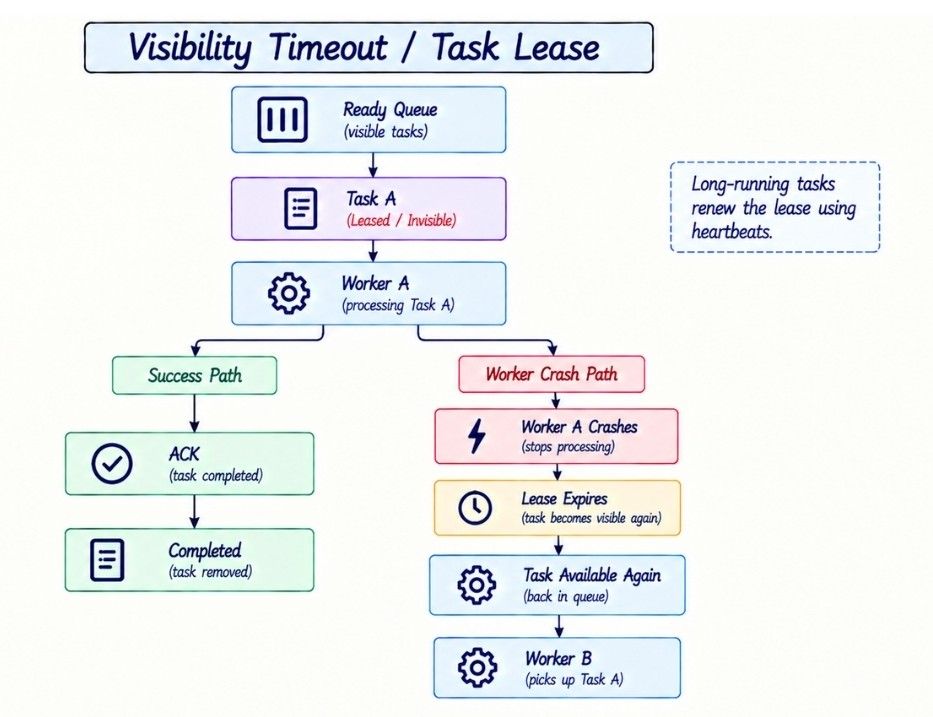
When Worker A receives a task, the system temporarily prevents another worker from processing the same task.
Task A
  ↓
Worker A

Leased / Invisible
for a limited time
If Worker A succeeds:
ACK
 ↓
Task Completed
If Worker A disappears:
Lease Expires
      ↓
Task Available Again
      ↓
Worker B Retries
For long-running work, leases should often be renewable.
A fixed one-minute lease is not appropriate for a three-hour video-processing task.
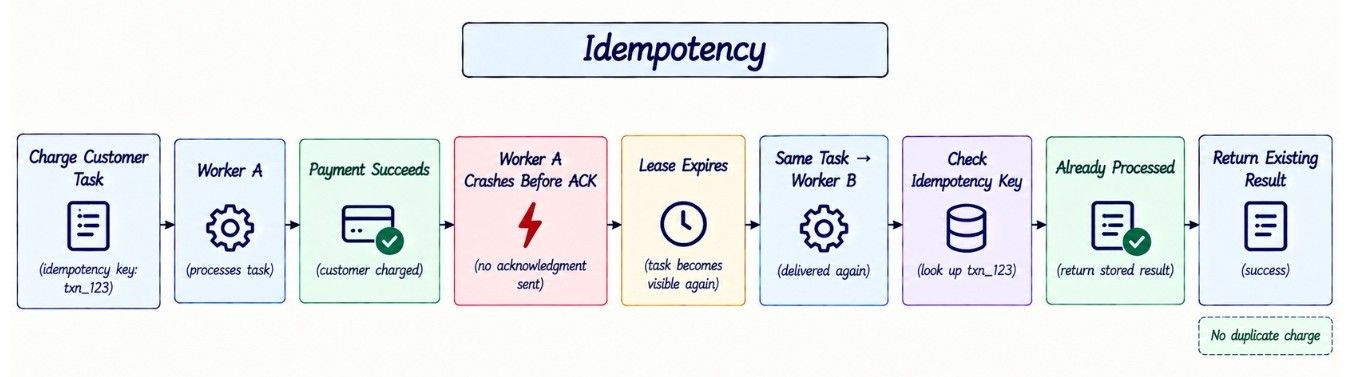
A critical failure can occur after the external side effect but before acknowledgement.
Example:
Task:
Charge customer

Worker A:
Charge succeeds
     ↓
CRASH before ACK
The queue never receives the acknowledgement.
The lease expires, and Worker B may process the task again.
This means a reliable distributed task queue should usually not claim that arbitrary external side effects execute exactly once.
The safer approach is idempotent processing.
Suppose a payment task contains:
idempotency_key = payment_order_123The downstream operation checks whether that logical action was already completed.
Task Arrives
     ↓
Check Idempotency Key
     |
   +-+--+
   |    |
  New  Exists
   |    |
   v    v
Execute Return Existing Result
Retries may execute the handler again, but they should not create duplicate business effects.
Idempotency should ideally be enforced by a durable atomic mechanism, not only an in-memory check.
A task is not intentionally retried after uncertain processing.
Possible loss
Fewer duplicate executionsThe system retries tasks until they succeed or exceed policy.
Reliable delivery
Possible duplicate execution
This is common for distributed task queues.
True end-to-end exactly-once execution is difficult when external systems and side effects are involved.
A stronger interview answer is:
Use at-least-once delivery with idempotent handlers to achieve effectively-once business behavior where possible.
Temporary failures should usually be retried.
Example:
Attempt 1 → 503
Wait

Attempt 2 → timeout
Wait longer

Attempt 3 → success
Retries should be bounded.
Infinite retries can consume resources forever and hide permanent problems.
If one million tasks fail because a downstream API is unavailable, retrying all of them immediately makes the outage worse.
Use exponential backoff:
Attempt 1 → wait 1 second
Attempt 2 → wait 2 seconds
Attempt 3 → wait 4 seconds
Attempt 4 → wait 8 seconds
Attempt 5 → wait 16 seconds
Add jitter so many tasks do not retry at the same instant.
This reduces retry storms.

Not every failure should be retried.
The worker should first classify the failure before applying a retry policy.
Error Type | Retry? | Examples |
|---|---|---|
Transient Failure | Yes | Network timeout, HTTP 503, temporary database failure |
Rate Limiting | Yes, with delay | HTTP 429, provider quota temporarily exceeded |
Invalid Input | No | Malformed payload, missing required field |
Unsupported Operation | No | Invalid task type, unsupported request |
Permanent Authorization Failure | Usually no | Invalid permission or revoked access |
Resource Temporarily Unavailable | Yes | Dependency temporarily offline |
Resource Permanently Missing | Usually no | Deleted resource that will not reappear |
Example decision flow:
Task Fails
    ↓
Classify Error
    |
    +---- Transient / Retryable
    |           ↓
    |     Apply Backoff + Jitter
    |           ↓
    |         Retry
    |
    +---- Permanent / Non-Retryable
                ↓
          Mark Failed / DLQ
For example:
HTTP 503
→ Retry with exponential backoff

HTTP 429
→ Retry after delay / Retry-After

Invalid payload
→ Do not retry

Permanent authorization failure
→ Do not repeatedly retry
Retry policies should also consider the operation itself. A timeout does not always mean the downstream action failed, so tasks with external side effects should use idempotency before retrying.
The goal is to retry temporary failures, while avoiding wasted work and retry storms for permanent failures.
After a task exceeds its retry policy, move it to a Dead Letter Queue (DLQ).
Ready Queue
    ↓
Worker
    ↓
Failure
    ↓
Retry
    ↓
Repeated Failure
    ↓
DLQ
The DLQ allows operators to:
Inspect failed tasks
Diagnose the cause
Fix data or configuration
Replay tasks
Discard permanently invalid work
A DLQ should be monitored rather than treated as permanent forgotten storage.
A task that should run tomorrow should not immediately enter the Ready Queue.
Instead:
Task API
   ↓
Scheduled Task Store
   ↓
Scheduler
   ↓
Due?
   ↓
Ready Queue
A task with:
run_at = 10:00normally means:
Do not make this task eligible before 10:00.
It does not automatically guarantee that a worker begins execution at exactly 10:00:00.000.
Actual start time also depends on scheduler delay, queue backlog, worker capacity, and downstream limits.
A scheduled task may contain:
task_id
task_type
payload
run_at
priority
status
At small scale, a database query may find due tasks:
SELECT *
FROM scheduled_tasks
WHERE run_at <= NOW()
  AND status = 'SCHEDULED'
ORDER BY run_at
LIMIT 1000;
At very large scale, repeatedly scanning a huge table becomes expensive.
Scheduled tasks can be partitioned into time ranges.
For example:
12:00–12:01
12:01–12:02
12:02–12:03
The scheduler focuses mainly on buckets near the current time rather than scanning billions of future tasks.
This improves scheduled-task lookup efficiency.
Some queue technologies support delayed delivery.
Task
 |
 | delay = 30 minutes
 |
 v
Delayed Queue
 |
 | delay expires
 |
 v
Ready Queue
This can simplify short or moderate delays when the queue provides the required semantics and delay range.
Long-term scheduling may still benefit from explicit durable scheduled-job storage.
Suppose we need:
Run cleanup every hour
Generate report every Monday at 9 AM
A recurring job may store:
job_id
schedule
task_type
payload
next_run_at
timezone
When due:
Scheduler
    ↓
Create Task Instance
    ↓
Ready Queue
    ↓
Worker
Then the scheduler calculates the next execution time.
The recurring job definition and the generated task instances should remain distinct.
Recurring schedules may use cron-like expressions.
For example:
0 9 * * 1A production scheduler must also define behavior for:
Time zones
Daylight-saving transitions
Missed schedules
Scheduler downtime
Overlapping runs
Long-running previous executions
For example, if a server was down at 9:00 AM and returns at 9:20 AM, should the job:
Run immediately?
Be skipped?
Run once for every missed occurrence?
This is called a misfire policy.
One scheduler is a single point of failure.
Scheduler
   ↓
CRASH
   ↓
No New Scheduled Tasks Released
So we may run:
Scheduler A
Scheduler B
Scheduler C
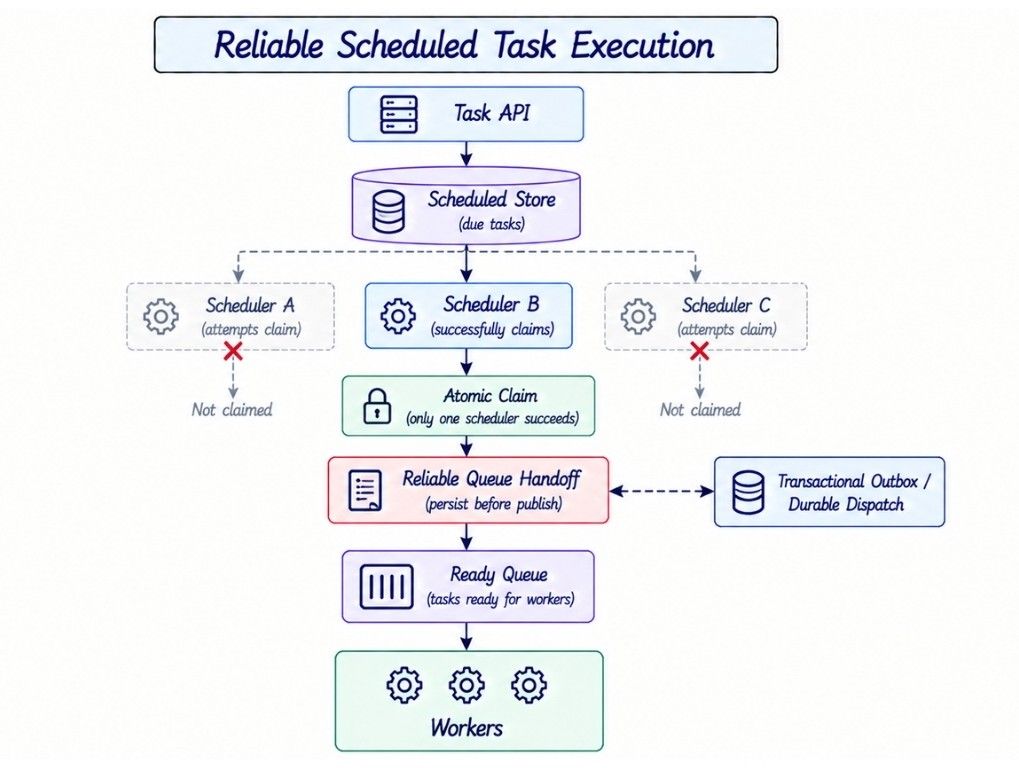
But now multiple schedulers may see the same due task.
They need safe coordination.
One practical coordination mechanism is an atomic state transition.
SCHEDULED
    ↓
Atomic Claim
    ↓
CLAIMED
Only one scheduler should successfully claim the task.
The exact mechanism may use:
Conditional update
Compare-and-set
Row locking
SELECT ... FOR UPDATE SKIP LOCKED
Another atomic datastore primitive
This is often simpler than introducing a separate lock service.
A scheduler can also acquire a distributed lease before processing a job.
Scheduler A
    ↓
Acquire job_123 Lease
    ↓
Success
    ↓
Schedule Task
Scheduler B:
Acquire job_123 Lease
    ↓
Already Held
    ↓
Skip
Locks should generally expire or use lease semantics so crashed owners do not block progress forever.
However, distributed locks alone do not eliminate every duplicate-execution race.
Task generation and execution should still be idempotent.
Another subtle problem appears when a scheduler:
Marks a scheduled task claimed.
Tries to publish it to the Ready Queue.
Crashes before publishing.
The task may become stuck.
A reliable design can use:
Transactional outbox
Durable dispatch state + retry
Queue/database transaction when supported
Reconciliation of claimed-but-not-enqueued tasks
The scheduler-to-queue handoff must be recoverable.
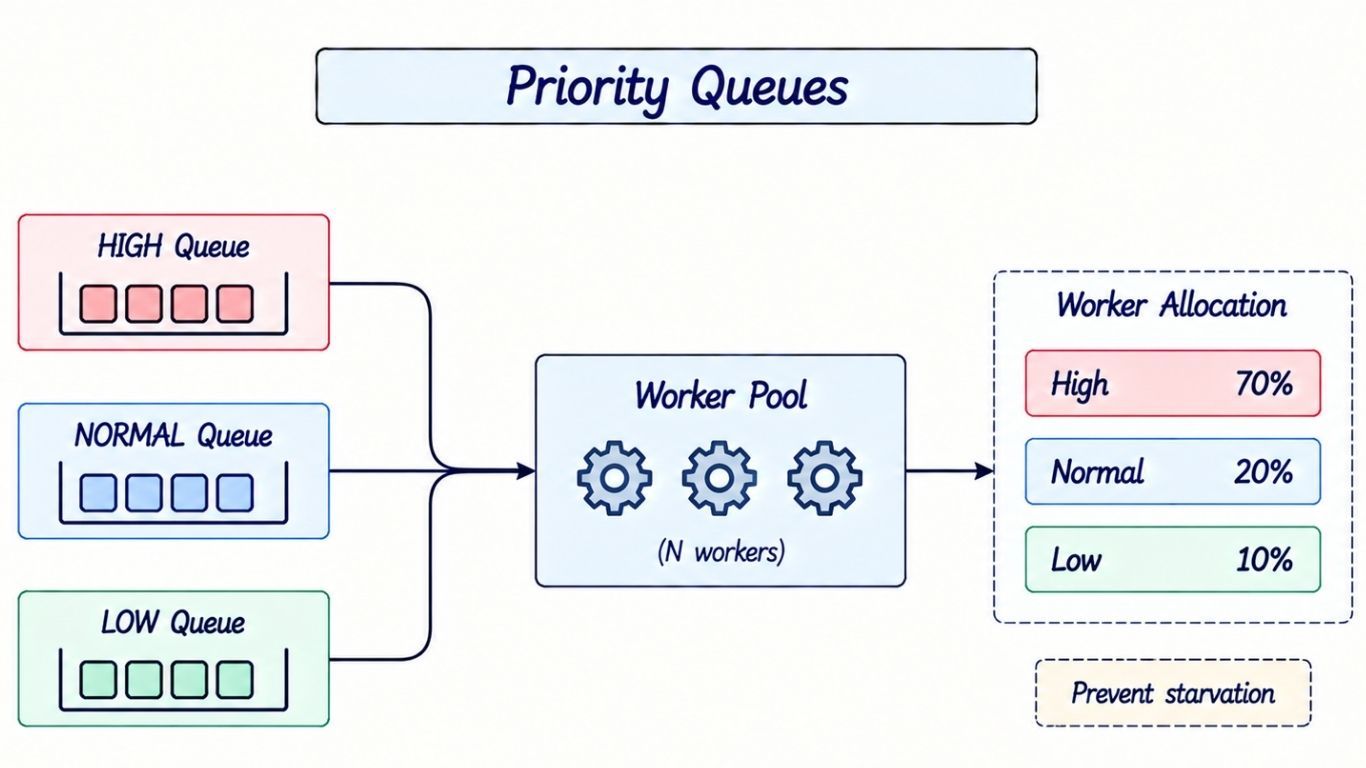
Not every task has equal importance.
Example:
HIGH   → Payment processing
NORMAL → Email generation
LOW    → Analytics aggregation
A practical design may use separate queues:
High Queue ----\
Normal Queue ---> Worker Capacity
Low Queue -----/
Queue isolation can prevent a flood of low-priority work from delaying critical tasks.
If high-priority work arrives continuously, low-priority tasks may never run.
This is starvation.
Possible solutions include:
Weighted scheduling
Reserved worker capacity
Priority aging
Per-priority worker pools
For example:
70% → High
20% → Normal
10% → Low
The exact policy depends on business requirements.
Useful autoscaling signals include:
Queue depth
Oldest task age
Task arrival rate
Processing rate
Worker utilization
Task execution latency
Suppose:
Queue Depth = 5,000,000This does not automatically mean the system is unhealthy.
If workers process work faster than tasks arrive, the backlog may disappear quickly.
Compare:
Queue A:
1,000,000 tasks
Processing = 500,000/sec
with:
Queue B:
10,000 tasks
Processing = 10/sec
Queue B may be operationally worse.
Monitor together:
Queue Depth
+
Oldest Task Age
+
Arrival Rate
+
Processing Rate
The age of the oldest eligible task is especially useful for detecting real backlog pain.
Some tasks may take seconds while others run for hours.
Using one worker pool can create head-of-line blocking.
A better design may isolate workloads:
Short Task Queue
      ↓
Short Task Workers

Long Task Queue
      ↓
Long Task Workers
This allows different:
Timeouts
CPU/memory allocation
Autoscaling policies
Retry policies
Long-running workers can periodically prove they are still alive.
heartbeat(task_id)If heartbeats stop:
Worker Possibly Dead
        ↓
Lease Eventually Expires
        ↓
Task Can Be Recovered
Heartbeats should typically renew a lease for a bounded time rather than creating permanent ownership.
Different task types may have different execution limits.
SEND_EMAIL      → 30 seconds
GENERATE_REPORT → 10 minutes
VIDEO_TRANSCODE → 2 hours
A stuck worker should not hold a task forever.
Timeout policy is part of task execution semantics.
For long jobs, checkpointing may reduce the amount of work lost after failure.
Some workflows require ordered dependencies.
Task A
  ↓
Task B
  ↓
Task C
Example:
Upload Video
    ↓
Transcode Video
    ↓
Generate Thumbnail
    ↓
Publish Video
Task B should become eligible only after Task A succeeds.
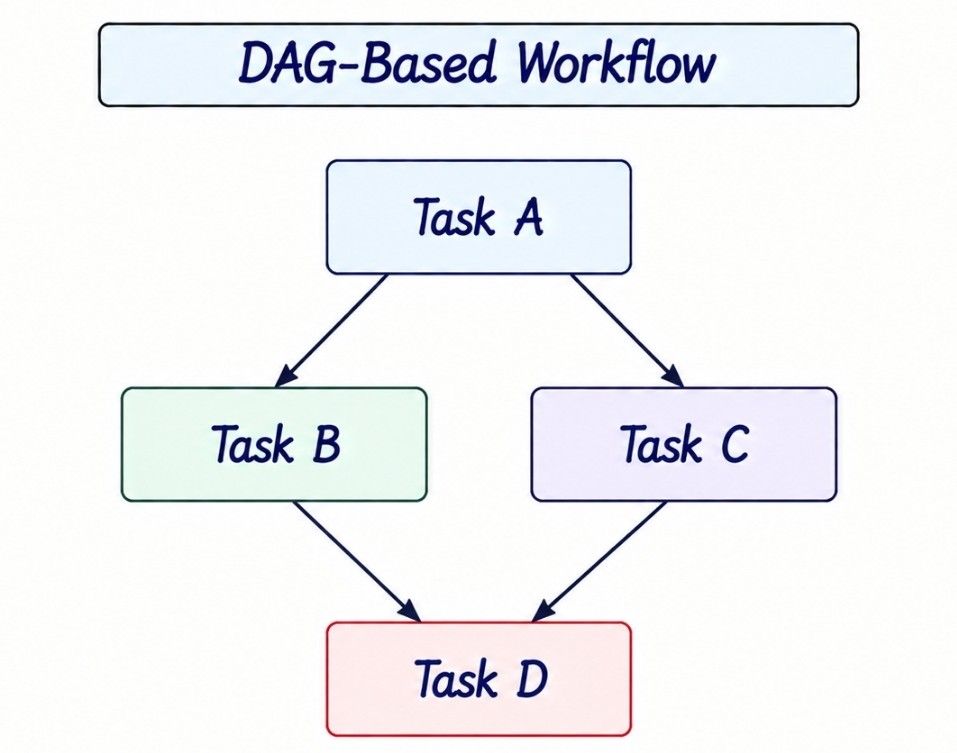
More complex dependencies form a Directed Acyclic Graph.
        Task A
       /      \
      v        v
   Task B    Task C
       \      /
        v    v
        Task D
Task D begins only after B and C succeed.
At this point, the system is becoming a workflow orchestration platform, not merely a task queue.
Do not introduce a DAG engine unless workflow dependencies are actually required.
A Message Queue primarily transports messages between services, while a Task Queue represents executable work that should be processed by workers.
Aspect | Message Queue | Task Queue |
|---|---|---|
Primary Purpose | Transfer messages/events between components | Distribute executable work to workers |
Typical Item | Event or message | Task or job |
Example |
|
|
Consumer Role | Consumes and reacts to messages | Executes the assigned task |
Task Status | Usually not a primary concern | Commonly tracks |
Retries | Depends on broker and consumer design | Usually a core task-processing feature |
Leases / Visibility Timeout | Depends on the messaging system | Common for recovering tasks after worker failure |
Scheduling / Delay | May or may not be supported | Often supports delayed and scheduled execution |
Execution Timeout | Usually handled by the consumer | Commonly part of task execution policy |
Result Tracking | Usually not required | May store task status and execution result |
Typical Use Case | Service-to-service events and asynchronous communication | Background jobs such as emails, reports, and video processing |
The terms Job Queue and Task Queue are often used interchangeably, and many real systems do not make a strict distinction.
For this design, we can use the following conceptual difference:
Aspect | Job Queue | Task Queue |
|---|---|---|
Primary Unit | Higher-level job or unit of work | Concrete executable task |
Scope | A job may represent a larger business operation | A task usually represents one specific operation |
Execution | A job may create one or multiple tasks | A task is directly processed by a worker |
Scheduling | Often associated with scheduled, recurring, or batch jobs | Commonly associated with executable background work |
Granularity | Usually coarser-grained | Usually finer-grained |
Example |
|
|
Relationship | One job can generate many tasks | Multiple tasks can belong to the same job |
For example:
Job Queue:

GenerateMonthlyInvoices
          ↓
       Job Runner
          ↓
   Create Task Instances
      /      |       \
     v       v        v
 Task 1   Task 2   Task 3
The generated tasks can then be executed through a Task Queue:
Task Queue
    |
    +----> GenerateInvoice(customer_1) → Worker
    |
    +----> GenerateInvoice(customer_2) → Worker
    |
    +----> GenerateInvoice(customer_3) → Worker
The distinction is conceptual rather than universal. Some platforms call every unit a job, while others call it a task.
In a system design interview, define the terminology you are using and then focus on the important architecture: scheduling, queueing, worker execution, retries, failure recovery, and scalability.
Kafka is primarily a distributed event-streaming and log platform, not a purpose-built task scheduler.
It can participate in work-processing systems, but a task queue may require features such as:
Individual task leases
Per-task acknowledgement behavior
Delayed execution
Retry scheduling
Priority
Task status
Dead-letter handling
Kafka can be a good fit when its partitioning, ordered consumption, replay, and throughput model match the workload.
The key lesson is:
Choose infrastructure based on required semantics, not popularity.
At high throughput, one queue partition may not be enough.
Possible partition keys include:
task_id
tenant_id
task_type
region
customer_id
For example:
hash(task_id) % Ncan distribute tasks across partitions.
Workers process partitions in parallel.
Partition choice affects ordering, load distribution, and hot-key behavior.
Global ordering across millions of tasks is expensive and usually unnecessary.
Preserve ordering only where required.
Suppose tasks for the same account must execute in order:
Update Balance
      ↓
Apply Fee
      ↓
Generate Statement
Use an ordering key:
partition_key = account_idTasks for one account stay ordered, while different accounts execute in parallel.
Suppose:
Company A → 10 million tasks
Company B → 100 tasks
Without controls, Company A may consume most worker capacity.
Possible protections include:
Per-tenant quotas
Rate limits
Fair scheduling
Weighted scheduling
Queue isolation
Reserved capacity
Fairness is important in multi-tenant task platforms.
Suppose an email provider supports:
1,000 requests/secwhile workers can process:
20,000 tasks/secAdding more workers will only overload the provider.
Use downstream-aware rate limiting:
Task Queue
    ↓
Rate Limiter
    ↓
Workers
    ↓
External Provider
The queue safely absorbs excess work.
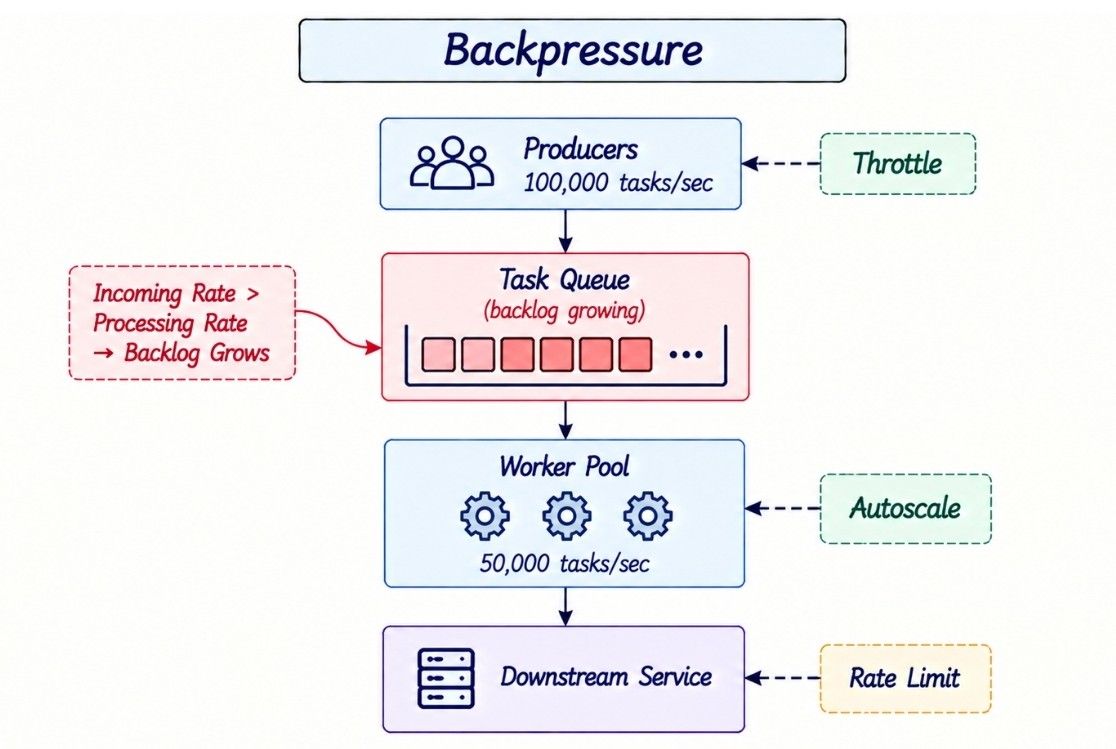
Suppose producers create:
100,000 tasks/secwhile workers process:
50,000 tasks/secThe backlog continuously grows.
Possible responses include:
Autoscale workers
Throttle producers
Delay non-critical work
Reject work when capacity limits are reached
Apply per-tenant quotas
Increase downstream capacity
Queues provide buffering, but they are not infinite storage.
The system needs overload protection.
The queue itself must survive failures.
A task should not disappear simply because one queue server crashes.
Possible approaches include:
Replicated queue storage
Durable distributed logs
Durable databases
Managed queue services
The correct technology depends on:
Throughput
Ordering
Latency
Delay support
Delivery guarantees
Operational complexity
Not everything belongs in the queue message.
A metadata database can store:
Task status
Attempt history
Schedule
Ownership
Execution timestamps
Last error
Result reference
Cancellation state
The queue is optimized for dispatch.
The metadata store is optimized for management, visibility, and querying.
Do not place multi-gigabyte payloads directly in the queue.
Instead:
Large File
   ↓
Object Storage
Queue message:
{
  "task_id": "task_123",
  "video_location": "object://video_123",
  "operation": "TRANSCODE"
}
Keep queue messages small and store large objects separately.
Some tasks produce output.
Example:
Generate PDF ReportLarge results may be stored in:
Object Storage
Database
Cache
The task record stores a reference:
task_id: task_123
status: SUCCESS
result_location: object://reports/report_123.pdf
A client can later request:
GET /tasks/task_123After submitting an asynchronous task, the client needs a way to know when the task completes.
There are three common approaches: Polling, Callback/Webhook, and Real-Time Push using WebSocket or SSE.
Aspect | Polling | Callback / Webhook | WebSocket / SSE |
|---|---|---|---|
How It Works | Client repeatedly checks task status | Server calls a client-provided endpoint | Server pushes updates over an open connection |
Direction | Client → Server | Server → Client | Server → Connected Client |
Complexity | Low | Medium | Medium to High |
Latency | Depends on polling interval | Usually low | Very low |
Extra Requests | Can be high | Low | Low after connection setup |
Client Endpoint Required | No | Yes | No webhook endpoint, but an active connection is required |
Failure Handling | Client simply polls again | Callback delivery needs retries | Reconnect and missed-event recovery may be needed |
Best For | Simple APIs and occasional status checks | Server-to-server integrations | Interactive applications and live UI updates |
Client → GET /tasks/123
       ← RUNNING

Client → GET /tasks/123
       ← SUCCESS
Simple, but frequent polling can create unnecessary traffic.
Task Completed
      ↓
Webhook
      ↓
Client Endpoint
Failed webhook deliveries should be retried with backoff.
Useful when the UI needs real-time task status or progress updates.
QUEUED → RUNNING → SUCCESSUse polling for simplicity, webhooks for server-to-server notifications, and WebSocket/SSE for real-time updates.
Cancellation depends on task state.
If still scheduled:
SCHEDULED → CANCELLEDIf queued but not started, mark it cancelled so workers skip it when claimed.
If already running, cancellation becomes cooperative.
Worker
  ↓
Periodically Check
Cancellation State
Some external side effects cannot be rolled back.
Therefore:
Cancellation does not automatically mean rollback.
Suppose a worker crashes halfway through execution.
Recovery depends on:
Lease Expiration
      +
Retry
      +
Idempotency
The architecture should assume workers may disappear at any time.
Workers are replaceable; durable state is not.
A poison task repeatedly fails or crashes workers.
Worker Receives Task
       ↓
Crash
       ↓
Task Retried
       ↓
Another Worker Crashes
Use:
Maximum attempts
Retry classification
DLQ
Worker isolation where necessary
This prevents one task from consuming resources indefinitely.
Suppose:
1 million tasksare scheduled for:
09:00:00At 9 AM, a huge amount of work becomes eligible at once.
Mitigations include:
Durable queue buffering
Partitioned scheduling
Batch release
Worker autoscaling
Rate limiting
Priority controls
Jitter when exact timing is unnecessary
The system should distinguish:
Run no earlier than 09:00from:
Start as close as possible to exactly 09:00because these require different capacity and precision guarantees.
Not every scheduler needs millisecond precision.
A reporting job may tolerate:
±30 secondswhile another domain may need much tighter timing.
Higher precision can increase coordination and capacity requirements.
Distributed systems must also handle:
Clock synchronization
UTC timestamps
User time zones
Daylight-saving transitions
Store absolute timestamps consistently, commonly in UTC.
For recurring local-time schedules, also preserve the intended scheduling timezone.
A global design may use regional queues and workers.
US Region
  ├── US Queue
  └── US Workers

EU Region
  ├── EU Queue
  └── EU Workers
Multi-region scheduling introduces additional questions:
Which region owns a scheduled job?
What happens during failover?
Can two regions execute the same task?
Where is authoritative task state?
How are duplicate effects prevented?
Should tasks remain close to regional data?
These are advanced design decisions and should be introduced only when requirements justify multi-region operation.
A production task system should monitor:
Throughput: Tasks submitted/sec and completed/sec
Failures: Failure rate and retry rate
Queue Health: Queue depth and oldest eligible task age
Latency: Scheduling delay and execution latency
DLQ: Dead Letter Queue size
Workers: Utilization and heartbeat failures
Workload Distribution: Tasks by priority and tenant
Dependencies: Downstream service errors
A particularly useful scheduler metric is:
scheduled_execution_delay
=
actual_start_time - expected_run_time
If a task scheduled for 10:00 consistently starts at 10:15, the system may be available, but the scheduler or worker capacity is operationally unhealthy.
Every task should have a unique:
task_idLogs should include fields such as:
task_id
task_type
worker_id
attempt_number
execution_time
error
This lets engineers trace:
Submitted
   ↓
Scheduled
   ↓
Queued
   ↓
Worker
   ↓
Retry
   ↓
Worker
   ↓
Success
Correlation IDs can also link a task back to the original request or business operation.
Suppose an application submits a task.
Application
     ↓
Task API
     ↓
Validate
     ↓
Persist Required Metadata
     ↓
Ready Queue
     ↓
Worker
     ↓
Acquire Lease
     ↓
Execute
     |
     +---- Success → ACK → COMPLETED
     |
     +---- Retryable Failure
                    ↓
               Retry / Delay
                    ↓
               Ready Queue
                    |
            Maximum Attempts?
                /       \
              No         Yes
              |           |
              v           v
            Retry        DLQ
The critical properties are:
Durable acceptance
Safe retries
Lease-based recovery
Idempotent processing
Bounded failures
For a future task:
Client
  ↓
Task API
  ↓
Scheduled Task Store
  ↓
Scheduler
  ↓
Find Due Task
  ↓
Atomic Claim
  ↓
Reliable Queue Handoff
  ↓
Ready Queue
  ↓
Worker
  ↓
Execute
For recurring work:
Recurring Job Definition
          ↓
       Scheduler
          |
          +---- Create Current Task
          |
          +---- Calculate next_run_at
The recurring definition remains durable while each occurrence becomes a separate task instance.
A complete high-level design is:
                         Producers
                            |
                            v
                     +-------------+
                     |  Task API   |
                     +------+------+
                            |
              +-------------+-------------+
              |                           |
              v                           v
        Immediate Tasks             Scheduled Tasks
              |                           |
              v                           v
        +-----------+              +--------------+
        |Ready Queue|              |Scheduled Store|
        +-----+-----+              +------+-------+
              |                           |
              |                           v
              |                    +-------------+
              |                    | Scheduler   |
              |                    +------+------+
              |                           |
              +-------------+-------------+
                            |
                            v
                     +-------------+
                     | Ready Queue |
                     +------+------+
                            |
                 +----------+----------+
                 |          |          |
                 v          v          v
              Worker 1   Worker 2   Worker N
                 |
        +--------+--------+
        |                 |
        v                 v
     Success            Failure
        |                 |
       ACK             Retry/Delay
                          |
                     Max Attempts
                       /       \
                     No         Yes
                     |           |
                     v           v
                  Ready Queue    DLQ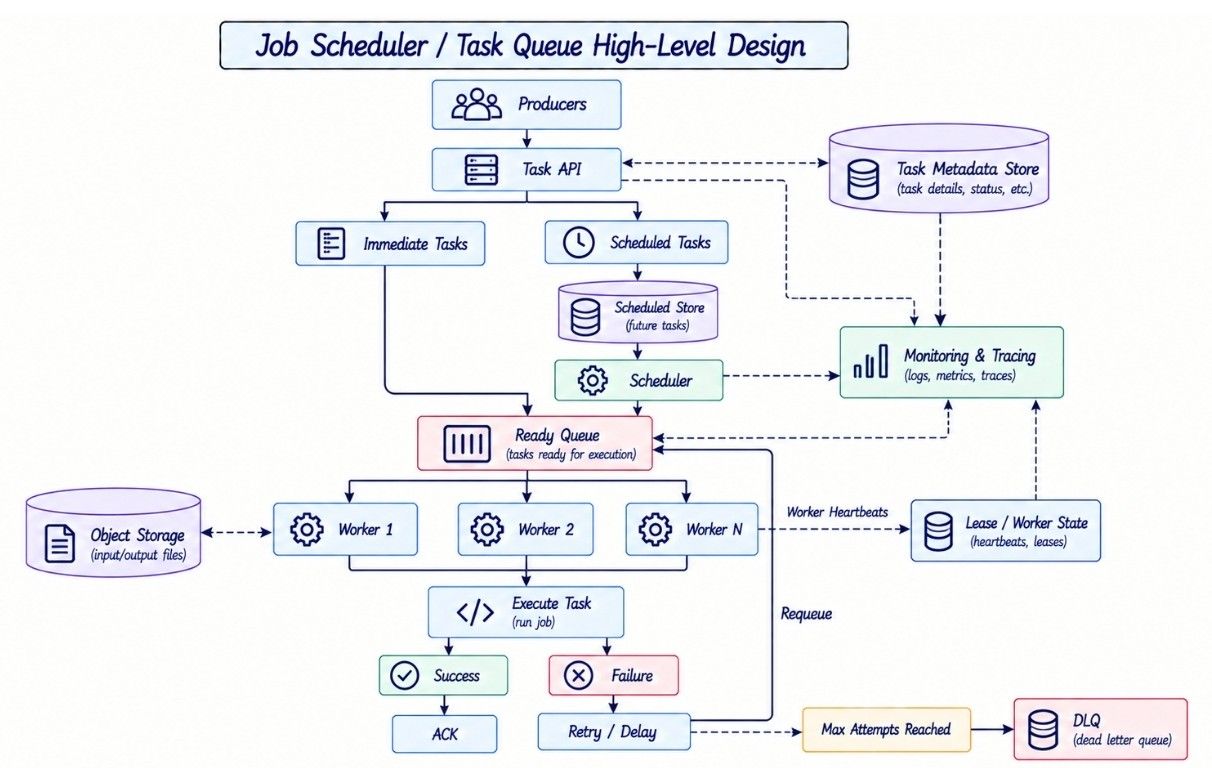
Supporting systems:
Task Metadata Store
Object Storage
Priority Queues
Rate Limiter
Worker Heartbeats
Idempotency Store / Downstream Idempotency
Monitoring and TracingHLD focuses on the overall distributed architecture, while LLD focuses on how individual components are implemented.
Area | HLD | LLD |
|---|---|---|
Focus | Distributed architecture | Internal component design |
Queue | Durability, partitioning, throughput |
|
Workers | Scaling, leases, failure recovery |
|
Retries | Retry architecture, backoff, DLQ |
|
Scheduling | Distributed scheduler and coordination | Scheduling algorithms and interfaces |
Task State | Durable lifecycle and recovery | State models and transition logic |
Main Question | How does the system scale and survive failures? | How is each component implemented? |
Possible LLD abstractions:
TaskHandler
    |
    +-- EmailTaskHandler
    +-- VideoTaskHandler
    +-- ReportTaskHandler
Retry strategies can use a common abstraction:
RetryPolicy
    |
    +-- FixedDelayRetry
    +-- ExponentialBackoffRetry
    +-- NoRetry
The HLD defines how the system works at scale, while the LLD defines how those components are structured in code.
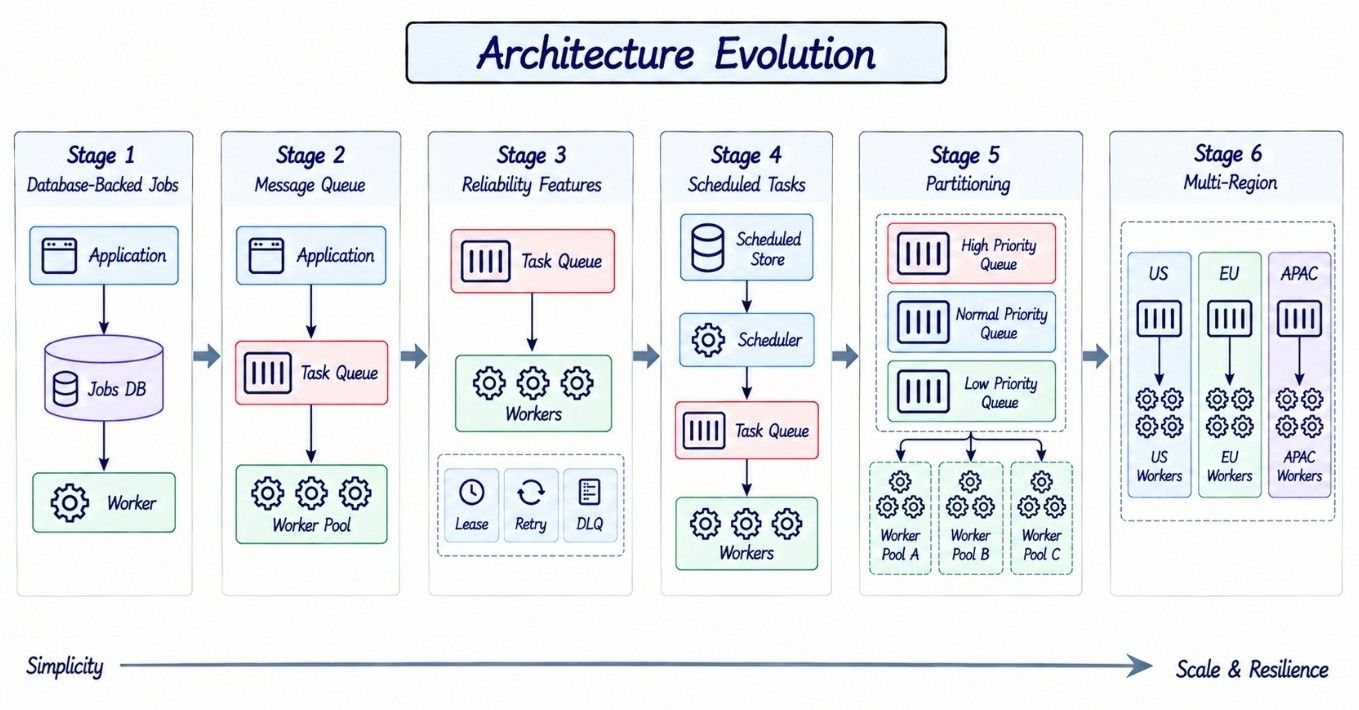
A good architecture should evolve as scale and reliability requirements increase.
Start with the simplest design:
Application
    ↓
Database Jobs Table
    ↓
Background Worker
This can work well for a small system with limited task volume.
As task volume increases, introduce:
Task Queue
Worker Pool
Retries
The queue buffers work, while multiple workers increase processing capacity.
As failures become important, add:
Visibility Timeout / Lease
Idempotency
DLQ
Task Metadata
Monitoring
These components help recover from worker failures and safely handle retries.
When future and recurring execution is required, add:
Scheduled Task Store
Distributed Scheduler
Recurring Jobs
Atomic Claiming
This allows multiple scheduler instances to safely process due tasks.
As traffic and workload diversity increase, add:
Partitioned Queues
Multiple Worker Pools
Priority Isolation
Autoscaling
Rate Limiting
Fair Scheduling
Time-Based Scheduling Partitions
These features improve throughput, workload isolation, and resource utilization.
Only when multi-region requirements justify the additional complexity, introduce:
Regional Queues
Multi-Region Ownership
Failover
Global Coordination
Advanced Observability
The key principle is to start simple and introduce complexity only when a specific scale, reliability, or business requirement demands it.
A strong system design should explain the important trade-offs behind architectural decisions.
At-Least-Once vs Duplicate Execution: Reliable retries prevent task loss but may cause duplicate execution, so handlers should be idempotent.
Scheduling Precision vs Cost: Tighter execution-time guarantees require more capacity, coordination, and infrastructure.
Single Queue vs Queue Isolation: A single queue is simpler, while separate queues provide better priority and workload isolation.
Retries vs Downstream Stability: Retries improve recovery but can amplify outages without exponential backoff, jitter, and limits.
Strict Ordering vs Throughput: Global ordering reduces parallelism; partition-level or local ordering scales better.
Priority vs Fairness: High-priority tasks should execute quickly without permanently starving lower-priority work.
Backlog vs Latency: Queues absorb traffic bursts, but increasing task age indicates that processing capacity is falling behind.
Simple Queue vs Workflow Engine: A task queue is simpler; dependencies, DAGs, and workflow state provide more power at significantly higher complexity.
Database Scheduler vs Specialized Scheduling: A database can work well at moderate scale, while partitioned or specialized scheduling becomes useful at very high scheduled-task volume.
The right design depends on the required scale, reliability, scheduling precision, and operational complexity.
Use a durable queue between producers and stateless workers.
Workers lease tasks, execute them, and acknowledge successful completion.
Add retries, idempotency, DLQ handling, autoscaling, partitioning, and observability as scale requires.
Its lease eventually expires and the task becomes available to another worker.
Because the first worker may already have produced a side effect, handlers should be idempotent.
Do not assume duplicate delivery can always be prevented.
Use task IDs, idempotency keys, atomic state changes, and idempotent downstream operations to prevent duplicate business effects.
Retry transient failures using exponential backoff and jitter.
Set a maximum attempt count and move repeatedly failing tasks to a DLQ.
Store the task durably with run_at.
Schedulers find due tasks, atomically claim them, and reliably publish them to the Ready Queue.
At high scale, partition scheduled tasks by time.
run_at = 09:00 mean the worker starts exactly at 09:00?Not necessarily.
It normally means the task should not become eligible before that time.
Actual start time depends on scheduling delay, queue backlog, worker capacity, and downstream rate limits.
Store a recurring definition containing its schedule and next_run_at.
When due, create a concrete task instance and calculate the next run.
Use atomic database claiming, conditional writes, distributed leases, or another coordination mechanism.
The generated work should still be idempotent.
Use priority-aware scheduling or separate queues and worker capacity.
Also explain how you prevent starvation.
Workers should be horizontally scalable.
Autoscale using queue depth together with oldest task age, arrival rate, processing rate, execution time, and worker utilization.
A DLQ stores tasks that exceed retry limits or cannot be processed normally.
Operators can inspect, repair, replay, or discard them.
It is the lease period during which a claimed task is unavailable to other workers.
If the worker does not acknowledge or renew the lease, the task becomes eligible for retry.
Use renewable leases, heartbeats, task-specific timeouts, checkpointing where useful, and separate worker pools for different workload classes.
Use partitioned scheduler work, queue buffering, scalable workers, batch release where acceptable, and downstream rate limiting.
If exact simultaneous execution is not required, controlled jitter can smooth the spike.
Usually, do not claim true end-to-end exactly-once execution.
Use at-least-once delivery with idempotent processing to achieve effectively-once business effects where possible.
Track prerequisites and release a task only after required dependencies succeed.
For complex graphs, use a workflow/DAG engine rather than overloading a simple task queue.
Use per-tenant quotas, rate limits, fair scheduling, weighted allocation, or queue isolation.
Partition related tasks by an ordering key such as account_id.
Preserve ordering only where needed instead of imposing global ordering.
A message queue mainly transports messages between services.
A task queue represents executable work and commonly adds execution state, retries, scheduling, leases, and worker failure handling.
Kafka can participate in task-processing systems, but it is fundamentally a distributed event-streaming/log platform.
Use it only when its partitioning, replay, ordering, and consumer semantics fit the workload.
Monitor:
Queue depth
Oldest task age
Scheduling delay
Task execution latency
Throughput
Retry rate
Failure rate
DLQ growth
Worker utilization
Lease/heartbeat failures
Downstream error rates
A large queue can drain quickly, while a smaller queue may contain very old work.
Queue depth must be evaluated together with task age, arrival rate, and processing rate.
Avoid relying on an unsafe sequence such as:
Mark task scheduled
↓
Publish to queue
where a crash between the two operations loses the dispatch.
Use a transactional outbox, durable dispatch state with retries, or another recoverable handoff strategy.
Scheduled tasks can be marked cancelled before dispatch.
Queued tasks can be skipped when claimed.
Running tasks require cooperative cancellation, and already completed external side effects may not be reversible.
Assume failures and retries are normal.
Design task execution so that a worker can crash at almost any point and the system can safely recover without silently losing work or creating uncontrolled duplicate effects.
Common mistakes in Job Scheduler / Task Queue System Design include:
Claiming exactly-once execution instead of designing for at-least-once + idempotency.
Retrying every failure without backoff, jitter, or retry limits.
Acknowledging tasks before work safely completes.
Missing leases/visibility timeouts, DLQ, or poison-task handling.
Treating run_at as an exact execution-time guarantee.
Ignoring duplicate scheduler claims or unsafe scheduler-to-queue handoff.
Using queue depth as the only health metric.
Ignoring priority starvation, tenant fairness, and downstream rate limits.
Putting large payloads directly in the queue.
Requiring global ordering or workflow/DAG complexity without a real requirement.
