
Durgesh Tiwari
Author
Design patterns in Java are proven, reusable solutions to common software design problems in object-oriented programming. They provide a standard way to structure code so that it becomes more flexible, maintainable, and scalable.
In simple words: Design patterns are “ready-made solutions” to common coding problems.
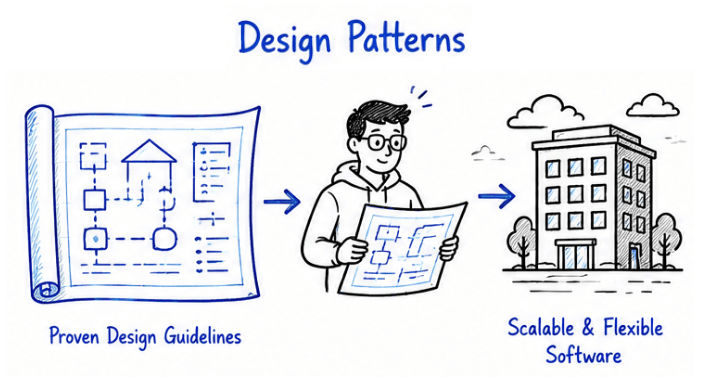
Design patterns are general reusable templates used to solve recurring design problems in software development. They are not complete code, but proven design guidelines that help developers build better software architecture.
👉 They act as best practices for writing clean, efficient, and structured code.
Without Design Pattern (Bad Approach)
public class EmailService {

    public void sendEmail() {
        System.out.println("Sending email...");
    }
}
👉 Problem: If we directly create objects everywhere, code becomes tightly coupled and hard to manage.
With Design Pattern (Better Approach – Singleton Idea)
public class EmailService {

    private static EmailService instance;

    private EmailService() {}

    public static EmailService getInstance() {
        if (instance == null) {
            instance = new EmailService();
        }
        return instance;
    }

    public void sendEmail() {
        System.out.println("Sending email...");
    }
}
👉 Here, only one object is created and reused, improving control and structure.
Design patterns are important because they provide standard, proven solutions to commonly occurring software design problems.
Benefits of Design Patterns
Improve overall code quality and structure.
Make code reusable and easier to maintain.
Reduce development time by using proven solutions.
Improve communication between developers (common language).
Help in building scalable and flexible applications.
👉 Design patterns are widely used in professional software development, especially in Java, Spring Boot, and enterprise systems, to build clean and maintainable architecture.
Design patterns are widely used in large-scale enterprise applications where software needs to be maintainable, scalable, and easy to extend.
They are commonly applied in:
Spring Framework applications
Banking and financial systems
E-commerce platforms
REST APIs and backend systems
👉 Design patterns help developers manage complex systems in a clean, structured, and reusable way, making enterprise applications easier to maintain and scale.
Design patterns in Java are mainly divided into three categories based on their purpose and usage in software design.

Creational patterns deal with object creation mechanisms. They help in creating objects in a controlled and flexible way instead of using direct instantiation.
Examples:
Singleton
Factory
Builder
👉 These patterns help manage and control how objects are created in a system, making code more flexible and reusable.
Structural patterns focus on how classes and objects are organized and combined to form larger structures.
Examples:
Adapter
Decorator
Proxy
👉 These patterns help in building clear relationships between classes and improving system structure.
Behavioral patterns focus on communication and interaction between objects.
Examples:
Observer
Strategy
Command
👉 These patterns define how objects communicate with each other and help manage complex workflows in applications.
Design patterns provide proven and reusable solutions to common software design problems in object-oriented programming.
Provide proven solutions to common design problems.
Improve code reusability across projects.
Make code easier to understand and maintain.
Enhance software scalability and flexibility.
Reduce development errors and improve code quality.
👉 Design patterns make software development faster, cleaner, and more reliable by following standard design practices.
Design patterns are very useful in software development, but they should not be used everywhere. Using them unnecessarily can make code more complex instead of improving it.
You should avoid design patterns when:
The problem is simple and does not require extra abstraction.
A basic and direct solution is already sufficient.
It makes the code unnecessarily complex or harder to read.
It increases development time without providing real benefit.
It is used just for the sake of using a pattern.
👉 Overusing design patterns can reduce code clarity and make maintenance more difficult instead of improving it.
Design patterns are essential tools in Java development that provide reusable and proven solutions to common software design problems.
They help developers:
Write clean, structured, and maintainable code.
Build scalable and professional applications.
Improve overall software architecture and design quality.
👉 Learning design patterns is an important step toward becoming a strong and professional Java developer.
