
Author
The Java Collections Framework (JCF) is a unified architecture that provides interfaces, classes, and algorithms for storing and manipulating groups of objects. It simplifies working with data structures and allows developers to choose the right collection type based on their requirements.
Collections can store data in lists, sets, queues, or maps, each with distinct behavior.
These are interfaces defined in the Collections Framework. They define behavior/contract that collection classes implement. Some are subinterfaces.
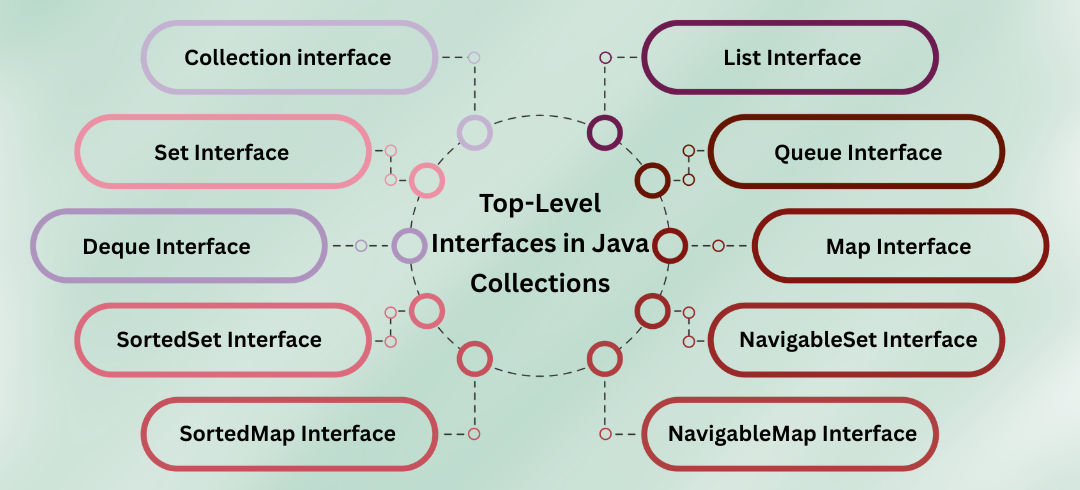
                   Iterable (Root interface)
                            │
                     Collection (Parent)
          ┌─────────────┬─────────────┬─────────────┐
          │             │             │
         List           Set           Queue
          │             │             │
  ┌───────┴───────┐     │     ┌───────┴───────┐
  │               │     │     │               │
ArrayList     LinkedList HashSet LinkedHashSet  PriorityQueue
Vector        Stack     TreeSet NavigableSet    ArrayDeque

Map (Separate)
   ├──────────────┬─────────────┬──────────────┐
HashMap   LinkedHashMap  TreeMap (SortedMap)  NavigableMap
iterator() method to traverse elements.for-each loops.Iterable
└── Collection
Iterable.add(), remove(), size(), contains(), iterator().Example:
Collection<String> coll = new ArrayList<>();
coll.add("Apple");
coll.add("Banana");
System.out.println(coll.contains("Apple")); // true
Note: Map is not part of the Collection hierarchy.
Common Implementations: ArrayList, LinkedList, Vector, Stack.
Example:
List<String> list = new ArrayList<>();
list.add("A");
list.add("B");
list.add("A"); // duplicates allowed
System.out.println(list); // [A, B, A]
Common Implementations: HashSet, LinkedHashSet, TreeSet.
Example:
Set<String> set = new HashSet<>();
set.add("A");
set.add("B");
set.add("A"); // duplicate ignored
System.out.println(set); // [A, B] (unordered)
Common Implementations: PriorityQueue, LinkedList, ArrayDeque.
Example:
Queue<Integer> queue = new LinkedList<>();
queue.add(10);
queue.add(20);
System.out.println(queue.poll()); // 10 (FIFO)
Common Implementations: ArrayDeque, LinkedList.
Deque (Double-Ended Queue)
Queue ──> Deque
           ├── ArrayDeque
           └── LinkedList
Example:
Deque<String> deque = new ArrayDeque<>();
deque.addFirst("A");
deque.addLast("B");
System.out.println(deque); // [A, B]
Collection, but a top-level interface.Common Implementations: HashMap, LinkedHashMap, TreeMap, NavigableMap.
Map Hierarchy (Separate Branch)
Map
 ├── HashMap
 ├── LinkedHashMap
 ├── TreeMap (SortedMap)
 │       └── NavigableMap
 └── Hashtable (Legacy)
Example:
Map<String, Integer> map = new HashMap<>();
map.put("A", 100);
map.put("B", 200);
System.out.println(map.get("A")); // 100
ceiling(), floor(), higher(), lower().SortedSet & NavigableSet
Set (Specialized)
 └── SortedSet
        └── NavigableSet
Example:
NavigableSet<Integer> navSet = new TreeSet<>();
navSet.add(10);
navSet.add(20);
System.out.println(navSet.ceiling(15)); // 20
ceilingKey(), floorKey(), higherKey(), lowerKey().SortedMap & NavigableMap
Map (Specialized)
 └── SortedMap
        └── NavigableMap
Example:
NavigableMap<Integer, String> navMap = new TreeMap<>();
navMap.put(1, "A");
navMap.put(3, "C");
System.out.println(navMap.higherKey(1)); // 3

| Type | Description |
|---|---|
| List | Ordered collection, duplicates allowed, index-based |
| Set | Unique elements, unordered/sorted, no index |
| Queue | FIFO or priority-based collection |
| Deque | Double-ended queue, supports both ends |
| Map | Key-value pairs, keys unique, values may duplicate |
Subinterfaces like SortedSet, NavigableSet, SortedMap, and NavigableMap are specialized versions of Set or Map.
Start
  │
  ▼
Iterable (Root)
  │
  ▼
Collection
  │
  ├───────────────┬───────────────┬───────────────┐
  ▼               ▼               ▼               ▼
 List             Set             Queue            Map
  │               │               │               │
  ▼               ▼               ▼               ▼
ArrayList        HashSet       PriorityQueue     HashMap
LinkedList       LinkedHashSet LinkedList       LinkedHashMap
Vector           TreeSet       ArrayDeque       TreeMap (SortedMap)
Stack           SortedSet      Deque            NavigableMap
                 NavigableSet
iterator() or for-each loops.