
Author
A NavigableSet in Java is a sorted set that allows you to navigate elements using closest-match search methods. It is part of the java.util package and is most commonly implemented by TreeSet.
It extends SortedSet and provides powerful navigation features such as:
lower()floor()ceiling()higher()descendingSet()subSet(), headSet(), tailSet()All elements in a NavigableSet are unique and stored in sorted order (natural order or a custom Comparator).
Set
 └── SortedSet
       └── NavigableSet
             └── TreeSet (Main Implementation)
Other implementation: ConcurrentSkipListSet (thread-safe)
A NavigableSet is a Set that:
It is perfect when you need sorted unique elements with smart lookup methods.
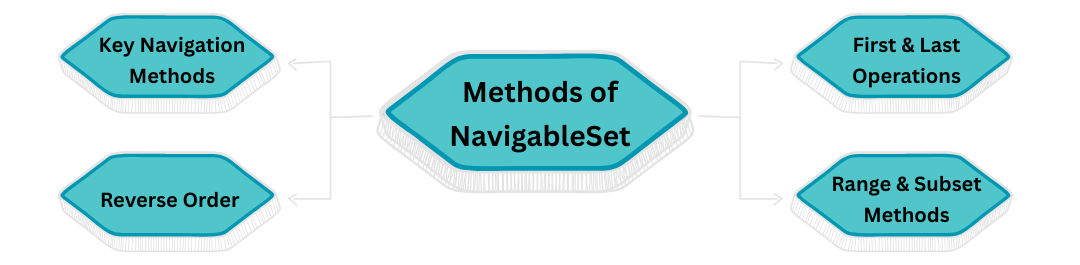
| Method | Description |
|---|---|
lower(e) |
Returns element strictly less than e |
floor(e) |
Returns element less than or equal to e |
ceiling(e) |
Returns element greater than or equal to e |
higher(e) |
Returns element strictly greater than e |
| Method | Description |
|---|---|
first() |
Returns the smallest element |
last() |
Returns the largest element |
pollFirst() |
Removes + returns first element |
pollLast() |
Removes + returns last element |
| Method | Description |
|---|---|
descendingSet() |
Returns Set in reverse order |
descendingIterator() |
Iterates in reverse |
| Method | Description |
|---|---|
subSet(from, to) |
Elements between from and to |
subSet(from, boolean, to, boolean) |
Range with inclusive/exclusive control |
headSet(to) |
Elements less than to |
tailSet(from) |
Elements greater than/equal to from |
import java.util.*;

public class NavigableSetExample {
    public static void main(String[] args) {
        NavigableSet<Integer> set = new TreeSet<>();

        set.add(10);
        set.add(20);
        set.add(30);
        set.add(40);

        System.out.println("Set: " + set);

        System.out.println("lower(20): " + set.lower(20));      // 10
        System.out.println("floor(20): " + set.floor(20));      // 20
        System.out.println("ceiling(25): " + set.ceiling(25));  // 30
        System.out.println("higher(30): " + set.higher(30));    // 40

        System.out.println("Descending Set: " + set.descendingSet());
    }
}
Output
Set: [10, 20, 30, 40]
lower(20): 10
floor(20): 20
ceiling(25): 30
higher(30): 40
Descending Set: [40, 30, 20, 10]
Use a NavigableSet when you need:
10–50)Common real-world use cases:
| Class | Description |
|---|---|
| TreeSet | Main implementation using a Red-Black Tree |
| ConcurrentSkipListSet | Thread-safe implementation |
| Operation | Time |
|---|---|
| add() | O(log n) |
| remove() | O(log n) |
| search() | O(log n) |
| traversal | O(n) |
| Feature | SortedSet | NavigableSet |
|---|---|---|
| Definition | Provides a set of elements in sorted (ascending) order | Extends SortedSet with advanced navigation methods |
| Order | Sorted order only | Sorted order + reverse order support |
| Navigation Methods | Not available | lower(), floor(), ceiling(), higher() |
| Element Retrieval | Only first() and last() | pollFirst(), pollLast() (remove + return) |
| Range Views | subSet(), headSet(), tailSet() | Enhanced versions with inclusive/exclusive control |
| Reverse View | Not available | descendingSet() |
| Interface vs. Extension | Base interface | Sub-interface of SortedSet |
| Common Implementation | TreeSet (also implements SortedSet) | TreeSet, ConcurrentSkipListSet |
lower(), floor(), ceiling(), higher().subSet(), headSet(), tailSet().descendingSet().pollFirst(), pollLast().