
Author
Regular Expressions (Regex) in Java are a powerful way to work with text using patterns. They help you search, validate, and manipulate strings efficiently without writing complex logic.
Regex (Regular Expression) is a pattern of characters used to match, search, or validate strings.
In simple words: Regex is a rule that tells Java how a text should look.
Examples
[a-z]+ → Matches only lowercase letters
\\\\d+ → Matches only numbers
[A-Z][a-z]+ → Matches words starting with a capital letter
\\\\w+@\\\\w+\\\\.com → Matches basic email format
Example Usage
String text = "Java123";

System.out.println(text.matches("[A-Za-z0-9]+"));
Output
true
? Here, the regex checks whether the string contains only letters and numbers.
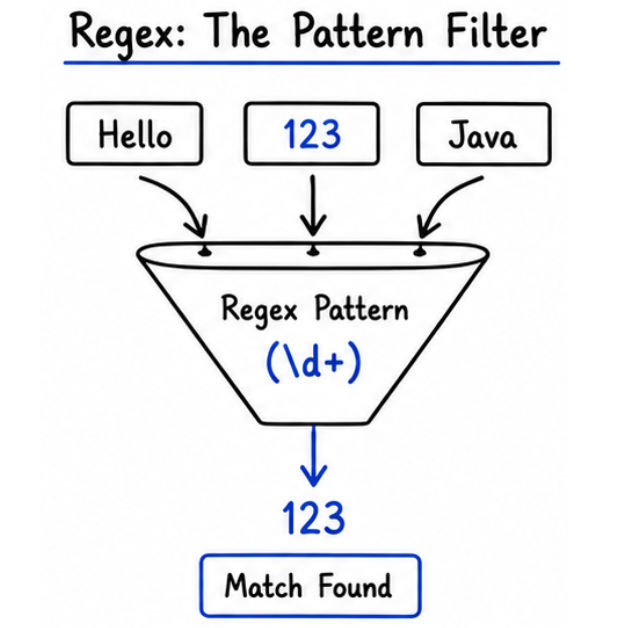
Regex is widely used in Java because it simplifies string handling and reduces the need for complex manual code.
Validates user input (email, phone number, password formats)
Searches text patterns in large amounts of data
Extracts useful information from strings
Replaces or modifies text efficiently
Reduces lengthy string-checking logic
Example
String email = "[email protected]";

System.out.println(email.matches("\\\\w+@\\\\w+\\\\.com"));
Output
true
Here, Regex checks whether the entered text follows a basic email format.
Regex is used in almost every backend system and modern application:
Validation: Email, phone number, Aadhaar format, passwords
Parsing: Extracting data from logs, files, or APIs
Searching: Finding keywords or patterns in large text data
Data cleaning: Removing unwanted symbols, spaces, or invalid characters
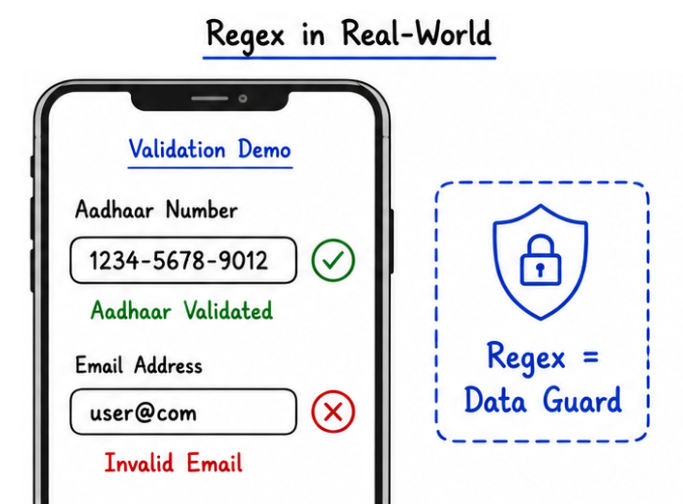
? Regex is extremely useful wherever applications need structured text processing and validation.
Java uses a regex engine to process and evaluate patterns against text data.
Steps:
Define a regex pattern
Compile the pattern using Pattern class
Create a Matcher object
Match the input string against the pattern
Check the result
Basic Flow
Regex Pattern → Pattern Class → Matcher Class → Match Result
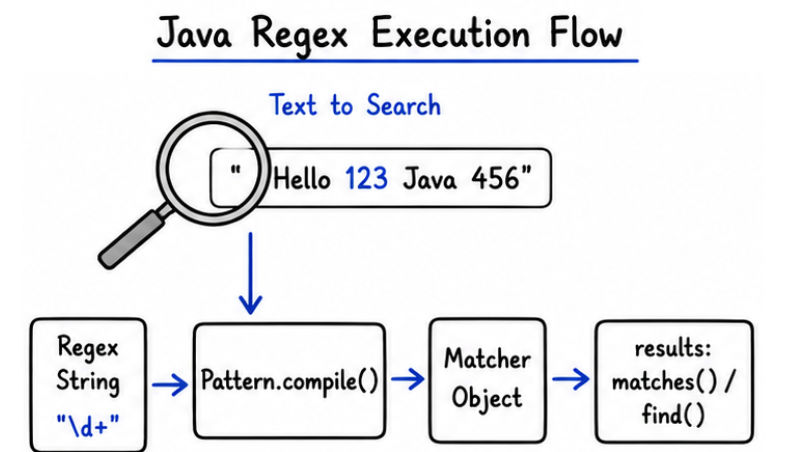
? Java internally compares input string with pattern rules.
Java provides a built-in regex engine through the java.util.regex package for pattern matching and text processing.
Main classes:
Pattern → Defines and compiles the regex rule
Matcher → Applies the regex pattern on input text and performs matching operations
Working Flow
Pattern → Compiled Regex
Matcher → Match Operation on String
The regex engine efficiently processes patterns and checks whether the given input matches the defined rules.
Reduces complex manual string-handling code
Provides fast and efficient text processing
Useful for validation, searching, and data extraction
Regex patterns can be reused in multiple places
Supported by many Java APIs and frameworks
Complex regex patterns can be difficult to read and understand
Debugging large regex expressions is not easy
Performance may slow down with very large input data
Not suitable for handling highly complex business logic
Pattern | Meaning | Example |
|---|---|---|
| Matches any single character |
|
| Matches digit (0–9) |
|
| Matches word character | abc123 |
| One or more occurrences |
|
| Zero or more occurrences |
|
| Optional character |
|
| Character set |
|
| Starts with pattern |
|
| Ends with pattern |
|
Regular Expressions in Java are a powerful tool for working with text data.
Simplifies validation and searching operations
Helps in parsing and processing strings efficiently
Reduces complex manual string-handling logic
Widely used in real-world backend and web applications
Regex makes text processing faster, cleaner, and more efficient in Java applications.
