
Author
Exception Chaining is a mechanism in Java that allows you to link one exception to another, so you can throw a new exception while preserving the original cause.
This is extremely useful when a low-level exception should not be exposed directly, but its root cause must still be traceable.
Throwing a higher-level exception while keeping the original (root) exception attached as the cause.
This ensures:
Java supports this using:
Throwable(Throwable cause) constructorinitCause(Throwable cause) methodgetCause() method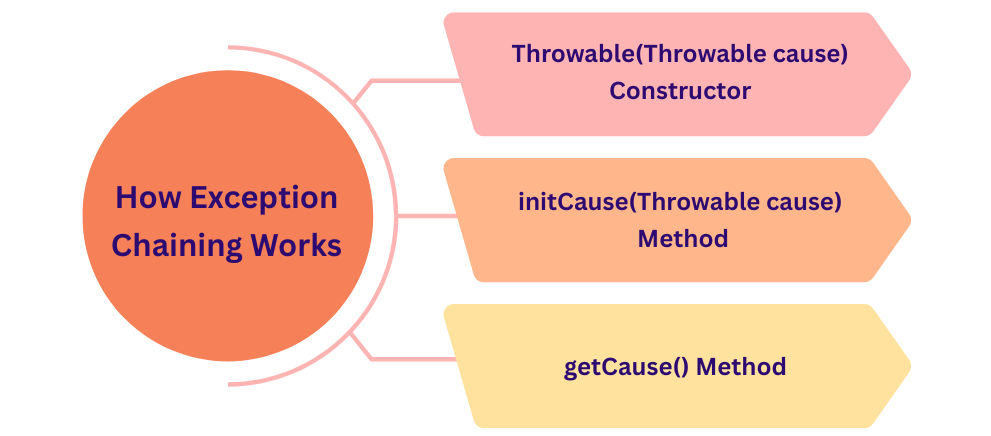
Throwable(Throwable cause) Constructorthrow new Exception("Top level exception", new NullPointerException("Root cause")
initCause(Throwable cause) MethodException ex = new Exception("Top level exception");
ex.initCause(new ArithmeticException("Root cause"));
throw ex;
getCause() Methodtry {
// code that throws exception
} catch (Exception e) {
System.out.println("Cause: " + e.getCause());
}
public class Test {
    public static void main(String[] args) {
        try {
            divide();
        } catch (Exception e) {
            e.printStackTrace();
        }
    }

    static void divide() throws Exception {
        try {
            int num = 10 / 0;  // Low-level exception
        } catch (ArithmeticException e) {
            throw new Exception("Error occurred while dividing", e); // Chaining
        }
    }
}
Output
java.lang.Exception: Error occurred while dividing
Caused by: java.lang.ArithmeticException: / by zero
class InvalidDataException extends Exception {
    public InvalidDataException(String message, Throwable cause) {
        super(message, cause);
    }
}

public class Main {
    public static void process() throws InvalidDataException {
        try {
            String s = null;
            s.length(); // NullPointerException
        } catch (NullPointerException e) {
            throw new InvalidDataException("Data processing failed", e);
        }
    }

    public static void main(String[] args) {
        try {
            process();
        } catch (InvalidDataException e) {
            e.printStackTrace();
        }
    }
}
Exception ex = new Exception("Top level error");
ex.initCause(new NullPointerException("Root cause error"));
throw ex;
We will see how a request flows through:
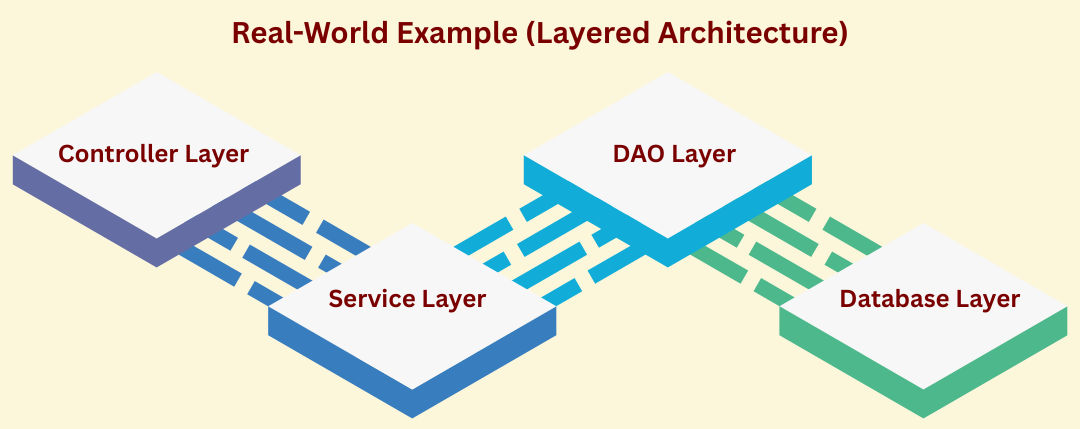
Controller Layer → Service Layer → DAO Layer → Database
The controller receives the user’s request (e.g., register a new user).
@RestController
public class UserController {

    @Autowired
    private UserService userService;

    @PostMapping("/register")
    public String registerUser(@RequestBody User user) {
        userService.registerUser(user); // call service layer
        return "User registered successfully!";
    }
}
The service layer performs business rules such as validations.
@Service
public class UserService {

    @Autowired
    private UserDAO userDAO;

    public void registerUser(User user) {

        // Business rules
        if (user.getEmail() == null || user.getEmail().isEmpty()) {
            throw new IllegalArgumentException("Email cannot be empty");
        }

        // Password rule
        if (user.getPassword().length() < 6) {
            throw new IllegalArgumentException("Password must be at least 6 characters");
        }

        // Call DAO
        userDAO.save(user);
    }
}
The DAO layer actually interacts with the database.
@Repository
public class UserDAOImpl implements UserDAO {

    @Override
    public void save(User user) {
        // Example: JDBC code
        String sql = "INSERT INTO users (name, email, password) VALUES (?, ?, ?)";

        // Database logic here…
        System.out.println("User saved to database: " + user.getName());
    }

    @Override
    public User findById(int id) {
        // fetch from DB (logic not shown)
        return new User("Demo User", "[email protected]", "123456");
    }
}
Actual tables stored in MySQL / Oracle / PostgreSQL.
users table
| id | name | password | |
|---|---|---|---|
| 1 | John Doe | [email protected] | ***** |
User → sends registration request
       ↓
Controller Layer → receives & forwards request
       ↓
Service Layer → validates data & applies business rules
       ↓
DAO Layer → saves data to database
       ↓
Database → stores the information
       ↓
Result → Success response is returned to user
java.lang.Exception: Top level error
    at ...
Caused by: java.lang.NullPointerException: Root cause error
    at ...
This “Caused by” line is the chained exception.
| Benefit | Explanation |
|---|---|
| Preserves Root Cause | Never lose the original error |
| Better Debugging | Full trace from top layer to root |
| Clear Context | Each layer adds meaningful messages |
| Best Practice | Essential for enterprise applications |
| Cleaner Code | Reduces confusion and error hiding |
| Method | Purpose |
|---|---|
getCause() |
Returns original cause |
initCause(Throwable cause) |
Sets cause manually |
| Constructor with cause | new Exception("msg", cause) |
Use it in:
