
Durgesh Tiwari
Author
Creational Design Patterns in Java focus on object creation mechanisms. They help in creating objects in a controlled, flexible, and efficient way instead of using the direct new keyword everywhere.
In simple words: Creational patterns control how objects are created in a program.
Creational patterns provide different ways to create objects while hiding the object creation logic from the user. This makes the system more flexible, reusable, and easier to maintain.
👉 They help reduce tight coupling between classes and object creation logic.
In real-world applications, object creation can become complex and repetitive. Creational patterns simplify this process and improve overall system design.
Benefits:
Provide flexible and controlled object creation
Improve code reusability across the application
Reduce complexity in object creation logic
Improve code maintainability and readability
Support scalable and modular application design
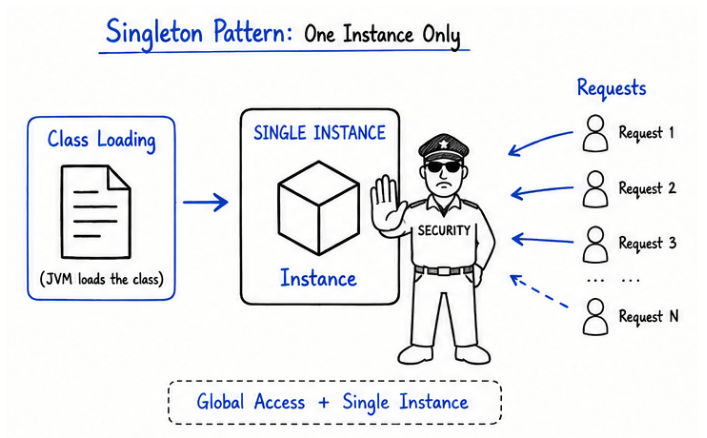
The Singleton Pattern ensures that only one instance of a class is created throughout the application and provides a global access point to that object.
Lazy Initialization → Object is created only when it is needed (on demand)
Eager Initialization → Object is created at the time of class loading (startup)
Thread-Safe Singleton → Ensures safe object creation in multi-threaded applications
Common use cases: Database connection manager, logging system, configuration manager.
public class Singleton {

    private static Singleton instance;

    private Singleton() {
        System.out.println("Singleton Object Created");
    }

    public static synchronized Singleton getInstance() {

        if (instance == null) {
            instance = new Singleton();
        }

        return instance;
    }
}
public class Main {

    public static void main(String[] args) {

        Singleton obj1 = Singleton.getInstance();
        Singleton obj2 = Singleton.getInstance();

        System.out.println(obj1 == obj2);
    }
}
👉 Output will be true because both references point to the same object.
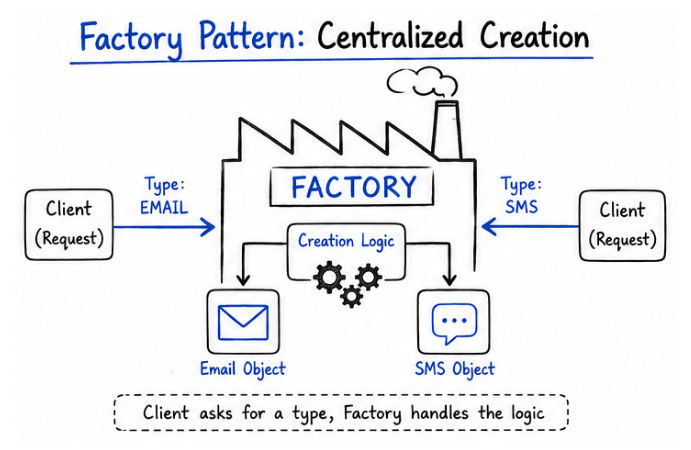
The Factory Pattern provides a way to create objects without exposing the creation logic to the client. Instead of using new directly, objects are created through a factory method based on input conditions.
👉 It returns different objects depending on the input type.
Example use case: Notification system (Email, SMS, Push notifications)
Factory Pattern Example
interface Notification {
    void notifyUser();
}
class EmailNotification implements Notification {
    public void notifyUser() {
        System.out.println("Sending Email Notification");
    }
}
class SMSNotification implements Notification {
    public void notifyUser() {
        System.out.println("Sending SMS Notification");
    }
}
class NotificationFactory {

    public static Notification createNotification(String type) {

        if (type.equals("EMAIL")) {
            return new EmailNotification();
        } else if (type.equals("SMS")) {
            return new SMSNotification();
        }
        return null;
    }
}
public class Main {
    public static void main(String[] args) {

        Notification n1 = NotificationFactory.createNotification("EMAIL");
        n1.notifyUser();

        Notification n2 = NotificationFactory.createNotification("SMS");
        n2.notifyUser();
    }
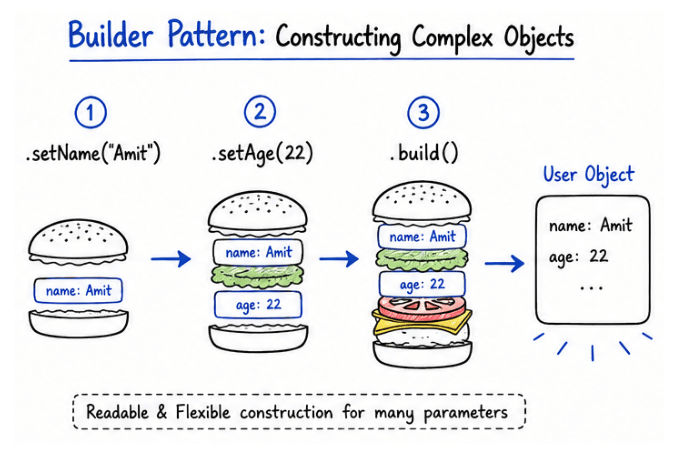
}The Builder Pattern is used to construct complex objects step by step. Instead of creating an object with many constructor parameters, it allows building the object in a more readable and flexible way.
In simple words: It helps create objects step-by-step in a clean and controlled manner.
👉 It is especially useful when an object has many fields or optional parameters.
Common use cases: User objects, configuration settings, order systems.
Builder Pattern Example
public class User {

    private String name;
    private int age;
    private String email;

    private User(UserBuilder builder) {
        this.name = builder.name;
        this.age = builder.age;
        this.email = builder.email;
    }

    public static class UserBuilder {

        private String name;
        private int age;
        private String email;

        public UserBuilder setName(String name) {
            this.name = name;
            return this;
        }

        public UserBuilder setAge(int age) {
            this.age = age;
            return this;
        }

        public UserBuilder setEmail(String email) {
            this.email = email;
            return this;
        }

        public User build() {
            return new User(this);
        }
    }

    public void showUser() {
        System.out.println(name + " " + age + " " + email);
    }
}
public class Main {
    public static void main(String[] args) {

        User user = new User.UserBuilder()
                .setName("Amit")
                .setAge(22)
                .setEmail("[email protected]")
                .build();

        user.showUser();
    }
}The Prototype Pattern is used to create new objects by copying existing objects instead of creating them from scratch.
In simple words: It creates a duplicate (clone) of an existing object.
👉 It is useful when object creation is expensive or time-consuming.
Common use cases: Gaming systems, document editors, object templates.

Prototype Pattern Example
public class Student implements Cloneable {

    private String name;

    public Student(String name) {
        this.name = name;
    }

    public void show() {
        System.out.println("Student Name: " + name);
    }

    @Override
    protected Object clone() throws CloneNotSupportedException {
        return super.clone();
    }
}
public class Main {
    public static void main(String[] args) throws Exception {

        Student s1 = new Student("Amit");

        Student s2 = (Student) s1.clone();

        s1.show();
        s2.show();

        System.out.println(s1 == s2);
    }
}Creational design patterns are widely used in modern Java applications to manage object creation efficiently and improve application scalability.
Common real-world use cases include:
Spring Framework for bean creation and dependency management
Hibernate for SessionFactory and object management
Enterprise Java applications
Microservices architecture
REST API and backend development
Large-scale distributed systems
👉 These patterns help developers build flexible, maintainable, and scalable Java applications.
uires better flexibility and control.
Use creational patterns when:
Object creation logic is complex
Better control over object creation is needed
You want to reduce tight coupling between classes
Reusable and scalable code is required
You are developing enterprise-level or large-scale applications
👉 Creational patterns improve flexibility and maintainability in complex systems.
Avoid using creational patterns when:
Object creation is simple and straightforward
Using patterns adds unnecessary complexity
A direct new object creation is already sufficient
Creational Design Patterns provide efficient and structured ways to manage object creation in Java applications.
They help developers:
Control and simplify the object creation process
Build flexible, reusable, and maintainable systems
Reduce tight coupling between classes
Improve application scalability and overall architecture quality
Creational patterns are essential for developing clean, professional, and enterprise-level Java applications.
