
Durgesh Tiwari
Author
Gradle is a modern build automation tool used in Java development to build, test, and deploy applications efficiently. It is designed to be faster and more flexible compared to older tools like Maven and Ant.
In simple words: Gradle helps automate project building and dependency management in a fast and flexible way.
Gradle is an open-source build tool that uses a Groovy or Kotlin-based DSL (Domain Specific Language) to define build logic.
It is mainly used for:
Building Java applications
Managing dependencies
Running unit tests
Packaging applications (JAR/WAR)
Supporting CI/CD workflows
Modern applications require fast builds and flexible configuration. Gradle solves performance limitations and complexity issues found in traditional build tools.
Benefits of Gradle
Faster build execution using incremental builds
Highly flexible and customizable build scripts
Easy and efficient dependency management
Supports multi-project builds
Works well with Spring Boot and modern frameworks
👉 Gradle is widely used in enterprise and Android development.
Feature | Gradle | Maven |
|---|---|---|
Configuration | Uses Groovy/Kotlin DSL | Uses XML ( |
Speed | Faster due to incremental builds | Slower as it rebuilds more often |
Flexibility | Highly flexible and customizable | Less flexible, more structured |
Learning Curve | Moderate | Easy for beginners |
Performance | Optimized and efficient builds | Standard build execution every time |
Script Style | Programming-based (DSL) | Declarative (XML-based) |
Gradle uses build scripts to define how a project is built, tested, and managed.
These scripts replace XML configuration (like Maven) with a more flexible code-based approach.
build.gradle → written in Groovy DSL
build.gradle.kts → written in Kotlin DSL
Example:
plugins {
    id 'java'
}

repositories {
    mavenCentral()
}

dependencies {
    implementation 'mysql:mysql-connector-j:8.0.33'
    testImplementation 'junit:junit:4.13.2'
}
Explanation
plugins → adds Java support to the project
repositories → defines where dependencies will be downloaded from
dependencies → lists external libraries required by the project
Gradle provides powerful dependency management by automatically downloading required libraries from repositories like Maven Central.
This removes the need for manually adding JAR files in the project.
implementation → Used for main application code dependencies
testImplementation → Used only for testing libraries
runtimeOnly → Required only during runtime execution
Dependencies are defined in build.gradle file
Gradle downloads required libraries automatically
It manages correct versions and avoids conflicts
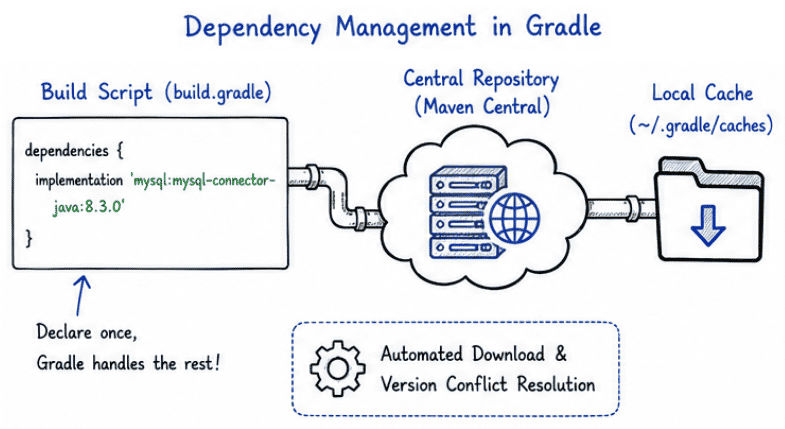
👉 Gradle simplifies dependency handling and ensures clean, automated project management without manual library setup.
Gradle works on a task-based execution model, where every build process is divided into small tasks.
These tasks are executed in a defined order to complete the full build lifecycle.
Compile → Test → Build → Package → Deploy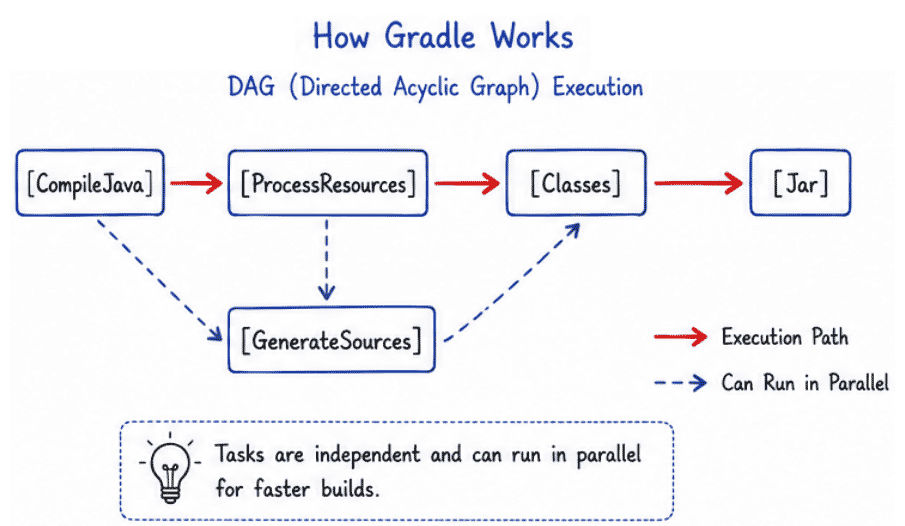
How It Works
Each task performs a specific job
Tasks can depend on other tasks
Gradle executes only required tasks (incremental execution)
This makes the build process faster and efficient
Gradle provides simple commands to build, test, and run Java applications.
gradle build → builds the entire project
gradle clean → removes previous build files
gradle test → runs unit tests
gradle run → runs the application
gradle assemble → creates JAR/WAR outputGradle is used to build Java projects automatically by handling compilation, testing, and packaging.
Steps to build a Java project:
Write Java source code in src/main/java
Define project dependencies in build.gradle
Run the build command
gradle buildGenerated JAR file is created in
build/libs/Code is compiled
Tests are executed
Project is packaged into a JAR/WAR file
Output is stored in build/libs folder
Gradle is a modern build tool that provides powerful features to simplify Java development.
Fast builds using caching and incremental execution
Automatic dependency management
Highly flexible build customization using scripts
Supports multi-project builds
Strong integration with Spring Boot
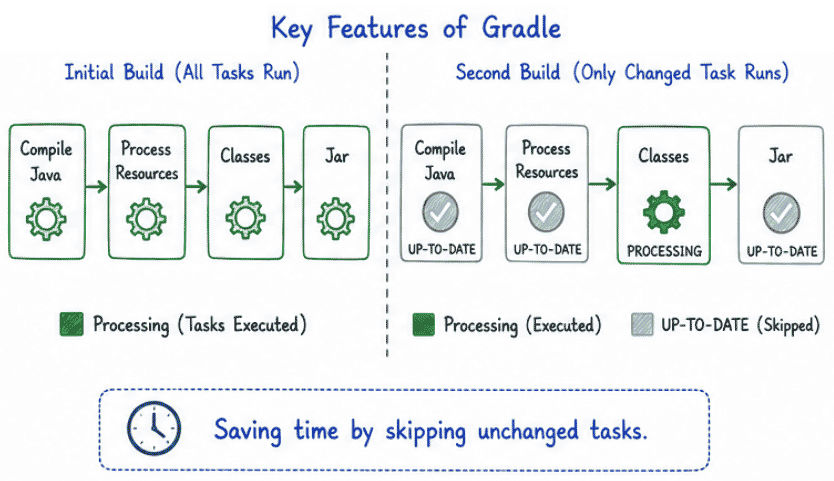
Gradle is widely used in modern software development for building and managing Java-based applications.
Spring Boot applications
Android application development
Microservices architecture
Enterprise backend systems
CI/CD pipelines (automated build and deployment)
Slightly harder to learn than Maven
Build scripts can become complex in large projects
Gradle is a powerful and modern build tool that improves speed, flexibility, and automation in Java development.
It is widely used in Spring Boot, Android, and enterprise systems, making it an essential tool for modern developers.
