
Durgesh Tiwari
Author
Code coverage and quality analysis are important practices in modern Java development used to measure how much code is tested and how good the code quality is.
In simple words: Code coverage checks how much code is tested, while quality analysis checks how clean, secure, and maintainable the code is.
Code coverage measures the percentage of application code executed during testing.
It helps developers identify:
Which code is tested
Which code is not tested
Whether test cases are sufficient
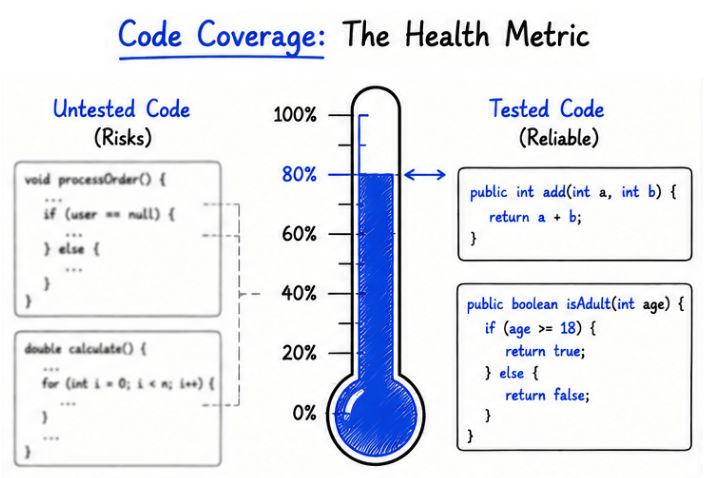
👉 Higher code coverage generally indicates better-tested and more reliable applications.
public int add(int a, int b) {
    return a + b;
}
@Test
public void testAdd() {
    assertEquals(5, add(2, 3));
}
👉 If the test executes the add() method successfully, that code is counted in coverage.
Different types of code coverage are used to measure how much of the application is tested during execution.
Line coverage measures the percentage of source code lines executed while running tests.
Example
if(age >= 18) {
    System.out.println("Eligible");
}
If the test executes this block, these lines contribute to line coverage.
👉 Higher line coverage indicates that more parts of the application have been tested.
Method coverage checks whether methods in the application have been invoked during testing.
Example
public void sendEmail() {
    // logic
}
If no test calls sendEmail(), the method is considered not covered.
👉 It helps identify unused or untested functionality.
Branch coverage verifies that all decision outcomes have been tested.
Example
if(balance > 1000) {
    approveLoan();
} else {
    rejectLoan();
}
To achieve 100% branch coverage:
One test should execute approveLoan()
Another test should execute rejectLoan()
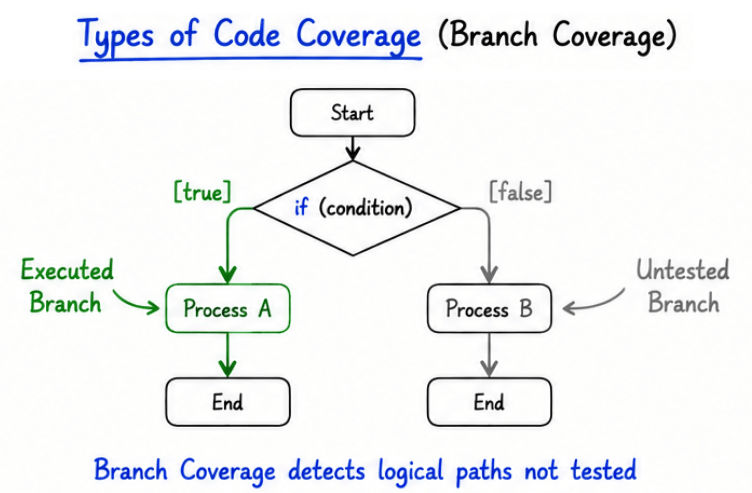
👉 Branch coverage is often more valuable than simple line coverage because it validates application logic more thoroughly.
Statement coverage measures whether every executable statement has been executed at least once.
Example
int total = price * quantity;
System.out.println(total);
Tests should execute both statements to achieve complete statement coverage.
👉 It helps ensure that no important piece of code remains completely untested.
Quality analysis is the process of checking whether code follows proper coding standards and best practices.
It helps developers identify issues related to:
Code complexity
Duplicated code
Security vulnerabilities
Bugs and errors
Code maintainability
👉 Quality analysis helps developers write cleaner, safer, and more reliable applications.
If a method is too long or contains duplicated logic, quality analysis tools can detect it and suggest improvements.
JaCoCo is one of the most widely used Java code coverage tools.
It helps developers measure how much application code is executed during testing.
Features
Generates code coverage reports
Integrates with Maven and Gradle
Supports HTML, XML, and CSV reports
Commonly used with JUnit and CI/CD pipelines
Maven Configuration Example
<plugin>
    <groupId>org.jacoco</groupId>
    <artifactId>jacoco-maven-plugin</artifactId>
    <version>0.8.11</version>
</plugin>
👉 JaCoCo automatically generates coverage reports after test execution.
SonarQube is a popular platform used for analyzing code quality and security issues.
It detects:
Bugs
Security vulnerabilities
Code smells
Duplicated code
👉 Commonly used in enterprise applications and CI/CD pipelines.
Checkstyle is used to verify Java coding standards and formatting rules.
It helps maintain consistent and readable code across projects.
PMD detects:
Unused variables
Dead code
Duplicate code
Poor coding practices
👉 It helps improve code quality and maintainability.
Code coverage and quality analysis are widely used in modern software development to improve application reliability, maintainability, and security.
They are commonly used in:
Spring Boot applications
Banking and financial systems
Enterprise software applications
REST API development
CI/CD pipelines
Open-source projects
👉 These practices help teams maintain high-quality and production-ready applications.
Improves overall test quality
Increases application reliability
Helps detect bugs early
Makes code changes and refactoring safer
Encourages cleaner and more maintainable code
Helps identify security vulnerabilities
Reduces technical debt
Improves overall software quality
👉 Together, code coverage and quality analysis help build stable, secure, and production-ready applications.
High code coverage does not guarantee bug-free applications
Too many quality rules may slow down development
Coverage tools cannot detect all logical or business-level issues
Poorly written test cases may still produce high coverage results
Code coverage and quality analysis are essential practices in modern Java development.
Code coverage helps measure how much application code is tested
Quality analysis improves code maintainability, readability, and security
Tools like JaCoCo and SonarQube are widely used in professional projects
👉 Together, they help developers build reliable, maintainable, and production-ready Java applications.
