
Author
Loops in Java are used to repeat a block of code multiple times. They help automate repetitive tasks, reduce errors, and make your code efficient.
A loop executes a block of code repeatedly until a condition becomes false.
Types of loops in Java:
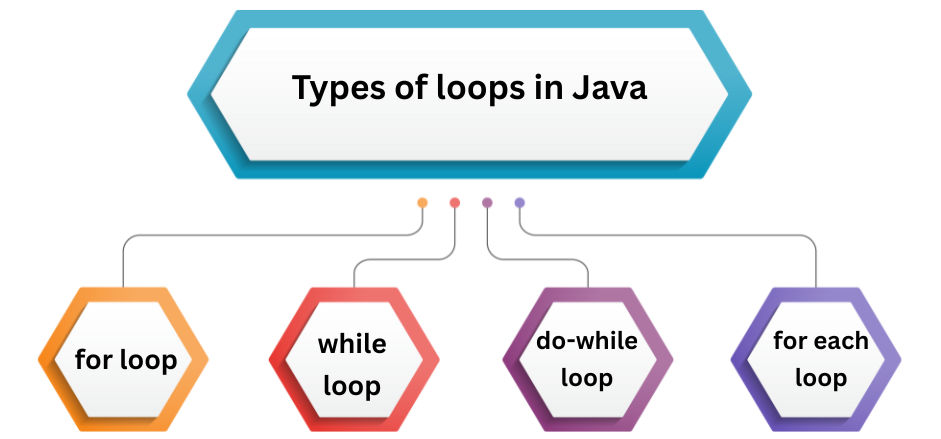
Used when you know how many times you want to repeat a block.
for (initialization; condition; update) {
    // code to execute
}
for (int i = 1; i <= 5; i++) {
    System.out.println(i);
}
Output:
1
2
3
4
5
while (condition) {
    // code to execute
}
int total = 0;
int num = 1;

while (total < 50) {
    total += num;
    num++;
}

System.out.println("Total: " + total);
Output:
Total: 55
do {
    // code to execute
} while (condition);
import java.util.Scanner;

Scanner sc = new Scanner(System.in);
int number;

do {
    System.out.print("Enter a positive number: ");
    number = sc.nextInt();
} while (number <= 0);

System.out.println("You entered: " + number);
sc.close();
for (type var : arrayOrCollection) {
    // code
}
int[] numbers = {10, 20, 30, 40};

for (int num : numbers) {
    System.out.println(num);
}
Output:
10
20
30
40
You can place one loop inside another. Useful for patterns, matrices, etc.
for (int i = 1; i <= 3; i++) {
    for (int j = 1; j <= 3; j++) {
        System.out.print("* ");
    }
    System.out.println();
}
Output:
* * *
* * *
* * *
import java.util.Scanner;

public class Factorial {
    public static void main(String[] args) {
        Scanner sc = new Scanner(System.in);
        System.out.print("Enter a number: ");
        int n = sc.nextInt();

        int factorial = 1;
        for (int i = 1; i <= n; i++) {
            factorial *= i;
        }

        System.out.println("Factorial of " + n + " is " + factorial);
        sc.close();
    }
}
Output Example:
Enter a number: 5
Factorial of 5 is 120
