
Author
The Class Loading Process and the JIT Compiler are two of the most important parts of the JVM Execution Engine.
They ensure that Java programs run securely, efficiently, and with high performance.
Java follows a dynamic class loading mechanism—classes are loaded into memory only when needed.
The Class Loading Process involves three major phases:
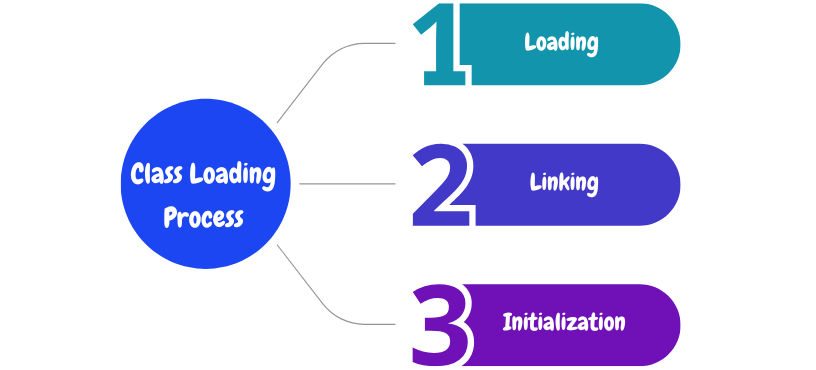
During this step, the JVM:
.class (bytecode) fileClass objects in the Method AreaClass Loaders Involved
Linking checks the correctness of the bytecode and prepares it for execution.
It has three sub-steps:
1. Verification
Ensures the bytecode is safe, valid, and follows JVM rules.
2. Preparation
Allocates memory for static variables of the class.
Default values are assigned (e.g., 0, null, false).
3. Resolution
Converts symbolic references into direct references.
Example: method names → actual memory addresses.
This phase runs:
Example:
static {
    System.out.println("Class loaded!");
}
Initialization happens only once in program lifetime.
The JIT (Just-In-Time) Compiler is part of the JVM Execution Engine.
Its job is to improve runtime performance by compiling frequently executed code (hotspots) into native machine code.
JIT performs multiple high-level optimizations:

Replaces method calls with the actual code block.
Removes unused/unreachable code.
Expands loops to reduce overhead.
Determines if an object can be safely allocated on the stack instead of heap.
Replaces constant expressions with precomputed values.
The HotSpot JVM includes:
This combination gives:
Source Code (.java)
       |
       v
   javac Compiler
       |
       v
 Bytecode (.class)
       |
       v
+---------------------+
|  Class Loader        |
| Loading/Linking/Init |
+---------------------+
       |
       v
+-------------------------+
|   Interpreter            |
+-------------------------+
       |
       v
[HotSpot Profiler]
       |
       v
+-------------------------+
|       JIT Compiler      |
| (Generates Machine Code)|
+-------------------------+
       |
       v
     CPU Execution
