
Durgesh Tiwari
Author
Behavioral Design Patterns in Java focus on communication and interaction between objects. These patterns help define how objects behave, share responsibilities, and communicate efficiently within an application.
In simple words: Behavioral patterns manage how objects interact and perform tasks together.
Behavioral patterns define communication mechanisms between objects so that tasks can be performed efficiently without creating tightly connected code.
Instead of focusing on object creation or structure, these patterns mainly deal with application behavior and object collaboration.
They are commonly used for:
Handling object communication
Managing responsibilities between components
Defining workflows and actions
Making application behavior more dynamic
👉 They help developers build scalable and maintainable software systems.
In large applications, managing communication between multiple objects becomes complex. Behavioral patterns simplify this interaction and improve software design.
Benefits:
Simplify communication between components
Reduce hardcoded dependencies
Make workflows easier to manage
Improve flexibility in application behavior
Support cleaner business logic implementation
Make systems easier to extend in future
Behavioral design patterns help manage communication, workflows, and responsibilities between objects in a software system.
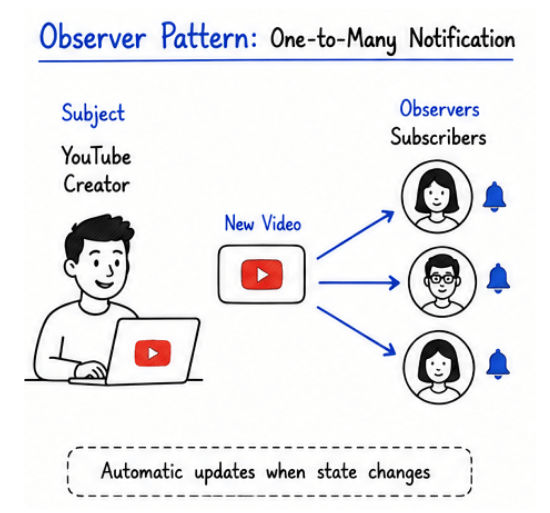
The Observer Pattern creates a one-to-many relationship between objects. When one object changes its state, all dependent objects are automatically notified.
👉 Common use case: Notification systems, event handling, live updates.
Observer Pattern – Java Example
In a YouTube-like application, subscribers automatically receive notifications whenever a creator uploads a new video.
import java.util.ArrayList;
import java.util.List;

interface Subscriber {
    void update(String videoTitle);
}

class User implements Subscriber {

    private String name;

    User(String name) {
        this.name = name;
    }

    public void update(String videoTitle) {

        System.out.println(
                name + " received notification: "
                        + videoTitle
        );
    }
}

class Channel {

    private List<Subscriber> subscribers =
            new ArrayList<>();

    void subscribe(Subscriber subscriber) {
        subscribers.add(subscriber);
    }

    void uploadVideo(String title) {

        System.out.println(
                "New video uploaded: " + title
        );

        for (Subscriber subscriber : subscribers) {
            subscriber.update(title);
        }
    }
}

public class Test {

    public static void main(String[] args) {

        Channel channel = new Channel();

        channel.subscribe(new User("Rahul"));
        channel.subscribe(new User("Aman"));

        channel.uploadVideo(
                "Behavioral Design Patterns"
        );
    }
}
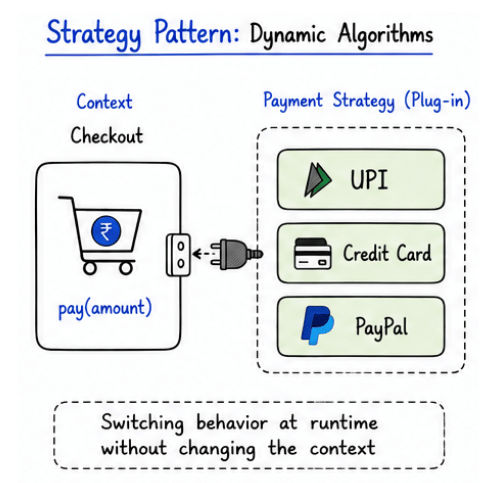
The Strategy Pattern allows multiple behaviors or algorithms to be selected dynamically at runtime.
👉 Common use case: Payment systems, sorting mechanisms, route selection.
Strategy Pattern – Java Example
An e-commerce application allows users to choose different payment methods like Credit Card, UPI, or PayPal during checkout.
interface PaymentStrategy {
    void pay(int amount);
}

class CreditCardPayment
        implements PaymentStrategy {

    public void pay(int amount) {

        System.out.println(
                "Paid using Credit Card: ₹" + amount
        );
    }
}

class UpiPayment
        implements PaymentStrategy {

    public void pay(int amount) {

        System.out.println(
                "Paid using UPI: ₹" + amount
        );
    }
}

class PaymentService {

    private PaymentStrategy strategy;

    PaymentService(PaymentStrategy strategy) {
        this.strategy = strategy;
    }

    void processPayment(int amount) {
        strategy.pay(amount);
    }
}

public class Test {

    public static void main(String[] args) {

        PaymentService service =
                new PaymentService(
                        new UpiPayment()
                );

        service.processPayment(500);
    }
}
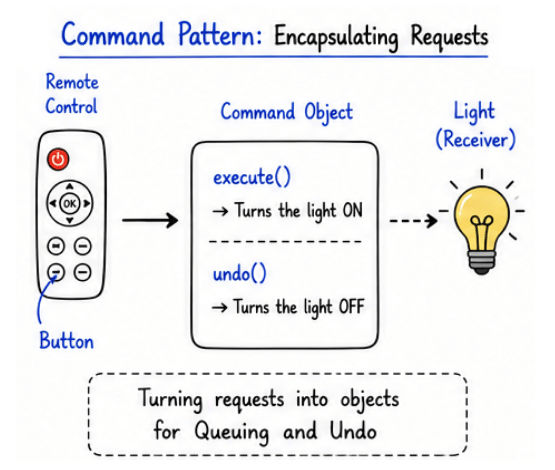
The Command Pattern converts requests into separate command objects so actions can be executed, queued, or reversed independently.
👉 Common use case: Remote controls, task automation, undo/redo functionality.
Command Pattern – Java Example:
A text editor stores operations like copy, paste, and delete as separate commands to support undo and redo features.
interface Command {
    void execute();
}

class Light {

    void turnOn() {

        System.out.println(
                "Light turned ON"
        );
    }
}

class LightOnCommand
        implements Command {

    private Light light;

    LightOnCommand(Light light) {
        this.light = light;
    }

    public void execute() {
        light.turnOn();
    }
}

public class Test {

    public static void main(String[] args) {

        Light light = new Light();

        Command command =
                new LightOnCommand(light);

        command.execute();
    }
}
The State Pattern allows an object to change its behavior based on its current state.
👉 Common use case: ATM machines, order management systems, media players.
Practical Examples for Other Behavioral Patterns
Order Placed
      ↓
Preparing
      ↓
Out for Delivery
      ↓
Delivered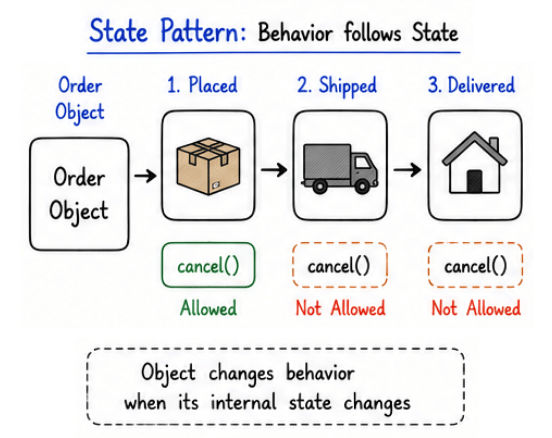
👉 The order behaves differently depending on its current state.
The Chain of Responsibility Pattern passes a request through multiple handlers until one handler processes it.
👉 Common use case: Authentication systems, logging frameworks, support workflows.
Chain of Responsibility Pattern
Scenario: Customer Support System
Level 1 Support
       ↓
Level 2 Support
       ↓
Manager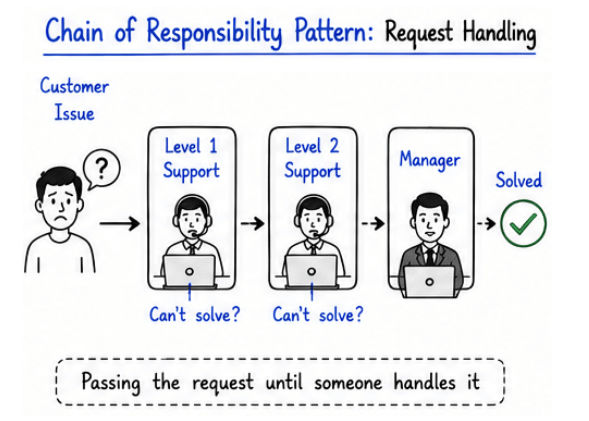
👉 Requests move through multiple handlers until someone resolves them.
The Template Method Pattern defines the overall structure of an algorithm while allowing subclasses to customize specific steps.
👉 Common use case: Framework design, report generation, data processing systems.
Template Method Pattern
Scenario: Report Generation System
Fetch Data
      ↓
Process Data
      ↓
Generate Report
Different report types customize only specific steps.
👉 The overall algorithm remains fixed.
The Iterator Pattern provides a way to access collection elements sequentially without exposing internal implementation details.
👉 Common use case: Collection frameworks, data traversal.
Example:
Java Collections Framework provides the Iterator interface, allowing developers to traverse collections like ArrayList, HashSet, and LinkedList without exposing their internal implementation details.
Scenario: Iterating through Products
List<String> products =
        List.of("Laptop", "Phone", "Tablet");

Iterator<String> iterator =
        products.iterator();

while (iterator.hasNext()) {

    System.out.println(
            iterator.next()
    );
}The Mediator Pattern reduces direct communication between objects by introducing a mediator object.
👉 Common use case: Chat systems, air traffic control systems, communication hubs.
Example Scenario: Chat Application
User A
   ↓
Chat Server
   ↓
User B
Users communicate through the chat server instead of directly interacting with each other.
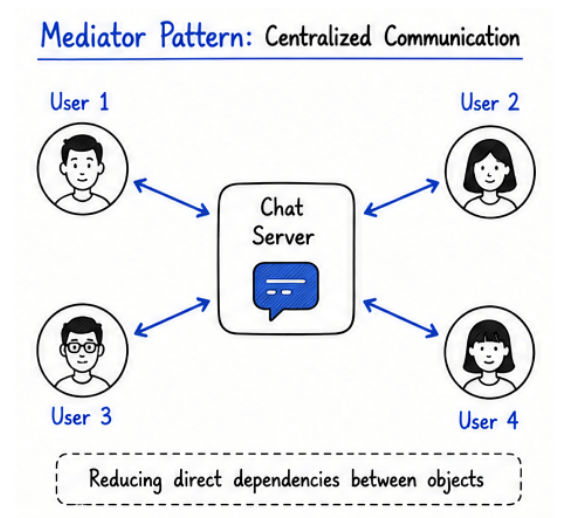
👉 This reduces tight coupling.
The Memento Pattern stores an object's previous state so it can be restored later when needed.
👉 Common use case: Undo functionality, game save systems, version history.
Example Scenario: Text Editor Undo Feature
Version 1
    ↓
Version 2
    ↓
Undo
    ↓
Version 1 Restored
👉 Previous states are saved and restored when required.
The Visitor Pattern allows new operations to be added to objects without modifying their existing classes.
👉 Common use case: Reporting systems, compilers, document processing tools.
Example Scenario: Report Export System
Customer Data
      ↓
PDF Visitor
Excel Visitor
HTML Visitor
The same object structure supports multiple operations without modifying existing classes.
👉 New behaviors can be added easily.
Behavioral design patterns are commonly used in event-driven systems where objects communicate through events instead of direct method calls.
In simple words: One object triggers an event, and other objects respond to it independently.
This approach helps applications become:
More flexible
Loosely coupled
Easier to extend
Better for asynchronous processing
Example:
In a Spring Boot application:
A user registers an account
A registration event is triggered
Email service sends a welcome email
Notification service sends an SMS
Analytics service records user activity
All services respond independently to the same event without directly depending on each other.
Structural Patterns | Behavioral Patterns |
|---|---|
Focus on organizing classes and objects | Focus on communication between objects |
Define relationships and system structure | Define interaction and responsibility flow |
Help build flexible architecture | Help manage application behavior |
Mainly deal with object composition | Mainly deal with object collaboration |
Example: Adapter, Facade | Example: Observer, Strategy |
👉 Structural patterns organize the system structure, while behavioral patterns control how objects interact and work together.
Use behavioral patterns when:
Multiple objects need to communicate efficiently
Application behavior changes dynamically
You want loose coupling between components
Complex workflows need better organization
Different behaviors should be selected at runtime
👉 Behavioral patterns are especially useful in enterprise systems, event-driven applications, APIs, and large-scale backend architectures.
Behavioral patterns are powerful, but overusing them can make applications unnecessarily complex.
Avoid using them when:
The application is very small
Simple logic can solve the problem
Extra abstraction is not needed
Too many patterns reduce readability
👉 Use behavioral patterns only when they actually improve flexibility, maintainability, or scalability.
Behavioral Design Patterns help manage communication, workflows, and responsibilities between objects efficiently in Java applications.
They help developers:
Build flexible and maintainable systems
Improve coordination between application components
Reduce tight coupling between objects
Simplify complex business workflows
Create scalable enterprise-level applications
👉 Behavioral patterns are essential for designing clean, dynamic, and professional software systems where multiple objects interact efficiently.
