
Durgesh Tiwari
Author
Packaging and Javadoc generation are important parts of Java project development. Packaging helps developers distribute Java applications easily, while Javadoc helps generate professional documentation directly from source code comments.
In simple words: Packaging creates deployable Java application files, and Javadoc creates documentation for developers.
Packaging is the process of converting compiled Java code into distributable files such as:
JAR (Java Archive)
WAR (Web Archive)
These files contain compiled classes, configuration files, libraries, and other application resources.
Creating a JAR File
Creates a JAR file named app.jar.
jar cf app.jar Test.classRuns the packaged Java application.
java -jar app.jar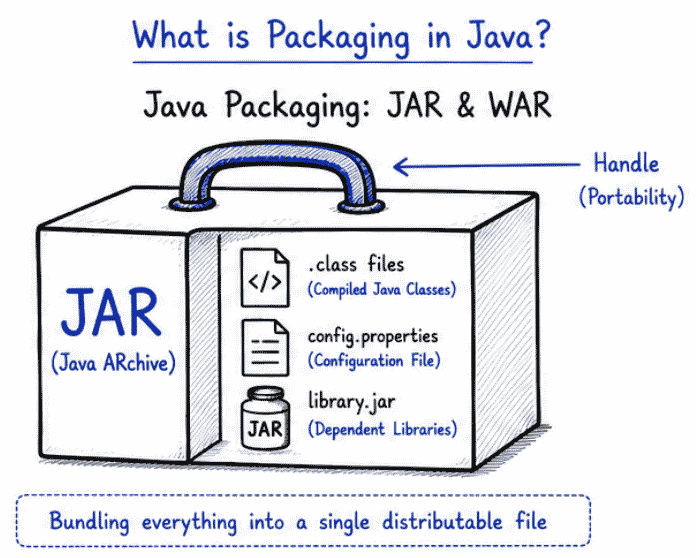
👉 JAR files make Java applications portable, organized, and easy to deploy.
Apache Maven can automatically package Java applications into distributable files like JAR or WAR.
During packaging, Maven compiles the code, runs tests, and creates the final build file.
Maven Packaging Command
mvn packageOutput Location
Generated JAR/WAR files are stored inside:
target/Gradle provides automatic packaging support for Java applications.
When the build process runs, Gradle compiles the source code, executes tests, and generates the final JAR/WAR file.
Gradle Build Command
gradle buildOutput Directory
The packaged files are generated inside:
build/libs/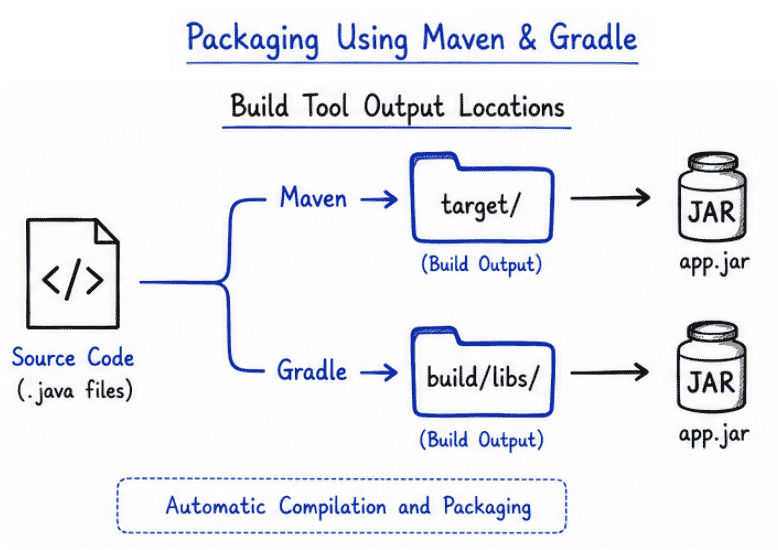
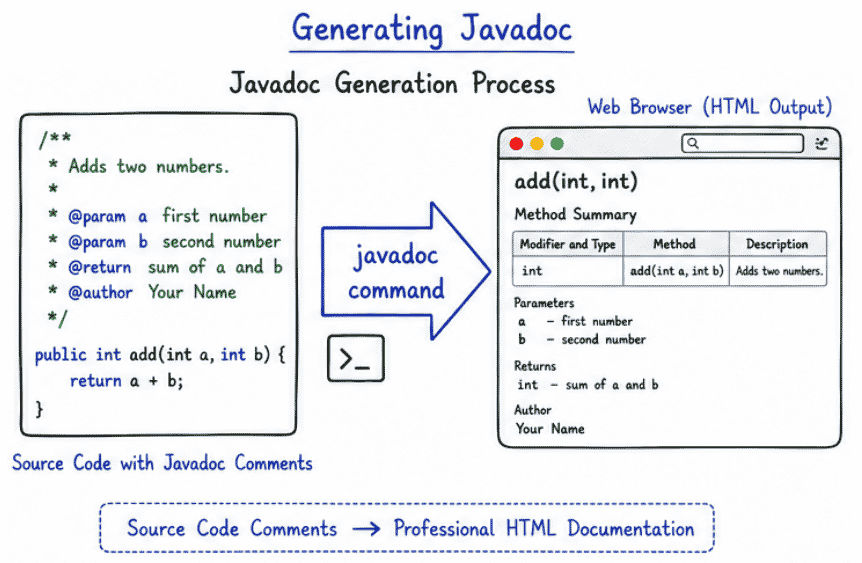
Javadoc is a documentation generation tool provided by Java. It creates HTML documentation directly from specially written comments inside Java source code.
Javadoc is mainly used to document classes, methods, constructors, and APIs in a clean and readable format.
👉 It helps developers understand how a program or library works without reading the entire source code.
Javadoc uses special multi-line comments to generate documentation from Java source code.
Syntax
/**
 * Documentation Comment
 */
Example
/**
 * This class performs calculator operations.
 */
public class Calculator {

    /**
     * Adds two numbers.
     */
    public int add(int a, int b) {
        return a + b;
    }
}Java provides the javadoc command to generate documentation from source code comments automatically.
Command
javadoc Calculator.javahere,
Java reads Javadoc comments from the source file
HTML documentation pages are generated automatically
Documentation includes classes, methods, and constructors
👉 This generates HTML documentation files automatically.
Javadoc provides special tags to describe methods, parameters, return values, and other important details.
Tag | Purpose |
|---|---|
| Specifies author name |
| Defines version information |
| Describes method parameters |
| Explains return value |
| Describes exceptions thrown |
Example
/**
 * Adds two numbers.
 * @param a first number
 * @param b second number
 * @return sum of numbers
 */
Packaging and Javadoc generation are widely used in modern Java development for deployment and documentation purposes.
Spring Boot applications
Enterprise Java systems
REST API development
Library and framework development
CI/CD pipelines
Open-source Java projects
Simplifies application deployment
Makes project distribution easier
Creates portable application files
Organizes project resources efficiently
Improves code readability
Helps developers understand APIs easily
Generates professional HTML documentation
Supports better team collaboration
Useful for framework and library development
Packaging and Javadoc generation are important parts of Java development that help in application deployment and documentation management.
Packaging creates deployable JAR/WAR files
Javadoc generates professional HTML documentation
Both improve maintainability, readability, and project organization
👉 These features are widely used in enterprise Java and modern backend applications.
