
Durgesh Tiwari
Author
Prompt Engineering is the skill of writing clear and effective instructions for AI models. A good prompt helps AI understand your request and generate more accurate, useful, and relevant responses.
Whether you use ChatGPT, Google Gemini, Claude, GitHub Copilot, or other AI tools, the quality of the output depends on how well you write the prompt.
Prompt Engineering is the process of writing clear and structured prompts that guide an AI model to produce the expected output.
A prompt can be:
A question
An instruction
A command
A task description
The clearer your prompt, the better the AI response.
Basic Prompt
Explain Machine Learning.
Better Prompt
Explain Machine Learning in simple English for beginners with real-world examples.
The second prompt gives more context, so the AI can generate a more useful response.
A well-written prompt helps AI understand your request more accurately and improves the quality of the response.
Produces more accurate answers
Improves content quality
Saves time
Reduces repeated corrections
Generates well-structured responses
Handles complex tasks more effectively
Most effective prompts include these four parts:

Clearly mention what you want AI to do.
Examples:
Explain a topic
Write an article
Generate code
Summarize a document
Provide background information so AI understands the situation.
Example:
Explain Machine Learning for first-year computer science students.
Mention your specific requirements.
Examples:
Use simple English
Add real-world examples
Explain step by step
Keep the answer under 500 words
Specify how you want the response.
Examples:
Paragraphs
Bullet points
Table
Markdown
JSON
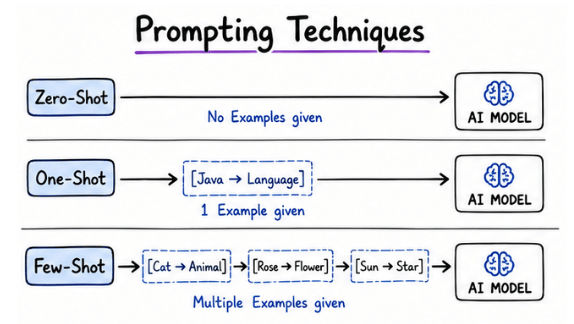
Zero-Shot Prompting means asking AI to perform a task without providing any examples.
Example
Explain Deep Learning in simple English.
Best For
Definitions
Explanations
Summaries
One-Shot Prompting provides one example before asking AI to perform a similar task.
Example
Java is a programming language.
Now explain Python.
Best For
Writing style guidance
Simple classification
Formatting tasks
Few-Shot Prompting uses multiple examples to help AI understand the expected pattern.
Example
Cat → Animal
Rose → Flower
Now answer:
Mango → ?
Output
Mango → Fruit
Best For
Classification
Pattern recognition
Data extraction
Consistent responses
Chain of Thought Prompting encourages AI to solve a problem step by step, which often improves reasoning.
Example
Instead of:
What is 25 × 18?
Use:
Solve 25 × 18 step by step.
Best For
Mathematics
Coding
Logical reasoning
Multi-step problems
Structured Prompting organizes a prompt into clear sections instead of writing everything in one sentence.
Example
Task: Explain Machine Learning
Audience: Beginners
Instructions: Use simple English and one real-world example.
Output: Headings and bullet points
This approach usually produces clearer and better-organized responses.
You can improve AI responses by refining your prompts.
Some simple ways include:
Write clear instructions
Add enough context
Mention the target audience
Specify the output format
Set a word limit if needed
Ask for examples
Break large tasks into smaller prompts
Example
Basic Prompt
Explain AI.
Better Prompt
Explain Artificial Intelligence in simple English for beginners with real-world examples and a short summary.
Follow these simple practices to get better AI responses.
Be clear and specific.
Provide enough context.
Mention the target audience.
Ask for examples when needed.
Review AI-generated content before using it.
Avoid these common Prompt Engineering mistakes:
Writing very short or unclear prompts
Not providing enough context
Forgetting to specify the output format
Assuming every AI response is correct
Always verify important information, especially for medical, legal, financial, or academic content.
Prompt Engineering is widely used in:
Content writing
Software development
Education
Customer support
Research
Data analysis
Image generation
Business automation
Good prompts help AI produce faster, more accurate, and better-organized results across different tasks.
Prompt Engineering is the skill of writing clear instructions that help AI generate accurate and useful responses. Better prompts lead to better results.
By learning techniques like Zero-Shot, One-Shot, Few-Shot, Chain of Thought, and Structured Prompting, you can use AI more effectively for writing, coding, learning, research, and everyday problem-solving.
