
Durgesh Tiwari
Author
An AI agent is an intelligent system that can understand a goal, make decisions, plan tasks, use tools, and complete actions with minimal human input. Unlike a traditional AI model, it focuses on achieving a goal instead of only generating answers.
To complete a task successfully, an AI agent relies on several core components. Each component performs a specific role, and together they help the agent understand a goal, make decisions, use tools, and complete tasks efficiently.
Every AI agent also follows an AI agent lifecycle. It starts by understanding the user's goal, creates a plan, uses the required tools, completes the task, and then returns the final response.
Understanding AI agent components and the AI agent lifecycle is important because they form the foundation of modern Agentic AI applications.
In this chapter, you'll learn about the different types of AI agents, their core components, and how an AI agent completes a task step by step.
Not all AI agents work in the same way. Some simply react to the current situation, while others can plan, learn, make decisions, and work independently to achieve a goal.
Based on their capabilities, the main types of AI agents are:
Reactive Agents
Goal-Based Agents
Utility-Based Agents
Learning Agents
Autonomous Agents
Collaborative Agents

Each type is designed for different tasks and real-world AI applications.
A Reactive Agent is the simplest type of AI agent. It makes decisions based only on the current situation. It does not remember past events or plan future actions.
These agents follow predefined rules, making them fast and suitable for simple, predictable tasks.
Example: A smart thermostat turns the heater on or off based on the current room temperature.
Characteristics
Responds to the current situation only
Doesn't use memory
Doesn't plan ahead
Fast and efficient
Best for simple tasks
A Goal-Based Agent works to achieve a specific goal. Instead of reacting immediately, it evaluates different options and chooses the best way to complete the task.
Because it can plan multiple steps before taking action, it is suitable for solving more complex problems.
Example: An AI travel assistant compares different flights and recommends the best option based on your budget and preferences.
Characteristics
Focuses on a specific goal
Plans before taking action
Evaluates multiple options
Makes informed decisions
Best for multi-step tasks
A Utility-Based Agent aims to find the best possible solution instead of just completing a task. It compares different options based on factors such as cost, quality, time, and user preferences before making a decision.
Example: While booking a hotel, the agent compares price, ratings, location, and facilities to recommend the best option.
Characteristics
Compares multiple options
Chooses the best solution
Considers user preferences
Optimizes decision-making
Delivers better results
A Learning Agent improves its performance by learning from experience, user feedback, and new data. As it learns, it becomes better at making decisions and providing personalized recommendations.
Example: Netflix recommends movies based on your viewing history and preferences.
Characteristics
Learns from experience
Improves over time
Adapts to new situations
Uses feedback to improve
Provides personalized recommendations
An Autonomous Agent can complete tasks with minimal human input. Once it receives a goal, it creates a plan, makes decisions, uses the required tools, and completes the task on its own.
Autonomous agents are a core part of Agentic AI because they focus on achieving goals rather than simply generating responses.
Example: An AI personal assistant can schedule meetings, send emails, set reminders, and manage your calendar.
Characteristics
Works independently
Makes decisions on its own
Uses tools and APIs
Handles multi-step tasks
Requires minimal human input
Some tasks are too complex for a single AI agent. In such cases, multiple AI agents work together to achieve a common goal. These are called Collaborative Agents.
Each agent is responsible for a specific task and shares information with other agents to complete the overall workflow efficiently.
Example: While preparing a report, one agent collects information, another writes the content, and a third reviews the final output.
You'll learn more about Collaborative Agents and Multi-Agent Systems in a later chapter.
Characteristics
Multiple agents work together
Each agent has a specific role
Shares information with other agents
Suitable for complex tasks
Improves efficiency and scalability
To complete a task, an AI agent uses several core components. Each component has a specific role, and together they help the agent understand a goal, make decisions, use tools, and complete tasks efficiently.
The main AI agent components are:
Goals
Memory
Planning
Reasoning
Tool Usage
Reflection
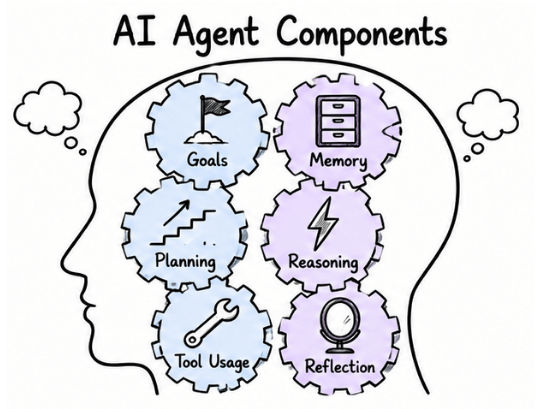
Let's understand each component briefly.
Every AI agent starts with a goal. A goal defines what the AI agent needs to achieve. It gives the agent a clear direction before it starts working on a task.
Example: If a user asks, "Find the best smartphone under ₹30,000," the agent first understands the goal, compares suitable smartphones, and recommends the best options.
Memory allows an AI agent to remember conversation history, user preferences, and important information while completing a task.
Example: If you tell the agent that your favorite programming language is Python, it can remember this preference and suggest Python-related resources in future conversations.
Planning helps an AI agent break a complex task into smaller steps and complete them in the correct order. This makes task execution more organized and efficient.
Example: To plan a trip, the agent may search for flights, compare hotels, create an itinerary, and estimate the total budget.
Reasoning enables an AI agent to analyze information, compare different options, and choose the best solution before taking action.
Example: While recommending a laptop, the agent compares the processor, RAM, storage, budget, and user requirements before making a recommendation.
Tool Usage allows an AI agent to access external tools such as APIs, databases, search engines, and file systems to collect real-time information or perform actions.
Example: To answer "What's the weather today?", the agent uses a weather API to fetch the latest weather information.
Reflection helps an AI agent review and improve its work before generating the final response. It checks for mistakes and improves the overall quality of the output.
Example: Before generating a report, the agent may verify facts, correct errors, and improve clarity.
Memory is an important part of an AI agent. It helps the agent remember information, maintain context, and make better decisions while completing a task. Different types of memory store different kinds of information.

Short-Term Memory stores temporary information needed during the current conversation or task. This information is usually cleared once the task is completed.
Example: If you ask an AI agent to summarize a document, it remembers the document's content until the summary is generated.
Long-Term Memory stores information for future use, such as user preferences, important facts, and previous interactions. This helps the agent provide more personalized responses across different conversations.
Example: If you prefer answers in simple English, the agent can remember this preference for future conversations.
Episodic Memory stores information about previous experiences and completed tasks. It allows the agent to use past experiences when handling similar situations.
Example: If an AI agent has successfully planned a project before, it can use that experience to plan a similar project more efficiently.
Semantic Memory stores general knowledge, facts, concepts, and rules. It enables the agent to understand information and answer questions accurately.
Example: Knowing that Paris is the capital of France or Python is a programming language are examples of semantic memory.
To complete a task, an AI agent must decide what to do, how to do it, and which action to take next. This is possible through planning and reasoning.
Planning helps the agent break a goal into smaller steps.
Reasoning helps the agent analyze information and choose the best action.
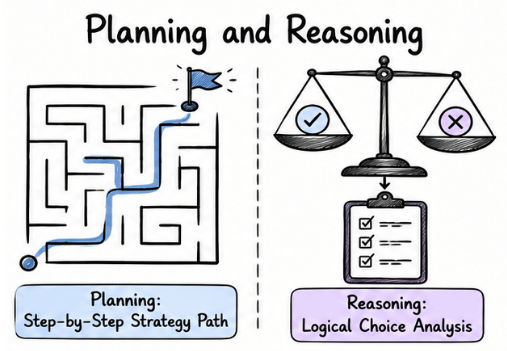
Together, these capabilities enable AI agents to solve complex tasks efficiently.
Planning is the process of creating a step-by-step strategy to achieve a goal. Instead of solving everything at once, the agent divides a complex task into smaller steps.
Example: If you ask an AI agent to plan a three-day trip to Goa, it may search for attractions, compare hotels, estimate the budget, and create a day-wise itinerary.
Sequential Planning: Completes tasks one step at a time in a fixed order.
Example: Read a document → Summarize it → Save the summary.
Dynamic Planning: Updates the plan when new information becomes available.
Example: If a flight is cancelled, the agent automatically searches for another available flight.
Hierarchical Planning: Breaks a large goal into smaller sub-tasks.
Example: Building a website can be divided into design, development, testing, and deployment.
Reasoning is the ability to analyze information, compare different options, and make logical decisions.
Example: While recommending a hotel, the agent may compare price, ratings, reviews, and location before selecting the best option.
Logical Reasoning: Uses facts and rules to reach a logical conclusion.
Example: If a store is closed, the agent knows it cannot place an order today.
Comparative Reasoning: Compares multiple options before making a decision.
Example: Comparing laptops based on price, performance, battery life, and customer reviews.
Context-Based Reasoning: Uses previous conversations and user preferences to make better decisions.
Example: If the user prefers budget hotels, the agent recommends affordable options instead of luxury hotels.
