
Durgesh Tiwari
Author
Large Language Models (LLMs) are trained on a fixed set of data, so they may not know recent updates or private information.
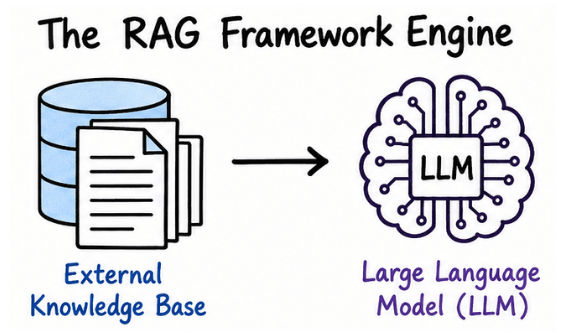
Retrieval-Augmented Generation (RAG) extends an LLM by allowing it to retrieve relevant information from external sources before generating a response.
By combining retrieved knowledge with the model's capabilities, RAG provides more accurate, up-to-date, and context-aware answers.
RAG is widely used in AI chatbots, enterprise search, customer support, and knowledge management systems.
Retrieval-Augmented Generation (RAG) is an AI technique that combines information retrieval with a Large Language Model (LLM).
Instead of relying only on its training knowledge, a RAG system first retrieves relevant information from a knowledge source and then uses it as context to generate the final response.
RAG retrieves relevant information before an LLM generates an answer.
Question:
"What is our company's latest leave policy?"
A standard LLM may not know the latest policy because it was not trained on your company's internal documents.
A RAG system retrieves the latest policy from the knowledge base and uses it to generate an accurate response.
Large Language Models (LLMs) rely on the knowledge learned during training. Without access to external data, they face several limitations:
Outdated Knowledge: Cannot automatically learn new information after training.
No Access to Private Data: Cannot answer questions about company documents, databases, or internal knowledge.
AI Hallucinations: May generate incorrect or misleading information when the correct answer is unavailable.
Difficult to Update: Retraining the model for new information is expensive and time-consuming.
Less Reliable Responses: Answers may be incomplete or inaccurate for recent or domain-specific topics.
RAG helps overcome the limitations of LLMs by connecting them to an external knowledge source. Instead of relying only on training data, it uses relevant and up-to-date information to generate more accurate responses.
Uses Current Information: Retrieves the latest data from the knowledge base.
Supports Private Knowledge: Accesses company documents, databases, and internal information.
Reduces AI Hallucinations: Generates responses based on retrieved context instead of guessing.
Improves Accuracy: Produces more relevant and reliable answers.
No Model Retraining: New information can be added by updating the knowledge base.
Example: If a user asks about the latest product warranty, the RAG system retrieves the current warranty details from the knowledge base before the LLM generates the response.
A RAG system combines a Retriever, a Knowledge Base, and a Large Language Model (LLM).
When a user asks a question, the retriever searches the knowledge base for relevant information and passes it to the LLM for processing.
User Question
      │
      ▼
   Retriever
      │
      ▼
Knowledge Base
      │
Relevant Documents
      │
      ▼
Large Language Model (LLM)
      │
      ▼
Generated Response
Each component has a specific role in the RAG pipeline.
A RAG system mainly consists of three components:
Knowledge Base
Retriever
Large Language Model (LLM)

Each component has a specific role in the RAG pipeline.
The Knowledge Base stores the information used by the RAG system.
It can contain:
PDF documents
Product documentation
Company policies
FAQs
Research papers
Web pages
Internal business documents
Unlike an LLM, the knowledge base can be updated whenever new information is available.
Example: Updating a company's return policy in the knowledge base allows the AI to provide the latest information.
The Retriever searches the knowledge base and finds the most relevant information for a user's query.
It uses embeddings and vector search to find content based on meaning rather than exact keywords.
Example: A search for "Reset my password" can also find documents titled "Forgot Password."
The LLM receives the user's question along with the retrieved information and generates the final response.
It uses the retrieved context to generate a clear and relevant answer.
Example: The LLM explains the latest product features using information retrieved from the knowledge base.
When a user asks a question, the RAG system follows a series of steps to retrieve relevant information and generate a response.
User Question
      │
      ▼
Create Embedding
      │
      ▼
Search Vector Database
      │
      ▼
Retrieve Relevant Chunks
      │
      ▼
Add Context to Prompt
      │
      ▼
Large Language Model (LLM)
      │
      ▼
Final Response
These steps work together to generate the final response.
Document Chunking is the process of dividing a large document into smaller sections called chunks.
Instead of searching an entire document, a RAG system searches these chunks to find the most relevant information. This improves retrieval speed and response accuracy.
Example: Instead of sending a 200-page manual to the LLM, the system retrieves only the section related to "How to reset the device?"
Chunk Size is the amount of content stored in a single chunk.
Small chunks: Less context but more precise retrieval.
Large chunks: More context but may include unnecessary information.
The ideal chunk size balances context and retrieval accuracy.
Chunk Overlap repeats a small portion of one chunk in the next to preserve context.
This helps the retriever find complete information, even when related content spans multiple chunks.
Example:
Chunk 1
Installation
Configuration

Chunk 2
Configuration
Usage Guide
Here, Configuration appears in both chunks.
Metadata is additional information stored with each chunk to improve retrieval.
Common metadata includes:
Document name
Source
Category
Author
Page number
Creation date
Metadata helps the retriever quickly find the most relevant content.
The basic RAG workflow works well for many applications, but large-scale AI systems often need more accurate and reliable retrieval.
To improve search quality and generate better responses, modern RAG systems use several advanced techniques. These techniques help retrieve more relevant information before it is sent to the Large Language Model (LLM).
Some of the most commonly used advanced RAG techniques are Hybrid Search, Re-ranking, and Graph RAG.
Hybrid Search combines Keyword Search and Semantic Search to retrieve more relevant information.
Keyword Search: Finds exact words or phrases.
Semantic Search: Finds content with similar meaning using embeddings.
By using both methods together, Hybrid Search improves retrieval quality.
Example: A search for "How do I recover my account?" can return documents containing "reset password", "restore account", or "forgot login credentials."
Re-ranking improves search results by ordering the retrieved documents based on their relevance.
The highest-ranked documents are sent to the LLM, helping it use the most useful context.
Example: If multiple documents are retrieved for "Reset my password," the Password Reset Guide is ranked above less relevant documents.
Graph RAG combines traditional RAG with a Knowledge Graph to understand relationships between data.
Instead of searching only documents, it can also use connections between people, products, or events to answer complex questions.
Example: If a user asks, "Who reports to the Engineering Manager?", Graph RAG follows the relationships in the knowledge graph to identify the correct employees.
Graph RAG is commonly used in enterprise AI, healthcare, finance, and knowledge management.
RAG is widely used in applications that require reliable and up-to-date information, including:
AI customer support chatbots
Enterprise knowledge assistants
Document search systems
Internal company search
Legal and compliance assistants
Healthcare information systems
Financial advisory platforms
AI-powered educational tools
RAG and Fine-Tuning solve different problems.
RAG uses external knowledge to answer questions.
Fine-Tuning trains the model for specific tasks or behaviors.
Feature | RAG | Fine-Tuning |
|---|---|---|
Knowledge Source | External documents and databases | Training data |
Model Retraining | Not required | Required |
Data Updates | Easy by updating the knowledge base | Requires retraining |
Best Use Case | Frequently changing information | Specialized tasks and behavior |
Note: RAG provides the latest information, while Fine-Tuning customizes how the model responds. Many AI applications use both together.
RAG offers several benefits for modern AI applications:
More Accurate Responses: Uses relevant information to improve answer quality.
Up-to-Date Information: Retrieves the latest data from external sources.
Supports Private Data: Works with company documents and knowledge bases.
Reduces AI Hallucinations: Grounds responses using retrieved context.
No Retraining Required: Update the knowledge base instead of the model.
Easy to Scale: Add new documents as information grows.
RAG also has some limitations:
Depends on Retrieval Quality: Poor retrieval can affect response quality.
Requires a Well-Organized Knowledge Base: Information must be maintained and updated.
More Complex Setup: Requires additional components such as a retriever and vector database.
Slightly Slower Responses: Retrieval adds an extra processing step.
Retrieval-Augmented Generation (RAG) enhances Large Language Models (LLMs) by providing relevant information from external knowledge sources before generating a response.
It enables AI applications to use external knowledge sources, making responses more reliable and suitable for real-world use cases.
