
Durgesh Tiwari
Author
Deep Learning is one of the most advanced areas of Artificial Intelligence (AI). It helps computers learn complex patterns from large amounts of data and solve problems that are difficult for traditional Machine Learning models.
Today, Deep Learning powers many modern technologies, including image recognition, voice assistants, language translation, self-driving cars, recommendation systems, and AI chatbots.
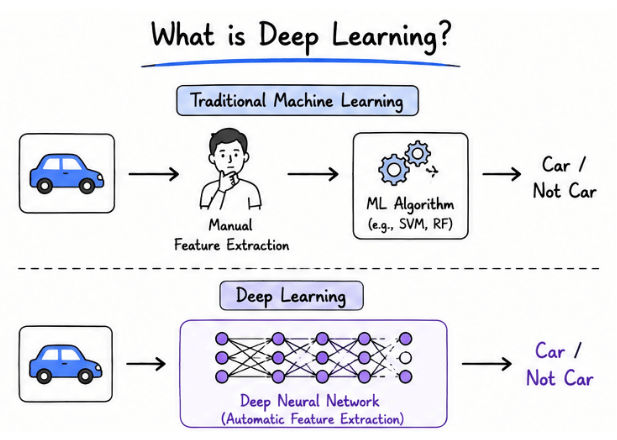
Deep Learning is a specialized branch of Machine Learning that uses artificial neural networks to learn from data and make intelligent decisions.
Unlike traditional Machine Learning, Deep Learning can automatically identify important features from large datasets without requiring extensive manual intervention.
Because of this capability, Deep Learning performs exceptionally well in tasks such as image recognition, speech processing, natural language understanding, and content generation.
Face recognition in smartphones
Voice assistants like Siri and Alexa
Language translation tools
AI chatbots and virtual assistants
Self-driving vehicle technology
These applications show how Deep Learning helps machines understand and interact with the world more effectively.
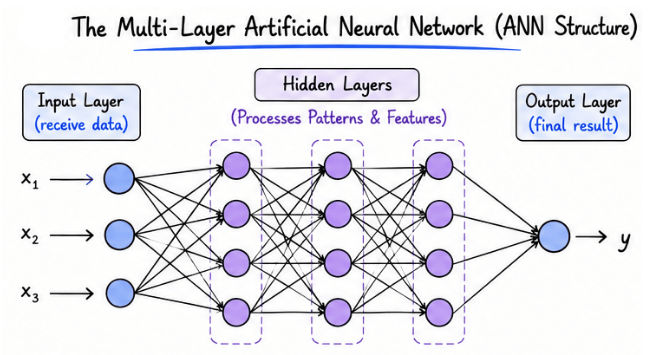
Deep Learning is built on Artificial Neural Networks (ANNs), which are inspired by the structure of the human brain.
A neural network consists of three main layers:
The input layer receives data from the outside world.
Example: An image recognition system receives image pixels as input.
Hidden layers process the input data and identify patterns, features, and relationships.
Deep Learning models often contain multiple hidden layers, which allow them to solve complex problems.
The output layer produces the final result.
Example: A model may classify an image as a cat, dog, or bird.
Deep Learning models improve through a training process that involves learning from data and correcting mistakes.
Collect and prepare training data.
Pass data through the neural network.
Generate predictions.
Compare predictions with actual results.
Calculate errors.
Update network weights using feedback.
Repeat the process until performance improves.
Over time, the model becomes more accurate and learns to make better predictions.
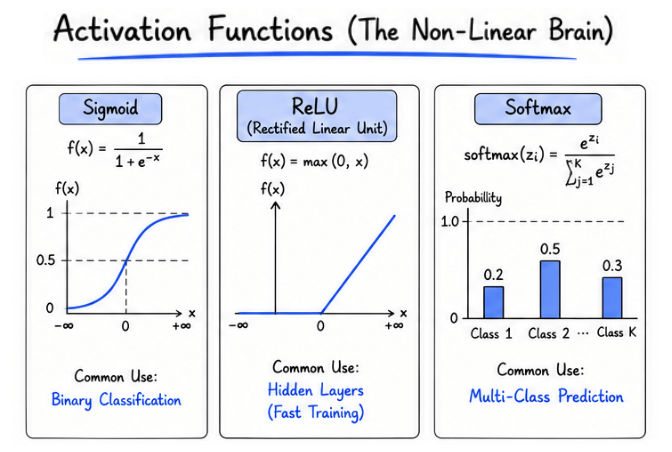
Activation functions help neural networks decide whether information should move to the next layer. They introduce non-linearity, allowing models to learn complex patterns.
Produces output values between 0 and 1.
Common Use: Binary classification problems.
Returns positive values and ignores negative values.
Why Popular: Faster training and better performance in deep networks.
Produces output values between -1 and 1.
Benefit: Handles both positive and negative values more effectively than Sigmoid.
Converts outputs into probability values.
Common Use: Multi-class classification tasks.
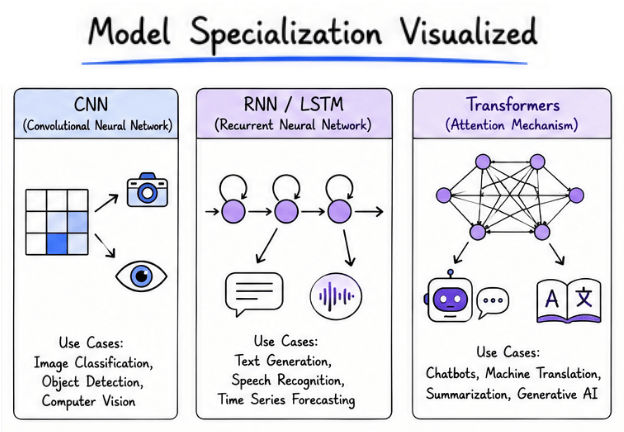
Different Deep Learning models are designed for different types of problems.
ANN is the basic form of a neural network and serves as the foundation of Deep Learning.
Common Uses:
Prediction systems
Classification tasks
Recommendation engines
CNN is mainly used for image-related tasks.
Common Uses:
Image classification
Face recognition
Medical image analysis
RNN is designed for sequential data where previous information matters.
Common Uses:
Language processing
Speech recognition
Time-series prediction
LSTM is an improved version of RNN that can remember information for longer periods.
Common Uses:
Text generation
Language translation
Speech processing
Transformers are the most advanced and widely used Deep Learning architecture today.
They power modern AI systems such as chatbots, large language models, and generative AI applications.
Common Uses:
ChatGPT and AI assistants
Language translation
Text generation
Content creation
Deep Learning is an advanced branch of Machine Learning that uses neural networks to learn from large amounts of data. It powers many modern AI applications, including image recognition, speech processing, language translation, and AI chatbots.
Understanding neural networks, training processes, activation functions, and popular Deep Learning models provides a strong foundation for learning advanced AI and Generative AI technologies.
