
Durgesh Tiwari
Author
Artificial Intelligence is evolving quickly. Earlier, AI was mainly used to answer questions, write content, translate languages, or summarize documents. It could generate useful responses, but it still depended on users to guide every step.
Today, AI can do much more. It can understand a goal, plan the required steps, use external tools, and complete tasks with very little human input. This new approach is called Agentic AI.
For example, if you ask an AI to plan a trip, it can compare hotels, check flight prices, create an itinerary, and even book tickets if the required tools are available.
Instead of simply generating answers, Agentic AI focuses on completing goals. This makes it more useful for building intelligent assistants, business automation, customer support systems, and many other real-world AI applications.
In this chapter, you'll learn what Agentic AI is, why it is important, and how AI agents solve real-world problems.
Agentic AI is a type of Artificial Intelligence that can understand a goal, plan the required steps, use tools, and complete a task with minimal human guidance.
Unlike a traditional AI model that mainly generates responses, an AI agent focuses on achieving the user's goal. It doesn't wait for instructions after every step. Instead, it decides what to do next based on the task and the available information.
For example, if you ask:
"Find the best laptop under ₹70,000 and compare the top three options."
A normal AI may give a general suggestion. An Agentic AI system can search online stores, compare prices, check reviews, and recommend the best options based on your requirements.
In simple words, Agentic AI is designed to complete tasks, not just answer questions. It combines the power of Large Language Models (LLMs) with planning, reasoning, memory, and tool usage to solve real-world problems more effectively.
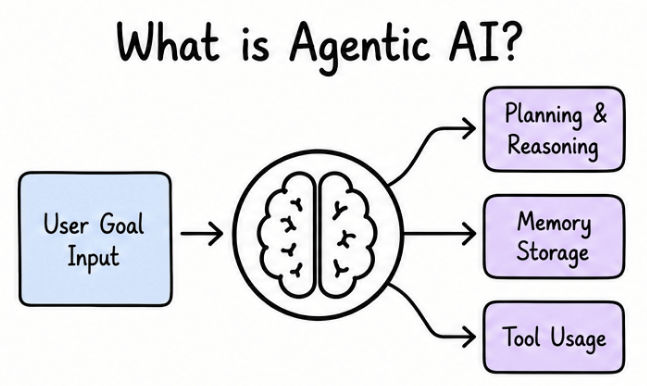
Large Language Models (LLMs) are great at understanding and generating text, but many real-world tasks involve multiple steps. They may require searching information, making decisions, using tools, or interacting with different systems.
This is where Agentic AI becomes useful.
Instead of waiting for instructions at every step, Agentic AI understands the user's goal, creates a plan, uses the required tools, and completes the task with minimal human input.
For example, if you ask an AI to organize a business meeting, it can check everyone's availability, schedule the meeting, send invitations, and notify participants—all from a single request.
As AI continues to improve, users expect it to complete tasks, not just answer questions. That's why Agentic AI is becoming an important part of modern AI applications.
Artificial Intelligence has evolved over time, and each stage has made AI smarter and more capable. Here's how AI has evolved:
Rule-Based AI: Followed predefined rules and could only perform fixed tasks.
Machine Learning (ML): Learned patterns from data instead of relying only on rules.
Deep Learning: Used neural networks to improve tasks like image recognition, speech recognition, and language understanding.
Generative AI: Created new content such as text, images, code, audio, and videos using models like ChatGPT and Gemini.
Agentic AI: Goes beyond content generation by understanding goals, planning tasks, using tools, making decisions, and completing actions with minimal human input.
Today, Agentic AI represents the next step in the evolution of Artificial Intelligence. It combines the power of Large Language Models (LLMs) with planning, reasoning, memory, and tool usage to solve real-world problems more effectively.
Artificial Intelligence has evolved significantly over time. Traditional AI, Generative AI, and Agentic AI each represent different stages of this evolution.
Traditional AI | Generative AI | Agentic AI |
|---|---|---|
Follows predefined rules | Generates new content | Completes goals and tasks |
Solves specific problems | Creates text, images, code, and more | Plans, reasons, and takes actions |
Limited learning capability | Understands prompts and generates responses | Uses tools, memory, reasoning, and planning |
Usually works independently of external tools | Limited tool usage | Works with APIs, databases, search engines, and files |
Best for automation | Best for content creation | Best for intelligent task automation |
An AI Agent and a chatbot may look similar because both interact with users, but they serve different purposes.
A chatbot is designed to answer questions and continue conversations. An AI Agent is designed to achieve a goal by planning steps, using tools, and completing tasks.
Chatbot | AI Agent |
|---|---|
Answers questions | Completes tasks |
Responds to user prompts | Works toward a goal |
Waits for the next instruction | Plans the next steps automatically |
Limited tool usage | Uses tools, APIs, and external services |
Best for conversations | Best for automation and complex tasks |
A workflow follows a fixed sequence of steps, while an AI Agent can think, make decisions, and change its actions based on the situation.
A workflow always follows predefined rules. An AI Agent chooses the best way to complete a task.
Workflow | AI Agent |
|---|---|
Follows fixed steps | Adapts to the situation |
Same process every time | Can change its approach |
No decision-making | Makes decisions automatically |
Rule-based execution | Uses reasoning and planning |
Best for repetitive tasks | Best for dynamic and complex tasks |
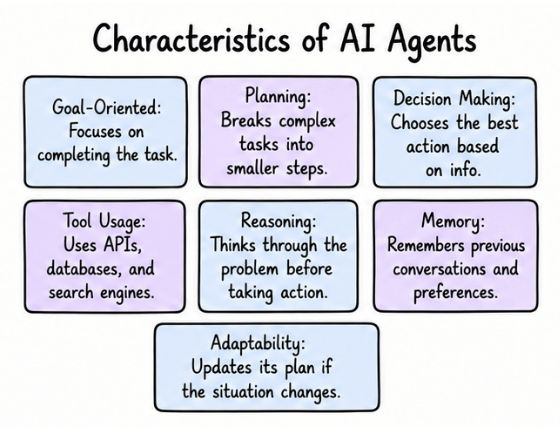
AI agents are more advanced than traditional AI systems because they can understand goals, make decisions, use tools, and complete tasks with minimal human input.
Some important characteristics of AI agents are:
Goal-Oriented: AI agents focus on achieving a specific goal instead of simply answering questions.
Planning: They break complex tasks into smaller steps and create a plan before taking action.
Decision Making: AI agents analyze the available information and choose the best action for the situation.
Tool Usage: They can use APIs, databases, search engines, file systems, and other external tools to collect information or perform tasks.
Reasoning: AI agents think through a problem, evaluate different options, and then decide the best solution.
Memory: They can remember previous conversations, user preferences, and important details to provide more personalized responses.
Adaptability: If new information becomes available or the situation changes, AI agents can update their plan and continue working toward the goal.
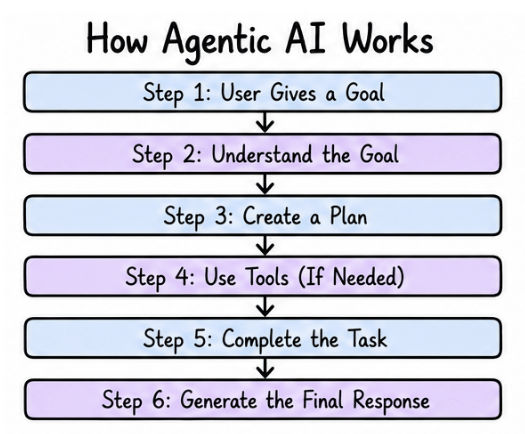
An AI Agent doesn't just answer a question. It follows a step-by-step process to understand the goal, make decisions, and complete the task.
A typical Agentic AI workflow looks like this:
User Gives a Goal
        │
        ▼
Understand the Goal
        │
        ▼
Create a Plan
        │
        ▼
Use Tools (If Needed)
        │
        ▼
Complete the Task
        │
        ▼
Generate the Final Response
For example, if you ask:
"Find the latest AI news and summarize the top five articles."
The AI agent will:
Understand your request.
Search trusted news websites.
Find the most relevant AI articles.
Summarize the important points.
Present the final summary.
Instead of asking for instructions at every step, an AI Agent plans the workflow, uses the right tools, and completes the task automatically
Agentic AI is transforming many industries by automating complex tasks and improving efficiency.
Some common applications include:
Customer Support: Resolve customer queries, manage support tickets, and provide 24/7 assistance.
Healthcare: Analyze medical records, support diagnosis, and assist healthcare professionals.
Finance: Detect fraud, generate financial reports, and provide investment insights.
Education: Create personalized learning experiences and answer students' questions.
Software Development: Write, review, test, and debug code.
Research: Collect information from multiple sources and generate summaries.
Travel: Plan trips, compare flight and hotel prices, and create travel itineraries.
Business Automation: Manage emails, schedule meetings, generate reports, and automate daily workflows.
As Agentic AI continues to evolve, its applications will expand across almost every industry.
Agentic AI offers several benefits over traditional AI systems.
Automates repetitive and time-consuming tasks.
Reduces manual effort and increases productivity.
Makes intelligent decisions based on available information.
Uses real-time data through external tools and APIs.
Handles complex workflows with minimal human guidance.
Provides more personalized and context-aware responses.
Improves efficiency in business operations and customer support.
Although Agentic AI is powerful, it also has some limitations.
It depends on the quality of the data and tools it uses.
Incorrect reasoning can lead to wrong decisions.
Complex AI agents require more computing resources.
Integrating multiple tools and services can increase development complexity.
Security and privacy must be carefully managed when accessing sensitive information.
Human supervision is still important for critical tasks such as healthcare, finance, and legal decisions.
In this chapter, you learned what Agentic AI is and why it is becoming an important part of modern AI applications.
You explored how Agentic AI is different from chatbots, workflows, and Generative AI, along with the key characteristics, working process, applications, advantages, and limitations of AI Agents.
In the next chapter, you'll learn about AI Agent Components and Lifecycle and understand how AI agents use goals, memory, planning, reasoning, tools, and execution to complete real-world tasks.
