
Durgesh Tiwari
Author
Artificial Intelligence is increasingly used in healthcare, education, banking, recruitment, transportation, cybersecurity, manufacturing, customer service, and many other areas.
AI can improve productivity, automate tasks, support decision-making, and help organizations analyze large amounts of information. However, AI systems can also create risks related to bias, privacy, misinformation, security, transparency, safety, and accountability.
Managing these risks requires understanding three closely related concepts:
AI Ethics
    ↓
Principles and Values

AI Governance
    ↓
Policies + Responsibilities + Controls

AI Regulations
    ↓
Legal Requirements
AI Ethics helps determine what responsible AI behavior should look like.
AI Governance turns ethical principles and organizational requirements into policies, responsibilities, processes, and controls.
AI Regulations establish legally enforceable requirements within particular jurisdictions and use cases.
Together, these areas help organizations develop and use AI more responsibly.
AI ethics refers to the principles and values that guide the responsible development and use of artificial intelligence.
It asks an important question:
How should AI be designed and used so that it provides value without creating unacceptable harm?
Important AI ethics principles include:
Fairness and Non-Discrimination
Transparency
Explainability
Privacy
Accountability
Safety and Security
Human Oversight
AI systems should be evaluated for inappropriate differences in outcomes across relevant individuals or groups.
Bias can enter an AI system through:
historical data;
data collection;
model development;
evaluation datasets;
system design;
deployment context.
For example, consider an AI recruitment system trained largely on historical hiring decisions.
If those historical decisions contain unfair patterns, the AI system may reproduce or amplify them.
However, fairness is more complicated than simply asking:
Does the model treat everyone equally?Different applications may require different definitions of fairness, and fairness metrics can sometimes conflict.
Organizations should therefore:
examine outcomes across relevant groups;
test realistic cases;
understand where errors occur;
evaluate whether particular groups are affected differently;
involve appropriate domain and legal expertise for high-impact applications.
Fairness should be evaluated in the context of the specific system, users, decisions, and potential impact.
Transparency means providing appropriate information about an AI system and how it is being used.
Depending on the context, people may need to understand:
the purpose of the AI system;
when AI is being used;
what types of information it uses;
important limitations;
how its outputs affect a process;
who is responsible for the system.
Transparency does not require exposing every technical implementation detail.
The appropriate level of transparency depends on the audience, use case, and potential impact of the system.
Explainability concerns providing meaningful information about how or why an AI system produced or supported an outcome.
Different audiences may need different explanations:
Audience | Typical Question |
|---|---|
Developer | Why did the system behave this way? |
Business Owner | Why is this system appropriate for the use case? |
End User | Why did I receive this outcome? |
Auditor / Regulator | What evidence supports this system or decision? |
Explainability does not necessarily mean exposing hidden model reasoning or every internal model calculation.
For an AI application or agent, useful explanations may include:
relevant input information;
sources used;
important business rules;
tools or systems involved;
approvals received;
actions performed;
evidence supporting the outcome.
For example:
Loan Support System

Recommendation:
Manual Review

Reason:
Income information could not be verified.

Data Source:
Verified application record.

Action:
Application routed to a human reviewer.
A traceable explanation like this is more useful than generating a long narrative that merely sounds convincing.
Good explainability should focus on meaningful reasons and traceable evidence.
AI systems often process personal, confidential, or sensitive information.
From an ethics perspective, organizations should consider how information is:
collected;
accessed;
processed;
stored;
shared;
retained;
deleted.
An important principle is data minimization:
Do not give the AI
all available data.

Give it only the data
required for the task.
For example, an HR assistant answering an employee's vacation-balance question may need access to that employee's leave information.
It probably does not need access to unrelated medical records, bank information, performance reviews, or other employees' salaries.
The important governance question is:
Does the AI system use only the information necessary and appropriate for its intended purpose?
Detailed technical privacy and security controls were covered earlier. Here, the focus is on ensuring that privacy requirements influence how AI systems are designed and governed.
Humans and organizations must remain accountable for AI systems.
An organization should not avoid responsibility simply by claiming:
The algorithm made the decision.
Responsibility should be clearly defined for important activities such as:
system ownership;
development;
evaluation;
approval;
deployment;
monitoring;
incident handling;
retirement.
Accountability becomes especially important when AI systems influence consequential decisions or perform actions on behalf of users or organizations.
AI systems should operate with an appropriate level of safety and reliability for their intended use.
The required controls depend on the system's capabilities and potential impact.
For agentic systems:
More Capability
      +
More Access
      +
More Autonomy
      =
More Need for Controls
Detailed AI-agent security was covered earlier. From a governance perspective, the important principle is:
The level of control should match the level of risk.
Appropriate human oversight is especially important for high-impact or consequential AI applications.
A simple pattern is:
AI Recommendation
        ↓
Human Review
        ↓
Final Decision
Not every AI output requires human approval.
The appropriate level of human involvement depends on factors such as:
Risk — What could go wrong?
Impact — How serious would the consequences be?
Uncertainty — How confident is the system?
Reversibility — Can the action easily be undone?
Human-in-the-loop workflow design was covered earlier. Here, human oversight is treated as an important governance mechanism.
AI governance is the system of policies, processes, responsibilities, standards, and controls used to manage AI throughout its lifecycle.
Without governance, different teams may independently select models, connect sensitive data, deploy agents, or automate important processes without consistent oversight.
An effective AI governance program usually connects several areas:
AI Governance
├── Policies and Standards
├── Roles and Ownership
├── AI System Inventory
├── Risk Management
├── Data Governance
├── Evaluation
├── Security and Privacy
├── Human Oversight
├── Documentation and Auditability
├── Monitoring
└── Incident Management
Each component serves a different purpose:
Policies and Standards define how AI may be developed and used.
Roles and Ownership establish who is responsible for systems and important decisions.
AI System Inventory provides visibility into AI systems operating across the organization.
Risk Management identifies, assesses, and manages AI-related risks.
Data Governance controls how important data is collected, accessed, used, and managed.
Evaluation determines whether systems meet required performance, quality, fairness, safety, and other criteria.
Security and Privacy protect systems, data, users, and organizational resources.
Human Oversight defines where human review, approval, or intervention is required.
Documentation and Auditability preserve important information and evidence about the system.
Monitoring tracks important behavior and changes after deployment.
Incident Management defines how significant failures, harmful outcomes, or policy violations are handled.
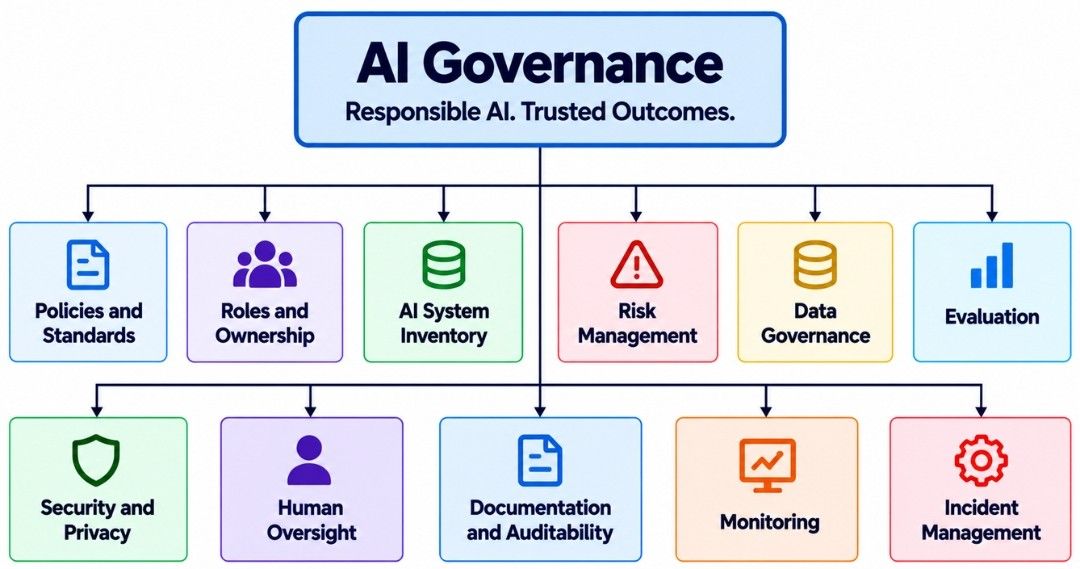
Some of these areas, such as evaluation, security, monitoring, and human oversight, were covered in greater technical depth earlier. Here, the focus is on how they fit into the overall governance system.
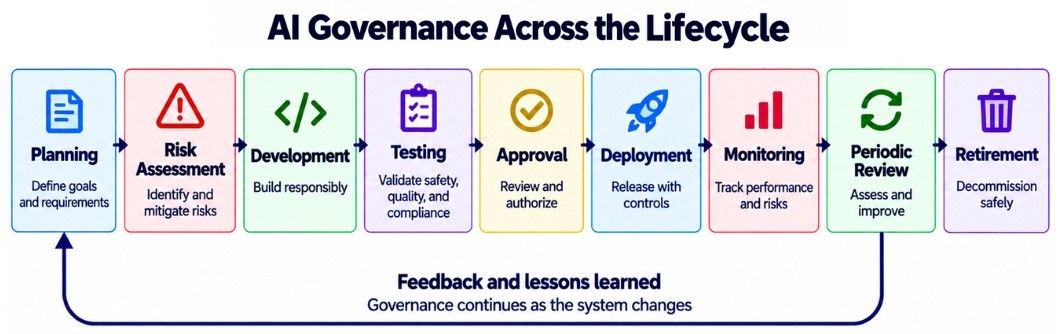
Governance should not begin only when an AI system is ready for production.
It should cover the complete AI lifecycle:
Planning
   ↓
Risk Assessment
   ↓
Development
   ↓
Testing
   ↓
Approval
   ↓
Deployment
   ↓
Monitoring
   ↓
Periodic Review
   ↓
Retirement
Consider a bank introducing an AI system to support loan decisions.
Governance should establish:
Ownership: Who is responsible for the system?
Purpose: What is the system intended and permitted to do?
Data: What information can it use?
Evaluation: How will performance and fairness be evaluated?
Approval: What reviews are required before deployment?
Oversight: Which important decisions require human review?
Incidents: How will failures and complaints be handled?
Review: When should the system be reassessed?
Good governance is therefore not simply paperwork.
Governance should connect organizational requirements with actual technical and operational controls.
AI policies define how people and systems are allowed to use AI within an organization.
An organization may define policies covering:
which AI providers and tools are approved;
whether confidential information may be entered into external AI services;
which AI applications require additional review;
when AI-generated content must be verified;
which decisions may be automated;
which actions require human approval;
which AI uses are prohibited or restricted.
For example, a policy might state:
Employees must not send confidential
customer information to unapproved
AI services.
However, policy alone is not enough.
Whenever practical, important requirements should be supported by technical controls:
Policy
   ↓
Technical Controls
   ↓
Monitoring
   ↓
Evidence
   ↓
Enforcement
For an AI agent, policies may also determine what actions it can perform.
Agent Action | Policy Decision |
|---|---|
Read customer record | Allowed |
Draft refund request | Allowed |
Issue small refund | Policy controlled |
Issue large refund | Human approval |
Delete customer account | Restricted |
This demonstrates how governance requirements can be translated into practical system behavior.
AI regulations are legally enforceable requirements governing the development, provision, deployment, or use of artificial intelligence.
While ethics helps organizations consider what they should do, applicable regulations establish what they must or must not do under law.
AI-related legal requirements may affect areas such as:
privacy;
employment;
financial services;
healthcare;
consumer protection;
cybersecurity;
intellectual property;
safety;
fundamental rights.
Requirements can vary significantly depending on:
jurisdiction;
industry;
type of AI system;
organization's role;
intended use;
potential impact.
Therefore:
There is no single worldwide AI law that applies identically to every AI system.
Organizations must determine which requirements apply to their particular systems and circumstances.
Several important frameworks, principles, recommendations, and regulations influence how organizations approach responsible AI.
However, they do not all have the same purpose or legal status.
Framework / Initiative | General Role |
|---|---|
European Union AI Act | Legal and regulatory framework |
NIST AI RMF | Voluntary AI risk-management framework |
OECD AI Principles | International AI principles |
UNESCO Recommendation | International ethical recommendation |
The European Union AI Act is a major legal framework specifically addressing artificial intelligence.
It follows a risk-based approach. Certain AI practices are prohibited, while particular categories of AI systems are subject to additional requirements.
Depending on the AI system, use case, and organization's role, applicable obligations may involve areas such as:
risk management;
documentation;
transparency;
human oversight;
data governance;
monitoring;
conformity requirements.
The Act uses phased application dates, so organizations should determine which provisions apply to their systems rather than assuming that every requirement applies to every AI application at the same time.
The NIST AI Risk Management Framework (AI RMF) is a voluntary framework designed to help organizations manage risks associated with AI systems.
The core functions of AI RMF 1.0 are:
GOVERN
   ↓
MAP
   ↓
MEASURE
   ↓
MANAGE
Govern: Establish and maintain policies, responsibilities, processes, and organizational oversight.
Map: Understand the AI system, its context, stakeholders, intended purposes, and potential risks.
Measure: Analyze, assess, and track identified AI risks.
Manage: Prioritize risks and determine how they should be addressed.
The AI RMF can help organizations structure AI risk management, but following a voluntary framework does not automatically establish legal compliance.
Organizations still need to identify the legal and regulatory requirements applicable to their specific systems.
The OECD AI Principles provide internationally recognized principles for trustworthy AI.
They emphasize areas such as:
human-centered values;
fairness;
transparency and explainability;
robustness;
security and safety;
accountability.
The principles provide broad guidance for developing and using AI in ways that support beneficial and responsible outcomes.
The UNESCO Recommendation on the Ethics of Artificial Intelligence provides an international ethical framework for AI.
It addresses areas such as:
human rights and human dignity;
fairness;
privacy;
transparency;
accountability;
human oversight;
sustainability;
social well-being.
These examples illustrate an important distinction:
Ethical principles, voluntary risk-management frameworks, recommendations, and legally enforceable regulations may support similar goals, but they are not interchangeable.
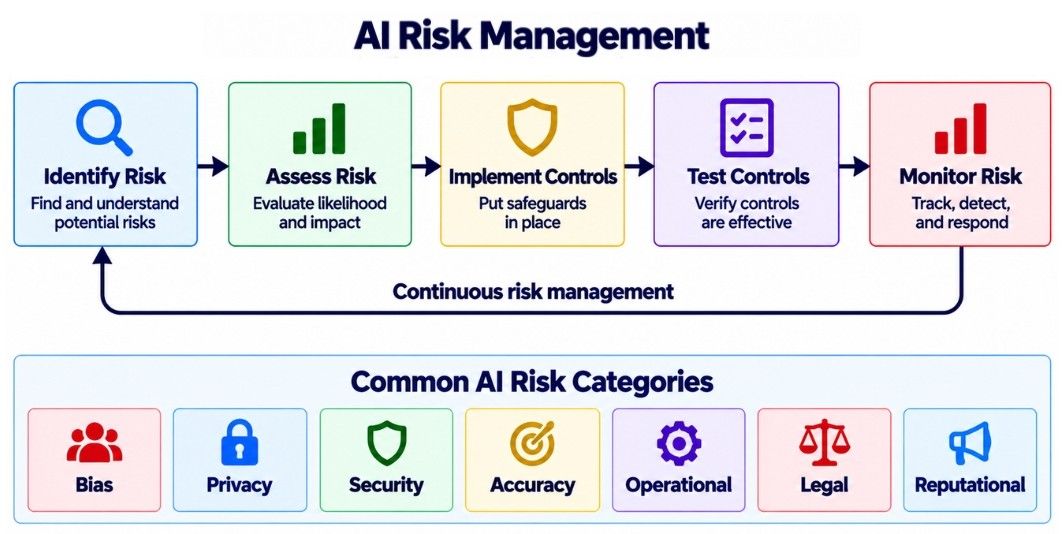
AI risk management is the process of identifying, assessing, controlling, and monitoring risks associated with an AI system.
A simple risk-management process is:
Identify Risk
     ↓
Assess Risk
     ↓
Implement Controls
     ↓
Test Controls
     ↓
Monitor Risk
The process is continuous. New risks may appear when models, data, integrations, users, or operating conditions change.
AI systems can create different types of risk:
Risk | Example |
|---|---|
Bias Risk | Unfair outcomes across relevant groups |
Privacy Risk | Inappropriate processing or exposure of personal information |
Security Risk | Manipulation, unauthorized access, or system compromise |
Accuracy Risk | Incorrect or misleading outputs |
Operational Risk | AI failures disrupting business processes |
Legal Risk | Violation of applicable requirements |
Reputational Risk | AI behavior damaging organizational trust |
These risks are not equally important for every AI application.
An AI system that summarizes public documentation generally has a different risk profile from an AI system that influences employment, medical, financial, or other consequential decisions.
Risk depends on more than the underlying model:
Use Case
   +
Data
   +
Users
   +
Integrations
   +
Autonomy
   +
Potential Impact
   ↓
Overall Risk
For example, the same underlying LLM may have a relatively limited impact when summarizing public documentation but a much higher potential impact when connected to sensitive enterprise data and authorized to perform financial actions.
The goal is not to eliminate every possible risk.
It is to identify important risks, implement appropriate controls, and determine whether the remaining risk is acceptable for the intended use.
Generative AI introduces additional governance challenges because the same technology can generate text, images, audio, video, software code, and other content across many different use cases.
Important concerns may include:
inaccurate or fabricated information;
confidential-data exposure;
harmful or inappropriate content;
intellectual-property concerns;
misinformation;
privacy violations;
insecure integrations;
inappropriate employee use.
The level of concern depends on the specific application and how generated content is used.
Organizations may establish Generative AI Acceptable Use Policies to define how employees and systems may use generative AI.
Employees should understand:
which AI tools are approved;
what information may be entered into them;
which uses are prohibited or restricted;
when generated content must be verified;
when additional review is required;
when human approval is required.
A simple workflow might be:
Employee
   ↓
Approved AI Tool?
   ↓
Allowed Data?
   ↓
Permitted Use Case?
   ↓
Generate Output
   ↓
Verify When Required
Generative AI governance should focus on the complete application and use case, not only on the underlying model.
For agentic AI, governance may also need to consider the tools, permissions, external systems, and actions available to the agent.
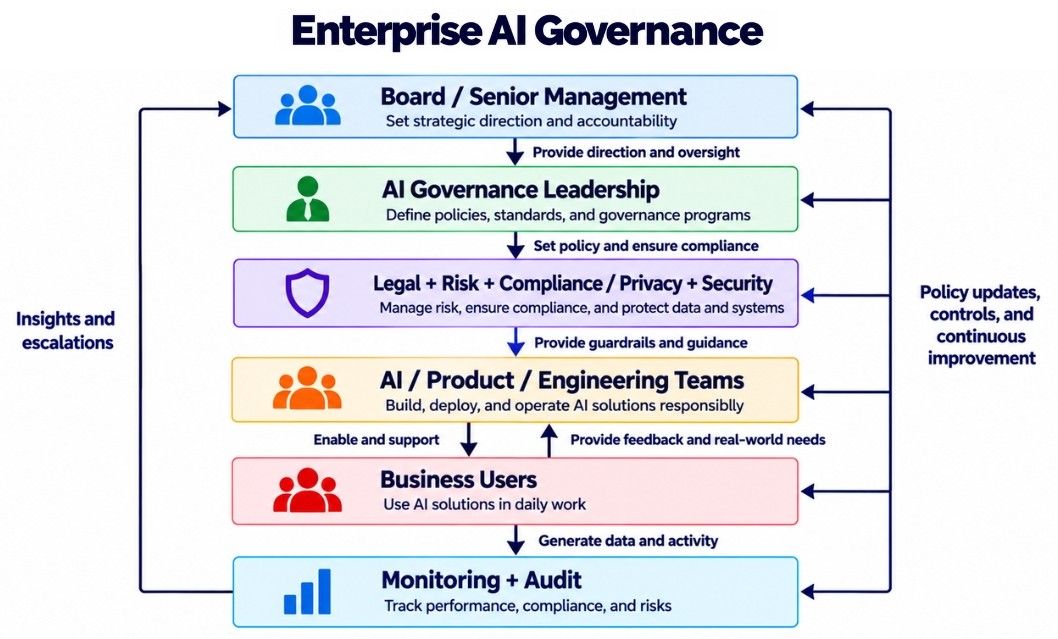
As organizations adopt more AI systems, governance must work consistently across teams, models, applications, agents, vendors, and business units.
Enterprise governance is therefore not only about controlling one AI application. It is about establishing consistent responsibility and visibility across many AI systems.
A practical governance structure may involve:
Board / Senior Management
          ↓
AI Governance Leadership
          ↓
Legal + Risk + Compliance
Privacy + Security
          ↓
AI / Product / Engineering Teams
          ↓
Business Users
          ↓
Monitoring + Audit
The exact structure varies by organization.
What matters is that responsibilities remain clear.
For example:
Board / Senior Management provides appropriate strategic oversight for significant AI risks.
Business Owners define the purpose, expected value, and business responsibility.
AI / Engineering Teams build, evaluate, deploy, and operate AI systems.
Security and Privacy Teams assess relevant security and data risks.
Legal and Compliance Teams identify applicable legal and regulatory requirements.
Governance Functions establish organizational policies, standards, and review processes.
Internal Audit may independently review important controls where appropriate.
Enterprise governance should connect business ownership with technical responsibility.
An important enterprise governance practice is maintaining an inventory of significant AI systems.
An organization should be able to identify:
what AI systems are deployed;
what each system does;
where it operates;
who owns it;
which important data it accesses;
which models or providers it uses;
its risk classification;
which controls and requirements apply.
An inventory may also include:
deployment status;
important dependencies;
vendors or external providers;
review dates;
approval status;
other information required by the organization's governance process.
Without sufficient visibility, an organization may not know the full scope of AI operating across different teams.
A practical governance process connects the previous concepts across the AI lifecycle.
1. Identify the Use Case: Define why AI is needed and what problem it should solve.
2. Identify Stakeholders: Determine who will use, operate, benefit from, or potentially be affected by the system.
3. Review Data: Understand the data required by the system and consider its quality, privacy, security, representativeness, and permitted use.
4. Assess Risk: Identify potential ethical, legal, privacy, security, safety, operational, and business risks.
5. Define Controls: Determine what evaluations, permissions, technical controls, human oversight, and documentation are required.
6. Test the System: Evaluate characteristics relevant to the use case, such as performance, fairness, robustness, privacy, security, and safety.
7. Approve Deployment: Ensure that appropriate owners and reviewers approve the system before production use, particularly for higher-risk applications.
8. Monitor and Manage Incidents: Observe production behavior and respond to significant failures, harmful outcomes, policy violations, or unexpected behavior.
9. Periodically Review: Reassess the system when models, data, requirements, use cases, integrations, or operating conditions change.
10. Retire Safely: When the system is no longer required, remove unnecessary access, integrations, credentials, data, and related resources according to applicable requirements.
The overall lifecycle can be viewed as:
Use Case
   ↓
Stakeholders
   ↓
Data Review
   ↓
Risk Assessment
   ↓
Controls
   ↓
Testing
   ↓
Approval
   ↓
Deployment
   ↓
Monitoring
   ↓
Periodic Review
   ↓
Retirement
AI governance is a continuous lifecycle, not a one-time approval step.
These concepts are closely related, but they serve different purposes.
Concept | Main Question | Primary Role |
|---|---|---|
AI Ethics | What should we do? | Principles and values |
AI Governance | How will we manage and control it? | Policies, roles, processes, and controls |
AI Regulation | What are we legally required to do? | Legal requirements |
Compliance | Can we demonstrate that applicable requirements are being followed? | Implementation and evidence |
A simple way to remember the relationship is:
Ethics
   ↓
Principles

Governance
   ↓
Policies + Controls

Regulation
   ↓
Legal Requirements

Compliance
   ↓
Implementation + Evidence
For example, consider fairness in an AI recruitment system:
Ethics: The system should avoid inappropriate discrimination.
Governance: The organization defines ownership, fairness evaluations, review processes, and controls.
Regulation: Applicable laws may establish specific legal requirements.
Compliance: The organization maintains evaluations, approvals, documentation, and other evidence showing that applicable requirements are being followed.
They work together, but they should not be treated as interchangeable concepts.
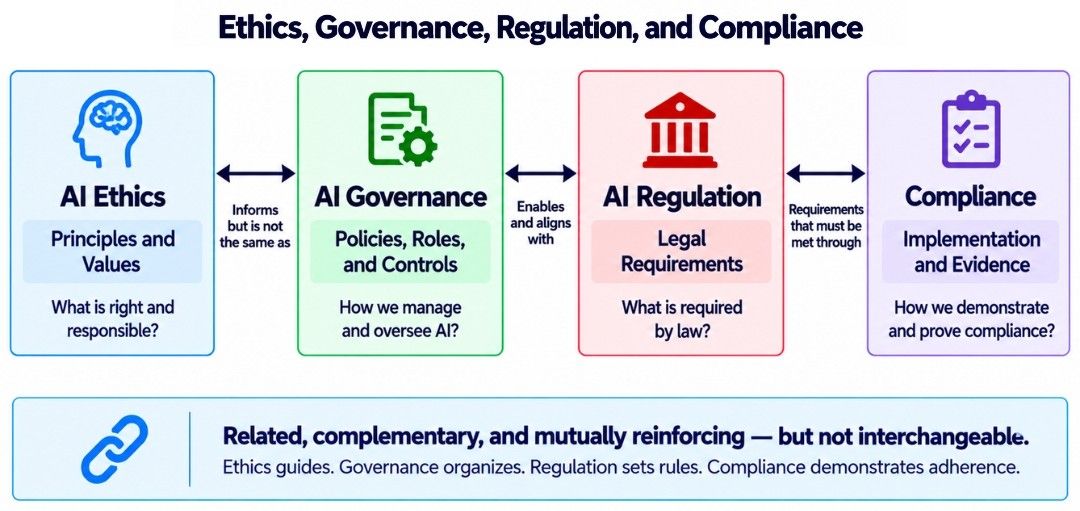
Effective AI governance can help organizations:
identify important risks earlier;
establish clear accountability;
protect sensitive information;
reduce inappropriate or discriminatory outcomes;
improve AI reliability;
support regulatory and policy compliance;
create consistent AI-development practices;
improve visibility across AI systems;
increase confidence among users, employees, and other stakeholders.
Governance should not exist simply to slow down AI adoption.
When designed well, it can help organizations adopt AI more consistently, safely, and responsibly.
Implementing effective AI governance is not easy.
Important challenges include:
Rapidly changing AI capabilities — governance processes must evolve as AI systems become more capable.
Different requirements across jurisdictions — organizations may operate under different legal and regulatory environments.
Difficulty evaluating some AI risks — characteristics such as fairness, reliability, or harmful behavior may be difficult to measure.
Third-party AI systems — organizations may have limited visibility into external models and services.
Changing models and providers — an application may change even when its business purpose remains the same.
Balancing innovation and risk management — excessive controls can slow useful experimentation, while insufficient controls can create unacceptable risk.
Maintaining governance over time — controls must continue to work as systems, data, integrations, and use cases evolve.
Generative and general-purpose AI create an additional challenge because the same underlying model may support applications with very different levels of risk.
For example:
Same Base Model
      │
      ├── Summarize Public Documentation
      │          ↓
      │     Lower Impact
      │
      └── Access Sensitive Data
          + Perform Financial Actions
                 ↓
            Higher Impact
For this reason, governance should focus on the complete AI system and its use case, not only on the underlying model.
AI ethics, governance, and regulations provide different but complementary mechanisms for developing and using AI responsibly.
AI ethics establishes principles and values, AI governance turns organizational requirements into roles, policies, processes, and controls, and AI regulations establish legal obligations where applicable.
Effective governance requires continuous risk management, accountability, appropriate human oversight, monitoring, and evidence that important requirements are being followed.
The goal is not to prevent AI innovation, but to help organizations create value with AI while maintaining appropriate responsibility, control, and risk management.
