
Durgesh Tiwari
Author
Generative AI can create different types of content, including text, images, videos, audio, and code. Different AI models are designed for different tasks. Some generate text, while others create images, videos, speech, or work with multiple types of content at the same time.
Although these models are powerful, they can sometimes generate incorrect or misleading information. This issue is called AI Hallucination.
A Generative AI model is an AI system trained on large amounts of data to create new content based on learned patterns.
Depending on the model, it can generate:
Text
Images
Videos
Audio
Code
Documents
Multimodal content
Today, Generative AI models are widely used in education, healthcare, software development, content creation, business, research, and entertainment.
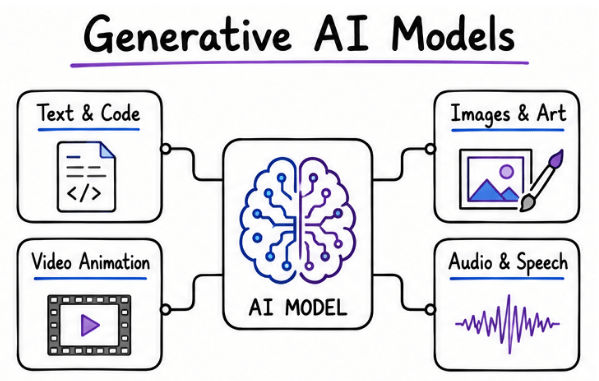
Text generation models understand and generate human language. They are trained on books, articles, websites, and other text sources.
Answer questions
Write articles and emails
Generate code
Summarize documents
Translate languages
Create conversations
ChatGPT
Google Gemini
Claude
Llama
DeepSeek
Mistral
Example: A student asks, "Explain Machine Learning in simple English." The AI generates an easy-to-understand explanation.
Image generation models create new images from text prompts instead of editing existing ones.
Digital artwork
Illustrations
Logo design
Marketing graphics
Product images
DALL·E
Midjourney
Stable Diffusion
Adobe Firefly
Example: "Create a modern office with AI robots helping employees." The AI generates an original image from the prompt.
Video generation models create videos from text prompts, images, or short video clips.
Educational videos
Marketing content
Animations
Product demonstrations
Social media videos
Sora
Runway
Pika
Kling AI
Example: "Create a 20-second animation showing the water cycle." The AI generates a short animated video.
Audio generation models create natural speech, music, and other audio content.
Voice assistants
Audiobooks
Podcast narration
Music generation
Speech synthesis
Voice cloning
ElevenLabs
Suno AI
Udio
Whisper
Example: Companies use AI-generated voices to create customer support messages without recording them manually.
Multimodal models can understand and generate multiple types of content, such as text, images, audio, videos, and documents.
They combine different types of information to provide more accurate and useful responses.
GPT-4o
Google Gemini
Claude
Qwen-VL
Llama Vision
Example: A user uploads an image and asks, "What is happening in this picture?" The AI analyzes the image and provides a detailed explanation.
An AI Hallucination happens when an AI model generates incorrect, misleading, or completely false information while presenting it as if it were correct.
Example: If someone asks, "Who invented Java in 2020?" the AI may generate a confident but incorrect answer instead of recognizing that the question is wrong.
Hallucinations are one of the biggest challenges in Generative AI.
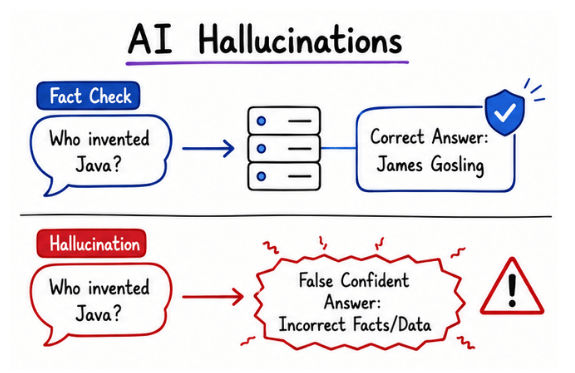
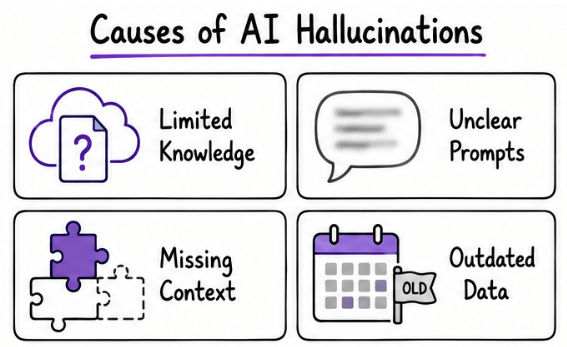
AI hallucinations can happen for several reasons.
Limited Knowledge: The model may not have enough information about a topic.
Unclear Prompts: Vague instructions can confuse the AI.
Missing Context: Without enough background information, the model may guess the answer.
Outdated Training Data: Some models may not know about recent events.
Predictive Responses: LLMs predict the most likely next word instead of verifying facts, which can sometimes produce incorrect information.
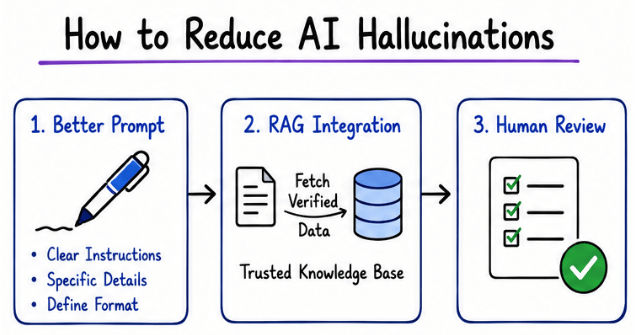
Although AI hallucinations cannot be completely eliminated, the following practices can help reduce them.
Write Clear Prompts: Provide clear instructions and enough context to help the AI generate more accurate responses.
Use Retrieval-Augmented Generation (RAG): RAG retrieves information from trusted sources before generating a response, improving factual accuracy.
Use Trusted Data Sources: Connect AI systems to reliable databases, knowledge bases, or company documents whenever possible.
Verify Important Information: Always review AI-generated content, especially for healthcare, legal, financial, and academic information.
Although hallucinations cannot be completely eliminated, they can be reduced by following good practices.
Write clear and detailed prompts.
Provide enough context and background information.
Use Retrieval-Augmented Generation (RAG) to retrieve information from trusted sources.
Connect AI systems to reliable databases or company documents.
Review and verify important AI-generated content before using it.
Always verify information related to healthcare, law, finance, and academic research.
Human review is still essential for ensuring accuracy and reliability.
Generative AI models can create text, images, videos, audio, code, and multimodal content. Each model is designed for specific tasks and is widely used in education, healthcare, software development, business, and content creation.
While Generative AI is highly capable, it can sometimes produce incorrect information through AI hallucinations. Understanding their causes and using techniques such as better prompting, RAG, trusted data sources, and human verification helps improve the accuracy and reliability of AI-generated content.
