
Durgesh Tiwari
Author
Enterprise agentic AI brings AI agents into real business environments where they work with company data, enterprise applications, employees, and established workflows. Unlike a simple chatbot, an enterprise agent may retrieve knowledge, use business tools, coordinate multi-step processes, and take permitted actions.
The challenge is not only making an agent capable enough to complete a task. Enterprises also need security, reliability, integration, governance, human oversight, observability, and measurable business value.
A simplified view is:
Employees / Customers
         ↓
     AI Agents
         ↓
Enterprise Tools and Workflows
         ↓
CRM / ERP / Databases / Knowledge Systems
         ↓
Business Processes
The goal is not to replace every existing application with an AI agent. Agents should be used where language understanding, flexible decision-making, tool use, and workflow automation create meaningful value.
Agentic AI in enterprises refers to AI systems that work toward business goals by combining models with tools, enterprise data, workflows, and organizational controls.
Consider three levels of capability:
System | Example |
|---|---|
Chatbot | Answer an employee's policy question |
Knowledge Agent | Retrieve the policy and answer with supporting sources |
Workflow Agent | Retrieve the policy, collect information, prepare a request, and submit it through an approved process |
For example, an employee asks:
Prepare my business trip request for next week's customer meeting.
The workflow might be:
Understand Request
      ↓
Retrieve Travel Policy
      ↓
Check Calendar
      ↓
Collect Trip Information
      ↓
Apply Company Rules
      ↓
Prepare Request
      ↓
Human Review
      ↓
Submit Through Approved System
The system is no longer only generating text. It is participating in a business process.
However, not every enterprise task needs an agent.
Use traditional software or workflow automation when a process is stable, deterministic, and easy to express with exact rules. Agents become more useful when the task involves natural language, unstructured information, changing context, or variable decisions.
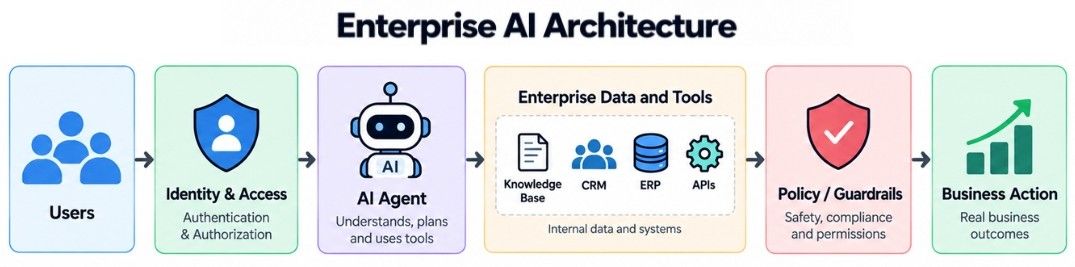
An enterprise AI architecture contains much more than an LLM.
A simplified architecture may look like this:
                    Users
                      ↓
              Enterprise Interface
                      ↓
               Identity / Access
                      ↓
                   AI Agent
                      ↓
         ┌────────────┼────────────┐
         ↓            ↓            ↓
     Knowledge     Business      Other
     Retrieval       Tools       Agents
         ↓            ↓            ↓
    Documents     CRM / ERP    Specialized
    Databases     APIs / Apps      Tasks
         └────────────┼────────────┘
                      ↓
              Policy / Guardrails
                      ↓
              Approval if Needed
                      ↓
                Business Action
Several supporting capabilities operate around this workflow:
authentication and authorization;
state and memory;
secrets management;
logging and tracing;
evaluation and monitoring;
audit records;
security controls.
A useful architectural principle is separation of responsibilities:
The LLM handles language understanding and flexible reasoning.
Deterministic software enforces exact business rules.
Identity systems establish who the user is.
Authorization systems determine what users and agents may access.
Enterprise applications and databases remain authoritative sources for business data.
Do not turn the LLM into the source of truth for the entire enterprise system.
Business process automation is one of the most practical applications of enterprise agentic AI.
Traditional automation works well when every step can be predefined:
Form Submitted
      ↓
Validate Fields
      ↓
Update Database
      ↓
Send Notification
Agentic workflows become useful when inputs or decisions are less predictable.
Consider invoice processing:
Invoice Received
      ↓
Extract Information
      ↓
Agent Reviews Context
      ↓
Match Purchase Order
      ↓
Check Business Rules
      ↓
Exception?
   ┌────┴────┐
   No       Yes
   ↓         ↓
Continue  Human Review
   ↓
ERP Update
The agent can interpret unstructured invoices or investigate unusual cases, while deterministic systems handle calculations, validation, and accounting rules.
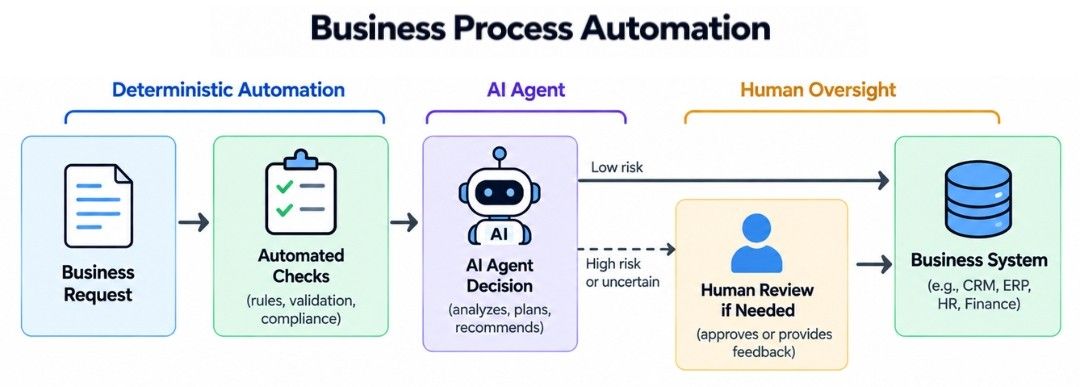
A strong enterprise pattern is:
Deterministic Automation
          +
Agentic Decision Support
          +
Human Oversight
          ↓
Enterprise Workflow
The right level of autonomy depends on the risk, impact, and reversibility of the business action.
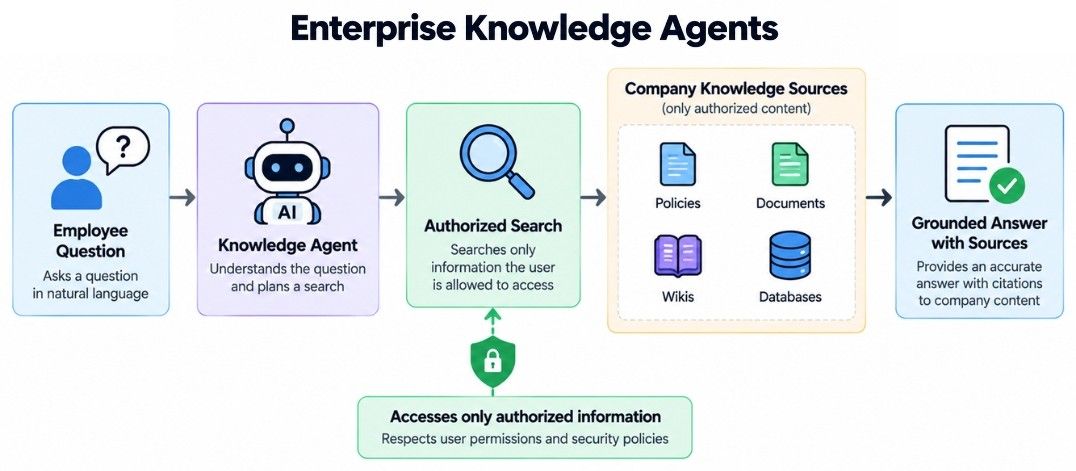
An enterprise knowledge agent helps employees find and use information distributed across company systems.
Enterprise knowledge may exist in:
policies and internal documentation;
company wikis;
databases;
support tickets;
project documents;
contracts;
product documentation;
internal portals.
For example:
What is our parental leave policy for employees in India?
A typical workflow is:
Employee Question
       ↓
Knowledge Agent
       ↓
Identify Information Need
       ↓
Search Authorized Sources
       ↓
Retrieve Relevant Documents
       ↓
Generate Grounded Answer
       ↓
Provide Supporting Sources
This can use RAG and other retrieval techniques discussed earlier in the course. In an enterprise environment, two additional concerns become especially important: permissions and freshness.
Suppose two employees ask the same question, but only one has permission to access a confidential finance document. The retrieval system should enforce those permissions before the document reaches an unauthorized workflow.
Freshness also matters. When an old policy conflicts with a newer version, the system needs reliable metadata, versioning, and authoritative sources.
Enterprise agents become more useful when they can work with systems such as Customer Relationship Management (CRM) and Enterprise Resource Planning (ERP) platforms.
A salesperson asks:
Summarize this account and prepare me for tomorrow's customer meeting.
The agent could retrieve:
recent customer interactions;
open opportunities;
account information;
relevant support issues;
recent sales activity.
Salesperson
    ↓
Sales Agent
    ↓
CRM
 ├── Customer
 ├── Opportunities
 ├── Activities
 └── Sales History
    ↓
Account BriefingA user asks:
Why is purchase order 5821 delayed?
The agent could investigate:
Purchase Order Question
        ↓
     ERP Lookup
        ↓
 ┌──────┼────────┐
 ↓      ↓        ↓
PO     Supplier  Inventory
Status  Data      Status
 └──────┼────────┘
        ↓
 Explain Delay
An important design distinction is read vs write access.
Reading an order status creates less risk than changing payment information or approving a purchase. Sensitive write operations should therefore receive stronger controls.
Enterprise agentic AI should not be viewed simply as:
Human → Replaced by AgentMany valuable systems instead use:
Human + Agent
      ↓
Collaborative Workflow
Agents are well suited for tasks such as:
information retrieval;
repetitive research;
summarization;
drafting;
routine workflow steps.
Humans provide judgment, organizational context, accountability, and approval for consequential decisions.
Consider a procurement workflow:
Employee Request
      ↓
Agent Collects Information
      ↓
Agent Compares Options
      ↓
Agent Prepares Recommendation
      ↓
Procurement Manager Reviews
      ↓
Approve / Edit / Reject
      ↓
Approved Action Executes
Human involvement should be based on risk, not added blindly to every step.
Too many approvals create friction and approval fatigue. Low-risk operations may be automated, while unusual, expensive, ambiguous, or sensitive cases can involve human review.
In enterprise environments, AI governance defines the organizational controls around AI systems.
At a practical level, organizations should clearly define:
which agents and models are approved;
who owns each agent;
what data and tools an agent can access;
which actions require approval;
how incidents are reported;
how agent activity can be audited;
who is accountable for the system.
Technical controls and organizational policies should work together.
For example, a policy saying that an agent must not access payroll information is stronger when authorization controls technically prevent that access.
Similarly, high-risk actions should not depend only on a prompt telling the model to be careful.
Good enterprise governance should translate important organizational policies into enforceable and auditable controls.
Detailed AI governance, ethics, and regulations will be covered separately in Article 28.
Enterprise agents often work with sensitive business systems, so access must be enforced across the complete workflow.
A useful pattern is:
User
 ↓
User Permissions
 ↓
Agent
 ↓
Agent Permissions
 ↓
Tool
 ↓
Resource Authorization
 ↓
Enterprise System
The system should consider both what the user is allowed to do and what the agent is allowed to do.
Suppose an employee asks:
Show me the CEO's compensation details.
The system should not retrieve the information first and then ask the LLM whether it should reveal it.
Authorization should be enforced before unauthorized data reaches the workflow.
The detailed principles of authentication, authorization, and least privilege were covered in the security article. In enterprise systems, the important point is to enforce them consistently across users, agents, tools, and enterprise resources.
Enterprise agents often depend on several external systems:
Agent
 ├── CRM
 ├── Billing API
 └── Customer Database
Even when the model behaves correctly, the overall workflow may fail because one of these dependencies is unavailable or returns unexpected information.
Common problems include:
API or tool failures;
timeouts and rate limits;
missing or outdated information;
permission errors;
external service outages.
For example:
Tool Fails
   ↓
Retry Appropriate?
 ┌────┴────┐
 Yes       No
 ↓          ↓
Retry    Fallback
 ↓          ↓
Still Fails?
     ↓
  Escalate
The detailed reliability techniques were covered in earlier production-focused articles. At the enterprise level, the key lesson is that reliability includes the complete dependency chain, not only the model.
Production-ready does not mean the agent never fails. It means failures can be detected, contained, and handled safely.
An agent can perform well technically without creating meaningful business value.
For example, a support agent might produce excellent responses but fail to reduce resolution time or improve customer outcomes.
Enterprise teams should therefore connect technical metrics with business outcomes.
Technical Metric | Possible Business Metric |
|---|---|
Task success rate | Cases successfully resolved |
Agent latency | Customer wait time |
Tool-call accuracy | Workflow accuracy |
Escalation rate | Human workload |
Cost per task | Operational cost |
Retrieval quality | Employee search efficiency |
Error rate | Rework or failure cost |
Suppose an enterprise knowledge agent reduces the average time employees spend finding policy information from 12 minutes to 3 minutes.
That communicates business impact more clearly than saying:
Our agent achieved an evaluation score of 0.91.Useful business questions include:
Did the process become faster?
Did quality improve?
Was human workload reduced?
Did customers receive better service?
Were fewer errors made?
Did operational costs decrease?
Did employee productivity improve?
Technical evaluation tells us whether the system works. Business metrics tell us whether the system is worth operating.
ROI (Return on Investment) compares the measurable value created by an initiative with its cost.
A simplified formula is:
ROI = ((Benefit - Cost) / Cost) × 100Suppose an organization spends $100,000 implementing and operating an agentic workflow and measures $160,000 in benefits:
ROI = (($160,000 - $100,000) / $100,000) × 100

ROI = 60%
The formula is simple. Measuring the real costs and benefits is harder.
model usage;
infrastructure;
engineering and integrations;
security and governance;
evaluation and monitoring;
human review;
maintenance;
employee training.
reduced handling time;
higher employee productivity;
fewer manual operations;
lower support costs;
fewer errors;
faster business processes;
improved conversion or customer outcomes.
Avoid measuring ROI only by the number of automated tasks.
If automation creates additional corrections, incidents, or human review, the apparent savings may not be real.
A more useful metric is often:
Cost per successful business outcome
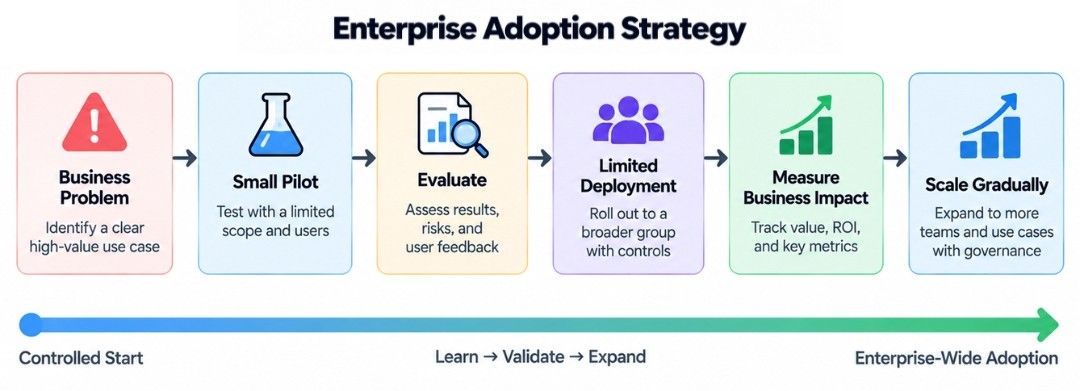
A strong enterprise agentic AI adoption strategy starts with a specific business problem rather than a company-wide goal to “use AI agents everywhere.”
A practical path is:
Identify Business Problem
        ↓
Measure Current Baseline
        ↓
Choose Suitable Use Case
        ↓
Assess Risk and Data
        ↓
Build Small Pilot
        ↓
Evaluate
        ↓
Deploy to Limited Users
        ↓
Measure Business Impact
        ↓
Improve
        ↓
Scale Gradually
Good first projects usually have:
a clear business goal;
measurable outcomes;
accessible and reliable data;
manageable integration requirements;
limited consequences when something goes wrong.
Prefer conventional software when the process is:
Stable
+ Deterministic
+ Rule-Based
+ Easy to Automate
An agent becomes more useful when the task involves:
Natural Language
+ Unstructured Information
+ Variable Decisions
+ Multiple Tools
+ Changing Context
+ Human Collaboration
Enterprise adoption should also include employee training.
Users need to understand what the agent can do, where its limitations are, when results should be verified, and how problems should be reported.
Enterprise agentic AI can support many business functions, but successful projects usually target a clearly defined workflow rather than trying to build one agent that does everything.
Area | Example Agent Capabilities |
|---|---|
Customer Service | Search knowledge, retrieve customer data, create tickets, escalate cases |
Sales | Prepare account briefings, research prospects, summarize CRM activity |
IT Support | Diagnose common issues, search documentation, create incidents |
Software Engineering | Inspect code, implement bounded changes, run tests |
Enterprise Knowledge | Answer questions across authorized internal knowledge |
Finance | Analyze documents, investigate exceptions, prepare reports |
HR | Answer policy questions, support internal processes, route sensitive cases |
Procurement | Compare suppliers, prepare requests, identify exceptions |
Across these use cases, the basic principle remains similar:
Business Goal
     ↓
AI Agent
     ↓
Enterprise Data + Tools
     ↓
Policies + Permissions
     ↓
Human Oversight When Needed
     ↓
Business Outcome
The technology matters, but the business outcome determines whether the project succeeds.
Enterprise agentic AI combines AI agents with enterprise data, applications, workflows, organizational controls, and human expertise to solve real business problems.
Successful enterprise systems keep responsibilities separated: models handle flexible language-based work, deterministic systems enforce exact rules, enterprise applications remain authoritative sources of business data, and humans retain appropriate control over consequential decisions.
Enterprise success should be measured through reliability, security, adoption, and measurable business outcomes, not only model benchmarks.
Enterprise Agent Success
        =
Technical Performance
        +
Reliability
        +
Security
        +
User Adoption
        +
Business Value
Start with a measurable business problem, build a controlled pilot, evaluate real performance and ROI, and scale only when the evidence supports it.
The goal is not to deploy the largest possible number of agents. It is to build useful, controlled, and reliable AI systems that improve real business processes.
