
Durgesh Tiwari
Author
Artificial Intelligence careers are evolving rapidly. Traditional AI roles have focused on data, machine learning, prediction, and automation, while modern AI engineering increasingly includes Large Language Models (LLMs), Retrieval-Augmented Generation (RAG), tool integration, AI agents, evaluation, security, observability, and governance.
Agentic AI extends these capabilities by enabling AI systems to work across multi-step workflows, tools, APIs, enterprise data, and external systems.
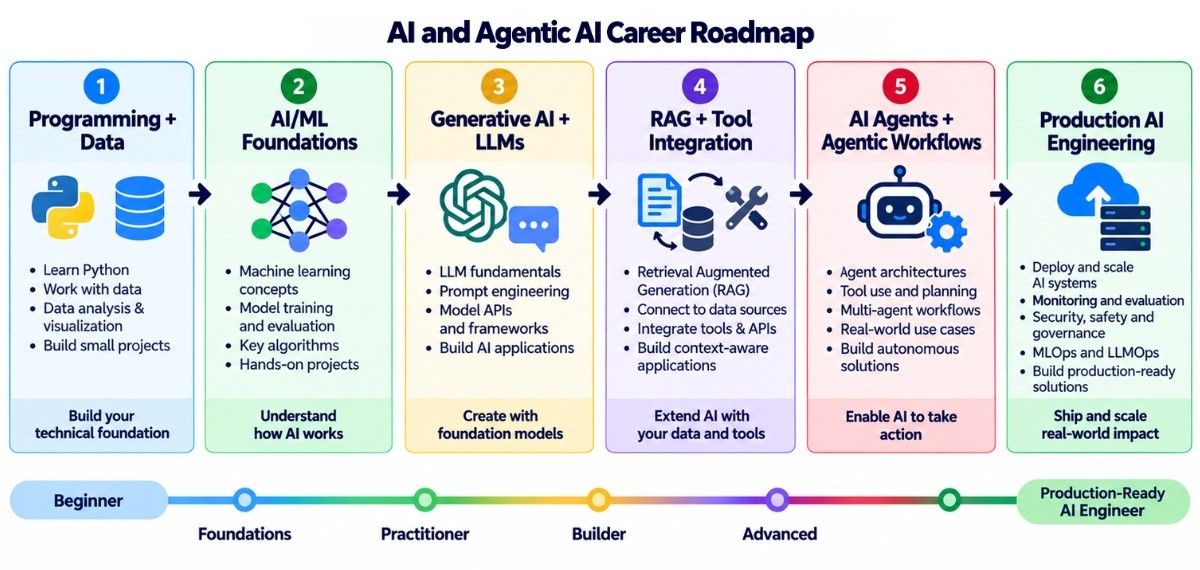
A practical career journey can be viewed as:
Programming + Data
        ↓
AI/ML Foundations
        ↓
Generative AI + LLMs
        ↓
RAG + Tool Integration
        ↓
AI Agents + Agentic Workflows
        ↓
Production AI Engineering
The goal is not to learn every new AI tool or framework. Instead, develop the engineering skills required to design, build, evaluate, deploy, secure, monitor, and improve real AI systems.
Before specializing in AI, build the technical foundations required to work with data, models, APIs, and software applications.
Python is one of the most important programming languages for AI development.
Focus on:
variables, data types, conditions, and loops;
functions and common data structures;
object-oriented programming;
exception and file handling;
modules, packages, and virtual environments;
APIs and JSON;
asynchronous programming basics.
Also become comfortable with:
Git and GitHub
Command Line
VS Code or another IDE
Jupyter Notebooks
You should be able to:
write and debug Python programs;
work with APIs and JSON;
organize code into modules;
handle common errors;
build small applications independently.
Build strong programming and debugging skills before depending heavily on AI frameworks.
You do not need advanced mathematics before starting AI, but understanding the fundamentals will make machine learning and deep learning easier to understand.
Focus on:
Linear Algebra: vectors, matrices, dot products, and tensors;
Probability and Statistics: distributions, mean, variance, conditional probability, correlation, and basic statistical reasoning;
Calculus: derivatives, gradients, chain rule, and gradient descent.
The objective is not to memorize equations. Learn enough mathematics to understand how models learn, how optimization works, and how model performance is interpreted.
AI systems depend heavily on data, so learn how to collect, clean, transform, analyze, query, and validate it.
Important technologies include:
NumPy — numerical computing;
Pandas — data manipulation and analysis;
Matplotlib — data visualization;
SQL — querying and manipulating structured data.
Important concepts include:
missing values and outliers;
data quality;
data leakage;
feature engineering;
train/test splitting;
structured vs unstructured data.
Build an Exploratory Data Analysis project using a real dataset.
Demonstrate:
data cleaning;
SQL or Pandas analysis;
useful visualizations;
meaningful findings;
documented assumptions.
Once your programming and data foundations are strong, move into the core concepts behind modern AI systems.
Learn the fundamentals of supervised and unsupervised learning and understand when different approaches are useful.
Focus on commonly used techniques such as:
Supervised Learning: Linear Regression, Logistic Regression, Decision Trees, Random Forests, and Gradient Boosting;
Unsupervised Learning: K-Means Clustering and Principal Component Analysis.
Use scikit-learn to build practical models.
More important than memorizing algorithms is understanding the complete machine-learning workflow:
Problem
   ↓
Data
   ↓
Features
   ↓
Model
   ↓
Training
   ↓
Evaluation
   ↓
Deployment
Learn how to select and interpret common evaluation metrics such as:
Accuracy
Precision
Recall
F1-score
ROC-AUC
MAE
MSE / RMSE
Build one or two projects such as:
customer churn prediction;
fraud detection;
house-price prediction;
customer segmentation.
Your project should demonstrate the problem, data, approach, evaluation, limitations, and results, rather than simply reporting model accuracy.
After understanding traditional machine learning, learn the foundations of neural networks.
Focus on:
neural networks;
forward and backpropagation;
activation and loss functions;
optimizers and regularization;
attention and transformers.
Learn at least one major deep-learning framework, preferably PyTorch.
Understand architectures such as CNNs and RNNs/LSTMs at a conceptual level, while giving particular attention to transformers, which are especially important for modern LLM systems.
Before moving deeply into LLM applications, understand the NLP concepts most relevant to modern AI engineering.
Focus on:
tokenization;
embeddings;
semantic similarity;
attention;
transformers.
A useful conceptual progression is:
Text
  ↓
Tokens
  ↓
Embeddings
  ↓
Contextual Representations
  ↓
Transformer
  ↓
Language Model
Understand how embeddings support semantic search and retrieval, and build enough knowledge of attention and transformers to work confidently with modern LLM applications.
Once the foundations are clear, move toward building practical applications with modern generative AI models.
The goal at this stage is to build applications with LLMs, not simply use chatbot interfaces.
Focus on:
LLM APIs;
tokens and context windows;
inference parameters;
prompt design and system instructions;
structured outputs;
context management;
model limitations and hallucinations;
function and tool calling.
Treat prompt engineering as one AI engineering skill, not an entire career path. Learn how to provide clear objectives, relevant context, constraints, examples, and output formats to make model behavior more reliable and easier to evaluate.
RAG is an important practical skill for building AI applications over private, enterprise, or specialized knowledge.
Understand how to build and improve a retrieval pipeline:
Documents
    ↓
Parsing + Chunking
    ↓
Embeddings
    ↓
Search Index
    ↓
Retrieval
    ↓
Relevant Context
    ↓
LLM
    ↓
Grounded Answer
Focus on:
document parsing and chunking;
embeddings and retrieval;
vector and hybrid search;
metadata filtering and reranking;
grounding and citations;
retrieval evaluation.
Build an application that allows users to ask questions about a collection of documents.
Demonstrate:
document ingestion;
retrieval;
grounded responses;
citations;
evaluation;
failure handling.
Tool integration is an important bridge between LLM applications and Agentic AI.
Learn how to connect AI applications with:
databases and search;
email and calendars;
internal and enterprise APIs;
document and business systems.
Focus on the engineering required for reliable tool execution:
tool schemas;
parameter validation;
API error handling;
authentication and authorization;
safe execution;
idempotency where appropriate.
You should be able to build an AI application that can use external data and software safely and reliably to complete real tasks.
After learning LLM applications, RAG, and tool integration, move toward AI agents and agentic workflows.
The detailed theory of agents was covered earlier. From a career perspective, focus on designing, building, and improving reliable agentic systems.
Develop practical skills in:
tool integration;
workflow state;
planning and orchestration;
error handling and retries;
human approval;
guardrails;
memory where required.
Do not assume every problem requires a highly autonomous agent. Many production systems combine deterministic logic with AI reasoning.
For example:
Input
  ↓
Classifier
  ↓
Retriever
  ↓
LLM Analysis
  ↓
Tool Execution
  ↓
Validator
  ↓
Human Approval
  ↓
Final Action
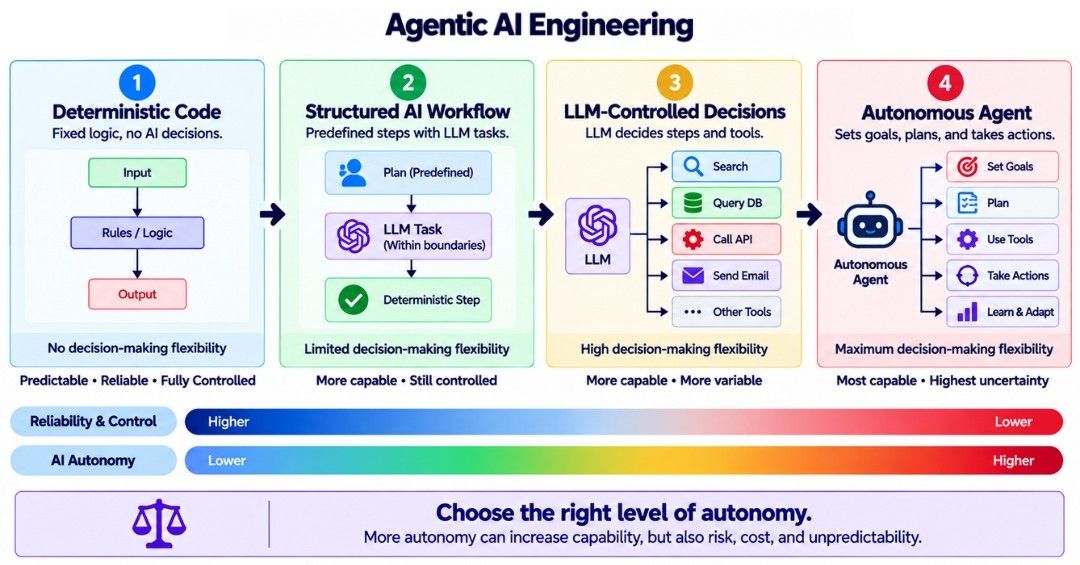
An important Agentic AI engineering skill is knowing when to use:
deterministic code for predictable rules and operations;
structured AI workflows for controlled multi-step tasks;
LLM-controlled decisions where reasoning or interpretation is required;
more autonomous agents when the task genuinely requires adaptive planning and execution.
The goal is not maximum autonomy. The goal is reliable automation for the problem being solved.
Once you can build reliable agentic workflows, develop experience with more advanced capabilities such as multi-agent systems and memory.
Learn the practical skills required to build multi-agent systems when task decomposition provides a real benefit:
agent roles and responsibilities;
routing and delegation;
coordination;
shared state;
parallel execution;
failure handling.
Do not use multiple agents simply to make an architecture look sophisticated. Use them when specialization or decomposition improves task performance, reliability, or maintainability.
Learn when an application actually needs:
short-term workflow state;
conversation memory;
long-term memory;
semantic memory or retrieval.
Also understand practical concerns such as stale information, relevance, privacy, retention, and permissions.
Memory should solve a real application requirement rather than being added automatically.
Building an AI application or agent that works in a demonstration is only the beginning.
Production AI engineers must make systems measurable, secure, controllable, deployable, observable, and maintainable.
Evaluation is an essential AI engineering skill. You should be able to measure whether an AI system actually works rather than relying only on impressive demonstrations.
Depending on the application, focus on metrics such as:
task success;
response correctness and groundedness;
retrieval quality;
tool-call accuracy;
workflow completion;
failure recovery;
latency and cost;
policy compliance.
The detailed evaluation methods were covered earlier. From a career perspective, you should be able to create evaluation datasets, analyze failures, measure improvements, and run regression tests when the system changes.
AI systems that access real data, tools, and external systems require appropriate security controls.
Develop practical knowledge of:
authentication and authorization;
least privilege;
tool-call and input validation;
secrets management;
guardrails;
audit logging;
human approval for sensitive actions.
Also understand important AI-specific risks such as prompt injection, data leakage, excessive permissions, and unsafe tool execution.
The goal is not to memorize security terminology. You should be able to design appropriate security and human-control mechanisms into an AI system.
Develop the software and infrastructure skills required to move AI applications beyond notebooks and prototypes.
Focus on:
REST APIs and FastAPI;
databases;
caching and queues;
Docker;
cloud platforms;
CI/CD;
testing and error handling;
production reliability.
Also become comfortable with AI-specific production concerns such as:
logging and tracing;
observability;
latency;
token usage and cost;
model and workflow failures;
fallback strategies.
A simplified production architecture is:
Frontend
   ↓
API Layer
   ↓
AI Application / Agent
   │
   ├── LLM
   ├── Retrieval
   └── Tools
   │
   ↓
State / Database
   │
   ├── Observability
   ├── Evaluation
   └── Security Controls
Production AI engineering is where software engineering and AI engineering become inseparable.
AI engineers should understand how governance, risk, privacy, human oversight, documentation, and applicable regulations can influence AI system design.
For Agentic AI, an especially important question is:
What actions should this AI system be allowed to perform autonomously?
The detailed governance concepts were covered earlier. From a career perspective, the goal is to understand how governance requirements affect permissions, system controls, evaluation, human oversight, and production operations.
Do not try to master every AI framework. Build strong fundamentals and learn enough technologies to create complete systems.
Area | Practical Technologies / Skills |
|---|---|
Programming | Python, Git |
Data | SQL, NumPy, Pandas |
Machine Learning | scikit-learn |
Deep Learning | PyTorch |
LLM Development | Model APIs, structured outputs, tool calling |
Retrieval | Embeddings, vector search, hybrid search, reranking |
Agent Development | Agent and workflow orchestration; LangGraph, LangChain, LlamaIndex, or Semantic Kernel |
Backend | FastAPI |
Databases | PostgreSQL, Redis |
Infrastructure | Docker, cloud platforms, CI/CD |
Evaluation | Evaluation datasets, automated evaluation, regression testing |
Observability | Logs, traces, latency, token usage, cost monitoring |
Security | Authentication, authorization, secrets management, guardrails |
You do not need to learn every technology in this table at once. Choose tools based on the systems you are building and focus on understanding the underlying concepts.
Learn the concepts before becoming dependent on a framework. Frameworks and tools will change faster than engineering fundamentals.
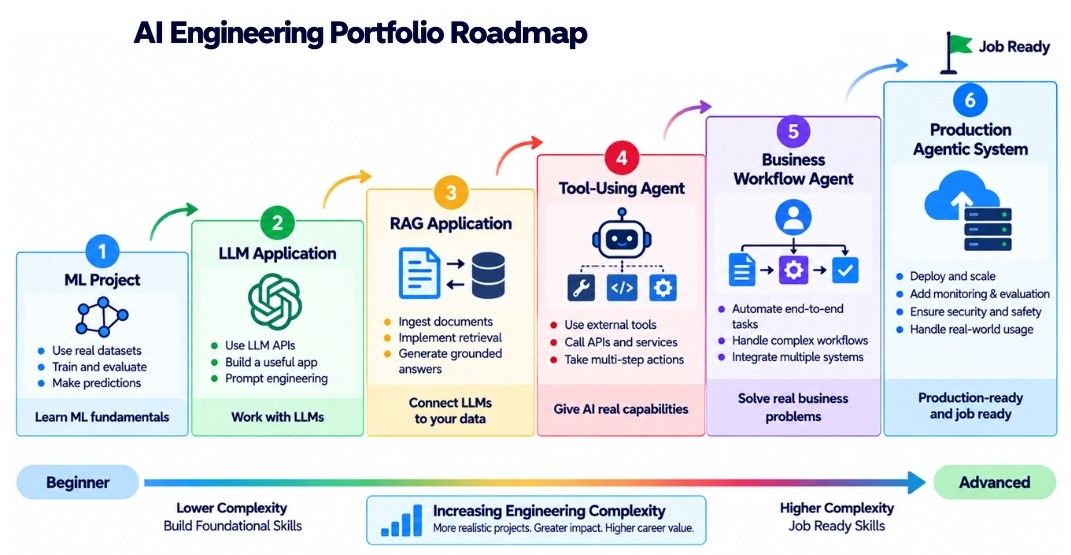
A strong portfolio should demonstrate increasing engineering complexity, rather than containing many similar chatbot projects.
A useful progression is:
ML Project
    ↓
LLM Application
    ↓
RAG Application
    ↓
Tool-Using Agent
    ↓
Business Workflow Agent
    ↓
Production Agentic SystemBuild something such as a Customer Churn Prediction System.
Demonstrate:
Python and data analysis;
data preprocessing;
machine learning;
appropriate evaluation;
clear interpretation of results.
Build an AI Writing or Analysis Assistant.
Demonstrate:
LLM APIs;
prompt and instruction design;
structured outputs;
input validation;
error handling.
Build a Document Intelligence Assistant.
Demonstrate:
document ingestion and chunking;
embeddings and retrieval;
grounded responses;
citations;
retrieval and response evaluation.
Build a Research Agent that can search for information, retrieve relevant sources, analyze findings, and generate a structured report.
Demonstrate:
tool integration;
multi-step execution;
source handling;
failure handling;
evaluation.
Build a Customer Support Agent that can work with a knowledge base, CRM tools, and business APIs while escalating appropriate cases to humans.
Demonstrate:
RAG and tool integration;
workflow state;
permissions;
human escalation;
evaluation.
Build an AI Business Operations Assistant that combines multiple capabilities such as:
email and calendar;
documents and databases;
research;
business APIs;
human approval.
A strong implementation should also demonstrate:
authentication and authorization;
state management;
guardrails;
evaluation;
observability;
error handling;
audit logging;
deployment.
This type of project demonstrates end-to-end AI engineering ability, rather than only prompt writing or basic model integration.
Different AI career paths emphasize different parts of the roadmap.
Career Path | Main Focus |
|---|---|
AI Engineer | AI applications, LLMs, RAG, APIs, deployment |
Machine Learning Engineer | ML models, data pipelines, training, MLOps |
Generative AI Engineer | LLM applications, RAG, evaluation, production integration |
Agentic AI Engineer | Agents, tools, workflows, state, evaluation, guardrails |
AI Solutions Architect | Architecture, enterprise integration, cloud, security |
AI Product Manager | Business problems, AI capabilities, product strategy, risk |
Responsible AI / Governance Specialist | Governance, risk, ethics, compliance, regulation |
These roles are not rigid boundaries. For example, an AI Engineer working on production agents may also need strong skills in backend development, evaluation, cloud infrastructure, security, and observability.
Choose a specialization based on the problems you want to solve while maintaining strong software engineering and AI fundamentals.
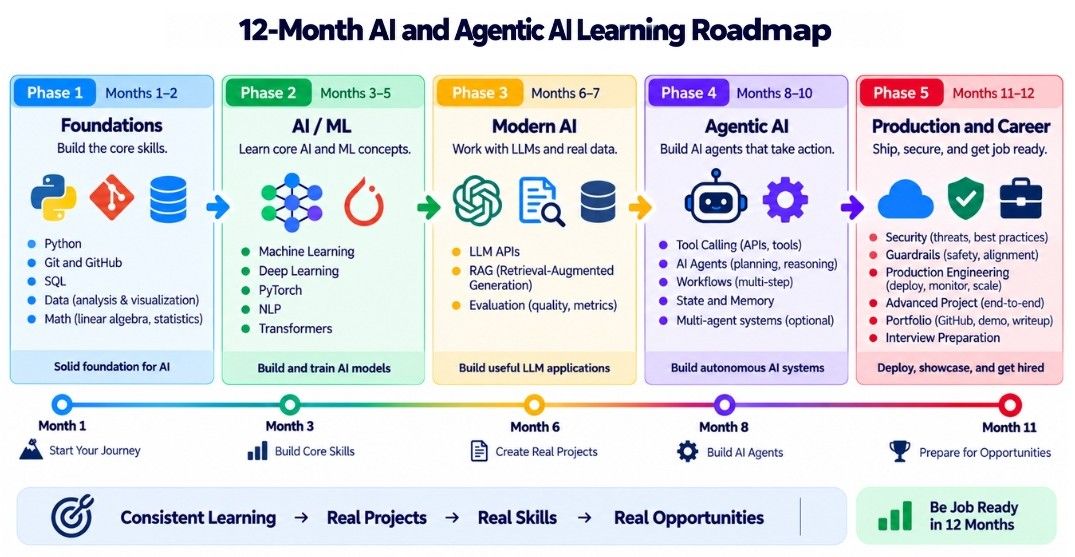
The following roadmap is an example, not a guaranteed timeline. Someone with software or ML experience may progress faster, while a complete beginner may need more time.
Month | Primary Focus |
|---|---|
1 | Python + Git |
2 | SQL + Data Analysis + Mathematics and Statistics Foundations |
3 | Machine Learning |
4 | Deep Learning + PyTorch |
5 | NLP + Transformers |
6 | Generative AI + LLM APIs |
7 | Embeddings + RAG |
8 | Advanced RAG + Evaluation |
9 | Tool Calling + AI Agents |
10 | Agentic Workflows + State + Memory |
11 | Security + Guardrails + Production Engineering |
12 | Advanced Agentic Project + Portfolio + Interview Preparation |
Do not wait twelve months before building projects. Apply a continuous learning cycle throughout the roadmap:
Learn
  ↓
Build
  ↓
Debug
  ↓
Evaluate
  ↓
Improve
  ↓
Publish
Each major stage should produce something that demonstrates your skills.
A strong AI or Agentic AI portfolio should demonstrate more than familiarity with frameworks. Employers should be able to see that you can:
Build: Develop working LLM, RAG, and agentic applications.
Integrate: Connect AI systems with APIs, databases, tools, and business systems.
Evaluate: Use evaluation datasets, meaningful metrics, failure analysis, and regression testing to demonstrate system quality.
Deploy: Move applications beyond notebooks using backend APIs, Docker, cloud platforms, and CI/CD.
Secure: Apply authentication, authorization, least privilege, sensitive-data handling, and safe tool execution.
Monitor: Track failures, latency, token usage, cost, and important tool or workflow activity.
Work within constraints: Understand responsible AI, risk, human oversight, documentation, and governance requirements.
Employers should see evidence that you can take an AI system from a real problem to a reliable production implementation, not just build isolated demos.
Simply uploading source code to GitHub is not enough. Your projects should make it easy for another engineer, recruiter, or interviewer to understand what you built, why you built it, and how well it works.
For important projects, clearly document:
Problem: What real problem does the project solve?
Architecture: How does the system work?
Technology Choices: Why did you choose these technologies?
Evaluation: How do you know the system works?
Failure Modes: What can go wrong, and how does the system handle failures?
Security: What important controls are implemented?
Deployment: How can someone run or access the application?
Trade-offs: What important design decisions did you make?
Improvements: What would you change in the next version?
A strong portfolio project should include a clear README, architecture diagram, setup instructions, representative examples, evaluation results, and deployment information where appropriate.
The objective is to provide evidence of your engineering decisions and problem-solving ability, not simply a collection of source-code repositories.
AI engineering interviews usually require more than knowing AI terminology or framework APIs. Prepare across four areas.
Be comfortable with:
Python;
APIs;
databases;
debugging;
common data structures;
asynchronous programming where relevant.
Focus on writing clear, reliable code and explaining your implementation decisions.
Be able to explain important concepts such as:
machine-learning fundamentals;
transformers and embeddings;
LLM behavior and limitations;
RAG;
AI evaluation.
The goal is not to memorize definitions. You should be able to explain how these concepts affect real AI applications.
Practice designing systems such as:
document Q&A applications;
customer-support agents;
research agents;
enterprise knowledge assistants;
tool-using workflows.
Be prepared to discuss engineering decisions involving:
retrieval;
tools and APIs;
workflow state;
human approval;
security;
evaluation;
observability;
scalability;
latency;
cost.
Interviewers may change requirements or introduce failure scenarios, so practice explaining trade-offs and how your architecture would adapt.
For every important portfolio project, be prepared to answer:
What problem were you solving?
How was the system designed?
Why did you choose that architecture?
What were the major failure modes?
How did you evaluate the system?
What trade-offs did you make?
What would you improve in the next version?
Knowing a framework is useful, but being able to explain why you designed a system in a particular way, how you validated it, and what trade-offs you made demonstrates much stronger engineering ability.
Your starting point should depend on your existing skills and experience.
Follow a foundation-first path:
Python
Data and SQL
Mathematics and Machine Learning Fundamentals
Deep Learning and Transformers
Generative AI and LLMs
RAG
Tool Integration and AI Agents
Production AI Engineering
Build strong programming and debugging skills, and start creating small projects as you learn.
Focus on:
AI and Machine Learning Fundamentals
Transformers and LLMs
RAG
Tool Calling
AI Agents and Agentic Workflows
AI Evaluation
Production AI Engineering
Use your existing backend, API, database, testing, and system-design skills as an advantage when building AI systems.
Focus on:
LLM Applications
RAG
Tool Integration
Agentic Workflows
AI Evaluation
Security and Human Control
Production Agentic Systems
Build on your existing knowledge of data, modeling, experimentation, and evaluation while developing stronger AI application and production engineering skills.
Building a career in AI and Agentic AI requires more than learning machine-learning algorithms, prompt engineering, or a particular agent framework.
A strong AI engineer combines software engineering, data, AI/ML fundamentals, LLM applications, RAG, agentic systems, evaluation, security, observability, production infrastructure, and responsible AI awareness.
Build projects throughout the learning process and make your engineering skills visible through architecture, implementation, evaluation, failure analysis, deployment, and documentation.
Models, frameworks, and tools will continue to change. The durable career advantage is the ability to engineer reliable AI systems that solve real problems.
