
Durgesh Tiwari
Author
Generative AI is one of the fastest-growing areas of Artificial Intelligence. Unlike traditional AI systems that mainly analyze data and make predictions, Generative AI can create new content such as text, images, audio, videos, and code.
Today, Generative AI is used in AI chatbots, coding assistants, content creation tools, image generators, and many modern AI applications.
Generative AI is a type of Artificial Intelligence that learns patterns from existing data and creates new content based on those patterns.
It can generate:
Text
Images
Audio
Videos
Code
Documents
Designs
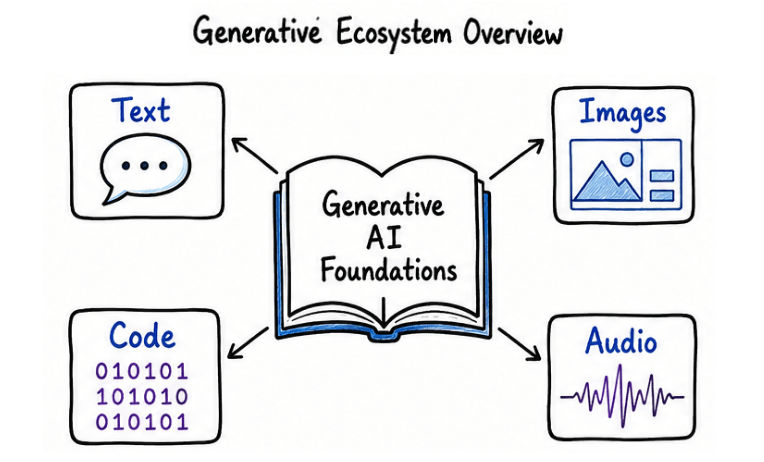
For example, Generative AI can write articles, answer questions, create images from text prompts, generate software code, and summarize information.
ChatGPT for content generation and question answering
Google Gemini for AI assistance
GitHub Copilot for coding support
Midjourney and DALL·E for AI image generation
These tools help users create content faster and improve productivity.
Traditional AI focuses on analyzing data, identifying patterns, and making predictions.
Generative AI goes a step further by creating entirely new content.
Feature | Traditional AI | Generative AI |
|---|---|---|
Purpose | Analyze and predict | Create new content |
Output | Predictions and decisions | Text, images, code, audio, videos |
Examples | Spam detection, fraud detection | ChatGPT, Gemini, DALL·E |
User Interaction | Task-oriented | Interactive and creative |
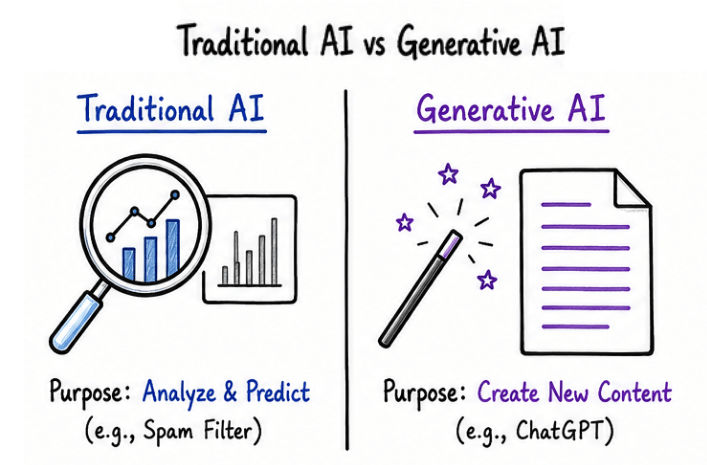
Example: A traditional AI system can classify emails as spam or important, while a Generative AI system can write email replies and generate summaries.
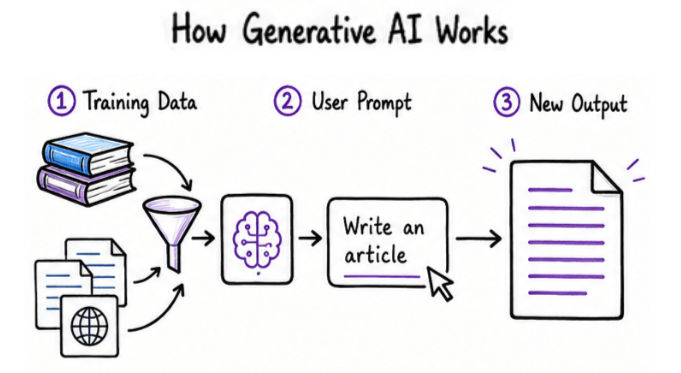
Generative AI learns from large datasets and uses that knowledge to create new content.
The model learns from large amounts of information such as:
Books
Articles
Websites
Images
Videos
Source code
During training, it learns patterns, relationships, language structures, and context from the data.
When a user enters a prompt, the model analyzes the request and determines what type of response is needed.
Example:
Prompt:
Explain Machine Learning in simple words.
The model identifies the topic and generates a beginner-friendly explanation.
Based on the prompt and learned patterns, the AI creates a new response.
The output may be:
Text
Images
Code
Summaries
Audio or video content
The generated content is created from learned patterns rather than copied from a single source.
Faster Content Creation: Generates articles, emails, reports, and other content within seconds.
Improved Productivity: Helps with research, coding, documentation, and daily tasks.
Learning Support: Provides explanations, study notes, coding assistance, and educational guidance.
Creativity and Brainstorming: Generates ideas for content, marketing campaigns, designs, and projects.
Task Automation: Automates repetitive work such as summarization, documentation, and content drafting.
Incorrect Information: AI can sometimes generate inaccurate or misleading responses.
Dependency on Training Data: Output quality depends on the quality and accuracy of training data.
Limited Understanding: AI predicts patterns from data but does not truly understand information like humans.
Privacy Concerns: Sensitive information should never be shared with public AI systems.
Human Review Required: Important content related to healthcare, finance, law, or business should always be verified by humans.
Generative AI is a branch of Artificial Intelligence that can create text, images, audio, videos, and code by learning patterns from large amounts of data.
Unlike Traditional AI, which mainly analyzes information, Generative AI can generate new content and assist with creative, educational, and professional tasks. Understanding Generative AI fundamentals provides a strong foundation for learning advanced topics such as Large Language Models (LLMs), Prompt Engineering, RAG, and AI Agents.
